Separating mixtures
Belajar sambil bermain
Jawab soal-soal ini untuk dapat energi, lalu memancing dan menjelajah. Tanpa akun.
Catatan pelajaran
Big idea: separating what has been mixed
- Big idea (key concept): Change. A mixture can be changed back into its separate parts, because nothing has been chemically joined.
- Related concept: Function. Each separation method has a job: it works because it uses one property that is different between the substances.
- Global context: Globalization and sustainability. Clean drinking water, salt, medicines and metals all depend on separating mixtures, and many places use distillation to get fresh water from sea water.
- A mixture contains two or more substances that are not chemically joined. Each substance keeps its own properties, so a mixture can be separated by physical methods.
- A pure substance is one substance only, with nothing else mixed in. Pure water is just water.
- When a solid dissolves in a liquid it makes a solution. The solid is the solute and the liquid is the solvent. A solid that does not dissolve is insoluble.
- To choose a method, ask: what is different about the substances? Size of pieces, solubility, boiling point and magnetism can all be used.
Filtration, evaporation and crystallisation
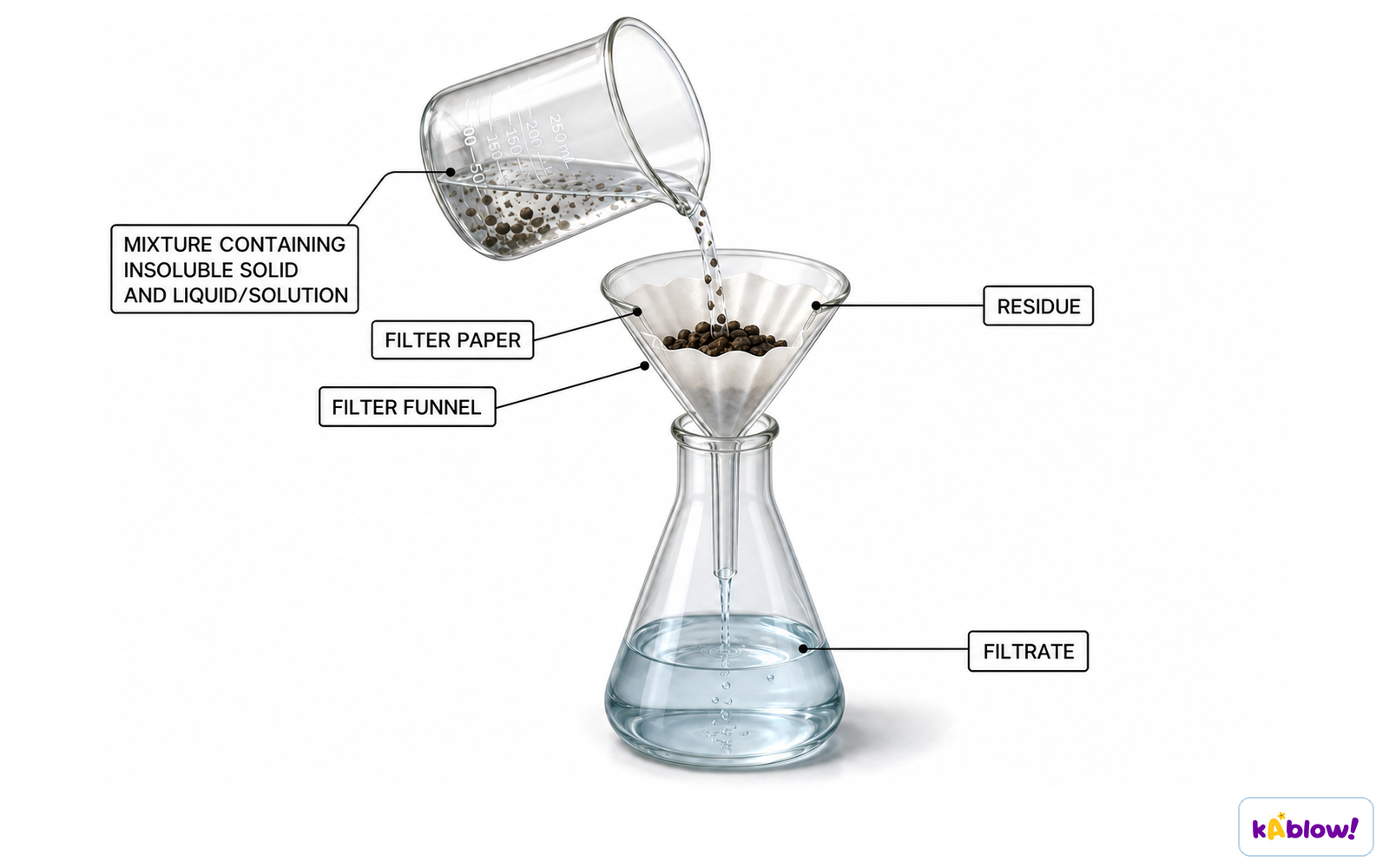
- Filtration separates an insoluble solid from a liquid. The mixture is poured through filter paper in a funnel. The paper has tiny holes: liquid particles pass through, but pieces of insoluble solid are too big.
- The solid left on the paper is the residue. The liquid that drips through is the filtrate. Sand in water separates this way.
- Filtration cannot separate a dissolved solid. Dissolved salt particles are tiny and pass through the paper with the water.
- To get a dissolved solid back, use evaporation. Heating the solution gives the water particles enough energy to escape as vapour. The solute stays behind.
- Crystallisation gives better, larger crystals: the teacher heats the solution gently to evaporate some of the water, then leaves it to cool slowly. Crystals form, and they are filtered off and dried.
- A teacher stops heating before the dish is dry. A hot solid left to dry out can spit, so the last of the water is left to evaporate slowly.
- Safety: eye protection is worn, the teacher does the heating, and hot equipment is left to cool before anyone touches it.
Filtration: residue and filtrate
Simple distillation: getting the solvent back
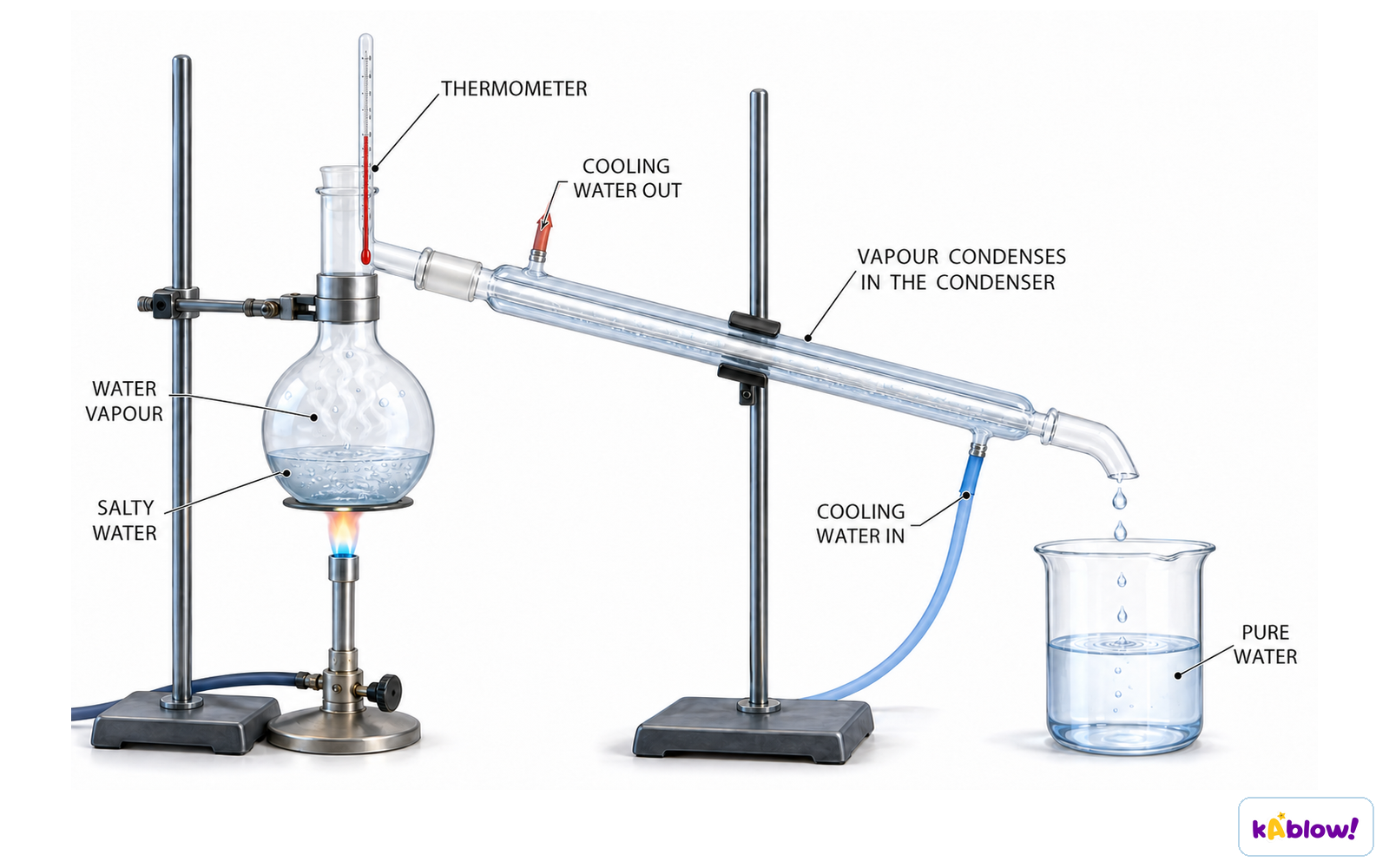
- Simple distillation collects the solvent from a solution, for example pure water from salty water. It uses the fact that water boils but salt does not.
- The solution is heated in a flask until it boils. The solvent turns to vapour and leaves through the side arm. The salt stays in the flask.
- The vapour passes into a condenser, a tube surrounded by a jacket of cold flowing water. Cooling water goes in at the lower end and out at the top, so the jacket stays full.
- In the cold tube the vapour condenses to liquid and drips into a beaker. The pure liquid collected is called the distillate.
- A thermometer at the side arm reads the temperature of the vapour. For pure water it should stay at about 100 °C while water is coming over.
- Distillation changes state twice: liquid to gas (boiling), then gas to liquid (condensing). No new substance is made, so it is a physical change.
- Distillation is always teacher-run or done with school safety rules: the glass is hot, so eye protection is worn and nobody touches the apparatus.
Simple distillation of salty water
Chromatography: separating dissolved colours
- Paper chromatography separates dissolved substances, such as the dyes in an ink. It is useful when the substances are all soluble, so filtering cannot help.
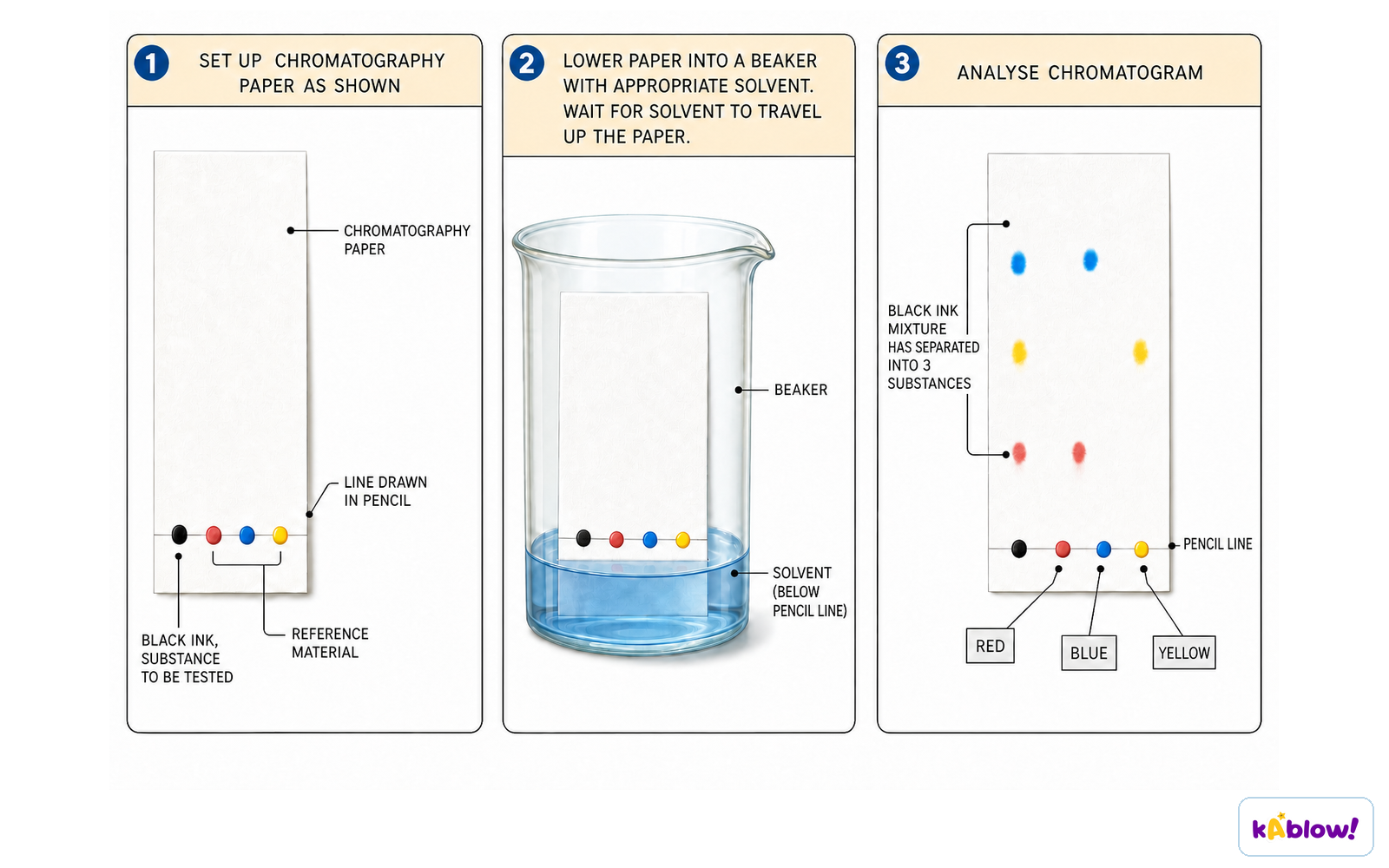
- Draw a start line in pencil near the bottom of the paper. Pencil lead does not dissolve, so it will not travel with the solvent. Put a small spot of each ink on the line.
- Stand the paper in a beaker with a little solvent (often water) that is below the pencil line. If the line were under the solvent, the ink would wash away into the beaker.
- The solvent soaks up the paper and carries the dyes with it. Each dye moves at its own speed, depending on how well it dissolves in the solvent and how strongly it sticks to the paper.
- Take the paper out when the solvent is near the top and mark the solvent front straight away. The finished paper is a chromatogram.
- Each separate spot is a different substance. A pure substance gives one spot. A mixture gives two or more.
- Reference spots of known dyes are run on the same paper. A spot in the ink that lines up with a reference spot is probably that dye.
Paper chromatography in three steps
Rf values, purity and choosing a method
- The Rf value (retention factor) describes how far a spot travels compared with the solvent: Rf = distance moved by the spot / distance moved by the solvent front. Both distances are measured from the pencil line.
- Worked example: the solvent front is 8.0 cm above the line and a spot is 5.6 cm above it, so Rf = 5.6 / 8.0 = 0.70. An Rf is never more than 1, because a spot cannot overtake the solvent.
- The same substance gives the same Rf on the same paper with the same solvent, so Rf values can be compared with a table to identify a substance.
- Purity can be tested by heating. A pure substance has a sharp melting or boiling point: pure water boils at 100 °C and ice melts at 0 °C. A mixture melts or boils over a range. Dissolved impurities usually lower a melting point and raise a boiling point.
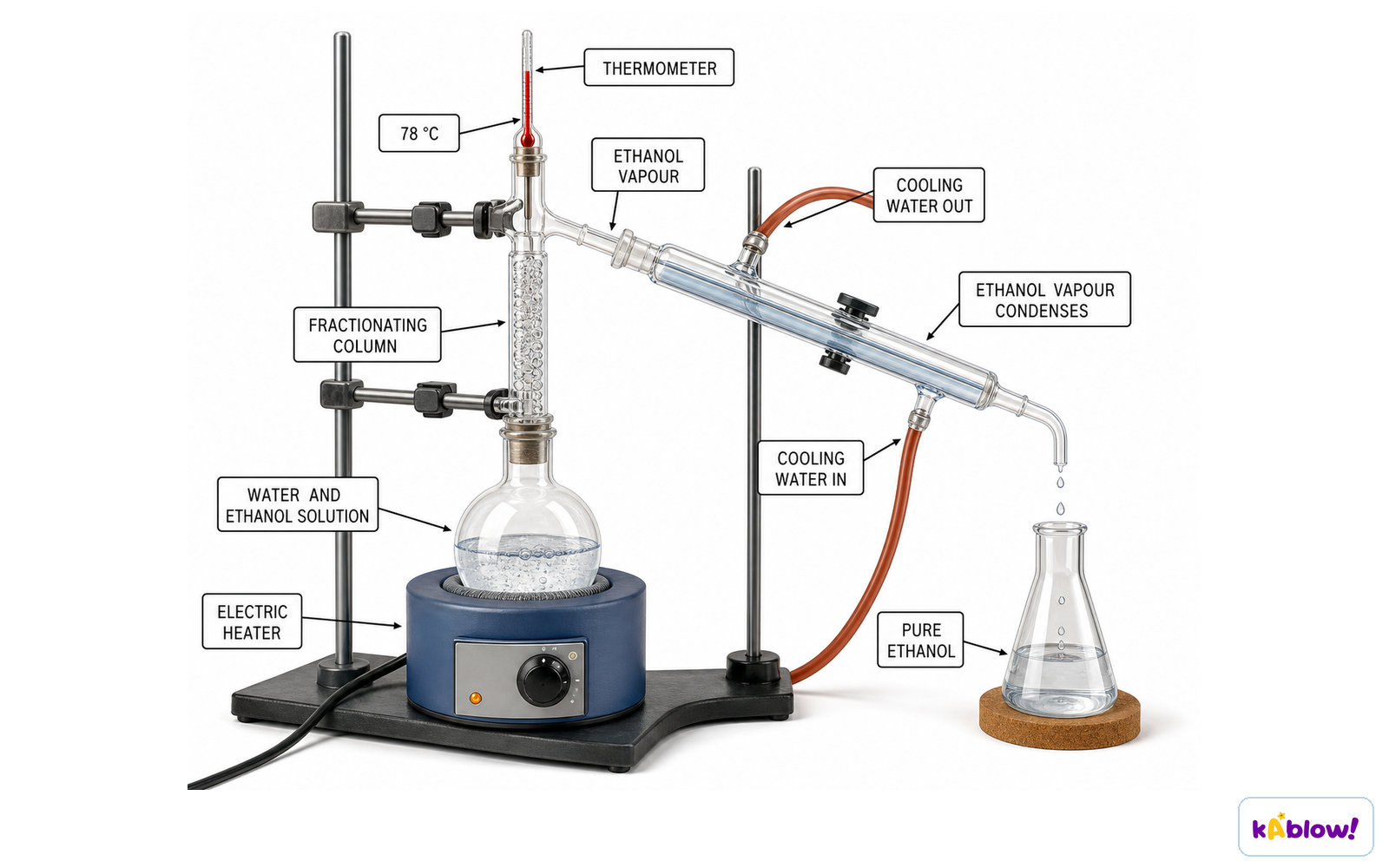
- Fractional distillation separates liquids that mix together, such as water and ethanol. A fractionating column above the flask lets the vapour rise and condense again and again. Ethanol boils at 78 °C, lower than water at 100 °C, so it reaches the top and is collected first.
- Choosing a method: insoluble solid in liquid, use filtration. Dissolved solid, use evaporation or crystallisation. Pure solvent from a solution, use simple distillation. Liquids with different boiling points, use fractional distillation. Dissolved coloured substances, use chromatography.
Fractional distillation of a water and ethanol mixture
Think like a scientist: do all black pens contain the same dyes?
- The question: do three brands of black pen (A, B and C) give the same chromatogram? Black is often a mixture of several coloured dyes.
- The independent variable is the brand of pen. The dependent variable is the pattern of spots: how many there are and their Rf values.
- Control variables to keep the same: the type of paper, the solvent, the height of the pencil line, the size of each ink spot, and how long the paper stays in the solvent.
- Method (safe school practical): draw a pencil line, add a small spot of each pen, stand the paper in a little water below the line, remove it when the solvent is near the top and mark the solvent front at once.
- Results: measure each spot and the solvent front in millimetres from the line, then calculate each Rf value and record them in a table.
- Evaluate: is one spot enough to say a pen is pure? A second solvent could split it. Repeating the test makes the results more reliable.
- Your task: write a plan to test whether the same pen gives the same Rf in two different solvents. State the variable you change, the variable you measure and three things you will keep the same.
Slide
Sign up free to view the lesson slides
Step through every slide for this topic — plus flashcards and revision notes — with a free account.
Soal latihan
Pratinjau gratis — 8 dari 54 soal. Daftar untuk melihat semuanya.
1.Which statement about a mixture is correct?
Easy- AIts substances are chemically joined in a fixed ratio each time
- BIts substances are not chemically joined, so physical methods can separate them
- CIt always melts or boils at one single sharp temperature
- DIt can only be separated by chemical reactions such as burning
2.Sand mixed with water is a mixture.
EasyTrue or false?
3.Which method would separate sand from a mixture of sand and water?
Easy- ASimple distillation
- BFiltration
- CChromatography
- DCrystallisation
4.Complete the sentence about filtration.
EasyThe solid left on the filter paper is called the ____ and the liquid that passes through is called the ____.
5.Why does filtration work for a mixture of sand and water?
Easy- ASand dissolves in water and passes through the paper
- BThe paper is chemically attracted to the sand
- CSand pieces are too big to fit through the tiny holes in the paper
- DWater particles are too big for the holes in the paper
6.In salt solution, what is the salt called?
Easy- AThe solvent
- BThe solute
- CThe filtrate
- DThe residue
7.In salt solution, which substance is the solvent?
Easy- ASalt
- BSand
- CAir
- DWater
8.Filtration can separate salt that has fully dissolved in water.
EasyTrue or false?
Unlock all 54 questions, flashcards & more
Buat akun gratis untuk melihat setiap soal, slide, kartu flash, dan catatan ulasan topik ini.