Acids, bases and salts
Belajar sambil bermain
Jawab soal-soal ini untuk dapat energi, lalu memancing dan menjelajah. Tanpa akun.
Catatan pelajaran
Big idea: acids, bases and salts
- Big idea (key concept): Change. When an acid meets a metal, a base or a carbonate, it changes into something new. The pattern of the change depends on what the acid meets.
- Related concept: Interaction. Acids interact with other substances in a few predictable ways, and each way makes a salt. That is why we can predict products before we do an experiment.
- Global context: Identities and relationships. Acids and alkalis are part of daily life, from the hydrochloric acid in your stomach to the lime farmers spread on fields. Salts are made and used all over the world.
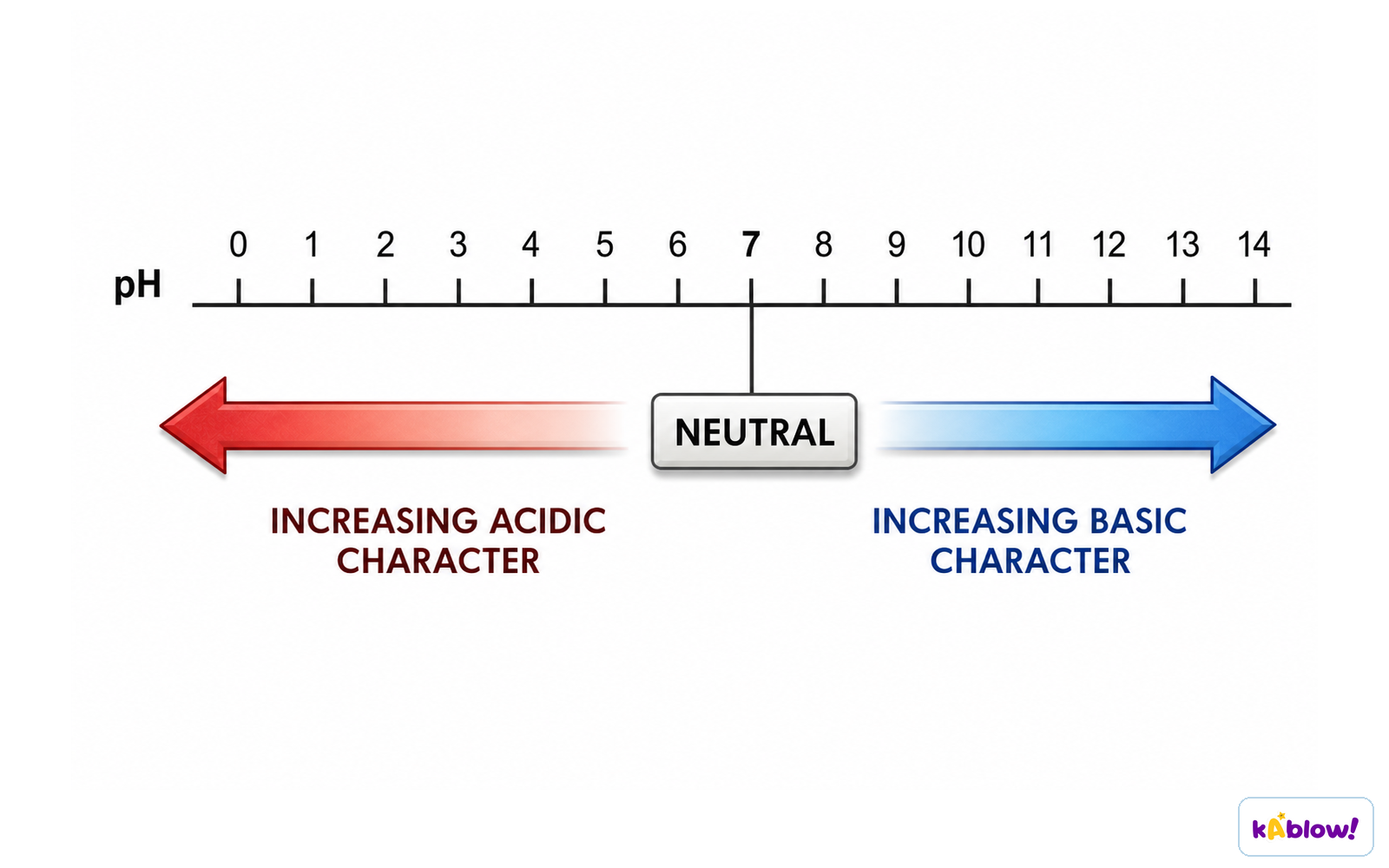
- Recap: an acid has pH below 7, an alkali has pH above 7 and a neutral solution has pH 7. A base is a substance that neutralises an acid, and an alkali is a base that dissolves in water. Acidic solutions contain hydrogen ions, H⁺. Alkaline solutions contain hydroxide ions, OH⁻.
- Indicators show pH. Litmus is red in acid and blue in alkali. Universal indicator is red or orange in strong acids, yellow in weak acids, green when neutral, blue in weak alkalis and purple in strong alkalis.
- Strong and concentrated do not mean the same. Strength is how much of the acid splits into ions. Concentration is how much acid is dissolved in the water. Hydrochloric acid is a strong acid, ethanoic acid (in vinegar) is a weak acid, and either can be dilute or concentrated.
The pH scale from acidic to alkaline
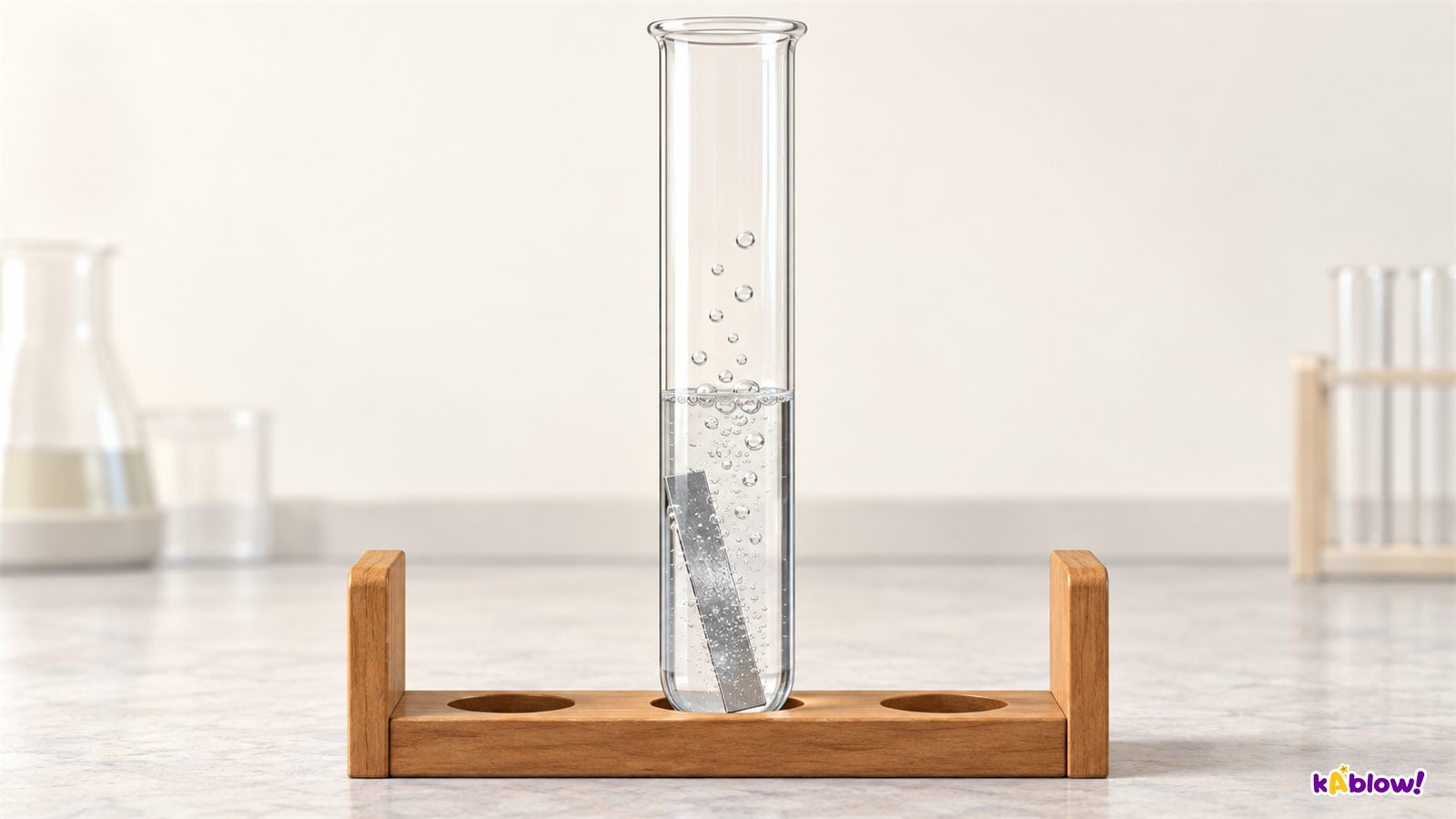
Acids with metals
- A reactive metal reacts with a dilute acid to make a salt and hydrogen gas: acid + metal → salt + hydrogen. You see fizzing, and the metal gets smaller.
- Magnesium + hydrochloric acid → magnesium chloride + hydrogen: Mg + 2HCl → MgCl₂ + H₂. Magnesium + sulfuric acid → magnesium sulfate + hydrogen: Mg + H₂SO₄ → MgSO₄ + H₂.
- Naming salts: the first part of the name comes from the metal. The second part comes from the acid. Hydrochloric acid makes chlorides, sulfuric acid makes sulfates and nitric acid makes nitrates. Zinc + hydrochloric acid makes zinc chloride.
- Test for hydrogen: a teacher holds a lit splint at the mouth of a test tube of the gas. Hydrogen burns with a squeaky pop. Hydrogen is flammable, so only small amounts are made and no flames are near the reaction.
- Not every metal reacts. Copper does not react with dilute hydrochloric or sulfuric acid, because it is not reactive enough. Very reactive metals such as sodium and potassium react far too violently and are never added to acid in school.
- In symbol equations, state symbols are added: Mg(s) + 2HCl(aq) → MgCl₂(aq) + H₂(g). The metal is a solid, the acid and the salt are dissolved in water, and hydrogen is a gas.
A metal reacting with dilute acid
Acids with bases and alkalis: neutralisation
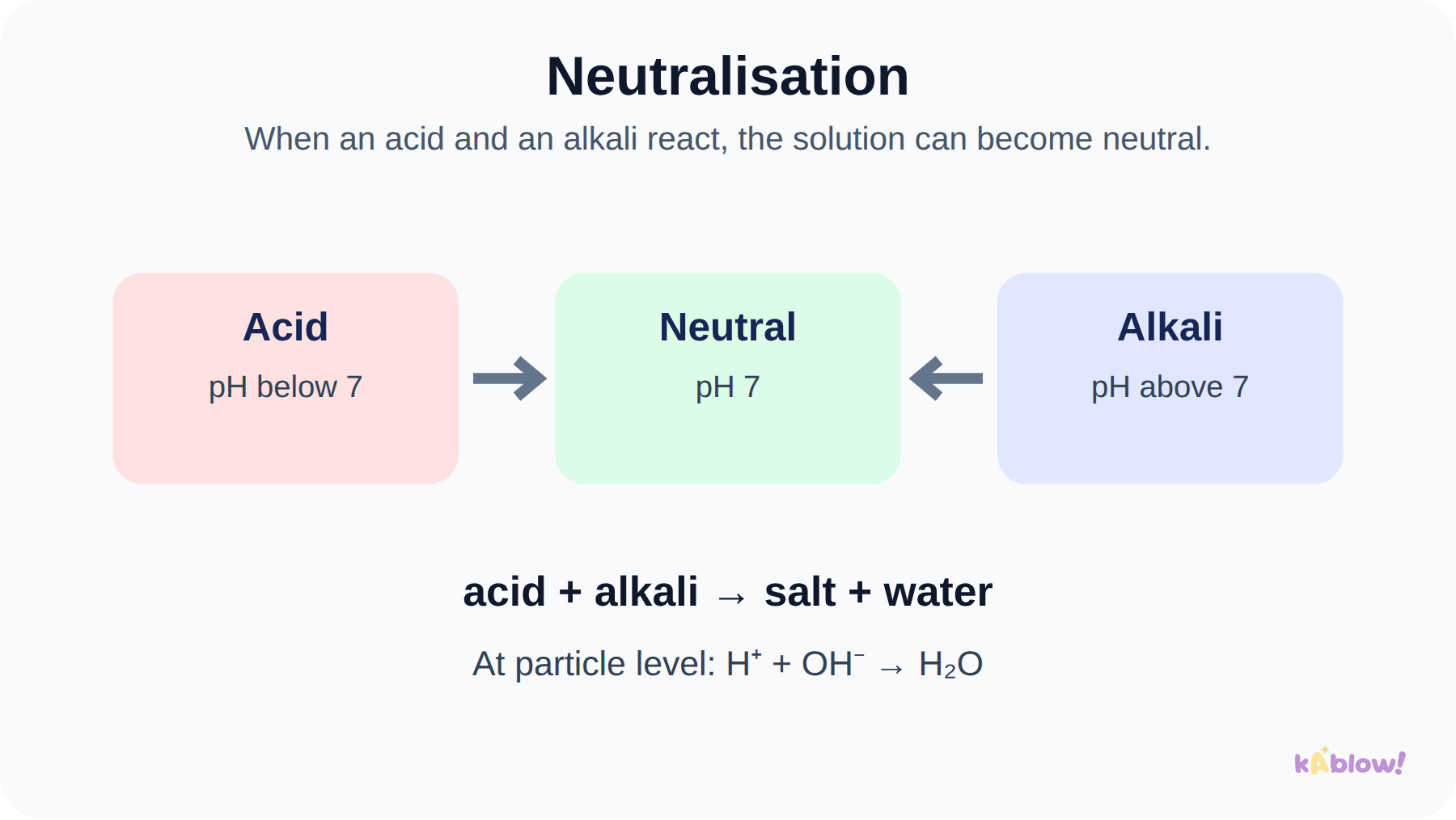
- An acid reacts with a metal oxide, a metal hydroxide or an alkali to make a salt and water: acid + base → salt + water. This is neutralisation.
- Copper oxide (a black solid base) + sulfuric acid → copper sulfate + water: CuO + H₂SO₄ → CuSO₄ + H₂O. The mixture turns blue because copper sulfate solution is blue.
- Other examples: NaOH + HCl → NaCl + H₂O, KOH + HNO₃ → KNO₃ + H₂O, Ca(OH)₂ + 2HCl → CaCl₂ + 2H₂O and 2NaOH + H₂SO₄ → Na₂SO₄ + 2H₂O. Check that each is balanced by counting atoms.
- In terms of particles, neutralisation is the reaction of hydrogen ions with hydroxide ions to make water: H⁺ + OH⁻ → H₂O. The pH moves towards 7 as the acid and alkali cancel each other out.
- If you add too much alkali, the extra makes the mixture alkaline. The solution is only neutral when exactly the right amounts of acid and alkali have been mixed.
- Neutralisation is useful. Indigestion tablets contain bases such as magnesium hydroxide that neutralise extra stomach acid. Farmers add lime to acidic soil. Toothpaste is mildly alkaline and helps neutralise acids made by bacteria on teeth.
Neutralisation: acid and alkali
Acids with carbonates
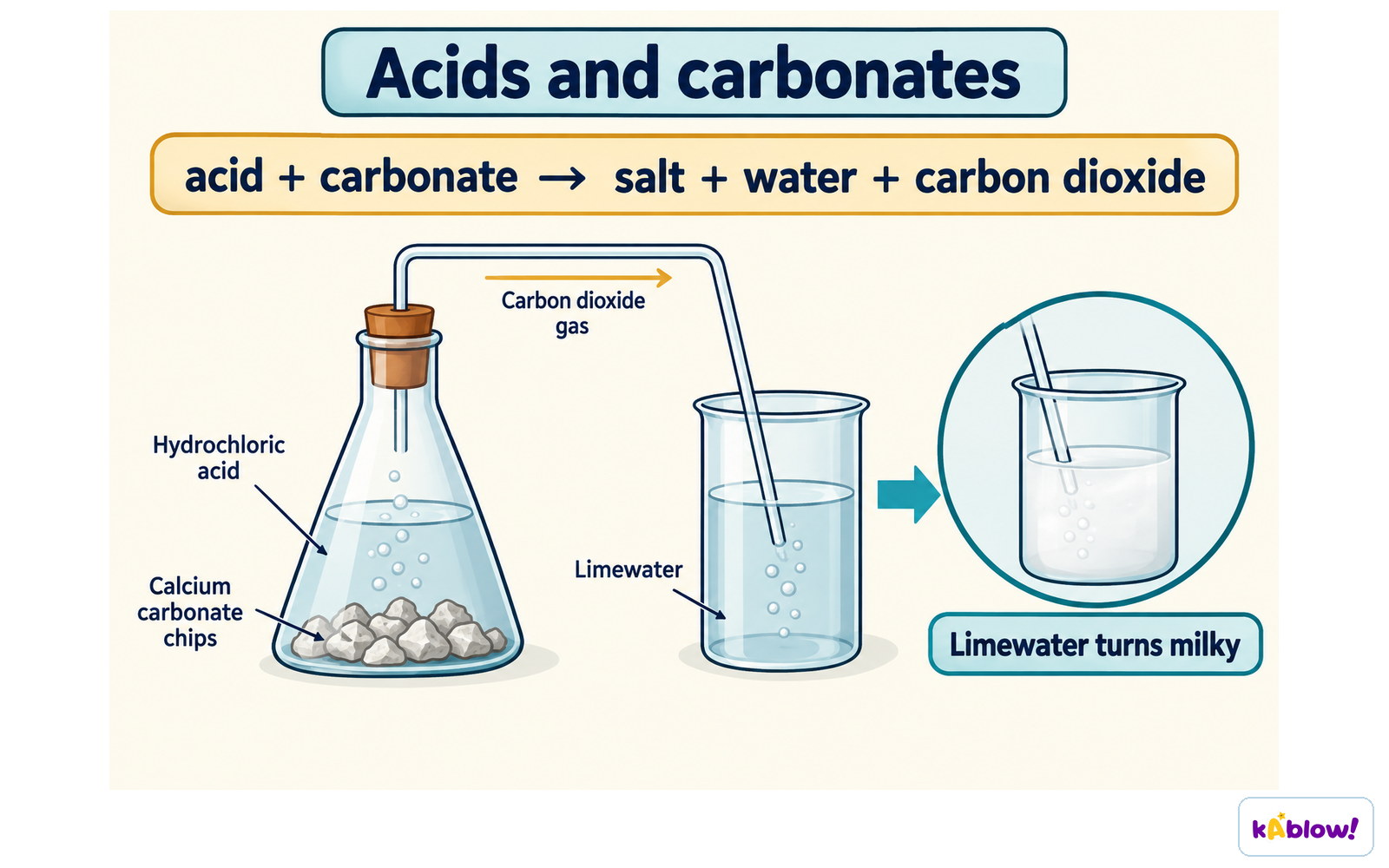
- A carbonate reacts with an acid to make a salt, water and carbon dioxide: acid + carbonate → salt + water + carbon dioxide. You see fizzing as the gas is made.
- Calcium carbonate + hydrochloric acid → calcium chloride + water + carbon dioxide: CaCO₃ + 2HCl → CaCl₂ + H₂O + CO₂. With state symbols: CaCO₃(s) + 2HCl(aq) → CaCl₂(aq) + H₂O(l) + CO₂(g).
- Other examples: Na₂CO₃ + 2HCl → 2NaCl + H₂O + CO₂ and MgCO₃ + H₂SO₄ → MgSO₄ + H₂O + CO₂. The salt name still comes from the metal in the carbonate and the acid used.
- Test for carbon dioxide: bubble the gas through limewater. If the gas is carbon dioxide, the limewater turns milky (cloudy). This test does not work for hydrogen.
- Limestone, marble and chalk are all forms of calcium carbonate. Acid rain reacts with them, which is why limestone statues and buildings wear away over time.
- Many indigestion remedies contain calcium carbonate. It neutralises stomach acid and makes carbon dioxide, which is why some people burp after taking one.
An acid reacting with a carbonate
Making a soluble salt
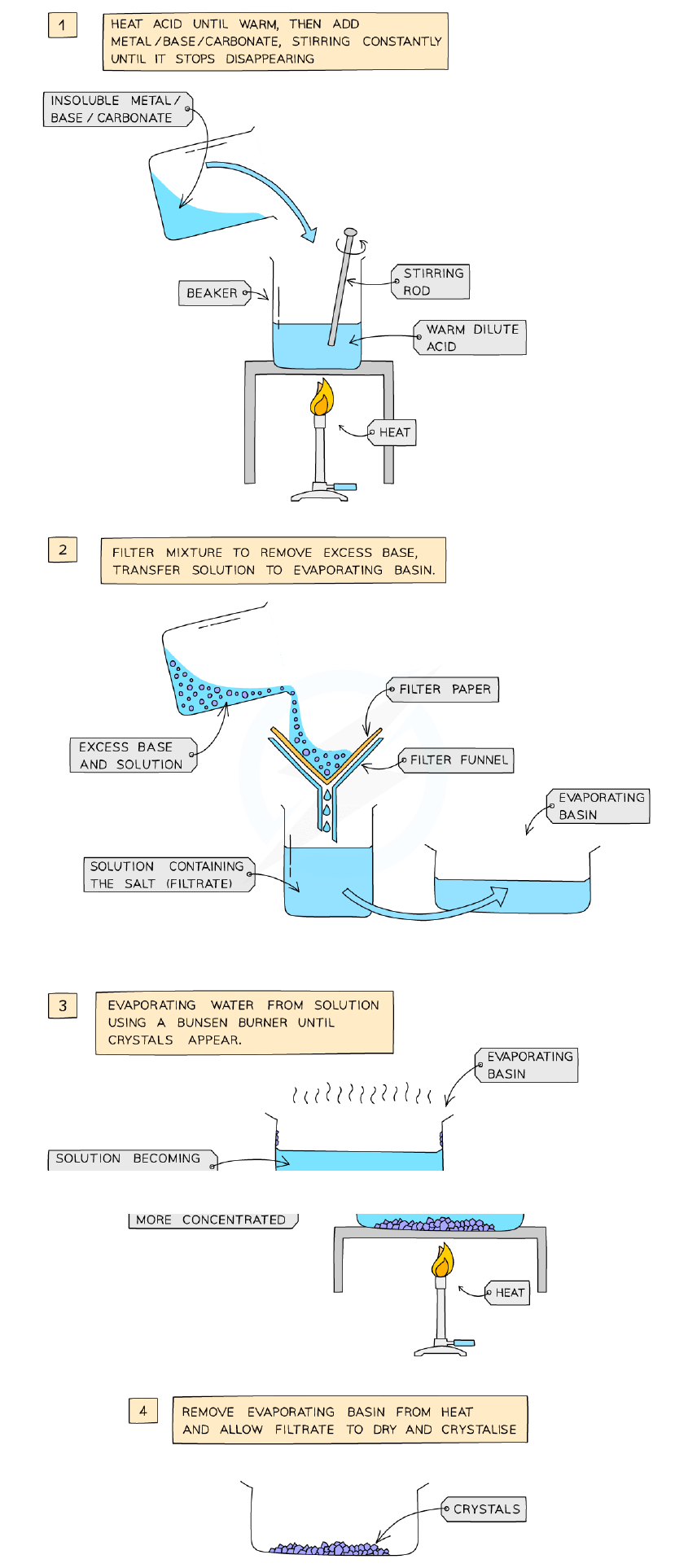
- A salt that dissolves in water can be made by reacting an acid with an insoluble solid: a metal, a metal oxide or a carbonate. A teacher shows this method to make copper sulfate from copper oxide and sulfuric acid.
- Step 1: warm some dilute sulfuric acid. Step 2: add copper oxide a little at a time, stirring, until some solid is left over that will not react. This is excess solid. Using excess means all of the acid has been used up.
- Step 3: filter the mixture. The excess copper oxide stays in the filter paper and the blue copper sulfate solution (the filtrate) goes through. Step 4: heat the filtrate gently to evaporate some of the water, then leave it to cool so crystals form.
- The crystals are blue because copper sulfate crystals have water locked into them. They are dried gently between filter papers. Boiling all the water away would spoil the crystals.
- Alkalis such as sodium hydroxide dissolve, so you cannot filter off the excess. To make a salt from an alkali, the exact amount of acid needed has to be found first, using an indicator and a burette.
- Staying safe: a teacher carries out any step that uses heated acid. Everyone wears eye protection, nobody tastes anything, spills are reported at once and skin is rinsed with plenty of cold water. Hazard symbols on bottles show if a chemical is corrosive or an irritant.
Making a soluble salt from an insoluble solid
Think like a scientist: finding the neutral point
- Question: how much alkali is needed to neutralise 20 cm³ of dilute acid? A teacher runs this with dilute solutions and everyone wears eye protection. Universal indicator is added to the acid, then alkali is added in steps until the indicator turns green.
- The independent variable is the volume of alkali added. The dependent variable is the pH or the colour of the indicator. You control the volume and concentration of acid, the amount of indicator and the alkali used.
- If alkali is added 5 cm³ at a time, you can only say that the neutral point is somewhere inside one step, for example between 15 cm³ and 20 cm³. Adding it drop by drop near the colour change gives a more accurate result.
- Colour judged by eye is subjective. A pH meter reads a number directly, and swirling the flask after every addition makes sure the mixture is mixed.
- Repeat the experiment and calculate a mean. Ignore a result that is far from the others (an anomaly) only after looking for the reason.
- Inquiry task: a student found that 20 cm³ of alkali neutralised 20 cm³ of acid in one experiment using 5 cm³ steps. Evaluate this method. Suggest two changes that would make the result more accurate and one that would make it more reliable.
Slide
Sign up free to view the lesson slides
Step through every slide for this topic — plus flashcards and revision notes — with a free account.
Soal latihan
Pratinjau gratis — 8 dari 54 soal. Daftar untuk melihat semuanya.
1.What are the products when an acid reacts with a reactive metal?
Easy- AA salt and water
- BA salt and hydrogen
- CA salt, water and carbon dioxide
- DOnly a salt
2.What are the products when an acid reacts with a carbonate?
Easy- AA salt and hydrogen only
- BA salt and water only
- CA metal, oxygen and water
- DA salt, water and carbon dioxide
3.What are the products when an acid reacts with an alkali?
Easy- AA salt and water
- BA salt and hydrogen
- CA salt and carbon dioxide
- DHydrogen and water
4.Magnesium is added to dilute hydrochloric acid and bubbles form. Which gas is made?
Easy- ACarbon dioxide
- BOxygen
- CHydrogen
- DChlorine
5.What happens to limewater when carbon dioxide is bubbled through it?
Easy- AIt turns blue
- BIt stays clear and bubbles
- CIt turns milky (cloudy)
- DIt turns bright pink
6.Match each acid to the family of salts it makes.
Easy- Hydrochloric acid
- Sulfuric acid
- Nitric acid
- Sulfates
- Nitrates
- Chlorides
7.During neutralisation the pH of the mixture moves towards 7.
EasyTrue or false?
8.Which of these pH values is acidic?
Easy- ApH 3
- BpH 7
- CpH 9
- DpH 13
Unlock all 54 questions, flashcards & more
Buat akun gratis untuk melihat setiap soal, slide, kartu flash, dan catatan ulasan topik ini.