Giant structures and material performance
Belajar sambil bermain
Jawab soal-soal ini untuk dapat energi, lalu memancing dan menjelajah. Tanpa akun.
Catatan pelajaran
Big idea: giant structures and material performance
- Key concept: Relationships. The arrangement of atoms and bonds explains material properties. Graphite has mobile electrons and layers; diamond has a rigid three-dimensional covalent network.
- Related concepts: Models and evidence. Use a scientific explanation to make predictions, then test it against observations.
- Global context: Scientific and technical innovation. Structure-property relationships guide choices for electrodes, cutting tools and electronic materials.
Introduction to Giant Structures
- Giant covalent structures contain billions of non-metal atoms joined by strong covalent bonds in a giant lattice.
- Diamond and graphite are allotropes of carbon – same element, different bonding arrangements.
- Giant structures have very high melting points due to many strong bonds.
- Silicon(IV) oxide (SiO₂) is also a giant covalent compound.
Diamond – Structure & Properties
- Each carbon atom bonds to four others in a tetrahedral arrangement.
- All bonds are identical, very strong covalent bonds; no intermolecular forces.
- Does not conduct electricity – all outer electrons are used in bonds.
- Extremely hard and dense – used in cutting tools and drills.
- Very high melting point – many strong bonds need lots of energy to break.
- Hard but brittle (can be smashed with a hammer).
Graphite – Structure & Properties
- Each carbon atom bonds to three others, forming layers of hexagons.
- One delocalised electron per carbon atom is free to move between layers.
- Conducts electricity – delocalised electrons carry charge.
- High melting point – strong covalent bonds within layers.
- Slippery – layers held by weak intermolecular forces can slide over each other.
- Used as a lubricant, in pencils, and as electrodes (unreactive, conducts).
Silicon(IV) Oxide (SiO₂)
- Giant covalent structure – each Si bonds to 4 O atoms, each O bonds to 2 Si atoms.
- Forms a tetrahedral arrangement similar to diamond.
- Very hard, high melting point, insoluble in water, does not conduct electricity.
- Occurs naturally as sand and quartz.
- Used to make sandpaper and to line furnaces (cheap, heat-resistant).
Metallic Bonding
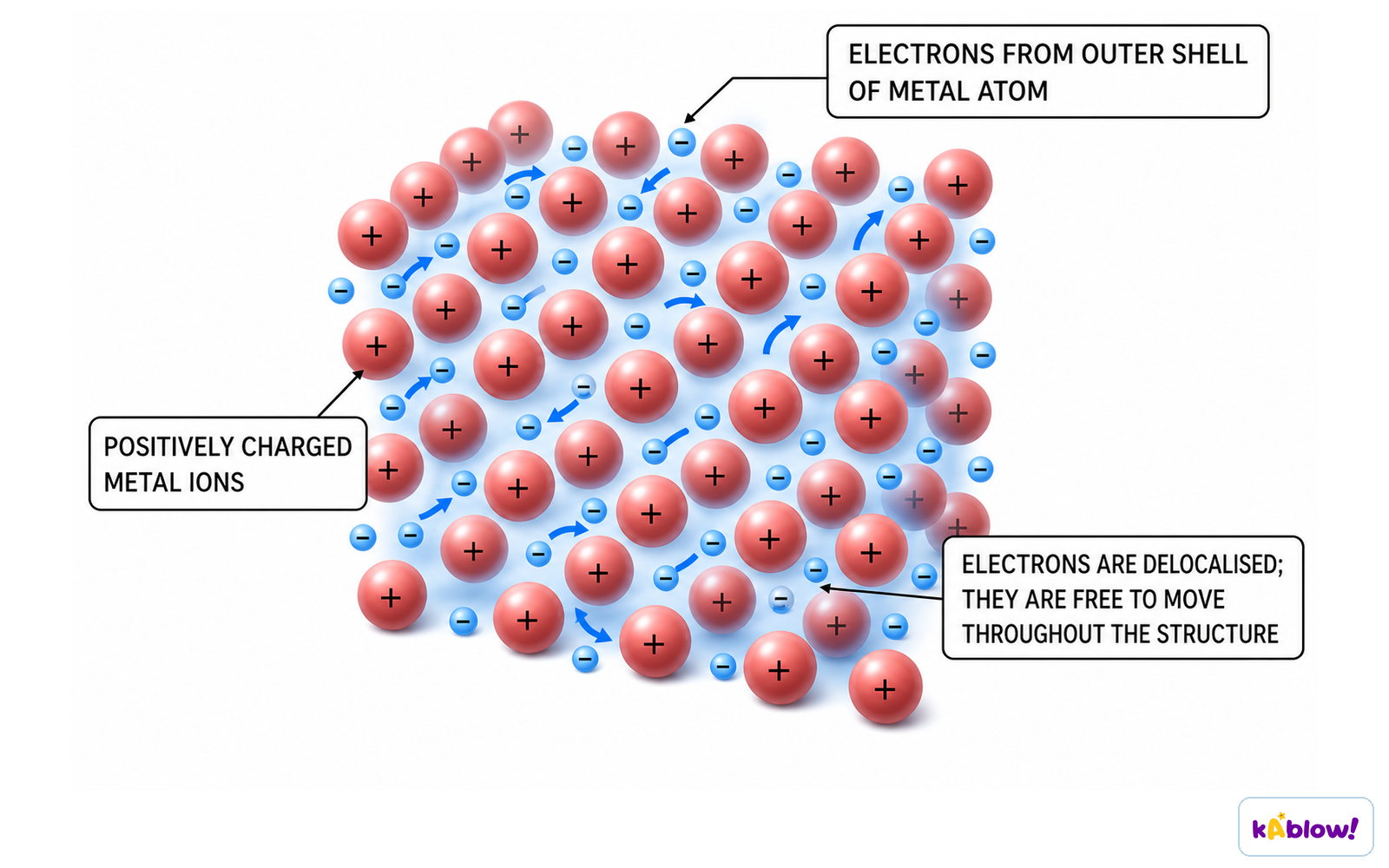
- Metals consist of a giant lattice of positive metal ions surrounded by a ‘sea of delocalised electrons’.
- The metallic bond is the electrostatic attraction between positive ions and delocalised electrons.
- High melting/boiling points – strong metallic bonds require lots of energy to break.
- Good conductors of heat and electricity – delocalised electrons move freely.
- Malleable and ductile – layers of ions can slide over each other without breaking bonds.
Metallic bonding
Think like a scientist
- Compare teacher-provided hardness and conductivity measurements for diamond, graphite and silica.
- Comparison: the giant structure being compared. Outcome: hardness and electrical conductivity.
- Control: compare samples at the same temperature. Explain why this makes the comparison fairer.
- Evidence: Use a consistent method, repeated observations where appropriate and a table with labelled quantities and units. Keep unexpected results and investigate their cause.
- Safety: Practical activities need teacher supervision and an appropriate risk assessment. Use the provided data or simulation where the investigation specifies it.
- Inquiry task: State a testable question, predict the outcome using the science, then explain how your observations would support or challenge the prediction.
Evaluate the science
- Structure-property relationships guide choices for electrodes, cutting tools and electronic materials.
- An idealised structure predicts trends, but defects, purity and manufacturing affect real material performance.
- Evaluation task: Link your conclusion to evidence, identify a limitation and suggest a specific improvement. Distinguish a measured result from an explanation of its cause.
Slide
Sign up free to view the lesson slides
Step through every slide for this topic — plus flashcards and revision notes — with a free account.
Soal latihan
Pratinjau gratis — 8 dari 52 soal. Daftar untuk melihat semuanya.
1.Which statement about carbon allotropes is correct?
Medium- ADiamond contains carbon atoms bonded to three other carbon atoms.
- BGraphite is a good conductor of electricity because of the presence of mobile ions.
- CDiamond is used as a lubricant because of the weak intermolecular forces between its layers.
- DGraphite is a good conductor of electricity because it contains delocalised electrons.
2.Which row describes how graphite can be used in electrolysis?
Medium- ADelocalised electrons – conducts electricity
- BDelocalised electrons – acts as an insulator
- CLow melting point – acts as an insulator
- DLow melting point – conducts electricity
3.Which statement correctly describes the bonding in metals?
Easy- AA lattice of negative ions in a 'sea of electrons'.
- BA lattice of positive ions in a 'sea of electrons'.
- CA lattice of neutral atoms with delocalised electrons.
- DA lattice of negative ions with delocalised electrons.
4.Which row provides a correct description of the properties of metals?
Easy- Amelting point high, boiling point low, conducts electricity yes
- Bmelting point low, boiling point high, conducts electricity yes
- Cmelting point low, boiling point low, conducts electricity no
- Dmelting point high, boiling point high, conducts electricity yes
5.What other property does graphite have that makes it useful for electrodes?
Medium- AGraphite is an unreactive substance and doesn’t react with the electrolyte.
- BGraphite is soft and easy to shape into electrodes.
- CGraphite has a low melting point due to the weak forces in between the layers.
- DGraphite dissolves readily in water.
6.Which of the following statements about graphite and diamond are incorrect? 1 They are allotropes of carbon. 2 They both conduct electricity. 3 They form different numbers of bonds within their structures. 4 They have different uses.
Medium- A2 and 3
- B2 only
- C1, 3 and 4
- D2 and 4
7.Which statement correctly describes the structure of macromolecules?
Medium- AGiant molecular crystal which is held together by weak intermolecular forces.
- BGiant molecular crystal which is held together by strong ionic bonds.
- CGiant molecular crystal which is held together by weak metallic bonds.
- DGiant molecular crystal which is held together by strong covalent bonds.
8.Which statement about graphite and diamond is not correct?
Medium- AGraphite is a good lubricant due to the weak forces in between the layers.
- BDiamond is used as a drill tip because it is an extremely hard substance.
- CGraphite has a low melting point due to the weak forces in between the layers.
- DDiamond is an allotrope of carbon.
Unlock all 52 questions, flashcards & more
Buat akun gratis untuk melihat setiap soal, slide, kartu flash, dan catatan ulasan topik ini.