Energy stores and transfers
Belajar sambil bermain
Jawab soal-soal ini untuk dapat energi, lalu memancing dan menjelajah. Tanpa akun.
Catatan pelajaran
Big idea: energy is moved between stores
- Big idea (key concept): Systems. A system is the group of objects we choose to look at. Energy moves around inside a system and out to its surroundings, and we can track every step.
- Related concept: Energy. Energy is not a substance you can see. It is a quantity we use to describe what can happen: things can speed up, rise, heat up or light up when energy is transferred to them.
- Global context: Globalization and sustainability. Every country relies on energy resources, and wasting less energy helps people everywhere.
- Energy is measured in joules (J). A bigger unit is the kilojoule (kJ): 1 kJ = 1000 J.
- Scientists think of energy as being held in stores, and moved between them by transfers. Nothing is 'used up': the energy ends up somewhere else.
Energy stores
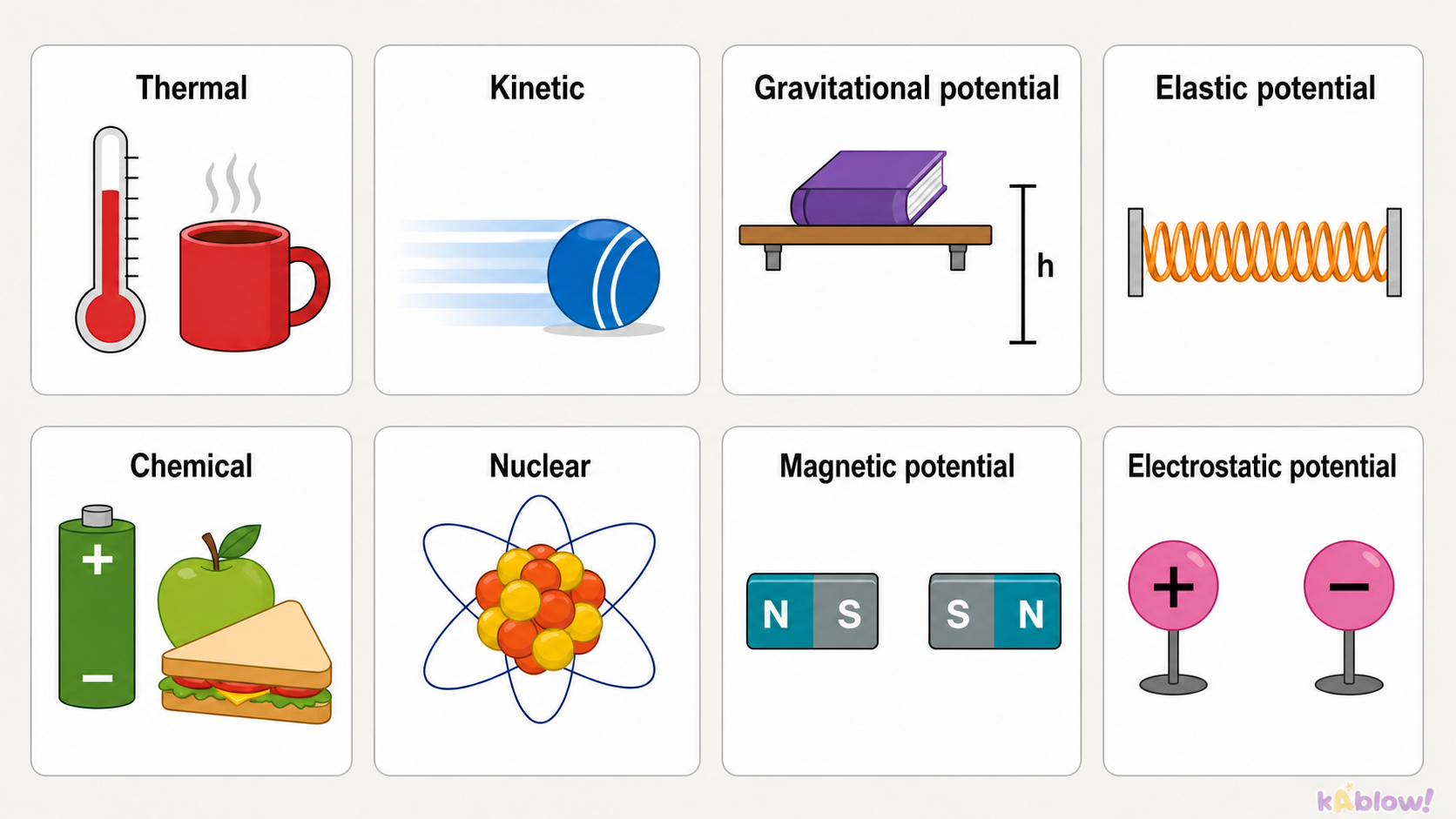
- Kinetic store: energy of anything that is moving.
- Gravitational potential store: energy of an object because of its height above the ground.
- Elastic potential store: energy in something stretched or squashed, such as a spring or a rubber band.
- Chemical store: energy in food, fuels and batteries, released in chemical reactions.
- Thermal store: energy of the moving particles inside an object. A hotter object, or one with more mass, has a bigger thermal store.
- Nuclear store: energy inside the centre (nucleus) of atoms. The Sun and nuclear power stations release it.
- Magnetic and electrostatic stores: energy held between magnets, or between charged objects, that attract or repel.
Eight energy stores with an everyday example of each
How big is a store?
- A kinetic store gets bigger when the object has more mass or moves faster. Speed matters most: doubling the speed makes the store 4 times bigger.
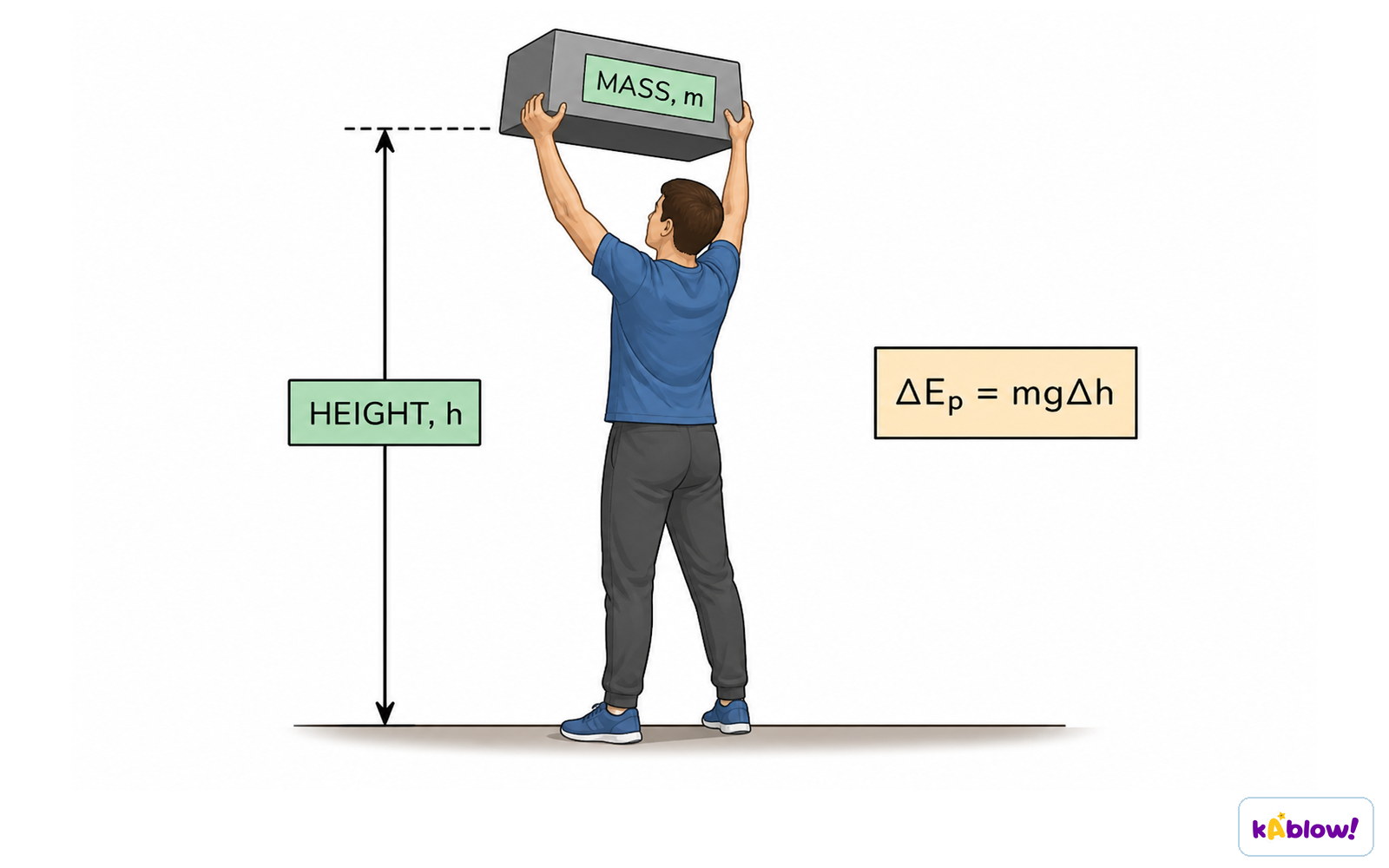
- A gravitational potential store gets bigger when the object has more mass or is lifted higher.
- To calculate the change in a gravitational store: change in energy (J) = mass (kg) x gravitational field strength (N/kg) x change in height (m).
- On Earth we use g = 10 N/kg (it is really about 9.8 N/kg, but 10 is close enough here).
- Worked example: a 2 kg bag is lifted 1.5 m. Energy = 2 kg x 10 N/kg x 1.5 m = 30 J.
- An elastic store gets bigger the more you stretch or squash a spring. A thermal store gets bigger when you heat something up.
Lifting a mass through a height raises its gravitational store
Energy transfers
- A transfer moves energy from one store to another. There are four pathways.
- Mechanically: a force moves something, like a person lifting a box or a bat hitting a ball.
- Electrically: an electric current carries energy, for example from a battery to a motor.
- By heating: thermal energy moves from a hotter object to a cooler one, like a hot cup warming your hands.
- By radiation: waves such as light carry energy across a gap, even empty space. Sound waves also carry energy by vibrations in the air.
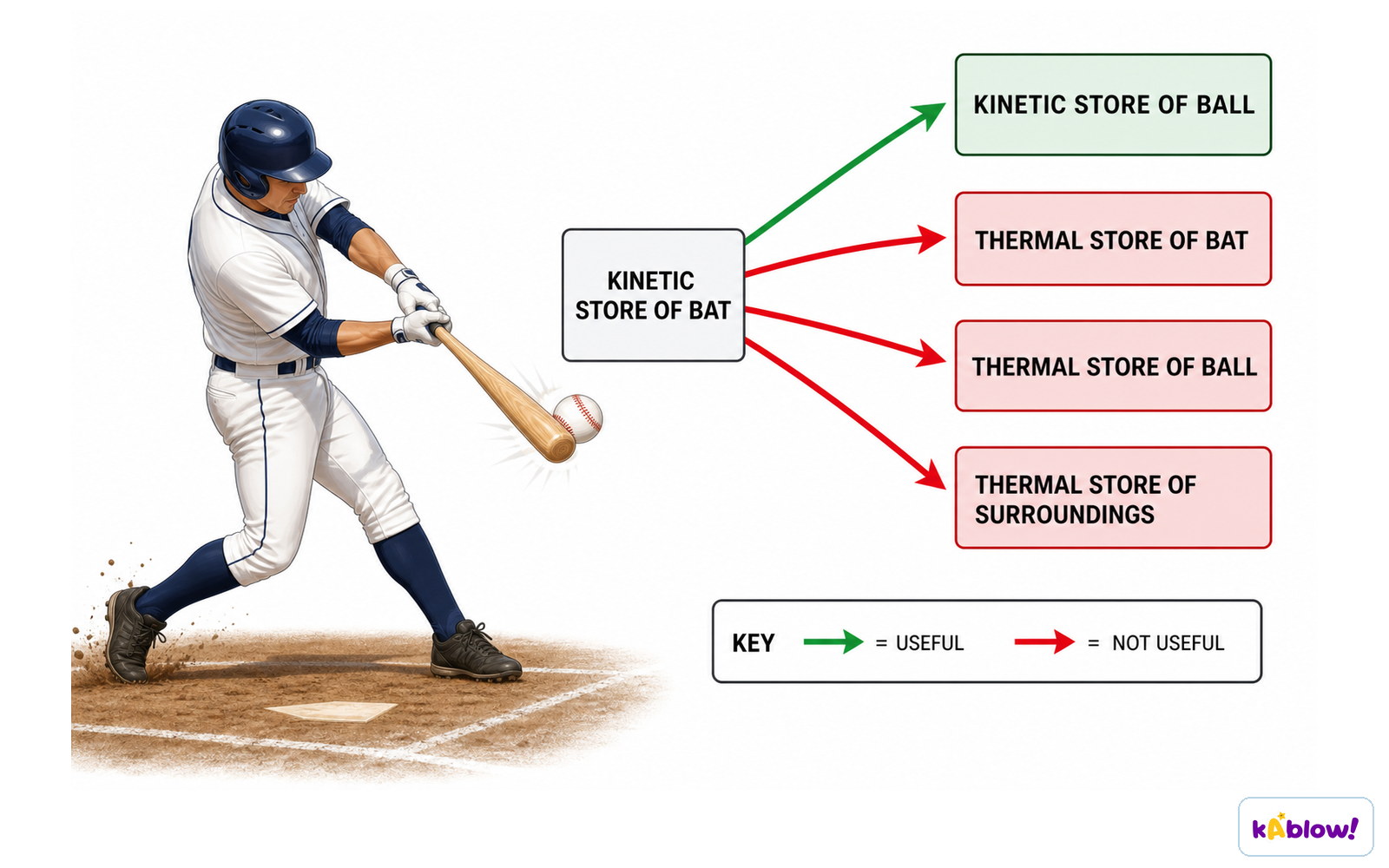
- To describe a transfer, name the store energy leaves, the store it arrives in and the pathway. Example: a bat hits a ball. Energy goes from the kinetic store of the bat to the kinetic store of the ball (mechanically), and some also goes to thermal stores.
Useful and wasted transfers when a bat hits a ball
Conservation, wasted energy and efficiency
- Conservation of energy: energy is never created or destroyed. The total amount before a change equals the total after it.
- In every real change some energy goes into stores we do not want, usually the thermal store of the surroundings. This is wasted energy. It spreads out and is hard to get back, so we say it is dissipated.
- Reducing friction, for example by oiling a bicycle chain, wastes less energy.
- Efficiency compares useful energy with the total: efficiency = useful output energy / total input energy x 100%.
- Worked example: a lamp takes in 20 J and 16 J becomes light, so efficiency = 16 / 20 x 100% = 80%. The other 4 J is wasted.
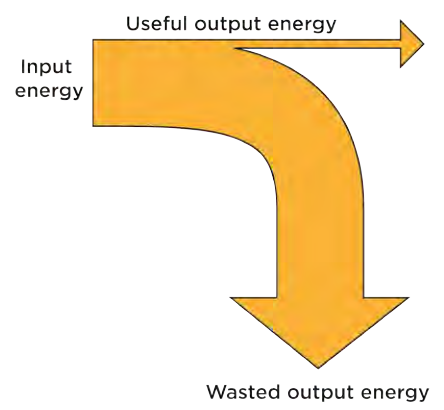
- Efficiency can never be more than 100%. A Sankey diagram shows the input energy splitting into useful and wasted output.
- Energy resources: fossil fuels (coal, oil, gas) are chemical stores that are non-renewable. Wind, solar and hydroelectric power are renewable, and burning less fuel also helps the environment.
A Sankey diagram: input split into useful and wasted energy
Think like a scientist: how much energy does a bouncing ball keep?
- A student drops a ball from different heights and measures the bounce height. This tests whether more energy at the start means a higher bounce.
- The independent variable (what you change) is the drop height. The dependent variable (what you measure) is the bounce height.
- Control variables (keep the same): the same ball, the same floor, the same way of reading the height.
- Repeat each drop at least 3 times and calculate the mean. A single reading can be a mistake.
- Inquiry task: use your results to calculate bounce height / drop height x 100% for each drop. Does the ball keep the same fraction each time? Where does the rest of the energy go, and how could you improve the method?
Slide
Sign up free to view the lesson slides
Step through every slide for this topic — plus flashcards and revision notes — with a free account.
Soal latihan
Pratinjau gratis — 8 dari 51 soal. Daftar untuk melihat semuanya.
1.Which of these is an energy store?
Easy- AA force
- BSpeed
- CKinetic
- DGravity
2.In which unit is energy measured?
Easy- AJoule (J)
- BNewton (N)
- CKilogram (kg)
- DDegree Celsius (°C)
3.A stretched rubber band is holding energy in which store?
Easy- AKinetic
- BChemical
- CNuclear
- DElastic potential
4.A new battery has not been connected to anything yet. In which store is its energy held?
Easy- AThermal
- BChemical
- CElastic potential
- DKinetic
5.A cyclist is riding along a flat road. In which store is the energy of her movement?
Easy- AGravitational potential
- BKinetic
- CChemical
- DNuclear
6.A book is lifted from the floor onto a high shelf. Which store of the book has increased?
Easy- AKinetic
- BElastic potential
- CThermal
- DGravitational potential
7.Which pathway carries energy from the Sun to the Earth across empty space?
Easy- ABy radiation (light)
- BBy conduction
- CMechanically
- DElectrically
8.Which of these energy resources is renewable?
Easy- ACoal
- BOil
- CWind
- DNatural gas
Unlock all 51 questions, flashcards & more
Buat akun gratis untuk melihat setiap soal, slide, kartu flash, dan catatan ulasan topik ini.