Moments and levers
Belajar sambil bermain
Jawab soal-soal ini untuk dapat energi, lalu memancing dan menjelajah. Tanpa akun.
Untuk pendidik: slide pelajaran, catatan ulasan siap pakai untuk Moments and levers (MYP Physics, Year 2) — gunakan dalam pelajaranmu, atau jalankan topik sebagai aktivitas kelas interaktif yang dimainkan pembelajar sebagai permainan langsung.
Catatan pelajaran
Big idea: forces can turn things
- Big idea. Key concept: Systems. A lever, a door or a seesaw is a system that turns about one fixed point.
- Related concept: Balance. An object stays balanced when the turning effects on it cancel out.
- Global context: Scientific and technical innovation. Spanners, scissors, cranes, wheelbarrows and bottle openers were all designed by understanding turning forces.
- A force can make an object turn as well as move. The fixed point it turns about is called the pivot (or fulcrum). A door turns about its hinge.
- The turning effect of a force is called its moment.
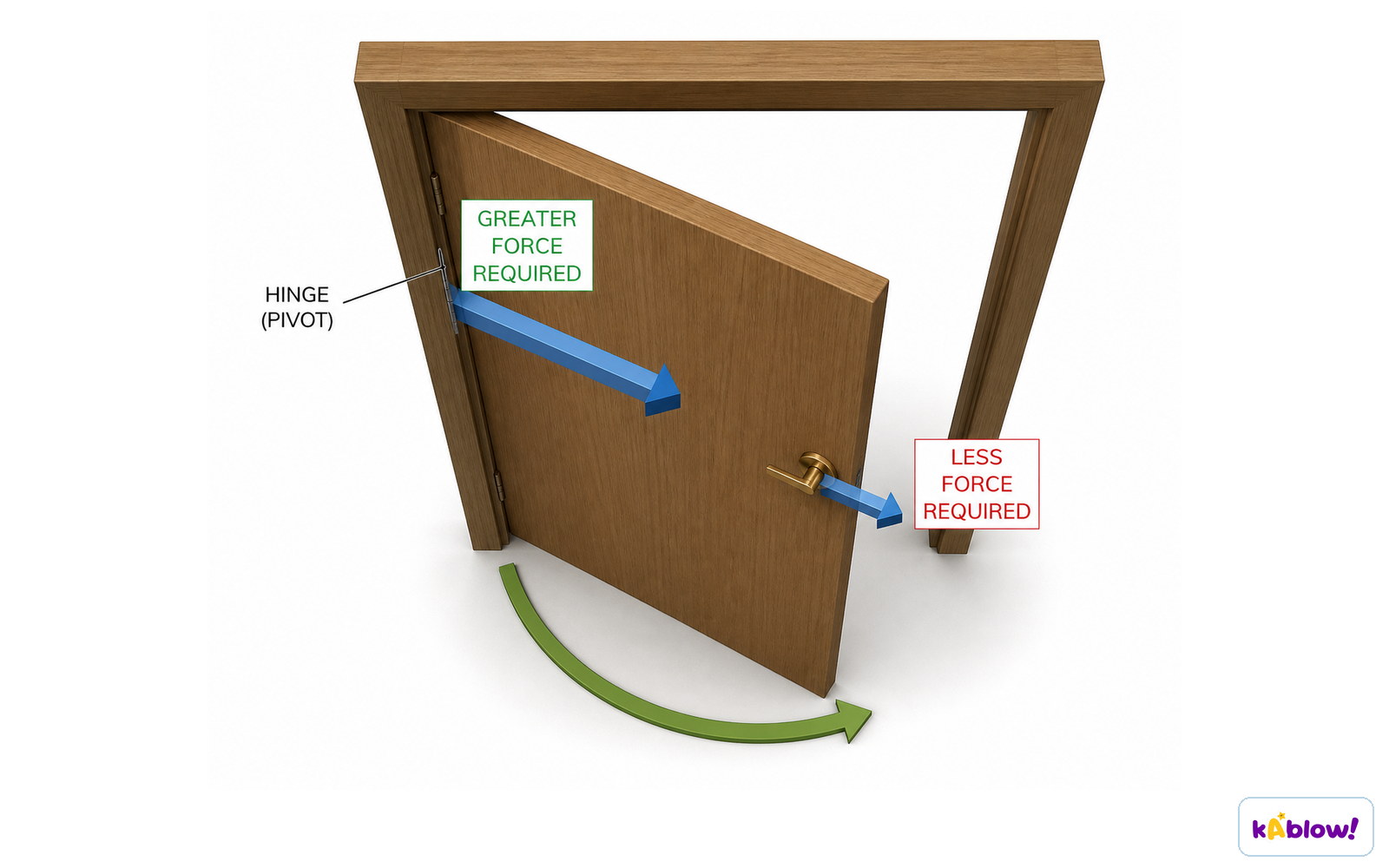
- Opening a door by pushing near the hinge is very hard. Pushing at the handle, far from the hinge, is easy. The same turning effect needs a smaller force when the force is further from the pivot.
A door turning about its hinge
Calculating a moment
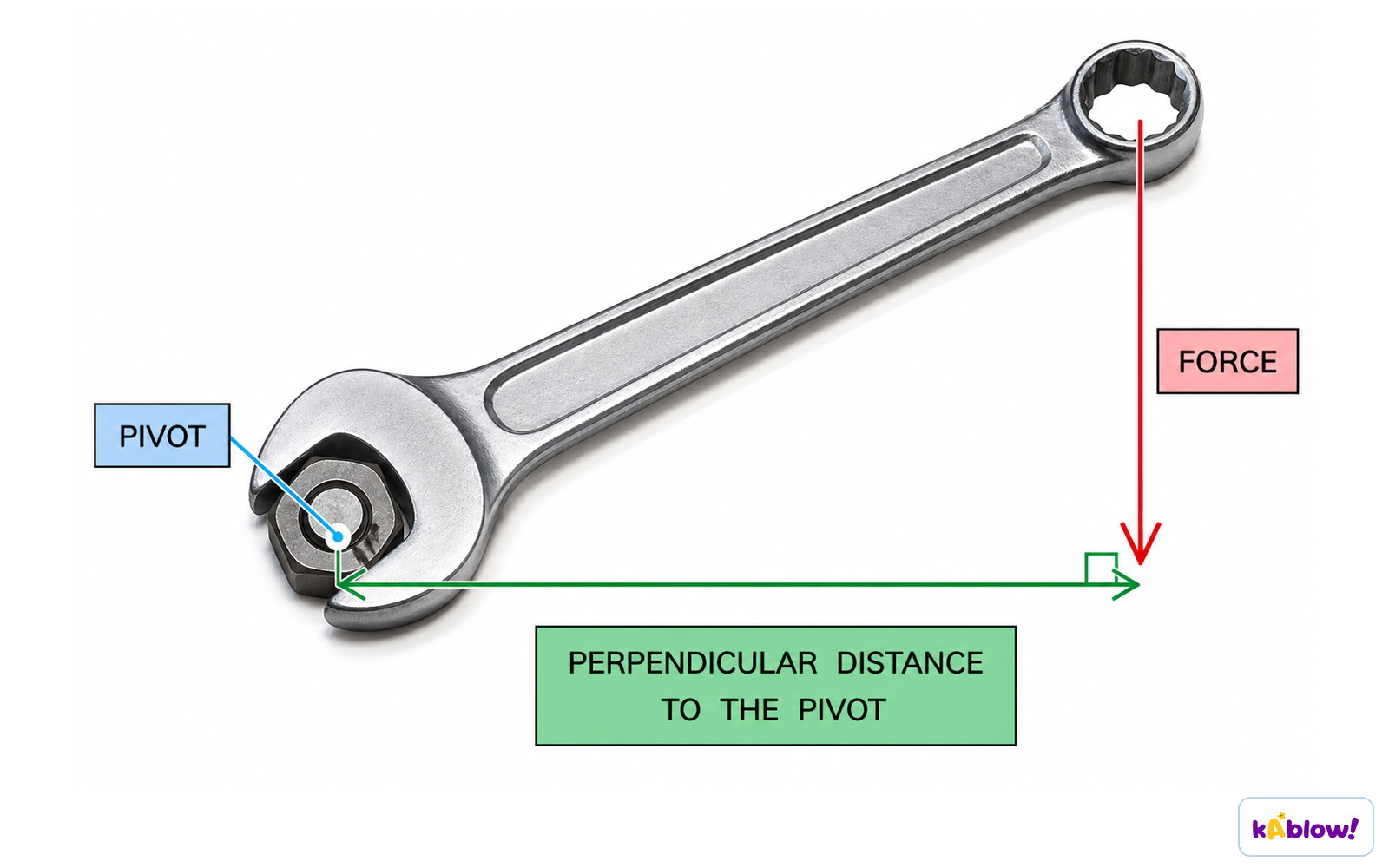
- moment = force × perpendicular distance from the pivot.
- The force is in newtons (N), the distance in metres (m), and the moment in newton metres (N m).
- Worked example: a 20 N force acts 0.5 m from a pivot. Moment = 20 N × 0.5 m = 10 N m.
- Change centimetres to metres first. A 30 N force at 40 cm is at 0.4 m, so the moment is 30 N × 0.4 m = 12 N m.
- Rearranged: force = moment ÷ distance and distance = moment ÷ force.
- A nut needs a moment of 24 N m to loosen it. With a spanner you grip 0.30 m from the nut, the force needed is 24 N m ÷ 0.30 m = 80 N. A longer spanner gripped 0.60 m away needs only 40 N.
- The door at the hinge: a 15 N push at the handle, 0.8 m from the hinge, gives 12 N m. Pushing at 0.1 m from the hinge, you would need 12 N m ÷ 0.1 m = 120 N to get the same moment.
A spanner turning a bolt
Clockwise and anticlockwise moments
- A moment can turn an object in one of two directions. Clockwise is the way the hands of a clock turn. Anticlockwise is the opposite way.
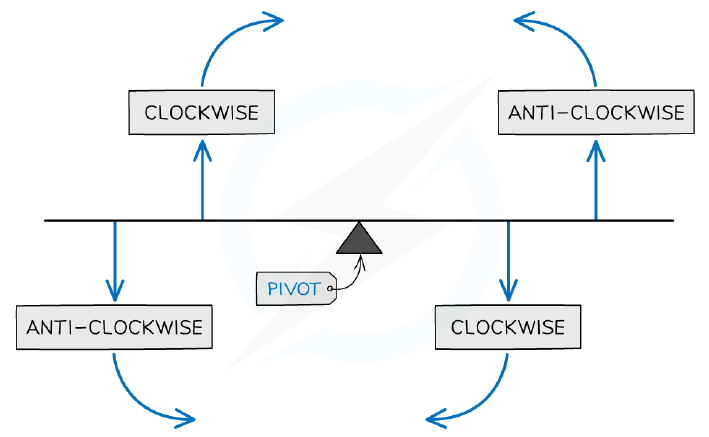
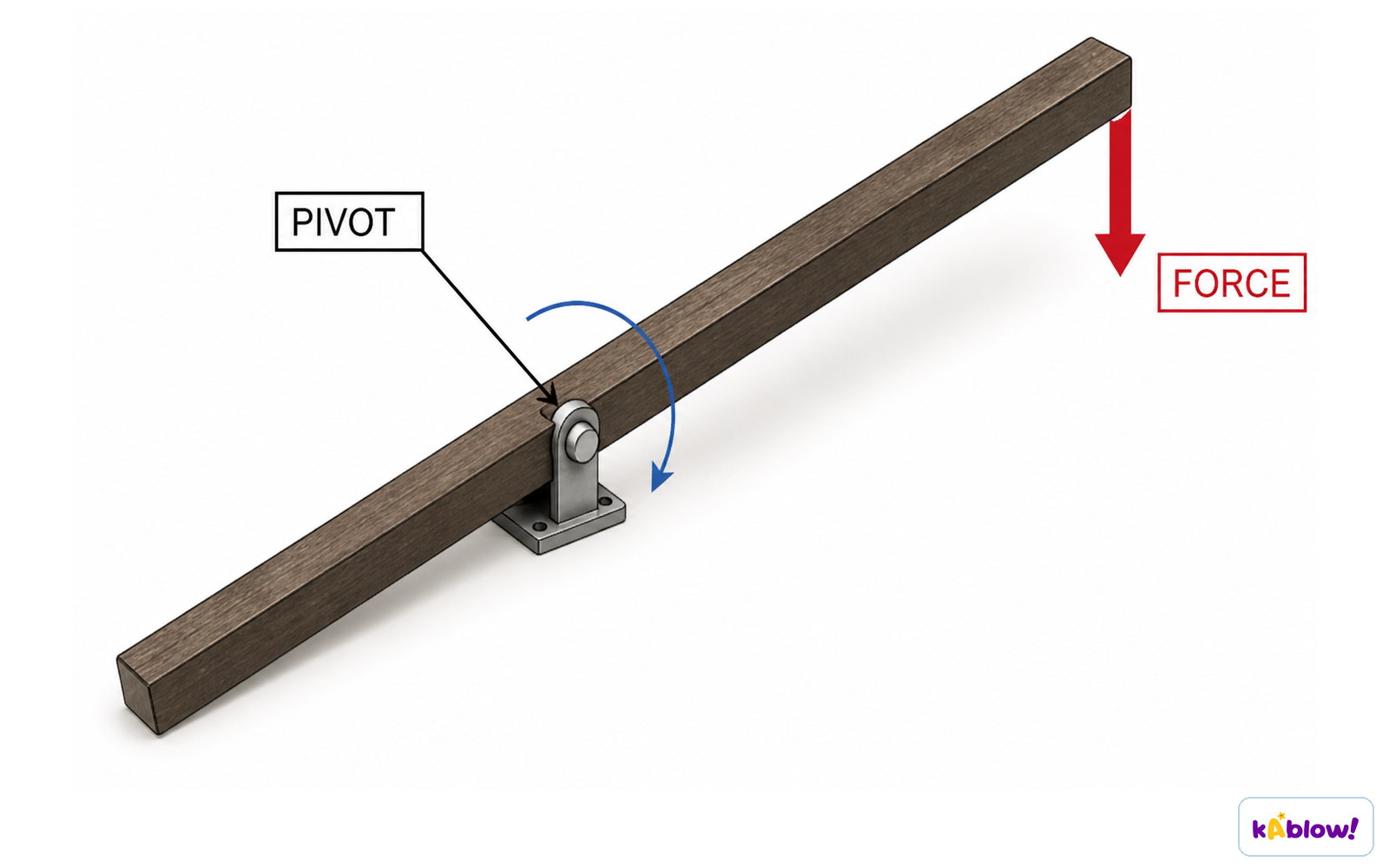
- Think of a beam with a pivot in the middle. A downward force on the right of the pivot pushes the right side down, so it turns the beam clockwise.
- A downward force on the left pushes the left side down, so it turns the beam anticlockwise.
- An upward force reverses the direction. An upward force on the left lifts the left side, so it turns the beam clockwise. An upward force on the right turns it anticlockwise.
- A force that acts through the pivot has a distance of zero, so its moment is 0 N m. The upward push of the pivot itself has no turning effect about the pivot.
- A uniform beam has its weight acting at its middle. If the beam is pivoted at its middle, its own weight has no moment either.
Which way a force turns a beam about its pivot
The principle of moments
- An object is balanced (in equilibrium) when it is not turning. The turning effects cancel out.
- The principle of moments says: for a balanced object, the sum of the clockwise moments = the sum of the anticlockwise moments, taken about the same pivot.
- Example: a beam has 30 N at 0.8 m on the left and 20 N at 1.2 m on the right. Anticlockwise moment = 30 × 0.8 = 24 N m. Clockwise moment = 20 × 1.2 = 24 N m. They are equal, so the beam is balanced.
- If the moments are not equal, the beam turns in the direction of the bigger moment. With 50 N at 0.6 m on the left (30 N m) and 40 N at 0.9 m on the right (36 N m), the bigger moment is clockwise, so the right side goes down.
- Use it to find a missing value. A 300 N adult sits 2.0 m from the pivot of a seesaw. A 400 N person on the other side balances it. Anticlockwise moment = 300 × 2.0 = 600 N m, so 400 N × d = 600 N m and d = 1.5 m. The heavier person sits closer to the pivot.
- With several forces on a side, add their moments. On the left, 10 N at 0.5 m and 20 N at 0.25 m give 5 + 5 = 10 N m. A 25 N force on the right balances this at d = 10 ÷ 25 = 0.4 m.
Levers in everyday life
- A lever is a rigid bar that turns about a pivot. You apply an effort to overcome a load.
- Because moment = force × distance, a long distance from the pivot lets a small effort balance a large load.
- A crowbar: an effort of 100 N acts 0.6 m from the pivot and the load is 0.1 m from the pivot. Effort moment = 60 N m, so the load force = 60 ÷ 0.1 = 600 N.
- A wheelbarrow: the wheel axle is the pivot. A 400 N load is 0.5 m from the axle and your hands are 1.0 m away. Effort = 400 × 0.5 ÷ 1.0 = 200 N.
- Other levers: scissors (pivot at the screw), bottle openers, spanners, seesaws and the claw of a hammer.
- Tweezers do the opposite. Your fingers press closer to the pivot than the tips are, so the tips push with a smaller force, which helps with delicate jobs.
- A lever does not give you free energy. The effort moves a longer distance than the load, so a smaller force acts over a larger distance.
A force turning a beam about its pivot
Think like a scientist: testing the principle of moments
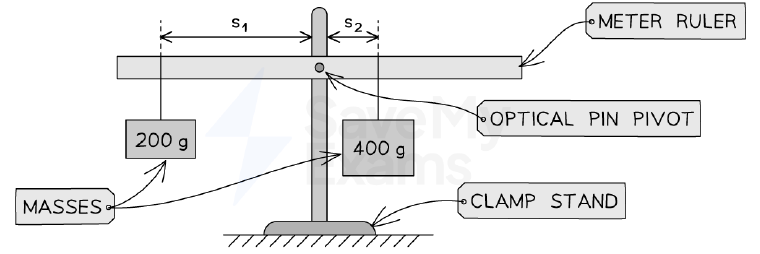
- In a safe school investigation, balance a metre ruler on a pin or knife-edge at its 50 cm mark. Hang a small mass on one side and balance it with a different mass on the other.
- Keep your feet clear of the falling masses and use small masses of 500 g or less.
- The independent variable is the distance of one mass from the pivot. The dependent variable is the distance of the second mass that gives balance. Control variables include the two masses, the pivot position and the ruler.
- Weights come from mass × 10 N/kg. A 200 g mass is 0.2 kg, so its weight is 2 N.
- Calculate the clockwise and anticlockwise moments for each balance. If the principle of moments holds, they should be close to equal. Small differences come from measuring errors, so repeat and take a mean.
- Inquiry task: plan an investigation to test whether the principle of moments still works when two masses hang on the left and one on the right. State your variables, how you will measure distance accurately, and how you will decide whether the moments are equal enough.
A metre ruler balanced on a pin
Slide
Sign up free to view the lesson slides
Step through every slide for this topic — plus flashcards and revision notes — with a free account.
Soal latihan
Pratinjau gratis — 8 dari 53 soal. Daftar untuk melihat semuanya.
1.Which unit is used for the size of a moment?
Easy- ANewton metre (N m)
- BNewton (N)
- CNewton per square metre (N/m²)
- DMetre per second (m/s)
2.Which equation gives the moment of a force?
Easy- Amoment = force ÷ perpendicular distance from the pivot
- Bmoment = force + distance from the pivot
- Cmoment = mass × perpendicular distance from the pivot
- Dmoment = force × perpendicular distance from the pivot
3.What is a pivot?
Easy- AThe force that makes an object turn
- BThe fixed point that an object turns about
- CThe distance between two forces
- DThe heaviest part of a lever
4.Which way of pushing a door needs the smallest force to open it?
Easy- APushing close to the hinge
- BPushing in the middle of the door
- CPushing at the handle, far from the hinge
- DPushing at the top of the door, near the hinge
5.Which direction is clockwise?
Easy- AThe same way the hands of a clock turn
- BThe opposite way to the hands of a clock
- CAlways upwards
- DAlways towards the pivot
6.Which of these tools works as a lever?
Easy- AA thermometer
- BA pair of scissors
- CA magnifying glass
- DA battery
7.A seesaw is balanced. How does the total clockwise moment compare with the total anticlockwise moment?
Easy- AThe clockwise moment is bigger
- BThe anticlockwise moment is bigger
- CThey are both zero
- DThey are equal
8.Why is it easier to loosen a tight nut with a long spanner?
Easy- AA longer spanner makes the nut weigh less
- BA longer spanner reduces the moment needed
- CFor the same force, a longer spanner gives a bigger moment
- DA longer spanner has a smaller pivot
Unlock all 53 questions, flashcards & more
Buat akun gratis untuk melihat setiap soal, slide, kartu flash, dan catatan ulasan topik ini.
Soal ujian lampau
Latihan soal ujian lampau untuk topik ini segera hadir.
Segera hadir