Inheritance
Belajar sambil bermain
Jawab soal-soal ini untuk dapat energi, lalu memancing dan menjelajah. Tanpa akun.
Catatan pelajaran
Genetic Inheritance & Genetic Crossing
- Gametes are haploid sex cells formed by meiosis, containing one copy of each chromosome and therefore one allele of each gene.
- The egg cell is larger than the sperm as it contains food to nourish the embryo; the sperm cell contains many mitochondria to release energy for movement.
- Fertilisation is the fusion of gamete nuclei to form a diploid zygote, restoring two alleles of each gene and creating genetic variation in offspring.
- Mendel carried out breeding experiments on pea plants, transferring pollen manually to eliminate uncertainty about parentage.
- Mendel found that the first generation (F1) all showed one parental characteristic, while the second generation (F2) showed both characteristics in a 3:1 ratio.
- A monohybrid cross starts with pure-breeding (homozygous) parents showing different phenotypes; a Punnett grid predicts the probability of offspring genotypes and phenotypes.
- To construct a Punnett grid: write parental phenotypes and genotypes, list possible gametes, place gametes on axes, combine them in boxes, and list genotype and phenotype ratios.
A Punnett square

Inheritance: Terminology
- A gene is a length of DNA on a chromosome that codes for a particular characteristic by coding for a specific protein.
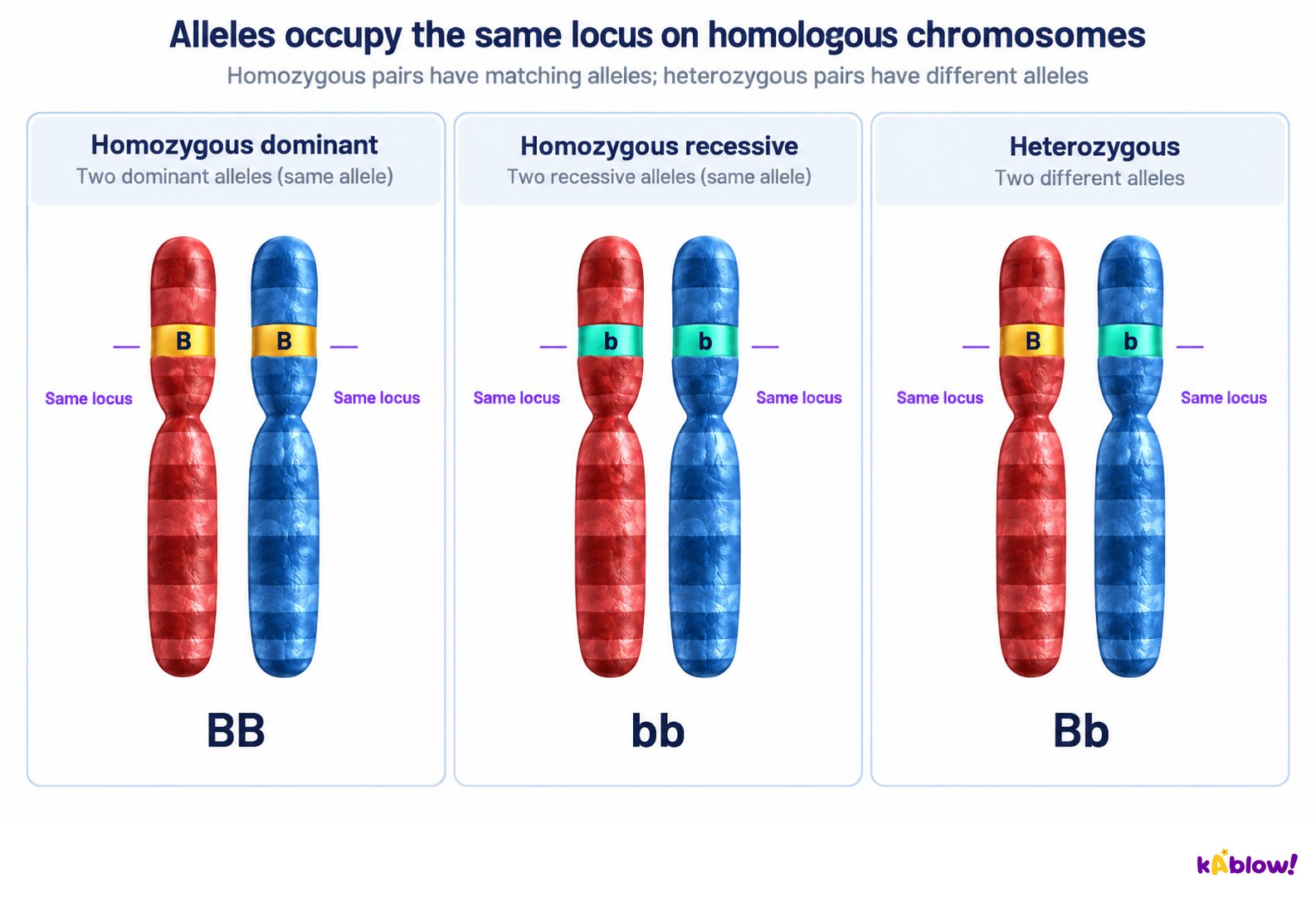
- Alleles are variations of the same gene; every individual has two alleles of each gene, one inherited from each parent.
- The genotype is the combination of alleles an organism inherits; if the two alleles are the same it is homozygous, if different it is heterozygous.
- The phenotype is the observable characteristics of an organism, determined by genotype alone (e.g. blood group), environment alone (e.g. scars), or an interaction of both (e.g. height, skin colour).
- A dominant allele needs to be inherited from only one parent to be expressed; a recessive allele must be inherited from both parents to be expressed.
- Co-dominant alleles are both expressed to an equal extent in the phenotype, e.g. speckled chickens (CW CB).
- Incomplete dominance occurs when both alleles are partially expressed, producing an intermediate phenotype, e.g. pink flowers in the marvel of Peru (CW CR).
Inheriting Alleles
- Phenotypic plasticity is the idea that although genotype remains fixed, phenotype can vary due to internal or external environmental influences on gene expression.
- Environmental stimuli such as light, chemicals, drugs and hormones can affect levels of regulatory proteins or transcription factors.
- UV radiation activates enzymes that increase melanin production, leading to skin pigmentation.
- Temperature can influence gene expression: the Himalayan rabbit's pigmentation gene is inactive above 35°C but active between 15°C and 25°C, causing black fur on cooler body parts.
- Phenylketonuria (PKU) is caused by a recessive allele on an autosome; a mutation in the PAH gene results in a non-functional phenylalanine hydroxylase enzyme, causing a build-up of phenylalanine.
- Two heterozygous carriers of PKU have a 25% chance of a child with PKU and a 75% chance of a child without PKU.
- Multiple alleles exist for some genes (e.g. ABO blood groups), but a diploid individual still inherits only two; alleles differ by one or a few bases called SNPs (Single Nucleotide Polymorphisms).
Sex Determination
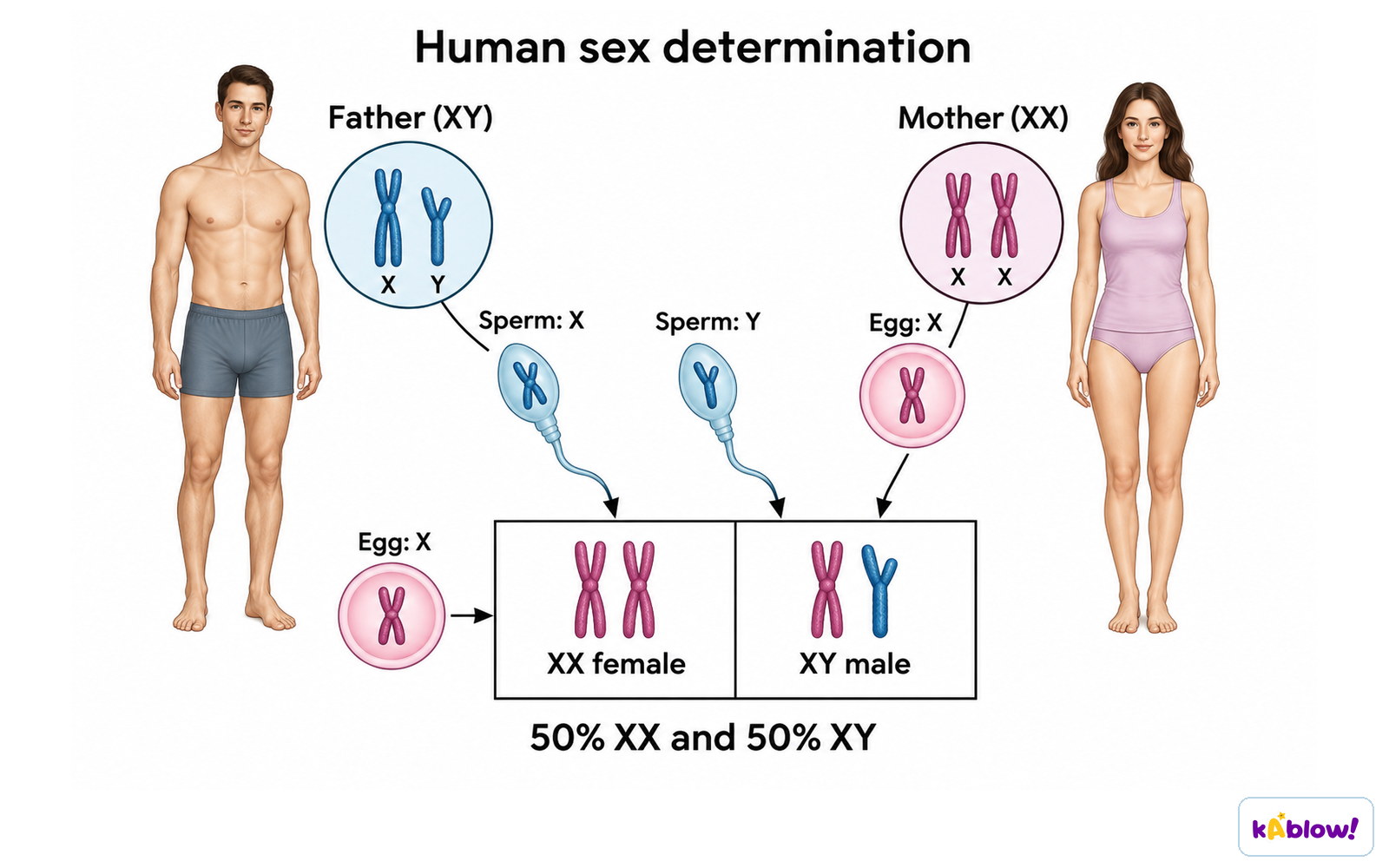
- Sex is determined by an entire chromosome pair: females are XX and males are XY (in mammals).
- All other chromosomes (pairs 1–22 in humans) are autosomes and do not determine sex.
- The father determines the sex of the child because only he can pass on a Y chromosome; half of his sperm carry X and half carry Y.
- The X chromosome is larger than the Y and carries around 16 times more genes; non-sex traits such as blood clotting factors are coded on the X but not the Y.
- The SRY gene on the Y chromosome is involved in testes development and testosterone production in male embryos.
- Sex-linked disorders such as haemophilia are caused by genes on one sex chromosome; haemophilia is caused by a recessive allele for factor VIII on the X chromosome.
- Females can be normal, carriers, or affected by haemophilia; males have only one copy of the gene so are affected if they inherit the recessive allele.
Pedigree Charts
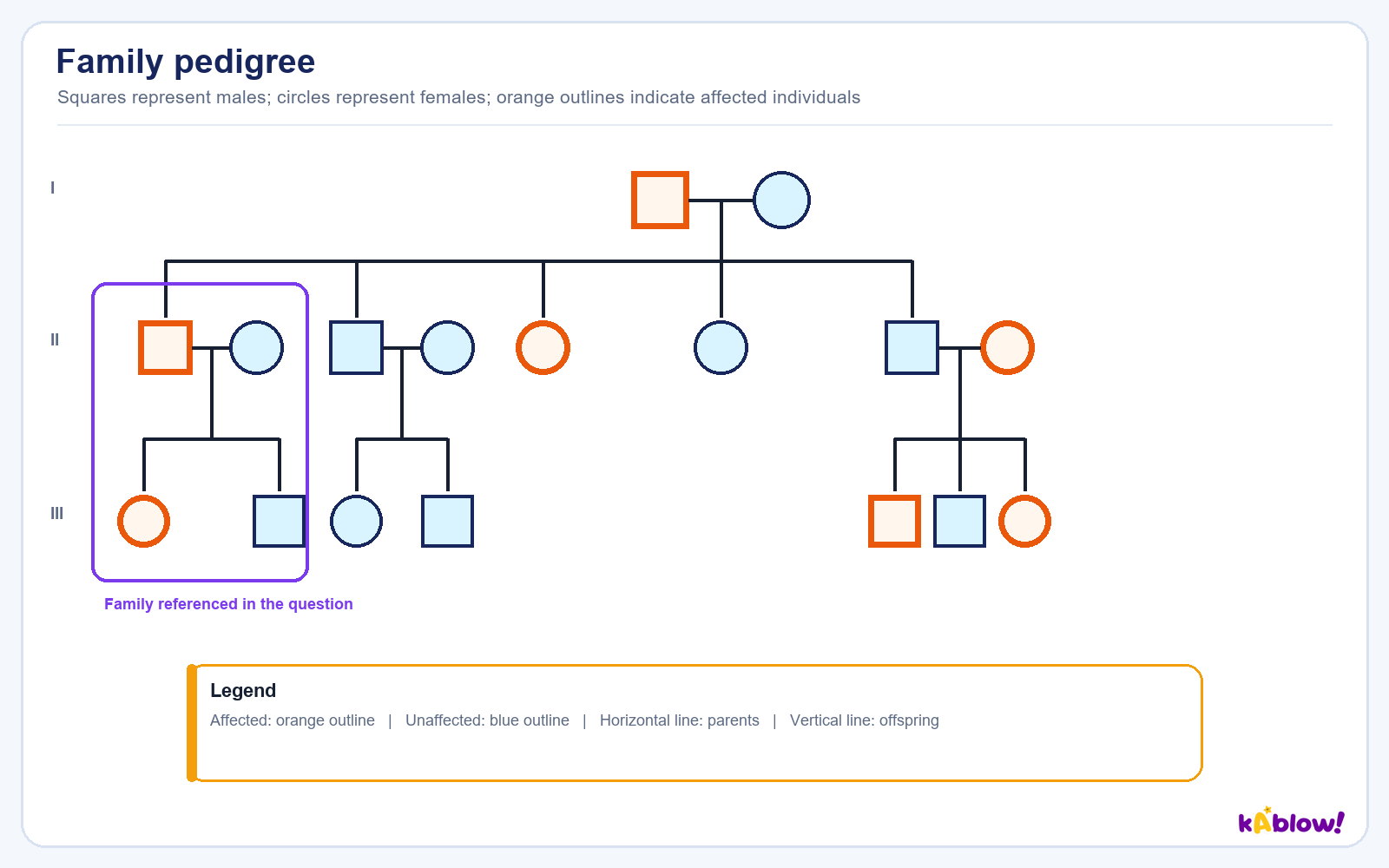
- Pedigree charts trace the inheritance of a characteristic through generations; males are squares and females are circles, with affected individuals shaded.
- Horizontal lines between individuals show they have produced children, linked underneath; Roman numerals may indicate generations, with the eldest child on the left.
- A recessive condition can be identified if it skips a generation or if unaffected parents have an affected child (both parents must be carriers).
- It is unlikely to be sex-linked if both males and females are affected.
- The genotype of an affected individual is homozygous recessive; carrier parents are heterozygous.
- Unaffected individuals in a pedigree may be homozygous dominant or heterozygous.
- Marriage between close relatives is prohibited in many countries because it increases the chance that both parents carry harmful recessive alleles, raising the risk of genetic disease in offspring.
A family pedigree chart
Continuous Variation: Skills
- Discrete variation falls into clear-cut categories with no overlap, e.g. blood groups (A, B, AB, O with Rhesus factor).
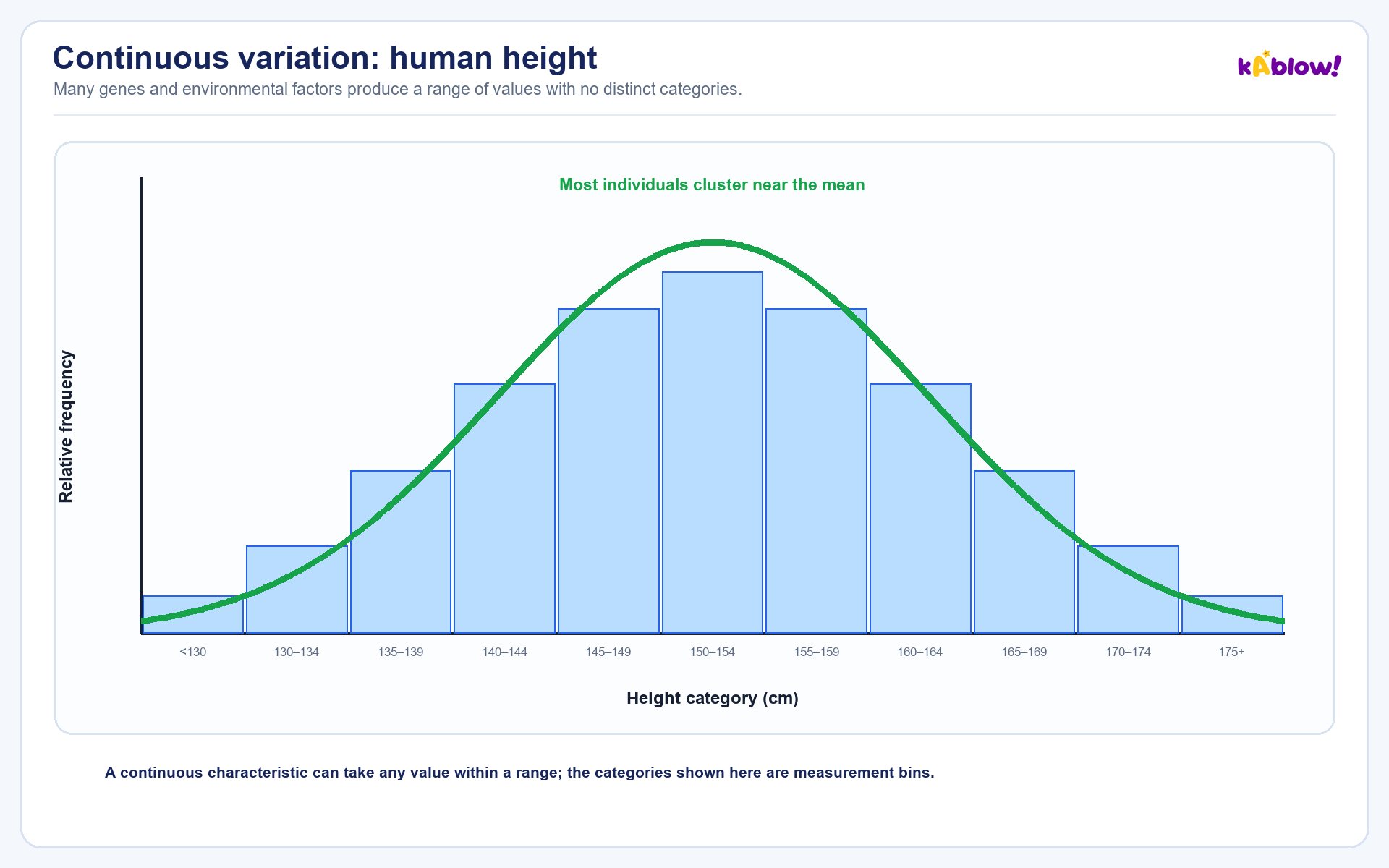
- Continuous variation occurs when two or more genes affect a characteristic, producing a range of values between two extremes, e.g. height, birth mass, skin colour.
- Continuous variation is caused by an interaction between genetics and the environment: Phenotype = genotype + environment.
- Polygenes are a large number of genes that have a combined additive effect on the phenotype.
- Continuous variation in a population often displays a normal distribution (bell-shaped curve).
- Box plots (box-and-whisker diagrams) split data into quartiles and require five values: lowest, first quartile, median, third quartile, highest.
- The box represents the interquartile range (middle 50% of data); whiskers represent the lowest and highest 25%.
- Outliers are data points more than 1.5 × the interquartile range above the third quartile or below the first quartile, plotted separately.
Continuous variation
Dihybrid Crosses & Unlinked Genes
- Unlinked genes are on separate chromosomes and segregate independently during meiosis.
- Assortment refers to the independent alignment of bivalents in metaphase I; segregation refers to which pole whole chromosomes are pulled to in anaphase I.
- Mendel's Law of Independent Assortment states that alleles of different genes are inherited independently of one another.
- Linked genes are on the same chromosome and tend to be inherited together.
- Dihybrid crosses show the inheritance of two different characteristics; genotypes are written with the two alleles of one gene followed by the two alleles of the other, e.g. YyGg.
- In a dihybrid cross between two double heterozygotes (e.g. BbEe × BbEe), the expected phenotypic ratio is 9:3:3:1.
- Gametes for dihybrid crosses can be determined using the FOIL method (First, Outside, Inside, Last).
Statistical Analysis of Dihybrid Crosses
- A chi-squared test compares observed phenotypic ratios with expected ratios to determine whether differences are due to chance.
- The calculated chi-squared value is compared with a critical value at a 5% probability level.
- If the chi-squared value is less than the critical value, the results are not significantly different from the expected ratio; the probability that results are due to chance is high.
- If the chi-squared value is greater than the critical value, the results are significantly different from the expected ratio; the probability that results are due to chance is low.
- The critical value depends on the degrees of freedom, which is the number of categories minus one.
Genes & Polypeptides: Skills
- A gene is a section of DNA that codes for one polypeptide; the number of genes a species has is not directly proportional to its size or complexity.
- A gene may be found at the same locus in different individuals; alleles of the same gene occupy the same locus.
- New alleles can arise through mutation; there are not always two alleles of every gene (some genes have multiple alleles).
- Not every eukaryotic cell contains two alleles of every gene; gametes are haploid and contain only one allele of each gene.
- Online gene databases can be used to find the locus of a human gene, the chromosome on which a gene is located, and evolutionary relationships between organisms; they are not restricted to scientists with special access.
Gene Linkage & Identifying Recombinants
- Linked genes are located on the same chromosome and do not assort independently, so they tend to be inherited together.
- In a test cross, if two genes are linked, the offspring mostly show parental combinations rather than the expected 1:1:1:1 ratio.
- Recombinants are offspring with combinations of alleles different from those of the parents, produced by crossing over during prophase I of meiosis.
- Crossing over between homologous chromosomes exchanges sections of DNA, creating new combinations of linked alleles.
- The frequency of recombinants depends on the distance between the genes on the chromosome; the further apart they are, the more likely crossing over occurs between them.
- When writing linked alleles, the combination on each chromosome should be shown, e.g. GH/gh indicates G and H are linked on one chromosome and g and h on the other.
- A test cross with a homozygous recessive individual can reveal whether genes are linked by the ratio of parental to recombinant offspring.
Slide
Sign up free to view the lesson slides
Step through every slide for this topic — plus flashcards and revision notes — with a free account.
Soal latihan
Pratinjau gratis — 8 dari 62 soal. Daftar untuk melihat semuanya.
1.Which of the following is not an example of how the external environment can influence gene expression?
Easy- AFur colouration of Siamese cats
- BPetal colour of snapdragons
- CSkin colouration after sun exposure
- DSea turtle eggs hatching as females if incubated at 30°C
2.Which option correctly completes the sentence: 'Multiple alleles are present _________.'
Easy- AAt the same locus on homologous chromosomes
- BAt different loci on different chromosomes
- CAt different loci on the same chromosome
- DOn sister chromatids
3.The diploid chromosome number of a koala (Phascolarctos cinereus) is 16. How many autosomes are there in a koala's egg cell?
Medium- A7
- B8
- C14
- D32
4.Two pea plants are heterozygous for two traits, pod and flower colour. The dominant trait for flower colour is purple and the recessive is white. The dominant trait for pod colour is green and the recessive is yellow. If they were to breed, what would be the ratio of their offspring's traits? The ratio is as follows: purple green : purple yellow : white green : white yellow.
Medium- A2 : 1 : 1 : 2
- B1 : 1 : 1 : 1
- C9 : 3 : 3 : 1
- D3 : 3 : 1 : 1
5.In a newt, normal tail length is dominant to short tail length and green scales are dominant to white scales. A heterozygous normal tailed newt with green scales was crossed with a short tailed newt with white scales. A large number of offspring were produced. They were either normal tailed with green scales or short tailed with white scales in equal number. What is the most likely cause of this pattern?
Medium- AThe genes are codominant
- BCrossing over has occurred
- CThe two genes are linked
- DThe traits are polygenic
6.Hair colour is a trait controlled by polygenic inheritance. Which statement is correct?
Easy- AHair colour shows discontinuous variation
- BIndividuals show a wide range of phenotypes for hair colour
- CNo two people have the same hair colour
- DChildren always have the same hair colour as one of their parents
7.Which of the following statements correctly describes co-dominance?
Medium- AThe alleles are both expressed to an equal extent in the phenotype.
- BTwo alleles are 'blended together'.
- COne allele is dominant over the other.
- DNeither allele is expressed in the phenotype.
8.Which option correctly completes the sentence: 'The segregation of alleles occurs during _________ in eukaryotic organisms.'
Easy- AMitosis
- BBinary fission
- CMeiosis
- DDNA replication before cell division
Unlock all 62 questions & more
Buat akun gratis untuk melihat setiap soal, slide, kartu flash, dan catatan ulasan topik ini.