Integration Of Body Systems
Belajar sambil bermain
Jawab soal-soal ini untuk dapat energi, lalu memancing dan menjelajah. Tanpa akun.
Catatan pelajaran
Integration in Living Organisms
- Complex organisms have body systems made of component parts that work together for the whole organism.
- Cell-cell communication is required within and between systems in organisms with billions of cells.
- Hormones are produced in the endocrine system but can affect other systems, e.g. the reproductive system.
- Multicellular organisms show a hierarchy of organisation: cells → tissues → organs → organ systems.
- Tissues are groups of specialised cells working together, e.g. epithelial tissue absorbs food in the small intestine.
- Organs are made of different tissues, e.g. the heart contains cardiac muscle, blood vessel and connective tissues.
- Emergent properties mean the whole organism is greater than the sum of its parts, e.g. a cheetah becomes an effective predator through integration of all body systems.
The central and peripheral nervous systems
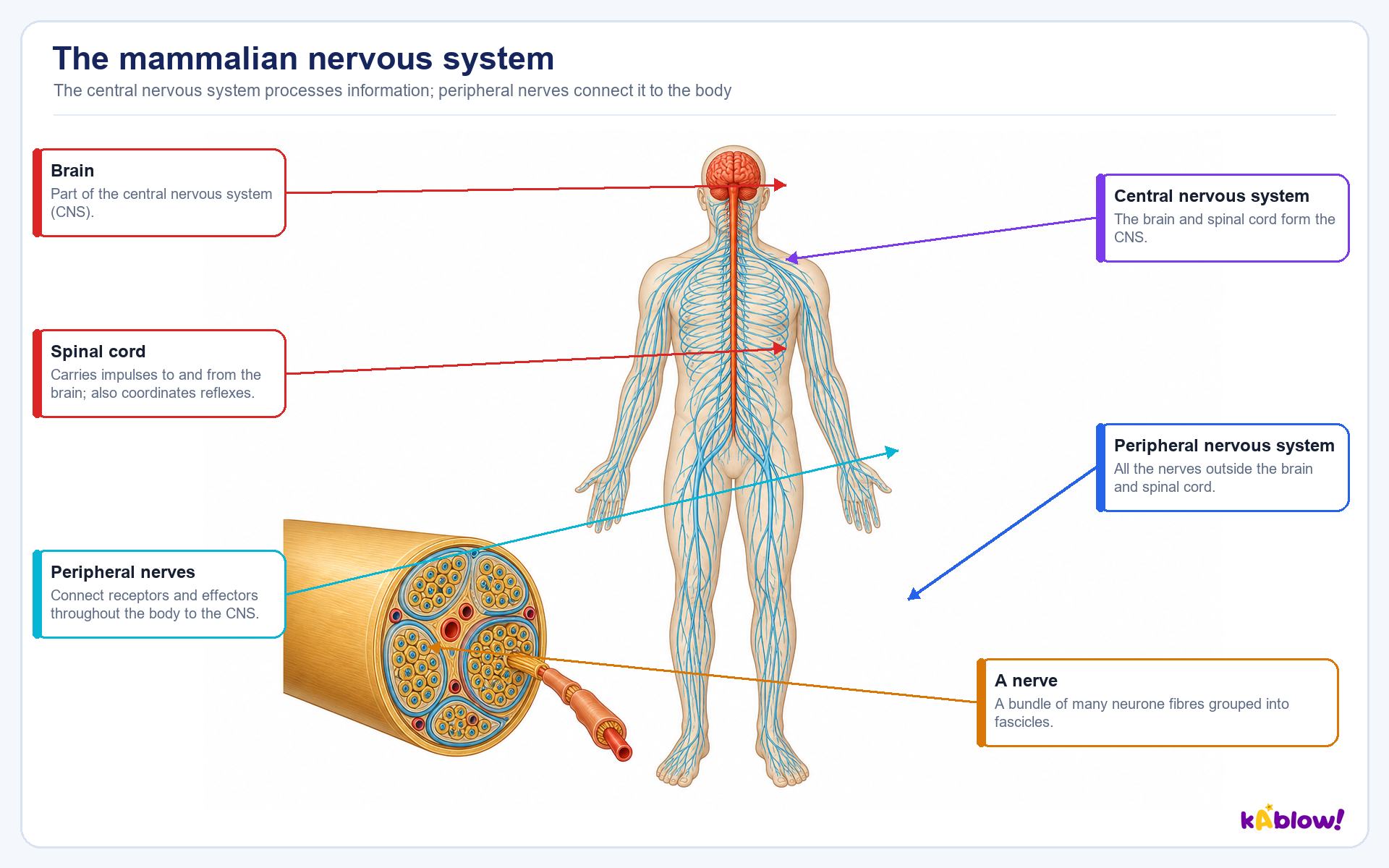
The Nervous System
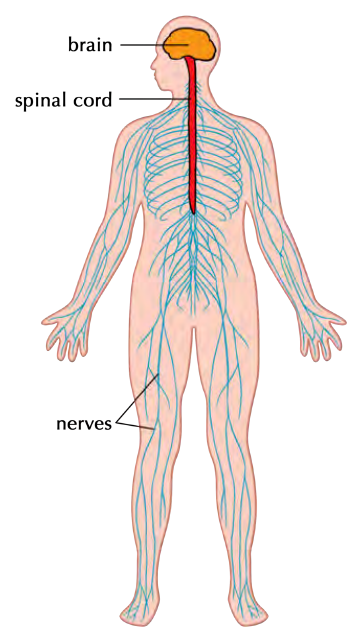
- The nervous system consists of the central nervous system (CNS) – brain and spinal cord – and the peripheral nervous system (PNS) – all other nerves.
- Information travels as electrical impulses along neurones; a bundle of neurones is a nerve.
- The brain is made of billions of interconnected neurones and controls complex conscious and unconscious behaviours.
- Cerebral cortex: outer folded layer responsible for intelligence, memory, consciousness and personality.
- Cerebellum: coordinates balance, muscle coordination and movement.
- Brainstem: relays messages; the medulla controls unconscious activities such as heart rate and breathing.
- Pituitary gland produces hormones including FSH and LH; hypothalamus regulates body temperature and controls the pituitary gland.
Diagram of the human nervous system showing the brain, spinal cord and nerves.
The Spinal Cord and Reflex Arc
- The spinal cord is part of the CNS and acts as an integration centre for unconscious processes.
- White matter contains mainly axons carrying information to and from the brain; grey matter contains neurones and synapses for reflex responses.
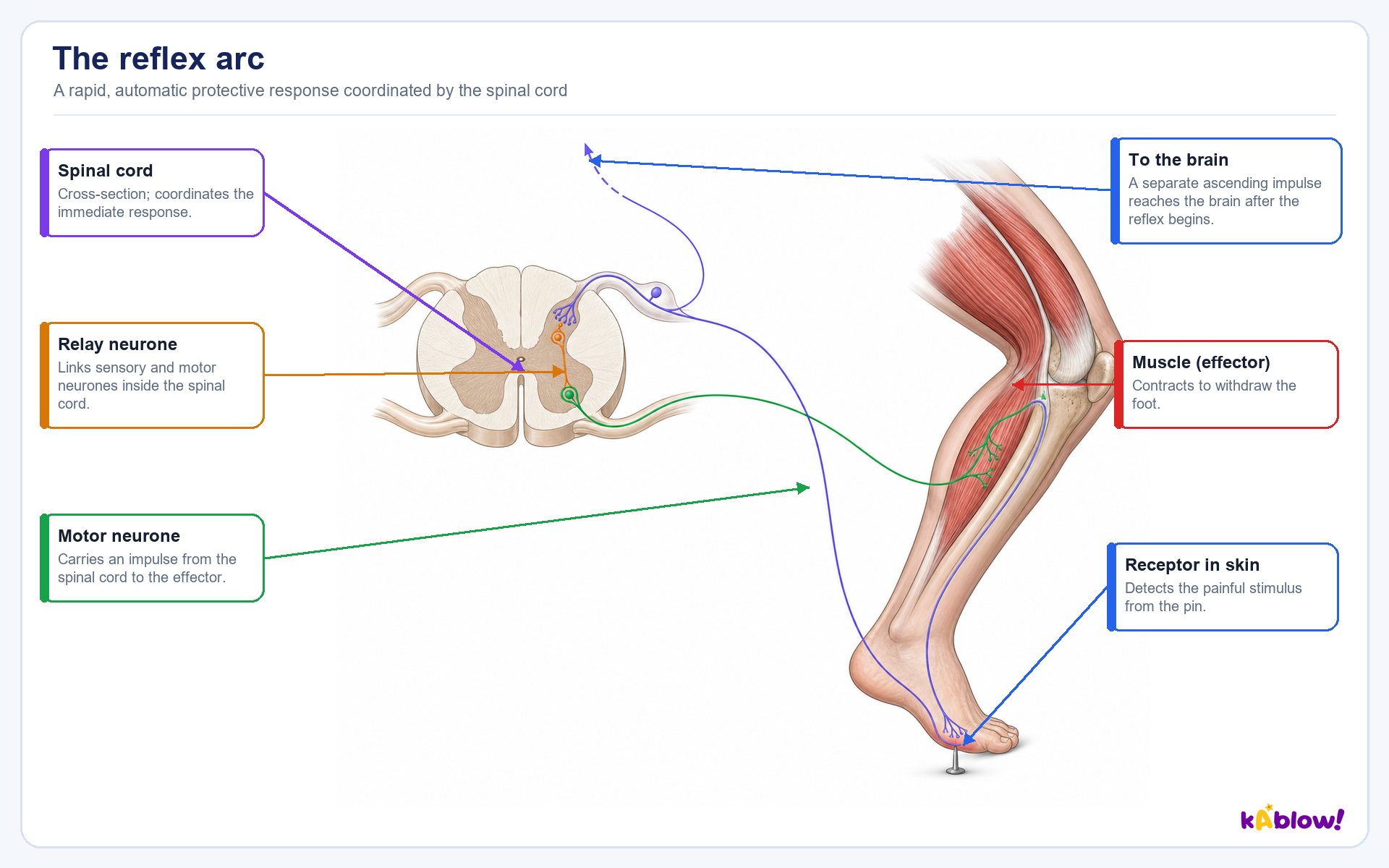
- A reflex arc is a pathway from receptor to effector without involving conscious brain regions.
- In a pain reflex arc, a nocireceptor detects a stimulus (e.g. sharp pin or hot flame).
- An impulse travels along a sensory neurone to the spinal cord, synapses with a relay neurone, then a motor neurone carries the impulse to an effector muscle.
- The muscle contracts and pulls the hand away; awareness of the reflex occurs after it has been carried out.
- Other reflexes include blinking, coughing, pupil reflex and knee reflex, which aid survival.
A reflex arc
Motor Neurones and Muscle Contraction
- Motor neurones carry action potentials to muscles, terminating at neuromuscular junctions.
- At the neuromuscular junction, an action potential causes calcium ions to enter the neurone, stimulating release of acetylcholine (ACh).
- ACh binds to receptors on the sarcolemma, opening ion channels and allowing sodium ions to diffuse in, depolarising the membrane.
- The action potential travels down T-tubules, triggering release of calcium ions from the sarcoplasmic reticulum.
- Calcium ions bind to troponin, moving tropomyosin and exposing myosin-binding sites on actin.
- This initiates the sliding filament model of muscle contraction.
Melatonin and Circadian Rhythms
- Circadian rhythms are daily cycles in physiology and behaviour, e.g. sleep, body temperature and hormone secretion.
- Melatonin is secreted by the pineal gland in the brain.
- Melatonin secretion increases in the evening in response to darkness and decreases at dawn in response to light.
- Light is detected by the retina, and signals are transmitted to the pineal gland.
- Increasing melatonin levels cause tiredness and promote sleep; decreasing levels prepare the body for waking.
- Melatonin contributes to the night-time drop in core body temperature and decreases urine production at night.
- Melatonin is still released in constant darkness on a roughly 24-hour cycle, showing light resets the rhythm daily.
Epinephrine and the Fight or Flight Response
- Epinephrine (adrenaline) is secreted by the adrenal medulla when stimulated by the sympathetic nervous system during stress, fear or excitement.
- It prepares the body for the 'fight or flight' response, causing increased heart rate, dry mouth and sweating.
- Epinephrine binds to receptors on the SAN, increasing the frequency of excitations and thus heart rate.
- This supplies more blood, oxygen and glucose to muscle cells, increasing aerobic respiration and energy release.
- Epinephrine also stimulates the cardiovascular control centre in the medulla oblongata, further speeding up heart rate.
- Blood vessels to less important organs (digestive system, skin) constrict, diverting blood to organs involved in fight or flight.
- Blood flow to the brain remains constant regardless of stress or relaxation.
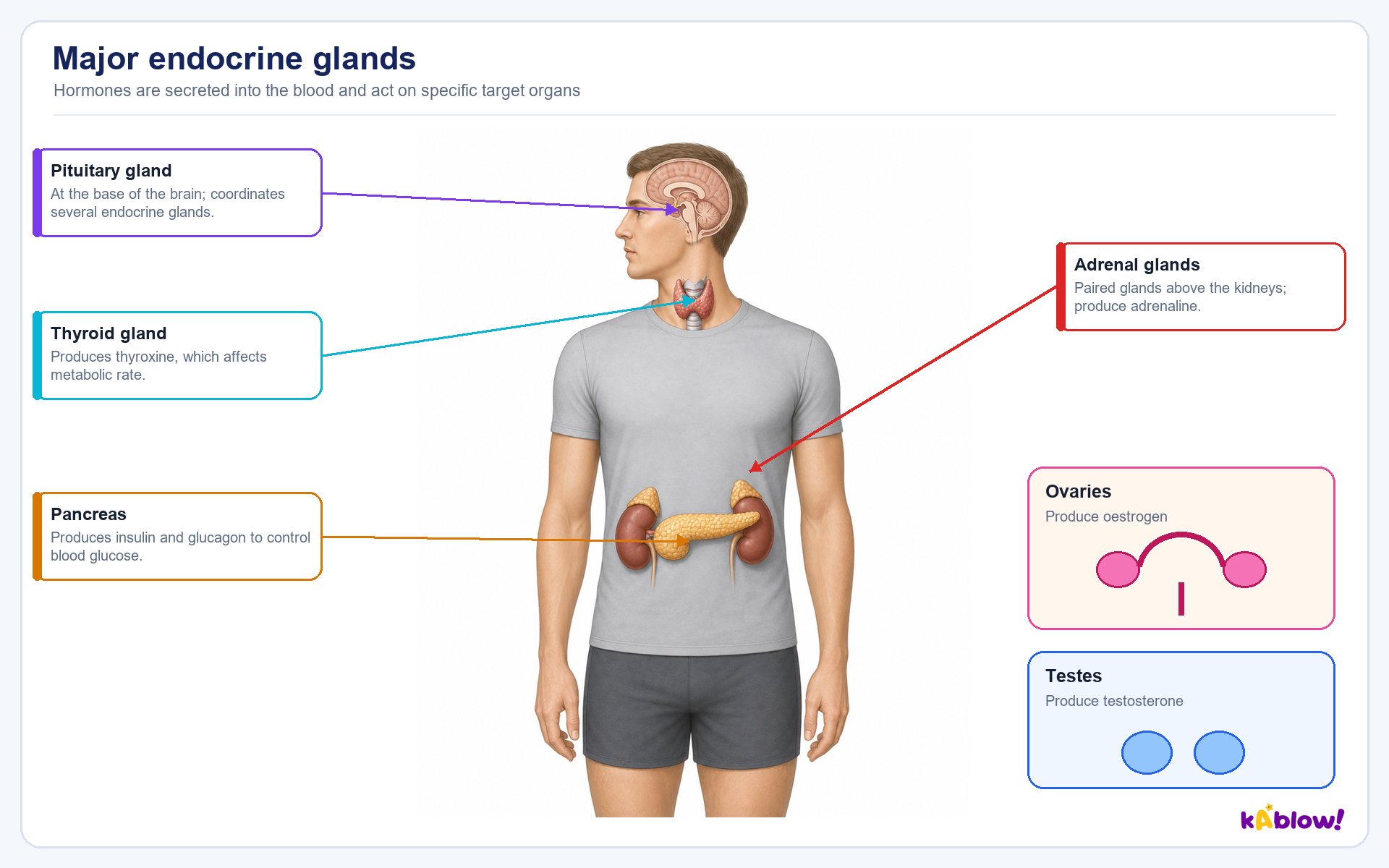
The major endocrine glands
Control Mechanisms: Heart Rate and Ventilation
- The medulla contains the cardioregulatory centre, with an acceleratory centre and an inhibitory centre connected to the SAN by autonomic nerves.
- Acceleratory centre sends impulses via sympathetic neurones; norepinephrine at the SAN increases heart rate.
- Inhibitory centre sends impulses via parasympathetic neurones; acetylcholine at the SAN decreases heart rate.
- Chemoreceptors detect changes in blood pH, oxygen and carbon dioxide levels; baroreceptors monitor blood pressure.
- These receptors are in the aorta and carotid arteries; higher frequency impulses activate the acceleratory centre, lower frequency activate the inhibitory centre.
- Ventilation rate is controlled by respiratory centres in the medulla.
- Carbon dioxide combines with water to form carbonic acid, which dissociates into H+ and HCO3−, lowering blood pH.
- Chemoreceptors in the medulla detect H+ and send more action potentials to diaphragm and intercostal muscles, increasing ventilation – an example of negative feedback.
Control of Peristalsis
- Peristalsis is a series of muscle contractions in the walls of the oesophagus or small intestine that push food along.
- It is controlled unconsciously by the enteric nervous system (ENS), a web of sensory, relay and motor neurones in the alimentary canal.
- The bolus is detected by stretch receptors as the canal distends.
- Relay neurones synapse with two motor neurones: one releases excitatory neurotransmitter causing longitudinal muscles to contract behind the bolus.
- Circular muscles contract to reduce lumen diameter, preventing food moving backwards.
- A second motor neurone releases inhibitory neurotransmitter, causing smooth muscle ahead of the bolus to relax and open the lumen.
Plant Tropisms and Auxin
- Tropisms are growth responses to external stimuli such as light, gravity, water and objects.
- Positive tropisms are towards a stimulus; negative tropisms are away from a stimulus.
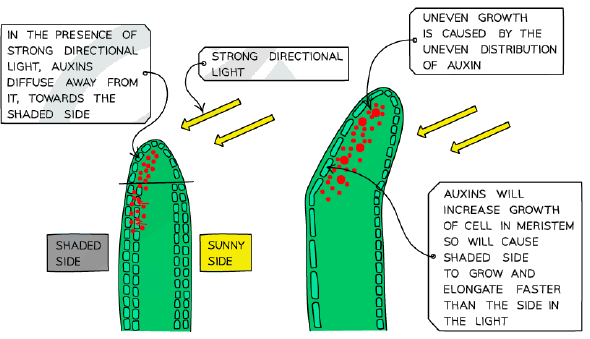
- Phototropism: stems grow towards light (positive phototropism) to maximise photosynthesis.
- Gravitropism (geotropism): stems grow away from gravity (negative gravitropism); roots grow towards gravity (positive gravitropism).
- Auxins are plant hormones that regulate tropisms.
- In shoots, auxin stimulates cell elongation; in roots, auxin inhibits cell elongation (slows growth).
- Efflux pumps coded by PIN3 genes carry auxins from cell to cell, maintaining an uneven distribution of auxin.
- Tropic responses can be studied qualitatively (diagrams) or quantitatively (angle of curvature).
Auxin and phototropism
Slide
Sign up free to view the lesson slides
Step through every slide for this topic — plus flashcards and revision notes — with a free account.
Soal latihan
Pratinjau gratis — 8 dari 62 soal. Daftar untuk melihat semuanya.
1.Which row of the table gives the most accurate summary of the actions of auxins?
Easy- AIn shoots: cells elongate; In roots: growth inhibited
- BIn shoots: cells grow in number; In roots: growth inhibited
- CIn shoots: cells elongate; In roots: growth promoted
- DIn shoots: cells grow in number; In roots: growth promoted
2.Which row of the table correctly describes examples of unconscious and conscious processes?
Medium- AConscious control: Detecting taste on the tongue; Unconscious control: Detecting information on balance
- BConscious control: Detecting temperature changes of the skin; Unconscious control: Sensing sound vibrations in the inner ear
- CConscious control: Detecting the water content of the blood; Unconscious control: Sensing pressure changes of the blood
- DConscious control: Sensing sound vibrations in the inner ear; Unconscious control: Detecting taste on the tongue
3.Which statement best describes the action of peristalsis in the alimentary canal?
Medium- AStriated muscles contract to move the partially digested food in a wave-like movement along the alimentary canal.
- BCircular muscles contract behind the partially digested food and the longitudinal muscles shorten.
- CSkeletal muscle contractions force the food through the alimentary canal with valves preventing backflow.
- DLongitudinal muscles contract behind the partially digested food and the circular muscles shorten.
4.Which statement accurately describes the raising of heart rate by the cardioregulatory centre of the brain?
Medium- ALow blood pressure, high blood oxygen concentration, and high blood pH result in a nerve signal sent by the acceleratory centre to speed up heart rate.
- BLow blood pressure, low blood oxygen concentration, and low blood pH result in a nerve signal sent by the acceleratory centre to speed up heart rate.
- CHigh blood pressure, high blood oxygen concentration, and high blood pH result in a nerve signal sent by the acceleratory centre to speed up heart rate.
- DHigh blood pressure, low blood oxygen concentration, and low blood pH result in a nerve signal sent by the acceleratory centre to speed up heart rate.
5.A person is admitted to hospital after suffering a stroke. It was found that the suprachiasmatic nucleus in the hypothalamus of the brain was damaged by the event. This resulted in the pineal gland secreting less melatonin into the bloodstream. Which of the following changes would be observed in the patient?
Medium- AIncreased thirst and more frequent urination.
- BDisrupted sleep patterns and increased irritability.
- CConstantly feeling cold and weight gain.
- DFatigue and forgetfulness.
6.What would not be considered a function of auxins?
Medium- AStimulates cell elongation in shoots, leading to an increase in plant height
- BStimulates the development of axillary buds further away from the shoot apical meristem
- CInhibits the development of axillary buds close to the shoot apical meristem
- DInhibits cell elongation in root cells, therefore slowing down root growth
7.Which of the following statements about melatonin are correct? I. Melatonin secretion increases in the evening in response to darkness and decreases at dawn in response to light. II. Increasing melatonin levels stimulate the body, preparing it for waking up and staying awake during the day. III. Melatonin is secreted by the hypothalamus. IV. The night-time drop in core body temperature triggers an increase in melatonin secretion. V. Melatonin levels vary during a 12-hour cycle known as a circadian rhythm.
Hard- AII, IV and V
- BI, III and IV
- CI only
- DII and V
8.Which of A - D gives the most accurate description of how efflux pumps contribute to plant tropisms?
Hard- AEfflux pumps pump low-density particles to the top of a horizontal root in order to initiate a positive gravitropism.
- BLight denatures PIN3 proteins which leads to fewer efflux pumps, and hence less cell elongation, on the sunny side of a plant shoot.
- CEfflux pumps are coded for by PIN3 genes and carry auxins from one cell to another in order to maintain an uneven distribution of auxins.
- DEfflux pumps carry auxins away from growing tissues on the removal of a stimulus, in order to maintain an even distribution of auxins.
Unlock all 62 questions & more
Buat akun gratis untuk melihat setiap soal, slide, kartu flash, dan catatan ulasan topik ini.