Neural Signalling
Belajar sambil bermain
Jawab soal-soal ini untuk dapat energi, lalu memancing dan menjelajah. Tanpa akun.
Catatan pelajaran
Neurones: Function & Structure
- The nervous system is divided into the central nervous system (CNS) (brain and spinal cord) and the peripheral nervous system (PNS) (all other nerves).
- Information travels as electrical impulses along nerve cells called neurones; a bundle of neurones is a nerve.
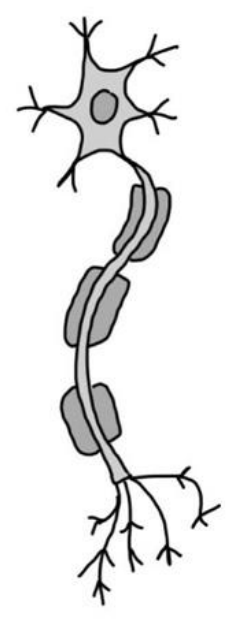
- Neurones have a long fibre called an axon, often insulated by Schwann cells that form the myelin sheath.
- The cell body contains the nucleus and other cellular structures; dendrites are extensions that receive impulses from other neurones.
- Sensory neurones carry impulses from receptors to the CNS; relay neurones connect sensory and motor neurones within the CNS; motor neurones carry impulses from the CNS to effectors (muscles or glands).
- Motor neurones have a large cell body within the spinal cord or brain, with many highly branched dendrites.
- Sensory neurones have a cell body that branches off in the middle, a single long dendron carrying impulses to the cell body, and a single long axon carrying impulses away.
Structure of a neurone
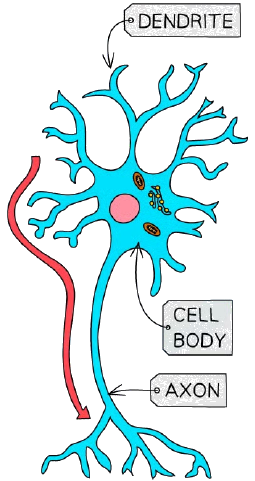
Resting Potential
- In a resting neurone, the inside of the axon is negatively charged relative to the outside; this is the resting potential, about -70 mV.
- The sodium-potassium pump uses ATP to actively transport 3 Na⁺ out for every 2 K⁺ in, creating concentration gradients.
- The membrane is much less permeable to Na⁺ than to K⁺, so K⁺ diffuses out faster than Na⁺ diffuses in, contributing to the negative inside.
- Negatively charged proteins inside the axon also contribute to the negative resting potential.
- The membrane is said to be polarised at resting potential.
Action Potentials
- A stimulus opens some sodium ion channels; if the membrane potential reaches the threshold potential (about -50 mV), voltage-gated sodium channels open.
- A large influx of Na⁺ causes depolarisation, reversing the potential from -70 mV to about +40 mV; this is an action potential.
- About 1 ms later, voltage-gated sodium channels close and voltage-gated potassium channels open, allowing K⁺ to diffuse out, causing repolarisation.
- The membrane potential briefly becomes more negative than resting potential, a period called hyperpolarisation (the refractory period), during which a new action potential cannot be generated.
- The all-or-nothing principle: an action potential is only generated if the threshold is reached; there is no small or large action potential.
- A stronger stimulus increases the frequency of action potentials, not their size.
- Propagation occurs via local currents: Na⁺ diffuses along the inside and outside of the axon, depolarising the next section to threshold.
Myelination and Saltatory Conduction
- Schwann cells wrap around the axon to form the myelin sheath, which contains phospholipids and has high electrical resistance.
- The myelin sheath acts as an electrical insulator, preventing impulses from passing through it.
- Gaps between Schwann cells are nodes of Ranvier, where ion channels and pumps are clustered.
- Action potentials jump from node to node, a process called saltatory conduction, which greatly speeds up transmission (up to 50 times faster).
- Myelinated neurones conduct impulses much faster than unmyelinated ones.
- A wider axon diameter also increases conduction velocity because it offers less resistance.
Synapses and Synaptic Transmission
- A synapse is the junction between two neurones, separated by a small gap called the synaptic cleft.
- When an impulse arrives at the presynaptic neurone, calcium ions enter and cause vesicles to fuse with the presynaptic membrane, releasing neurotransmitters into the cleft by exocytosis.
- Neurotransmitters diffuse across the cleft and bind to receptors on the postsynaptic membrane, opening sodium channels and generating an action potential if threshold is reached.
- Acetylcholine (ACh) is a common neurotransmitter; it is broken down by acetylcholinesterase into acetate and choline, which are recycled.
- Synapses ensure unidirectional transmission because neurotransmitter is released on one side and receptors are on the other.
- Inhibitory synapses open potassium channels, hyperpolarising the postsynaptic membrane and preventing an action potential.
- Summation (temporal or spatial) allows multiple impulses to add together to reach threshold.
Interpreting Oscilloscope Traces
- An oscilloscope displays membrane potential (mV) against time (ms).
- A resting potential appears as a horizontal line at about -70 mV.
- An action potential appears as a spike rising to between +30 and +40 mV.
- The rising phase of the spike shows depolarisation; the falling phase shows repolarisation.
- The trace often shows a short period of hyperpolarisation after repolarisation, when the potential is more negative than resting potential.
Nerve Conduction Velocity and Correlation
- Conduction velocity is correlated with myelination and axon diameter.
- Correlation is an association between variables; it does not necessarily imply causation.
- The correlation coefficient (r) indicates the strength of a linear relationship; perfect correlation is 1 or -1, no correlation is 0.
- Pearson's linear correlation tests for linear correlation between two quantitative variables with normal distribution.
- The coefficient of determination (R²) is the square of r; a value closer to 1 (100%) indicates a strong correlation.
Effects of Exogenous Chemicals
- Neonicotinoids are synthetic pesticides that bind irreversibly to acetylcholine receptors in insects, blocking synaptic transmission and causing paralysis and death.
- They are less toxic to mammals because a smaller proportion of synapses are cholinergic and neonicotinoids bind more strongly to insect receptors.
- Cocaine blocks reuptake of dopamine by binding to the dopamine transporter, leading to increased dopamine in the synapse and feelings of pleasure.
- Cocaine also blocks reuptake of serotonin and norepinephrine, enhancing confidence and energy.
- Regular cocaine use increases the number of dopamine receptors, leading to increased sensitivity and depression when drug levels fall.
Neurones in the Brain
- Pain receptors (nociceptors) are sensory receptors with free nerve endings containing TRP channels that open in response to high temperature, acid, or chemicals like capsaicin.
- Entry of positively charged ions triggers an action potential that travels to the CNS and then to the cerebral cortex, where pain is perceived.
- The cerebrum is the largest part of the brain (about 80% of mass) and is responsible for conscious activities such as vision, hearing, speech, thinking, and memory.
- The cerebral cortex (grey matter) consists of cell bodies of neurones and is highly folded, increasing surface area and allowing more neuronal connections.
- More connections between neurones enable more complex behaviours, known as emergent properties.
- Interactions between neurones in the cerebrum lead to consciousness, including qualitative perception and complex awareness of the environment.
Nerve cell (neuron)
Slide
Sign up free to view the lesson slides
Step through every slide for this topic — plus flashcards and revision notes — with a free account.
Soal latihan
Pratinjau gratis — 8 dari 60 soal. Daftar untuk melihat semuanya.
1.Between which structures do sensory neurones transmit electrical impulses?
Easy- AFrom effectors to the central nervous system (CNS).
- BFrom effectors to receptors.
- CFrom receptors to effectors.
- DFrom receptors to the central nervous system (CNS).
2.Where would myelin be found?
Easy- AWrapped around the axon of a neurone, forming an insulating sheath.
- BInside the synaptic cleft between two neurones.
- CIn the cell body, surrounding the nucleus.
- DAt the nodes of Ranvier, filling the gaps between Schwann cells.
3.Which event directly results in the production of an action potential?
Easy- ADiffusion of neurotransmitter across the synaptic cleft.
- BFusion of vesicles with the presynaptic membrane.
- CMembrane potential reaches the resting potential.
- DMembrane potential reaches the threshold potential.
4.Neurotransmitters leave the presynaptic neurone and enter the synaptic cleft. After this, they travel across the cleft to a receptor on the postsynaptic neurone membrane. Which processes are required for this to occur? (select all that apply)
Medium- AExocytosis of neurotransmitter from the presynaptic neurone
- BEndocytosis of neurotransmitter from the presynaptic neurone
- CDiffusion of neurotransmitter across the synaptic cleft
- DActive transport of neurotransmitter across the synaptic cleft
- EHydrolysis of neurotransmitter by acetylcholinesterase before it can bind
5.The following graph shows an action potential in a mouse neurone after stimulation with a pulse of current. What is the threshold potential needed to open voltage gated sodium channels in this neurone?
Medium- A-70 mV
- B-50 mV
- C-30 mV
- D+50 mV
6.The opening of axon membrane voltage gated potassium channels are responsible for which part of the action potential?
Medium- ARepolarisation of the membrane.
- BDepolarisation of the membrane.
- CHyperpolarisation of the membrane.
- DSignalling vesicular release of neurotransmitters.
7.It is thought that conditions such as schizophrenia are caused by an overabundance of the neurotransmitters serotonin and dopamine in some regions of the brain. Given this is the case, which drug mode of action could work in treating symptoms of schizophrenia?
Medium- AIncreased permeability of the presynaptic neurone to calcium.
- BIncreased reuptake of serotonin and dopamine by pre synaptic neurones.
- CRelease of acetylcholinesterase into the presynaptic cleft.
- DBlockage of serotonin and dopamine receptors in postsynaptic neurones.
8.Which of the following statements about myelinated nerve fibres are correct? (select all that apply)
Medium- ANodes of Ranvier facilitate saltatory conduction.
- BSchwann cells are responsible for forming the myelin sheath.
- CThe myelin sheath acts as an electrical conductor allowing electrical impulses to conduct at a more rapid rate.
- DThe myelin sheath prevents loss of nerve impulses along the axon.
- EMyelin increases the permeability of the axon membrane to sodium ions.
Unlock all 60 questions & more
Buat akun gratis untuk melihat setiap soal, slide, kartu flash, dan catatan ulasan topik ini.