Climate Change
Belajar sambil bermain
Jawab soal-soal ini untuk dapat energi, lalu memancing dan menjelajah. Tanpa akun.
Catatan pelajaran
The Greenhouse Effect and Anthropogenic Climate Change
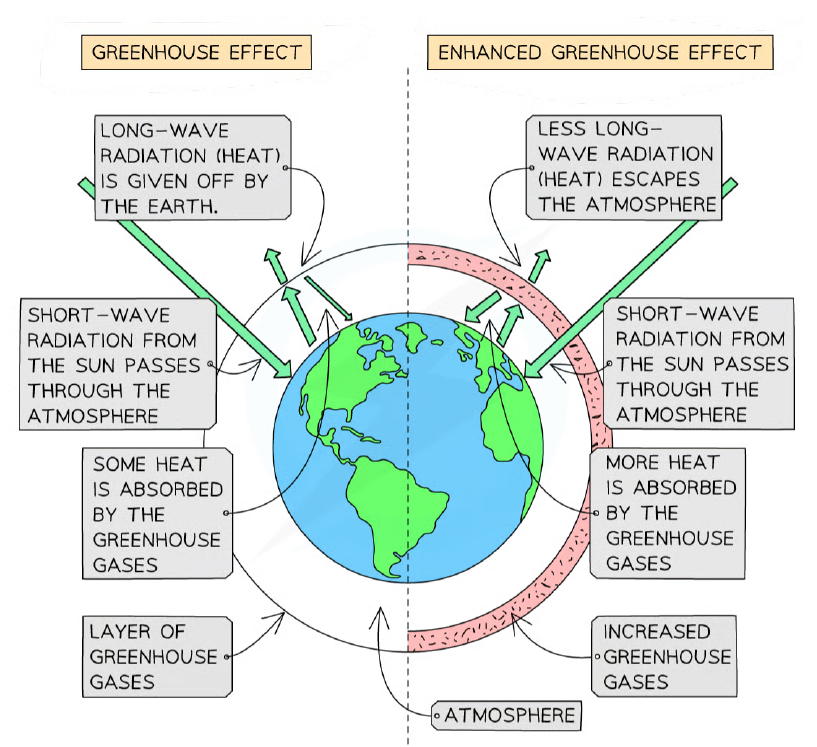
- Radiation from the sun hits the Earth and is re-radiated back from the surface.
- A greenhouse gas absorbs this re-radiated radiation, trapping it in the atmosphere so it is not lost to space.
- Greenhouse gases act like the glass of a greenhouse, hence the term greenhouse effect.
- The greenhouse effect is natural and keeps Earth warm enough for life; without it, Earth would have dramatic temperature fluctuations like Mars (20°C to −153°C).
- Key greenhouse gases include carbon dioxide and methane.
- Increasing levels of these gases from human activities lead to anthropogenic climate change.
- Global warming refers to the rise in global temperatures mainly due to increasing greenhouse gas concentrations.
- Climate change refers to long-term changes in climate measures such as precipitation, temperature, and wind patterns, often a consequence of global warming.
The greenhouse effect
Human Activities and Carbon Dioxide
- Atmospheric carbon dioxide has fluctuated naturally due to volcanic eruptions and weathering of limestone.
- Since the industrial revolution (late 1700s), atmospheric carbon dioxide has risen to its highest levels in Earth's history.
- Fossil fuel combustion for factories, transport, and homes releases carbon dioxide.
- A clear correlation exists between increasing carbon dioxide since the industrial revolution and increasing global temperatures.
- Correlation alone does not prove causation, but combined with knowledge of greenhouse gases it provides strong evidence.
- Carbon dioxide is also released when natural carbon stores (carbon sinks) are damaged; sinks include trees, soils, peat bogs, and oceans.
- Deforestation, soil degradation, peat harvesting, and ocean warming all add carbon dioxide to the atmosphere.
Human Activities and Methane
- Methane (CH₄) is a simple hydrocarbon and the main component of natural gas.
- Methane is produced by some bacteria naturally, but levels have risen significantly in the last 150 years due to human activities.
- Methane is released from the guts of ruminant mammals such as cattle; intensive farming has greatly increased this contribution.
- Landfill sites release methane when organic matter decomposes.
- Extraction of fossil fuels from underground releases methane.
- Anaerobic bacteria in waterlogged rice paddy fields release methane.
- Warming of the poles releases methane from natural stores such as permafrost (ground frozen all year round).
Correlation, Causation, and Positive Feedback
- Positive correlation: as one variable increases, the other also increases; negative correlation: as one increases, the other decreases.
- Antarctic ice cores show a positive correlation between global temperatures and atmospheric carbon dioxide over hundreds of thousands of years.
- Correlation does not prove causation; it is not possible to say which variable influenced the other, and an unknown third variable might be involved.
- Positive feedback is a mechanism that leads to additional change away from equilibrium, amplifying deviation and driving systems towards a tipping point.
- Global warming has a positive feedback effect: warming leads to more warming.
Positive Feedback Mechanisms
- Albedo is the extent to which a surface reflects light; snow and ice have high albedo, while rock and soil have low albedo.
- As polar ice melts, Earth's overall albedo decreases, so more solar energy is absorbed by exposed rock, soil, and dark ocean, increasing global warming.
- Decomposition by bacteria and fungi occurs faster at higher temperatures, releasing more carbon dioxide.
- Increased decomposition in peat bogs and permafrost releases huge volumes of carbon dioxide.
- Permafrost is a huge carbon sink because organic material cannot decompose at low temperatures; decay organisms are inactive when frozen.
- Melting permafrost leads to release of methane due to methanogenic microorganisms (archaea) in the soil.
- Global warming increases droughts, making wildfires more likely; combustion of plants releases carbon dioxide and reduces photosynthesis, so less carbon dioxide is removed.
Impact of Climate Change: Boreal Forests
- Boreal forests (taiga) cover much of North America, Europe, and Russia and are an important carbon sink due to their size.
- Global warming can cause boreal forests to switch from a carbon sink to a carbon source, known as a tipping point.
- Reduced snow leads to less snowmelt water, causing drought and reducing photosynthesis in coniferous trees.
- Lack of water causes loss of green pigment (forest browning), and eventually trees die.
- Dead trees dry out and the risk of forest fires increases.
- Legacy carbon combustion releases carbon locked up for many years in living trees, dead needles, and soil.
- This can tip forests from carbon sink to source, and the change can be irreversible.
Impact of Climate Change: Polar Habitats and Ocean Currents
- Many species rely on polar ice; sea ice forms when the ocean freezes, and landfast ice is attached to land.
- Global warming means less sea ice and earlier break-up, causing problems for breeding animals.
- Emperor penguins breed on Antarctic sea ice; early melting does not give them enough time to raise young.
- Walruses rely on Arctic sea ice; early loss means nursing mothers must care for young further from the water's edge.
- Ocean currents redistribute heat; warm currents like the Gulf Stream moderate coastal temperatures (e.g. Europe warmer than Canada at similar latitude).
- Upwelling brings cold, nutrient-rich water to the surface, supporting marine life and fisheries.
- El Niño events involve warming of the central Pacific, preventing nutrient upwelling off Central and South America, reducing primary production and causing extreme weather.
Impact of Climate Change: Range Shifts and Coral Reefs
- Species have tolerance limits; if conditions change beyond these, they must migrate or face extinction.
- Migration may be a poleward shift (towards poles) or an upslope shift (to higher altitude).
- Montane bird species in Papua New Guinea have moved upslope by an average of more than 100 m over 50 years.
- North American tree species show range contraction and northward spread.
- Coral reefs are built by reef-building corals (polyps) that live symbiotically with algae; algae provide carbon compounds and coral provides shelter.
- Around 25% of ocean fish species depend on coral reefs.
- Corals are sensitive to temperature and pH; warming causes polyps to expel algae, leading to coral bleaching and death.
- Ocean acidification weakens calcium carbonate exoskeletons and reduces carbonate ion availability for building hard parts.
Ocean Acidification
- The oceans dissolve huge amounts of carbon dioxide, forming carbonic acid (H₂CO₃): CO₂ + H₂O → H₂CO₃.
- Carbonic acid dissociates to hydrogen ions (H⁺) and hydrogen carbonate ions (HCO₃⁻): H₂CO₃ → H⁺ + HCO₃⁻.
- Hydrogen carbonate ions can dissociate further to more H⁺ and carbonate ions (CO₃²⁻): HCO₃⁻ → H⁺ + CO₃²⁻.
- Normally this keeps oceans slightly alkaline and supplies carbonate ions for organisms.
- As atmospheric carbon dioxide increases, more dissolves, more H⁺ is produced, and the ocean becomes more acidic (ocean acidification).
- Oceans remain alkaline but pH has decreased, moving closer to neutral.
- The reaction H⁺ + CO₃²⁻ → HCO₃⁻ reverses to buffer H⁺, reducing carbonate ions available for calcium carbonate exoskeletons.
- Note: ocean acidification shares the same cause as global warming (increased atmospheric carbon dioxide) but is not a direct result of global warming.
Carbon Sequestration
- Carbon sequestration is the process of capturing and storing carbon dioxide from the atmosphere.
- It can be increased by removing carbon into natural carbon sinks; artificial storage is still at the research stage.
- Forest regeneration (reforestation) involves planting new trees in deforested areas; afforestation is creating new forests.
- Mature trees store huge amounts of carbon in their biomass; e.g. Costa Rica plants seven times more trees than it cuts down.
- Peat bog restoration: peat bogs form when plant matter cannot fully decompose due to waterlogged, acidic conditions, storing carbon.
- Draining peat bogs for fuel, development, or agriculture increases decay organism activity and releases carbon dioxide.
- Filling in drainage ditches and regulating peat harvesting allows peat bogs to recover and sequester carbon.
- Scientists debate whether planting fast-growing non-native trees or rewilding with native species is best; non-native trees sequester carbon faster, but rewilding may benefit biodiversity more.
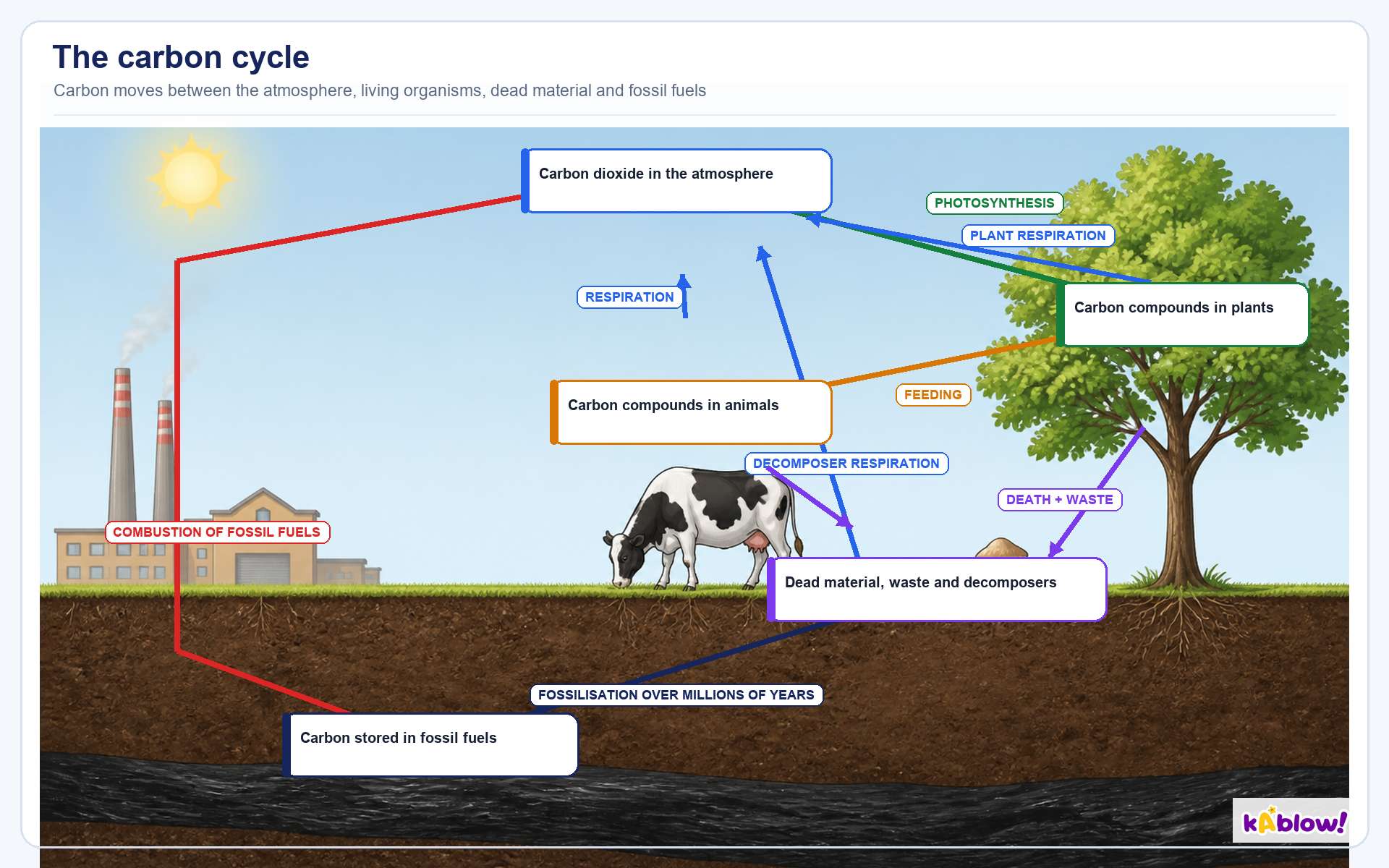
The carbon cycle
Slide
Sign up free to view the lesson slides
Step through every slide for this topic — plus flashcards and revision notes — with a free account.
Soal latihan
Pratinjau gratis — 8 dari 59 soal. Daftar untuk melihat semuanya.
1.Which process results in the production of methane gas?
Easy- ACombustion of fossil fuels
- BLivestock farming
- CDeforestation
- DOcean acidification
2.How does climate change affect boreal forests? I. A change from net carbon loss to net carbon accumulation. II. An increase in drought. III. A decrease in legacy carbon combustion.
Easy- AI and II only
- BII only
- CI, II and III
- DII and III only
3.A climate change sceptic made the following statement: 'There is no consensus amongst scientists that climate change is real, global warming is a natural and normal phenomenon which has occurred at other points in history'. Which of the following opposes the idea that global warming is a natural phenomenon?
Medium- AThe idea that many factors contribute towards global climate
- BData produced by companies involved in global fossil fuel supply shows decreasing greenhouse gas production
- CScientific research which links the combustion of fossil fuels with global warming
- DPublished data which shows that rates of global warming have not been consistent over the last 50 years
4.How does peat drainage lead to an increased warming effect?
Medium- ADrainage allows saprotroph activity to increase, releasing carbon dioxide when the organic matter stored in the peat is broken down.
- BWater seals the stored carbon dioxide underground, so the loss of water allows the gas to escape.
- CThe removal of water from the peatland allows herbivores to move in and consume the vegetation growing on the peat bog, eventually leading to the release of carbon stored in the vegetation into the atmosphere.
- DDrained land can be used for crop growth, removing carbon from the soil.
5.Different greenhouse gases have different global warming potential, or GWP. Gas | GWP over 100 years Carbon dioxide | 1 Methane | 21 Nitrous oxide | 310 Sulfur hexafluoride | 23,900 Which factors contribute to the global warming potential of greenhouse gases?
Medium- AAtmospheric concentration only.
- BAtmospheric concentration and ability to absorb radiation.
- CAtmospheric concentration, ability to absorb radiation, and atmospheric lifetime.
- DAbility to absorb radiation only.
6.Which of the following are impacts of global warming? I. Increased UV radiation reaching earth due to depletion of ozone gas in the atmosphere II. Ocean acidification III. An increase in the number of extreme weather events
Medium- AI and II only
- BII and III only
- CIII only
- DI, II, and III
7.The pH content of a water body in Australia was measured over a 10 year period. Scientists are concerned about the general downward trend of the data, which shows less alkali conditions than is characteristic. Which of the statements suggests why the scientists may have cause for concern? I. Decreased rates of photosynthesis may occur at low pH II. Decreasing pH increases calcium carbonate solubility III. Some species of algae thrive in extreme pH levels
Hard- AI and II only
- BII and III only
- CNone of the above
- DII only
8.The greenhouse effect is a naturally occurring process that is essential for keeping Earth warm enough for life.
EasyTrue or false?
Unlock all 59 questions & more
Buat akun gratis untuk melihat setiap soal, slide, kartu flash, dan catatan ulasan topik ini.