Mutations & Gene Editing
Belajar sambil bermain
Jawab soal-soal ini untuk dapat energi, lalu memancing dan menjelajah. Tanpa akun.
Catatan pelajaran
Gene Mutations: Definition and Causes
- A gene mutation is a change in the sequence of base pairs in a DNA molecule; this may result in a new allele.
- Mutations occur all the time and at random; they are more likely during DNA replication (S phase of interphase) due to copying errors.
- Mutagenic agents are environmental factors that increase the mutation rate of cells.
- Radiation can cause chemical changes in DNA, including high-energy radiation such as UV light and ionising radiation such as X-rays, gamma rays and α particles.
- Chemical substances can also cause changes to DNA, e.g. benzo[a]pyrene and nitrosamines found in tobacco smoke, and mustard gas.
- Mutagens can also come from inside the cell, such as particular enzymes that break down DNA or produce mutagenic substrates.
- Some mutations occur at random during DNA replication and repair when errors are not detected by the proofreading process carried out by DNA polymerase.
- If DNA polymerase detects a wrong nucleotide, it removes and replaces it before continuing DNA synthesis.
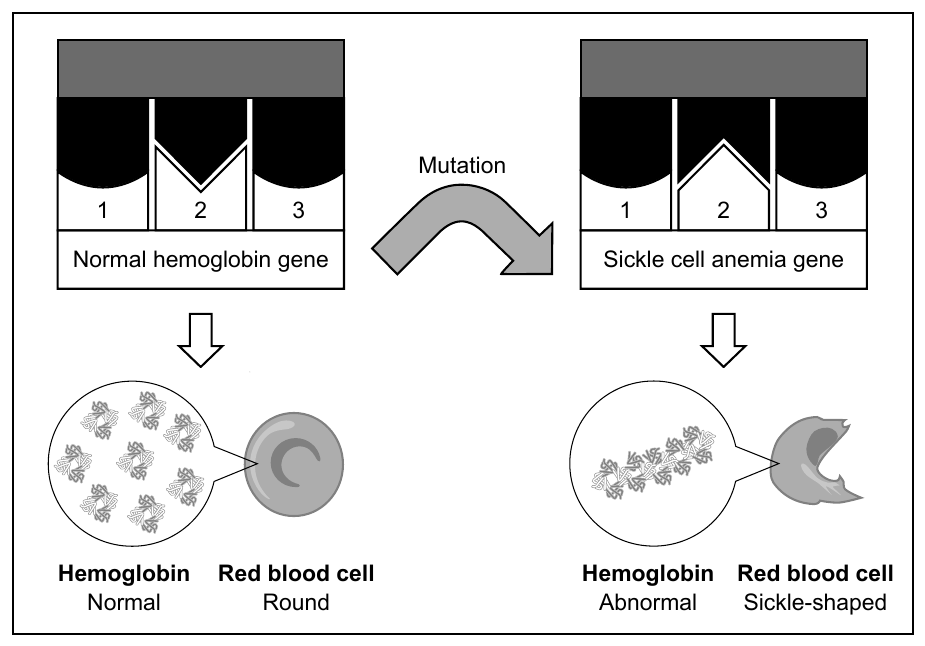
The sickle cell mutation
Types of Gene Mutation
- A substitution mutation occurs when a nucleotide base in the DNA sequence is randomly swapped for a different base.
- A substitution mutation only changes the amino acid for the triplet where the mutation occurs; it does not have a knock-on effect further along the gene.
- An insertion mutation occurs when a nucleotide (with a new base) is randomly inserted into the DNA sequence.
- A deletion mutation occurs when a nucleotide (and therefore its base) is randomly deleted from the DNA sequence.
- Insertions and deletions are frameshift mutations: they change the triplets further on in the DNA sequence, so the entire sequence after the mutation is read incorrectly.
- Frameshift mutations may dramatically change the amino acid sequence produced and therefore the ability of the polypeptide to function.
Consequences of Base Substitutions
- A base substitution can only change the amino acid for the triplet in which the mutation occurs; it will not have a knock-on effect on the rest of the sequence.
- A base substitution can result in single nucleotide polymorphisms (SNPs), which represent a difference in a single DNA nucleotide.
- SNPs occur normally throughout a person's DNA, roughly once in every 300 nucleotides, meaning there are about 10 million SNPs in the human genome.
- SNPs are commonly found in non-coding regions of DNA between genes and can act as biological markers to help locate genes associated with disease.
- Substitution mutations can take three forms: silent mutations (no change to the amino acid sequence due to the degenerate genetic code), missense mutations (alter a single amino acid), and nonsense mutations (create a premature stop codon).
- Sickle cell anaemia is an example of a disease caused by a missense substitution mutation changing a single amino acid in the sequence.
- Cystic fibrosis is an example of a disease caused by a nonsense mutation, although this is not always the only cause.
Consequences of Insertions and Deletions
- Insertions and deletions are two types of point mutations, which involve a change in the DNA base sequence at a single location.
- An insertion occurs when an extra nucleotide is incorporated into the DNA sequence during replication.
- A deletion mutation occurs when a nucleotide is missed or absent from the replicated strand.
- These mutations are often considered more harmful than substitutions because they impact on the way the rest of the sequence is read by mRNA or the ribosome.
- Insertions and deletions can cause a frameshift mutation, leading to a complete change to the entire amino acid sequence of a protein after the mutation site.
- The mRNA is read in codons (groups of 3 nucleotides), so if an additional 1 or 2 nucleotides are added or removed, the sequence is 'shifted' and the entire mRNA and resulting protein are completely different.
- A frameshift mutation can result in the addition of the wrong amino acids and/or the creation of a codon that stops the protein from growing longer.
- Although a frameshift mutation during translation is rare (10-5 to 10-7 per codon), the effects are generally catastrophic for the resulting protein.
Mutations in Germ and Somatic Cells
- The effect of a mutation can vary depending on whether it occurs in a germ cell or a somatic cell.
- Germ cells use meiosis to produce gametes; somatic cells use mitosis to produce cells all over the body.
- If a mutation occurs in a germ cell, it can be passed on to the offspring and next generation.
- Cells involved in inheritance of genetic information — eggs, sperm and zygote — are known as the germ line.
- A mutation that occurs in sperm cells could potentially affect the zygote of that offspring, and all cells developed from that zygote will contain the mutation.
- Somatic cell mutations are not inherited by offspring; instead, these mutations are associated with cancers.
- Cancers arise due to uncontrolled mitosis; cancerous cells divide repeatedly and uncontrollably, forming a tumour (an irregular mass of cells).
- Cancers start when a mutation occurs in the genes that control cell division; if the mutated gene causes cancer it is referred to as an oncogene.
Randomness and Hotspots of Mutations
- Mutations can occur anywhere in the base sequence of a genome on all chromosomes in all organisms.
- This is how new strains of viruses or bacteria can come into existence.
- Some locations of the genome are more likely to mutate than others.
- Uncoiled DNA has a higher probability of encountering mutations than DNA tightly coiled around a histone because it is more exposed.
- Many mutations occur in non-coding regions of DNA such as satellite DNA.
- Mutation hotspots are regions where mutations are more frequent; one hotspot is where cytosine (C) is followed by guanine (G), called a CpG site.
- When methylation occurs at a CpG site, C can mutate into thymine (T) in a substitution mutation; repeated occurrences form a CpG island, associated with cancers such as colorectal cancer.
Mutations and Genetic Variation
- Differences between organisms of the same species are known as variation (e.g. coat colour in mammals, body length in fish, flower colour in flowering plants).
- Variation results from small differences in DNA base sequences between individual organisms within a population.
- Sources of these differences include mutation, meiosis, and random fertilisation during sexual reproduction.
- The original source of genetic variation is mutation, which results in the generation of new alleles that can influence evolution of a species.
- Mutations in the dividing cells of the sex organs lead to changes in the alleles of the gametes that are passed on to the next generation.
- A new allele may be advantageous, disadvantageous or have no apparent effect.
- An advantageous allele is more likely to be passed on because it increases the chance that an organism will survive and reproduce; a disadvantageous mutation is more likely to die out.
- Mutations in a species are, in the long term, essential for evolution by natural selection; mutation is the only source of variation in asexually reproducing species.
Intentional Changes to Base Sequences
- No known mechanisms exist where cells are able to intentionally mutate or change their DNA base sequence.
- Proofreading processes exist to change a mutation back into its original sequence, but no mechanism exists for making a deliberate change to a base or sequence of bases with the purpose of changing a trait of the organism.
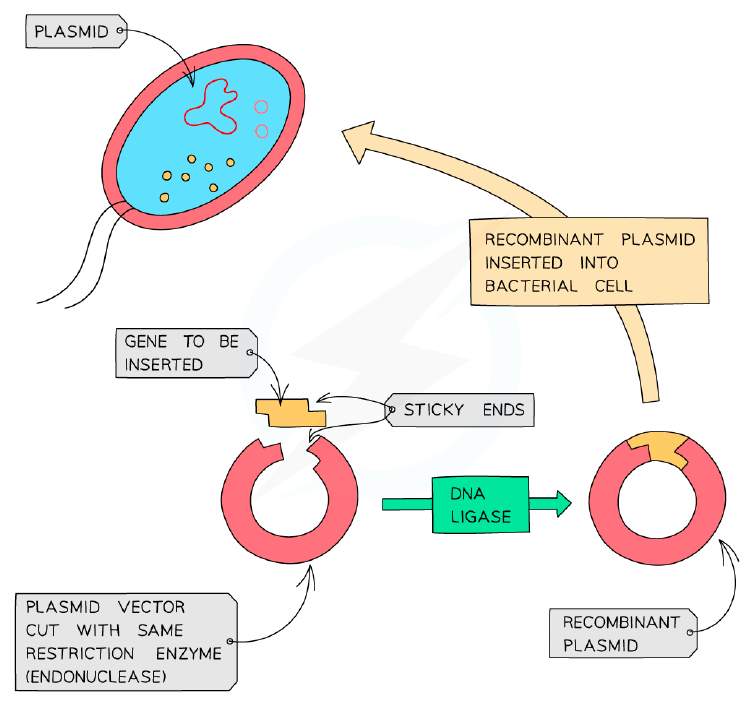
Inserting a gene into a plasmid
Commercial Genetic Testing
- There are two types of genetic testing available: clinical or medical genetic testing and commercial genetic testing.
- Clinical genetic testing is carried out through healthcare providers such as doctors, nurse practitioners, or genetic counselors, who determine which test is needed, order the test, collect the DNA sample, and share results with the patient.
- Commercial genetic testing provides genetic tests marketed directly to customers; test kits can be bought online or in stores, and customers send a DNA sample and receive results directly from the company.
- Commercial genetic testing provides people access to their genetic information without necessarily involving a healthcare provider, which can pose problems.
- Commercially available genetic tests are not scientifically validated and can give inaccurate results.
- Unexpected information about health, family relationships, or ancestry may be stressful or upsetting.
- People may make important decisions about disease treatment based on inaccurate or misunderstood information, and individuals often are not provided with genetic counseling.
Slide
Sign up free to view the lesson slides
Step through every slide for this topic — plus flashcards and revision notes — with a free account.
Soal latihan
Pratinjau gratis — 8 dari 61 soal. Daftar untuk melihat semuanya.
1.Which of the following are mutagenic agents?
Easy- AX-rays, benzo(a)pyrene, gamma rays
- BX-rays, benzo(a)pyrene, radio waves
- CX-rays, microwaves, radio waves
- DX-rays, benzo(a)pyrene, microwaves
2.Which of the following statements correctly describes the impact of the substitution mutation shown below? Original sequence: AUGGAAAUACCGCCAGGA Mutated sequence: AUGGAAAUACUGCCAGGA
Medium- AThe codon encoding an amino acid was changed to a stop codon, truncating the polypeptide
- BThe sequence of amino acids may code for a different protein structure
- CThe resulting polypeptide chain will be elongated
- DThere will be no change in the polypeptide chain
3.The risk of developing a cancerous tumour is increased by exposure to which of the following? (select all that apply)
Medium- AUltraviolet light
- BBenzo[a]pyrene
- CCarbon monoxide
- DX-rays
4.Sickle cell anaemia is caused by a mutation in the gene that codes for haemoglobin. Which of the following correctly explains how this mutation causes sickle cell anaemia?
Medium- AIt causes valine to be replaced by glutamic acid, altering the structure of the haemoglobin protein.
- BIt produces an allele known as HbA.
- CIt causes glutamic acid to be replaced by valine, altering the structure of the final haemoglobin protein.
- DIt causes an amino acid substitution at the 8th position in the polypeptide.
5.Which type of mutation involves a nucleotide base being randomly swapped for a different base?
Easy- ASubstitution mutation
- BInsertion mutation
- CDeletion mutation
- DFrameshift mutation
6.Insertion and deletion mutations are often more harmful than substitution mutations because they cause a frameshift.
EasyTrue or false?
7.Match the type of mutation with its correct description.
Medium- Silent mutation
- Missense mutation
- Nonsense mutation
- Creates a premature stop codon
- Does not alter the amino acid sequence
- Alters a single amino acid in the polypeptide chain
8.Place the following steps in the correct order to show how a frameshift mutation affects a polypeptide.
Medium- A nucleotide is inserted into the DNA sequence
- The reading frame of the mRNA is shifted
- All subsequent codons are read incorrectly
- The amino acid sequence of the polypeptide is drastically altered
Unlock all 61 questions & more
Buat akun gratis untuk melihat setiap soal, slide, kartu flash, dan catatan ulasan topik ini.