Electronic Configurations
Belajar sambil bermain
Jawab soal-soal ini untuk dapat energi, lalu memancing dan menjelajah. Tanpa akun.
Catatan pelajaran
The Electromagnetic Spectrum
- The electromagnetic spectrum covers all electromagnetic radiation, divided into bands or regions by frequency, wavelength and energy.
- Gamma rays, X-rays and UV are high frequency, high energy and can damage cells, making them hazardous to health.
- All electromagnetic waves travel at the same speed in a vacuum: the speed of light, c = 3.00 × 10⁸ m s⁻¹.
- Frequency and wavelength are inversely related: higher frequency means shorter wavelength, lower frequency means longer wavelength.
- The key relationship is c = fλ, so frequency can be calculated from wavelength, or vice versa.
- A continuous spectrum contains all colours of visible light, blending smoothly with no gaps, produced when white light is refracted through a prism or water droplets.
- A line spectrum only shows certain fixed frequencies, telling us that emitted light from atoms is quantised (quanta means 'little packet').
- Electrons can only possess certain amounts of energy — they cannot have any energy value.
Emission Spectra
- Electrons move in energy levels around the nucleus; when they absorb energy they move to higher levels, and they release energy when returning to lower levels.
- The frequency of the emitted energy matches the frequency of the energy absorbed.
- If emitted energy is in the visible region, passing it through a diffraction grating produces a line emission spectrum.
- Each line is a specific energy value, suggesting electrons can only possess a limited choice of allowed energies.
- In the hydrogen spectrum, lines get closer together towards the blue end — this is called convergence, converging towards the higher energy end.
- The maximum energy corresponds to the ionisation energy of the electron.
- The visible lines were first observed by Johannes Balmer and correspond to electron jumps from higher levels down to n = 2.
- The line emission spectrum of hydrogen provided evidence of energy levels; Niels Bohr applied Quantum Theory in 1913, proposing electrons exist only in fixed energy levels.
Electron Jumps in the Hydrogen Spectrum
- Transitions from n = ∞ to n = 3 are in the infrared region and have low energy.
- Transitions from n = ∞ to n = 2 are in the visible region and have medium energy.
- Transitions from n = ∞ to n = 1 are in the ultraviolet region and have high energy.
- Emission in the visible region occurs for an electron jumping from any higher energy level to n = 2.
- The full hydrogen spectrum shows sets or families of lines corresponding to electrons jumping from higher levels to lower levels.
Energy Levels, Sublevels & Orbitals
- Electrons are arranged around the nucleus in principal energy levels or principal quantum shells, numbered by principal quantum numbers (n).
- The lower the principal quantum number, the closer the shell is to the nucleus; the higher the n, the greater the energy of the electron in that shell.
- Each principal quantum number holds a fixed maximum number of electrons: n = 1 up to 2, n = 2 up to 8, n = 3 up to 18, n = 4 up to 32.
- The mathematical relationship is 2n²; for example, in the third shell n = 3 and the number of electrons is 2 × (3²) = 18.
- Principal quantum shells are split into subshells given the letters s, p and d; elements with more than 57 electrons also have an f subshell.
- The energy of electrons in subshells increases in the order s < p < d < f.
- The order of subshells overlaps for higher principal quantum shells.
Orbitals and Their Shapes
- Subshells contain one or more atomic orbitals; orbitals exist at specific energy levels and electrons can only be found at these levels, not in between.
- Each atomic orbital can be occupied by a maximum of two electrons.
- The s orbitals are spherical in shape, and their size increases with increasing shell number (e.g. the 3s orbital is bigger than the 1s orbital).
- The p orbitals are dumbbell-shaped; every shell has three p orbitals except the first one (n = 1).
- The p orbitals occupy the x, y and z axes and point at right angles to each other, so are oriented perpendicular to one another.
- The lobes of the p orbitals become larger and longer with increasing shell number.
- The shape of the d orbitals is not required for IB Chemistry.
Subshells and Orbitals: Numbers and Energies
- Each subshell holds a specific number of orbitals: s has 1, p has 3 (labelled px, py and pz), d has 5, and f has 7.
- Each orbital holds a maximum of 2 electrons, so the maximum electrons per subshell are: s = 2, p = 6, d = 10, f = 14.
- In the ground state, orbitals in the same subshell have the same energy and are said to be degenerate (e.g. the px and py orbitals have the same energy).
- The ground state is the most stable electronic configuration of an atom, with the lowest amount of energy.
- This is achieved by filling the subshells of lowest energy first (1s) — this is called the Aufbau Principle.
- The subshells increase in energy as s < p < d < f, but the 3d orbital has slightly higher energy than the 4s orbital, so 4s is filled before 3d.
- The order of subshells in terms of increasing energy does not follow a regular pattern at n = 3 and higher.
Writing Electron Configurations
- The electron configuration gives information about the number of electrons in each shell, subshell and orbital of an atom; subshells are filled in order of increasing energy.
- Electrons can be imagined as small spinning charges rotating clockwise or anticlockwise around their own axis.
- Electrons with the same spin repel each other — this is spin–pair repulsion.
- Hund's rule: electrons fill degenerate orbitals singly first, with parallel spins, to minimise repulsion; they pair only after all orbitals are singly occupied, with opposite spins.
- In a p subshell, electrons fill px, py and pz orbitals singly before pairing.
- Pauli Exclusion principle: an orbital holds two electrons with opposite spins only; electrons pair only when no empty orbital of the same energy is available.
- Pairing costs less energy than jumping to a higher orbital.
- There are two formats: full configuration lists all electrons from 1s onward; shorthand configuration uses the symbol of the nearest noble gas in brackets (e.g. [Ar]) to represent inner electrons.
Electron shells and the Periodic Table
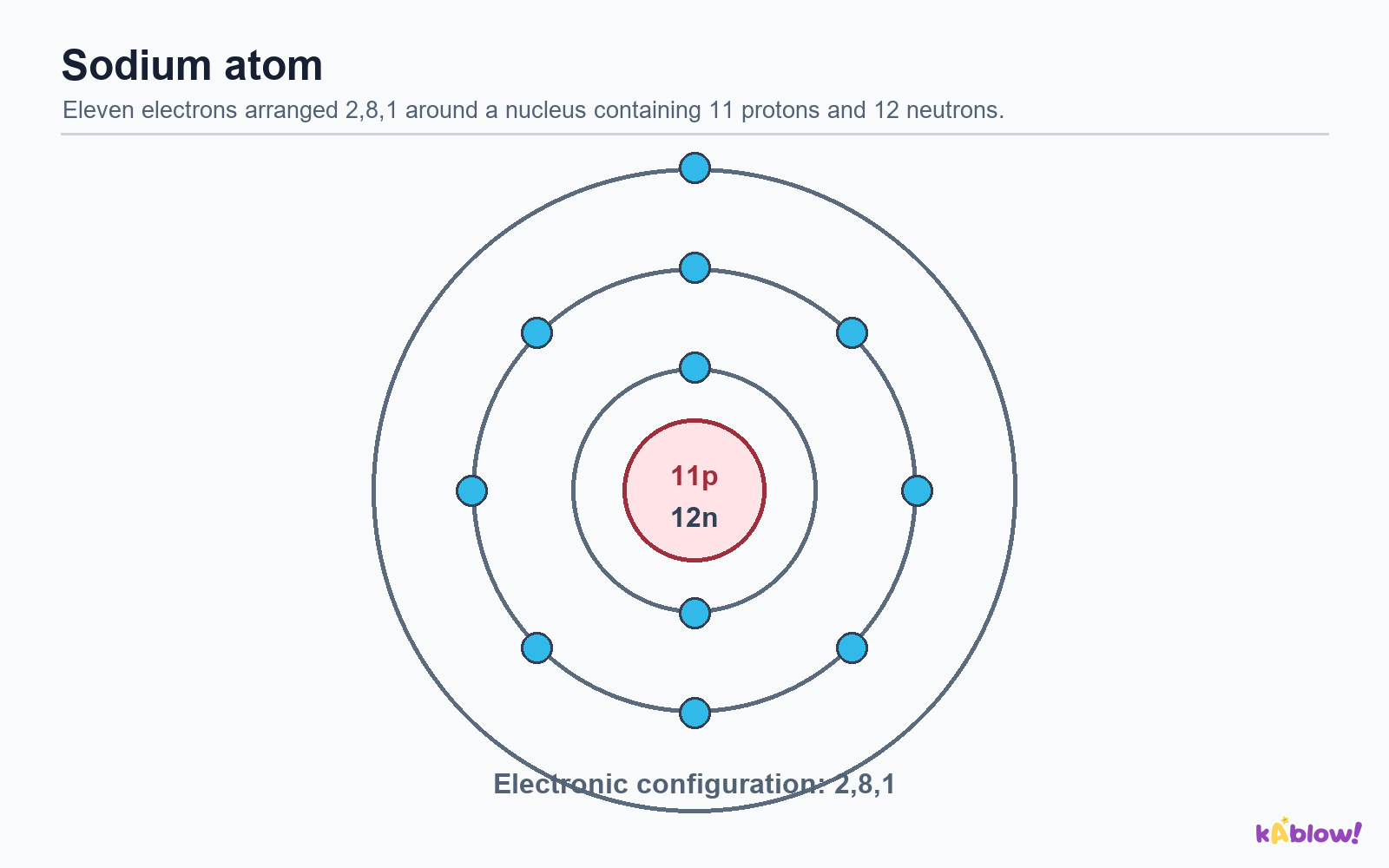
Electron Configurations of Ions and the Periodic Table Blocks
- Anions (negative) form by adding electrons to the outer shell; cations (positive) form by removing electrons from the outer shell.
- Transition metals fill the 4s before 3d when neutral, but lose electrons from 4s first, not 3d, when forming ions.
- In the Periodic Table, elements are grouped into blocks based on their valence subshell: s-block (valence electrons in an s orbital), p-block (p orbital), d-block (d orbital), f-block (f orbital).
- Example — Fe (atomic number 26): full configuration 1s² 2s² 2p⁶ 3s² 3p⁶ 4s² 3d⁶; shorthand [Ar] 4s² 3d⁶.
- Example — Fe²⁺ has 24 electrons; electrons are removed from the 4s orbital before the 3d: full configuration 1s² 2s² 2p⁶ 3s² 3p⁶ 3d⁶; shorthand [Ar] 3d⁶.
- Exceptions to the Aufbau principle: Cr is [Ar] 3d⁵ 4s¹ (not [Ar] 3d⁴ 4s²) and Cu is [Ar] 3d¹⁰ 4s¹ (not [Ar] 3d⁹ 4s²), because promoting an electron from 4s to 3d achieves a half full or full d-subshell, which is energetically favourable.
Ionisation Energy from an Emission Spectrum (HL)
- Energy (e.g. heat or electricity) can excite electrons to higher levels (n = 2 to ∞); when electrons return to lower levels, they emit energy as electromagnetic radiation.
- A fall to n = 1 releases ultraviolet radiation — this is the Lyman series.
- The amount of energy released corresponds to the difference between the energy levels.
- The line spectrum supports Bohr's model, which proposes electrons occupy discrete energy levels; electrons require a specific amount of energy to move between levels, like steps on a ladder.
- Limitations of Bohr's model: assumes electrons have fixed positions, assumes all energy levels are spherical, and only accurately explains the hydrogen spectrum — it fails for atoms with more than one electron.
- As spectral lines are produced, they become closer together at higher energy levels; the point where lines appear to merge is the limit of convergence.
- The limit of convergence corresponds to the energy required to remove an electron from the atom — the first ionisation energy.
- In the Lyman series, the convergence limit represents an electron falling from n = ∞ to n = 1; for hydrogen this corresponds to a wavelength of 91.16 nm (91.16 × 10⁻⁹ m).
Calculating First Ionisation Energy from the Convergence Limit
- The first ionisation energy (IE₁) of an atom can be calculated using the frequency (or wavelength) of the convergence limit.
- Use the equations ΔE = hf and c = fλ; rearrange c = fλ to f = c ÷ λ if frequency is not given.
- Constants: h = Planck's constant (6.63 × 10⁻³⁴ J s), c = speed of light (3.00 × 10⁸ m s⁻¹), f = frequency (s⁻¹), λ = wavelength (m).
- Step 1: calculate the frequency of the convergence limit, converting wavelength into m (nm to m = × 10⁻⁹).
- Step 2: substitute into ΔE = hf to give the energy change per atom in J atom⁻¹.
- Step 3: calculate the energy per mole by multiplying by Avogadro's constant (NA = 6.02 × 10²³).
- Step 4: convert J mol⁻¹ to kJ mol⁻¹ by dividing by 1000.
- Example — sodium: frequency 1.24 × 10¹⁵ s⁻¹ gives IE₁ = 8.22 × 10⁻¹⁹ J atom⁻¹, then × 6.02 × 10²³ = 494 916 J mol⁻¹ = 495 kJ mol⁻¹.
Successive Ionisation Energies (HL)
- Successive ionisation energies of an element increase, because once the outer electron is removed the atom becomes a positive ion, making further electron removal more difficult.
- As more electrons are removed: shielding decreases, the proton-to-electron ratio increases, and attraction between the nucleus and remaining electrons increases.
- The increase is not constant — it depends on the electronic configuration.
- Large jumps in ionisation energy show a change in shell, while smaller jumps show changes within a subshell.
- Successive ionisation energy data can predict or confirm the electronic configuration, identify the number of outer electrons, and determine the group number in the Periodic Table.
- Example — calcium: IE₁ = 590, IE₂ = 1150, IE₃ = 4940, IE₄ = 6480 kJ mol⁻¹; the first electron is easy to remove due to spin-pair repulsion in the 4s orbital, the second is harder (no spin-pair repulsion), and the third is much harder as it comes from the 3p subshell, which is closer to the nucleus.
- Example — sodium: a large increase between the first and second ionisation energies shows the first electron removed is from the valence shell, so Na is in Group 1; the jump corresponds to removing an electron from the 3s to the full 2p subshell.
- Example — aluminium: a large increase between the third and fourth ionisation energies shows the first three electrons (3p and 3s) are easier to remove, so Al belongs to Group 13 (Group III).
Ionisation Energy Trends and Periodicity
- Ionisation energy shows periodicity — a repeating trend across a period in the Periodic Table.
- Group 1 metals have low first ionisation energies; noble gases have very high values due to stable configurations.
- Four key factors affect first ionisation energy: nuclear charge (more protons = stronger attraction), distance of outer electrons from the nucleus, shielding by inner electrons, and spin–pair repulsion between paired electrons.
- Across a period, first ionisation energy increases because nuclear charge increases (pulling electrons closer), atomic radius decreases, and shielding stays roughly constant since electrons are added to the same shell.
- Down a group, first ionisation energy decreases due to greater atomic radius and more shielding.
- There is a slight decrease in IE between beryllium and boron because boron's fifth electron is in the 2p subshell, which is further from the nucleus than beryllium's 2s subshell (Be: 1s² 2s², IE₁ = 900 kJ mol⁻¹; B: 1s² 2s² 2p¹, IE₁ = 800 kJ mol⁻¹).
- There is a slight decrease in IE between nitrogen and oxygen due to spin-pair repulsion in the 2p orbital of oxygen (N: 1s² 2s² 2px¹ 2py¹ 2pz¹, IE₁ = 1400 kJ mol⁻¹; O: 1s² 2s² 2px² 2py¹ 2pz¹, IE₁ = 1310 kJ mol⁻¹).
- There is a large decrease in ionisation energy between the last element in one period and the first element in the next period, because of increased distance between the nucleus and outer electrons (a new shell is added) and increased shielding by inner electrons; these outweigh the increased nuclear charge.
Slide
Sign up free to view the lesson slides
Step through every slide for this topic — plus flashcards and revision notes — with a free account.
Soal latihan
Pratinjau gratis — 8 dari 56 soal. Daftar untuk melihat semuanya.
1.Which region of the electromagnetic spectrum has the highest frequency?
Easy- ARadio waves
- BInfrared
- CVisible light
- DGamma rays
2.What is the speed of all electromagnetic waves in a vacuum?
Easy- A3.00 × 108 m s-1
- B3.00 × 106 m s-1
- C6.63 × 10-34 m s-1
- D1.00 × 108 m s-1
3.A continuous spectrum contains all frequencies of visible light, whereas a line spectrum contains only certain specific frequencies.
EasyTrue or false?
4.Which of the following correctly describes the relationship between frequency and wavelength for electromagnetic radiation?
Easy- AThey are directly proportional
- BThey are inversely proportional
- CThey are independent of each other
- DThey are equal in magnitude
5.What is the maximum number of electrons that can occupy the n = 3 energy level?
Easy- A8
- B18
- C32
- D2
6.Which of the following gives the correct order of subshell energies from lowest to highest?
Easy- As < p < d < f
- Bs < d < p < f
- Cf < d < p < s
- Dp < s < d < f
7.Which of the following statements about atomic orbitals are correct? (select all that apply)
Medium- AAn s orbital is spherical in shape.
- BA p orbital is dumbbell-shaped.
- CEach orbital can hold a maximum of two electrons.
- DThe d orbitals are spherical.
- EAll p orbitals in the same subshell have different energies.
8.Match each subshell with the number of orbitals it contains.
Medium- s
- p
- d
- f
- 1
- 3
- 5
- 7
Unlock all 56 questions & more
Buat akun gratis untuk melihat setiap soal, slide, kartu flash, dan catatan ulasan topik ini.