Measuring Enthalpy Change
Belajar sambil bermain
Jawab soal-soal ini untuk dapat energi, lalu memancing dan menjelajah. Tanpa akun.
Catatan pelajaran
Heat vs Temperature
- Temperature is a measure of the average kinetic energy of the particles in a substance.
- Heat is a measure of the total energy content of a substance.
- A beaker of boiling water has a much higher heat content than a single drop at the same temperature, so it can cause a more severe burn.
- Particles have kinetic energy because they are moving; the faster they move, the higher the temperature.
- Energy cannot be created or destroyed, only transferred — this is the Law of Conservation of Energy.
- In a chemical reaction, the system is the reacting substances and the surroundings is everything else.
- An open system allows both matter and energy to move in and out; a closed system allows energy but not matter; an isolated system allows neither.
Exothermic and Endothermic Reactions
- The total chemical energy inside a substance is called its enthalpy (or heat content).
- An enthalpy change is represented by ΔH (Δ = change, H = enthalpy) and can be positive or negative.
- In an exothermic reaction, the products have less enthalpy than the reactants; heat is given off to the surroundings, so the surroundings warm up and ΔH is negative.
- In an endothermic reaction, the products have more enthalpy than the reactants; heat is absorbed from the surroundings, so the surroundings cool down and ΔH is positive.
- Exothermic reactions are thermodynamically possible because the reactants have higher enthalpy than the products, but they may not occur if the rate is too slow (kinetically controlled).
- A decrease in temperature of the surroundings indicates an endothermic reaction.
- When the energy of the system decreases, the reaction is exothermic.
Exothermic and endothermic reactions
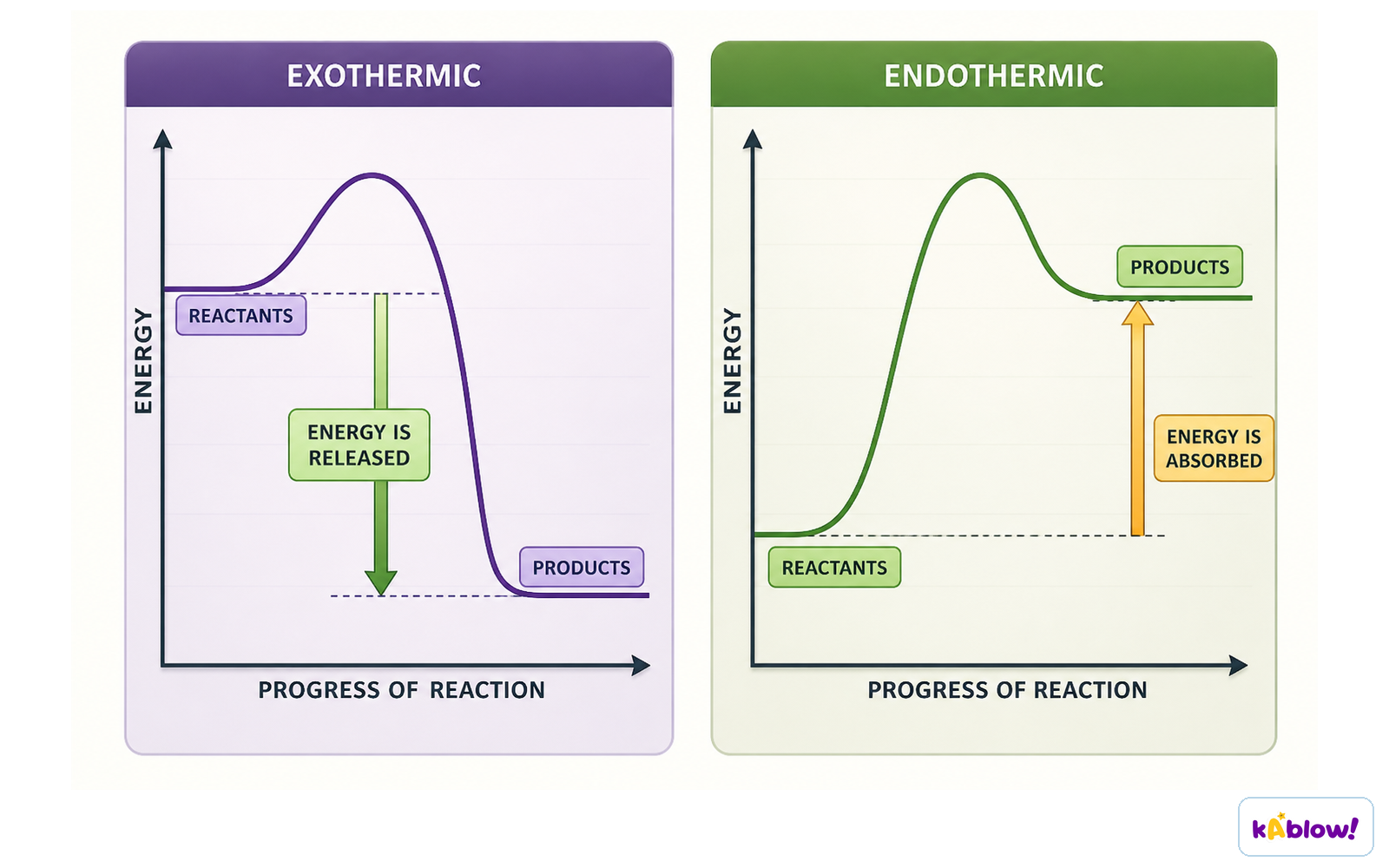
Energy Profiles
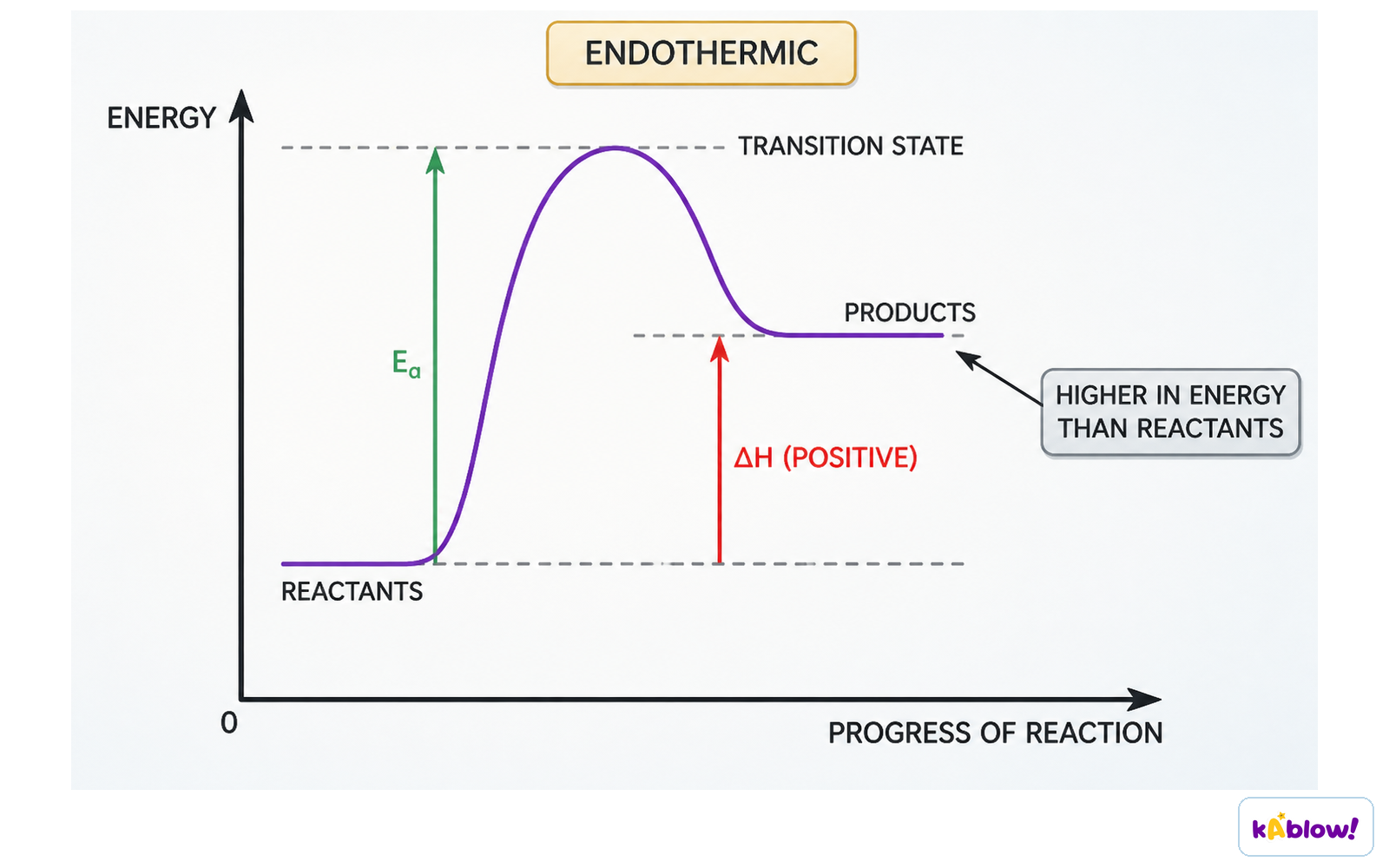
- An energy profile shows how the energy of a chemical system changes during a reaction, including reactants, products, and the transition state.
- The transition state is a stage where bonds are partially broken and formed; it is unstable, cannot be isolated, and is the highest energy point on the pathway.
- Activation energy (Ea) is the minimum energy needed for reactant molecules to collide successfully and start the reaction.
- In an exothermic reaction, the reactants are higher in energy than the products, so the activation energy is relatively low.
- In an endothermic reaction, the reactants are lower in energy than the products, so the activation energy is relatively high.
- On an energy level diagram, Ea is the energy difference from reactants to the transition state, while ΔH is the energy difference from reactants to products.
- Always label the axis of energy level diagrams.
Reaction pathway diagrams
Standard Enthalpy Change
- Standard enthalpy change, ΔH⦵, refers to the heat transferred at constant pressure under standard conditions and states.
- Standard conditions are: pressure of 100 kPa, concentration of 1 mol dm⁻³ for solutions, and each substance in its standard state.
- Temperature is not part of the definition of standard state, but 298.15 K is usually specified.
- The symbol ⦵ indicates standard conditions, e.g. ΔH⦵.
- Standard enthalpy of reaction, ΔHr⦵: enthalpy change when reactants in the stoichiometric equation react to give products under standard conditions; can be exothermic or endothermic.
- Standard enthalpy of formation, ΔHf⦵: enthalpy change when one mole of a compound is formed from its elements under standard conditions; can be exothermic or endothermic.
- Standard enthalpy of combustion, ΔHc⦵: enthalpy change when one mole of a substance is burnt in excess oxygen under standard conditions; always exothermic.
- Standard enthalpy of neutralisation, ΔHneut⦵: enthalpy change when one mole of water is formed by reacting an acid and alkali under standard conditions; always exothermic.
Calorimetry Experiments
- Calorimetry is a technique used to measure enthalpy changes of chemical reactions.
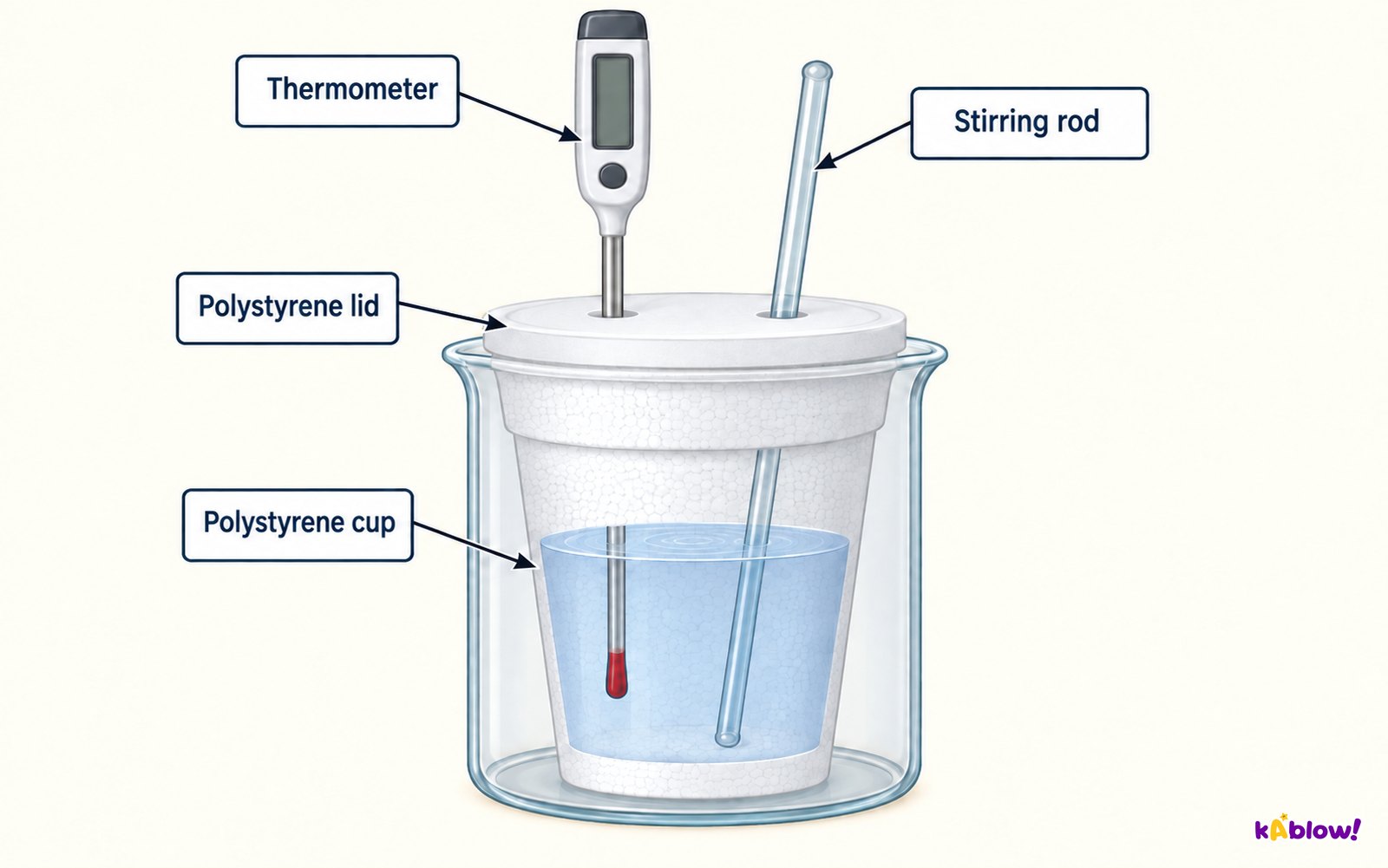
- A simple calorimeter can be made from a polystyrene cup, a vacuum flask, or a metal can.
- The energy transferred as heat is calculated using q = m × c × ΔT, where q is heat transferred (J), m is mass of water (g), c is specific heat capacity (J g⁻¹ K⁻¹), and ΔT is temperature change (K).
- The specific heat capacity of water is 4.18 J g⁻¹ K⁻¹.
- For reactions in solution, carry out the reaction with an excess of one reagent and measure the temperature change over a few minutes.
- Assumptions made in calorimetry: the specific heat capacity and density of the solution are the same as pure water, the container's heat capacity is ignored, the reaction is complete, and heat losses are negligible.
- There is no need to convert temperature units between °C and K because the change in temperature is the same.
Polystyrene-cup calorimetry
Temperature Correction Graphs
- For reactions that are not instantaneous, heat may be lost to the surroundings before the maximum temperature is reached.
- A temperature correction graph is used to find the true maximum temperature change.
- Steps: record temperature before adding reactants for a few minutes, add the second reactant and continue recording, then plot the graph.
- Extrapolate the cooling section of the graph back to the time when the second reactant was added to find the maximum temperature change.
- This method assumes the rate of cooling is constant.
- The same analysis can be used for endothermic reactions, but there will be a 'warming' section as the substances return to room temperature.
Enthalpy of Combustion Experiments
- In a combustion calorimetry experiment, the heat released by burning a fuel is used to increase the temperature of a known mass of water.
- A typical simple calorimeter uses a spirit burner and a copper calorimeter containing water.
- The heat released by combustion is calculated using q = m × c × ΔT, where m is the mass of water.
- The amount of fuel burned is found from the mass lost by the spirit burner and its molar mass.
- The enthalpy of combustion is calculated as ΔH = q ÷ n, where n is the moles of fuel burned.
- Not all heat produced is transferred to the water; some is lost to the surroundings and some is absorbed by the calorimeter.
- To minimise heat losses, place the copper calorimeter not too far above the flame, use a lid, and shield from draughts.
- Main sources of error in combustion experiments are heat losses and incomplete combustion.
Worked Example: Calculating Enthalpy Change from Calorimetry Data
- Example: 0.01 mol of propan-1-ol heated 250 g of water, raising the temperature from 298 K to 310 K.
- Calculate q = m × c × ΔT = 250 g × 4.18 J g⁻¹ K⁻¹ × 12 K = 12 540 J.
- This is the energy released by 0.01 mol of propan-1-ol.
- Energy per mole = q ÷ n = 12 540 J ÷ 0.01 mol = 1 254 000 J mol⁻¹.
- Convert to kJ mol⁻¹ by dividing by 1000: ΔH = -1254 kJ mol⁻¹ (negative because combustion is exothermic).
Slide
Sign up free to view the lesson slides
Step through every slide for this topic — plus flashcards and revision notes — with a free account.
Soal latihan
Pratinjau gratis — 8 dari 62 soal. Daftar untuk melihat semuanya.
1.Which statement best describes the difference between heat and temperature?
Easy- ATemperature is a measure of the average kinetic energy of particles, while heat is a measure of the total energy content of a substance.
- BHeat is a measure of the average kinetic energy of particles, while temperature is a measure of the total energy content of a substance.
- CHeat and temperature are both measures of the total energy content of a substance.
- DTemperature is a measure of the total energy content of a substance, while heat is a measure of the average kinetic energy of particles.
2.In an exothermic reaction, the temperature of the surroundings increases.
EasyTrue or false?
3.The reaction of propane with oxygen is: C₃H₈ + 5O₂ → 3CO₂ + 4H₂O, ΔH = -2219 kJ mol⁻¹. What is the classification of this enthalpy change?
Easy- AEnthalpy of combustion
- BEnthalpy of formation
- CEnthalpy of neutralisation
- DEnthalpy of reaction
4.Which of the following are standard conditions for enthalpy changes? (select all that apply)
Medium- APressure of 100 kPa
- BConcentration of 1 mol dm⁻³ for solutions
- CTemperature of 298.15 K
- DEach substance in its standard state
- EPressure of 1 atm
5.Match each enthalpy change with its symbol.
Medium- Standard enthalpy of reaction
- Standard enthalpy of formation
- Standard enthalpy of combustion
- Standard enthalpy of neutralisation
- ΔHr
- ΔHf
- ΔHc
- ΔHneut
6.Place the steps of a calorimetry experiment to determine the enthalpy change of a reaction in solution in the correct order.
Medium- Measure initial temperature of the solution
- Add the second reactant
- Record temperature over time
- Extrapolate the cooling curve to find maximum temperature change
7.In an endothermic reaction, the products have less enthalpy than the reactants.
EasyTrue or false?
8.Which of the following is the correct definition of average bond enthalpy?
Medium- AThe energy required to break one mole of a specific bond in a gaseous molecule, averaged over a range of compounds.
- BThe energy released when one mole of a bond is formed in the gaseous state.
- CThe energy required to break one mole of bonds in a solid compound.
- DThe energy change when one mole of a compound is formed from its elements.
Unlock all 62 questions & more
Buat akun gratis untuk melihat setiap soal, slide, kartu flash, dan catatan ulasan topik ini.