Wave Phenomena
Belajar sambil bermain
Jawab soal-soal ini untuk dapat energi, lalu memancing dan menjelajah. Tanpa akun.
Catatan pelajaran
Wavefronts & Rays
- Wavefronts are lines joining all points that oscillate in phase and are perpendicular to the direction of wave motion.
- Rays are lines showing the direction of motion (and energy transfer) of the wave, perpendicular to the wavefront.
- A surface wave propagates in two dimensions and has circular wavefronts (e.g., water waves).
- A spherical wave propagates in three dimensions and has spherical wavefronts (e.g., sound or light).
- The distance between successive peak wavefronts (or trough wavefronts) is equal to the wavelength.
- In diagrams, peaks are often represented with a darker line and troughs with a fainter line.
Reflection, Refraction & Transmission
- When waves meet a boundary, they can be reflected, refracted, transmitted, or absorbed.
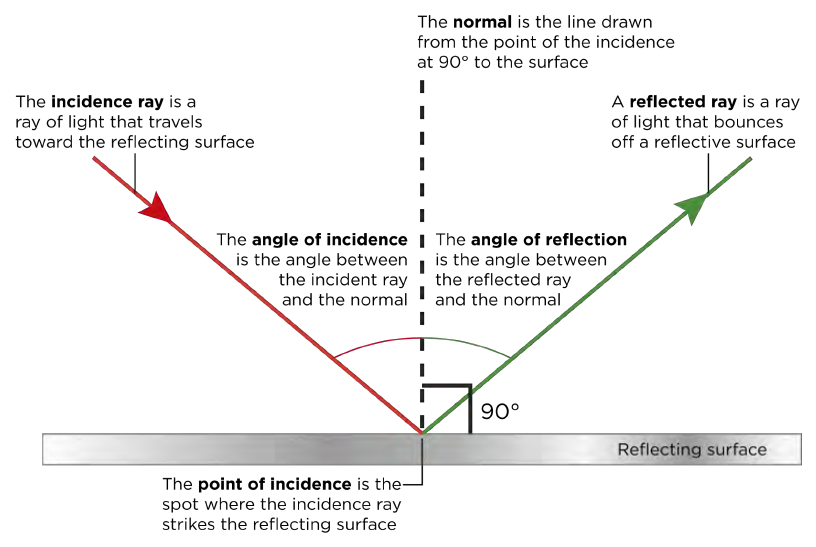
- Reflection: a wave bounces back into the original medium; the angle of incidence equals the angle of reflection.
- During reflection, the frequency, wavelength, and speed of the wave do not change.
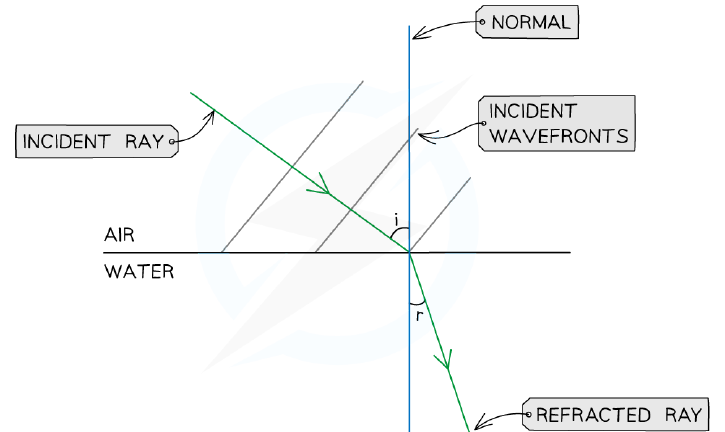
- Refraction is the change in direction of a wave when it passes between media of different densities, caused by a change in speed.
- When a wave refracts, its speed and wavelength change, but its frequency remains the same.
- Going from less dense to more dense: waves slow down, wavelength shortens, and the ray bends towards the normal.
- Going from more dense to less dense: waves speed up, wavelength lengthens, and the ray bends away from the normal.
- Transmission is the general term for a wave passing through a substance; refraction is a type of transmission.
Reflection of light
Diffraction of Waves
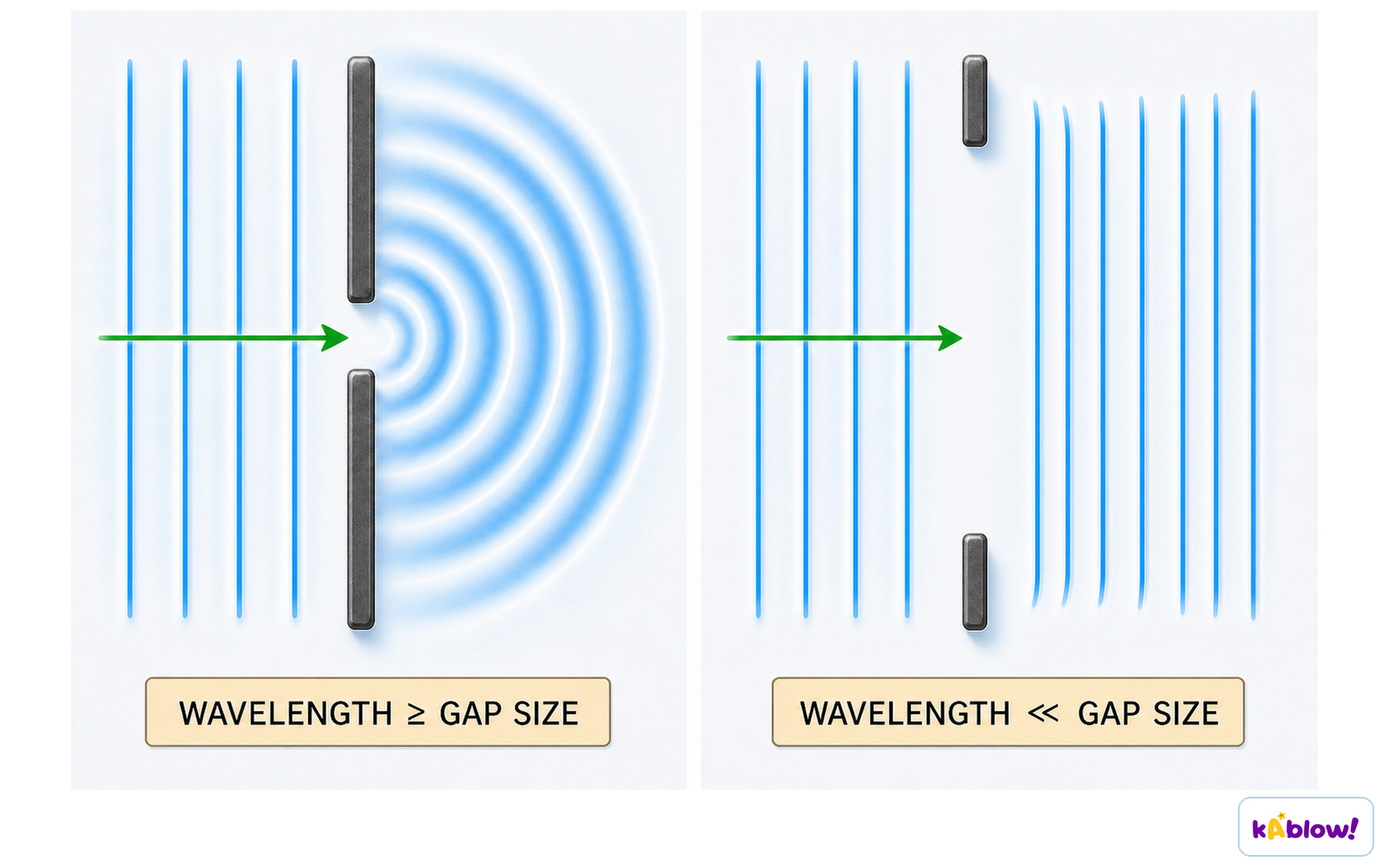
- Diffraction is the spreading out of waves after they pass through a narrow gap or around an obstruction.
- Diffraction effects are most noticeable when the wavelength is similar in size to the gap width or barrier.
- For gaps much smaller than the wavelength, the wave spreads out significantly; for gaps much larger, there is little diffraction.
- When waves diffract through an aperture, their amplitude decreases because the barrier absorbs some wave energy.
- Diffraction also occurs around a barrier: longer wavelengths diffract more, producing a smaller 'shadow' region behind the barrier.
- When a barrier is smaller than the wavelength, no diffraction occurs around it and the shadow region is very small.
Diffraction through a gap
Refraction of Waves
- The refractive index n of a material tells us how optically dense it is; n = c / v, where c is the speed of light in a vacuum and v is the speed in the medium.
- The refractive index is a dimensionless quantity (no units); for air, n ≈ 1.
- Snell's law relates the angles of incidence and refraction: n₁ sin θ₁ = n₂ sin θ₂, or n₁/n₂ = sin θ₂ / sin θ₁ = v₂ / v₁.
- The angles of incidence and refraction are measured from the normal, which is drawn at 90° to the boundary.
- When light passes from a less dense to a more dense medium, the refracted ray bends towards the normal and the wavelength decreases.
- When light is incident along the normal (90° to the boundary), it passes straight through without changing direction.
Refraction of light
Critical Angle & Total Internal Reflection
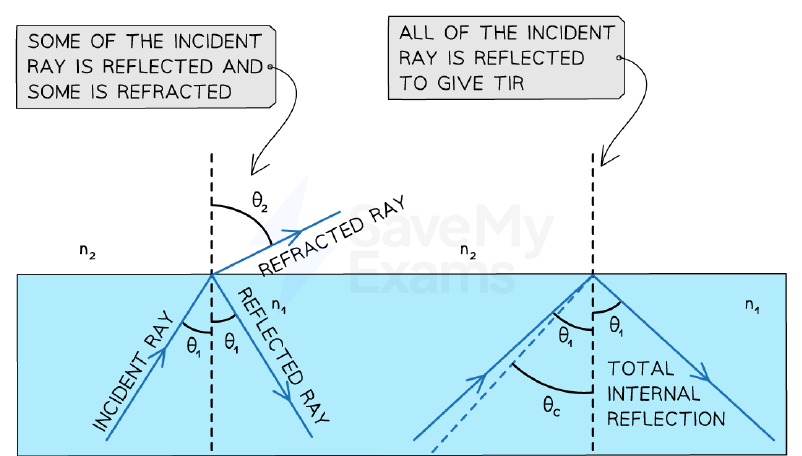
- As the angle of incidence increases, the angle of refraction also increases until it reaches 90°; this angle of incidence is the critical angle θc.
- The critical angle is given by sin θc = n₂ / n₁, where n₁ is the refractive index of the denser medium and n₂ is that of the less dense medium.
- The larger the refractive index of a material, the smaller its critical angle.
- Total internal reflection occurs when the angle of incidence exceeds the critical angle and the refractive index of the first medium is greater than that of the second.
- Total internal reflection follows the law of reflection: angle of incidence = angle of reflection.
Partial reflection/refraction compared with total internal reflection (angle of incidence > critical angle)
Superposition of Waves
- The principle of superposition states that when two or more waves overlap at a point, the resultant displacement is the sum of the individual displacements.
- Individual wave displacements may be positive or negative and are combined algebraically.
- Superposition can be analysed using displacement–position or displacement–time graphs.
- When two pulses meet, their displacements combine to form a resultant displacement; after interacting, they continue as normal.
- Interference is the effect observed due to the superposition of two or more waves.
Interference of Waves
- Constructive interference occurs when waves meet in phase (peak-to-peak or trough-to-trough), resulting in a larger amplitude.
- Destructive interference occurs when waves meet in antiphase (peak-to-trough), resulting in cancellation.
- For sustained interference, waves must be coherent: they must have the same frequency and a constant phase difference.
- Path difference is the difference in distance travelled by two waves from their sources to the point where they meet.
- Constructive interference occurs when path difference = nλ (n = 0, 1, 2, ...).
- Destructive interference occurs when path difference = (n + ½)λ (n = 0, 1, 2, ...).
Young’s Double-Slit Experiment
- Young's double-slit experiment produces an interference pattern using a single wave source passing through a double slit.
- Lasers are commonly used because the light must be coherent and monochromatic.
- The pattern consists of bright fringes (maxima) from constructive interference and dark fringes (minima) from destructive interference.
- Each bright fringe is identical and has the same width and intensity.
- The fringe spacing s is given by s = λD / d, where λ is the wavelength, D is the distance from slits to screen, and d is the slit separation.
- Fringe spacing increases if the wavelength increases, the screen distance increases, or the slit separation decreases.
- The order n of a maximum gives its position away from the central maximum (n = 0 is the central maximum).
Single-Slit Diffraction
- Single-slit diffraction produces a pattern of bright and dark fringes on a screen.
- The central maximum is the brightest and widest fringe.
- Making the slit narrower increases the width of the central maximum and the fringe spacing.
- Using a longer wavelength (e.g., red light) produces wider fringes than a shorter wavelength (e.g., blue light).
- Increasing the distance between the slit and the screen increases the width of the fringes.
- A modulated interference pattern is observed when single-slit diffraction combines with double-slit interference.
Diffraction Gratings
- A diffraction grating consists of many parallel slits, producing sharper and brighter maxima than a double slit.
- The condition for constructive interference (maxima) is d sin θ = nλ, where d is the slit spacing, θ is the angle of diffraction, and n is the order.
- White light passed through a diffraction grating produces a spectrum; violet appears closest to the centre and red furthest away.
- The number of visible orders depends on the wavelength and the slit spacing.
Slide
Sign up free to view the lesson slides
Step through every slide for this topic — plus flashcards and revision notes — with a free account.
Soal latihan
Pratinjau gratis — 8 dari 63 soal. Daftar untuk melihat semuanya.
1.In a reflection ray diagram, the angle of incidence is the angle between
Easy- Athe incident ray and the normal.
- Bthe incident ray and the boundary surface.
- Cthe incident ray and the reflected ray.
- Dthe reflected ray and the boundary surface.
2.A ray of light refracts as it passes from one medium into another. Which property of the light wave remains the same?
Easy- AFrequency
- BWavelength
- CWave speed
- DAmplitude
3.Light from a monochromatic laser beam is incident on the surface of a body of water. What changes to the speed, wavelength, and frequency of the light wave would be observed as it passes from the air to the water?
Easy- ASpeed decreases, wavelength decreases, frequency no change
- BSpeed no change, wavelength increases, frequency decreases
- CSpeed increases, wavelength decreases, frequency no change
- DSpeed decreases, wavelength no change, frequency increases
4.Diffraction can be observed in
Easy- Aall waves
- Bsound waves only
- Ctransverse waves only
- Dlight waves only
5.For fringes to be observed in a double-slit interference experiment, the light emitted from each slit must be
Easy- Acoherent.
- Bmonochromatic.
- Cin phase.
- Dof equal intensity.
6.White light is passed through a diffraction grating. Which colour appears closest to the centre of the pattern when viewed on a screen?
Medium- AViolet
- BBlue
- CRed
- DGreen
7.Light of different wavelengths is incident on a single slit. A diffraction pattern is observed on a screen a distance away. What is the relationship between the wavelength of the light and the width of the bright fringes on the diffraction pattern?
Medium- ARed light produces a diffraction pattern with the widest fringes.
- BBlue light produces a diffraction pattern with the widest fringes.
- CAll wavelengths of light produce bright fringes of equal width.
- DChanging the width of the slit is the only variable that affects the width of the bright fringes.
8.Monochromatic light is incident on a narrow slit to produce a diffraction pattern of bright and dark fringes on a screen. The slit is then made narrower. What is the change to the pattern observed on the screen?
Medium- AThe fringe spacing will become wider.
- BThe intensity of the central maximum will increase.
- CThe fringe spacing will become narrower.
- DThe width of the central maximum will decrease.
Unlock all 63 questions & more
Buat akun gratis untuk melihat setiap soal, slide, kartu flash, dan catatan ulasan topik ini.