Exothermic & Endothermic Reactions
Belajar sambil bermain
Jawab soal-soal ini untuk dapat energi, lalu memancing dan menjelajah. Tanpa akun.
Catatan pelajaran
Exothermic & Endothermic Reactions
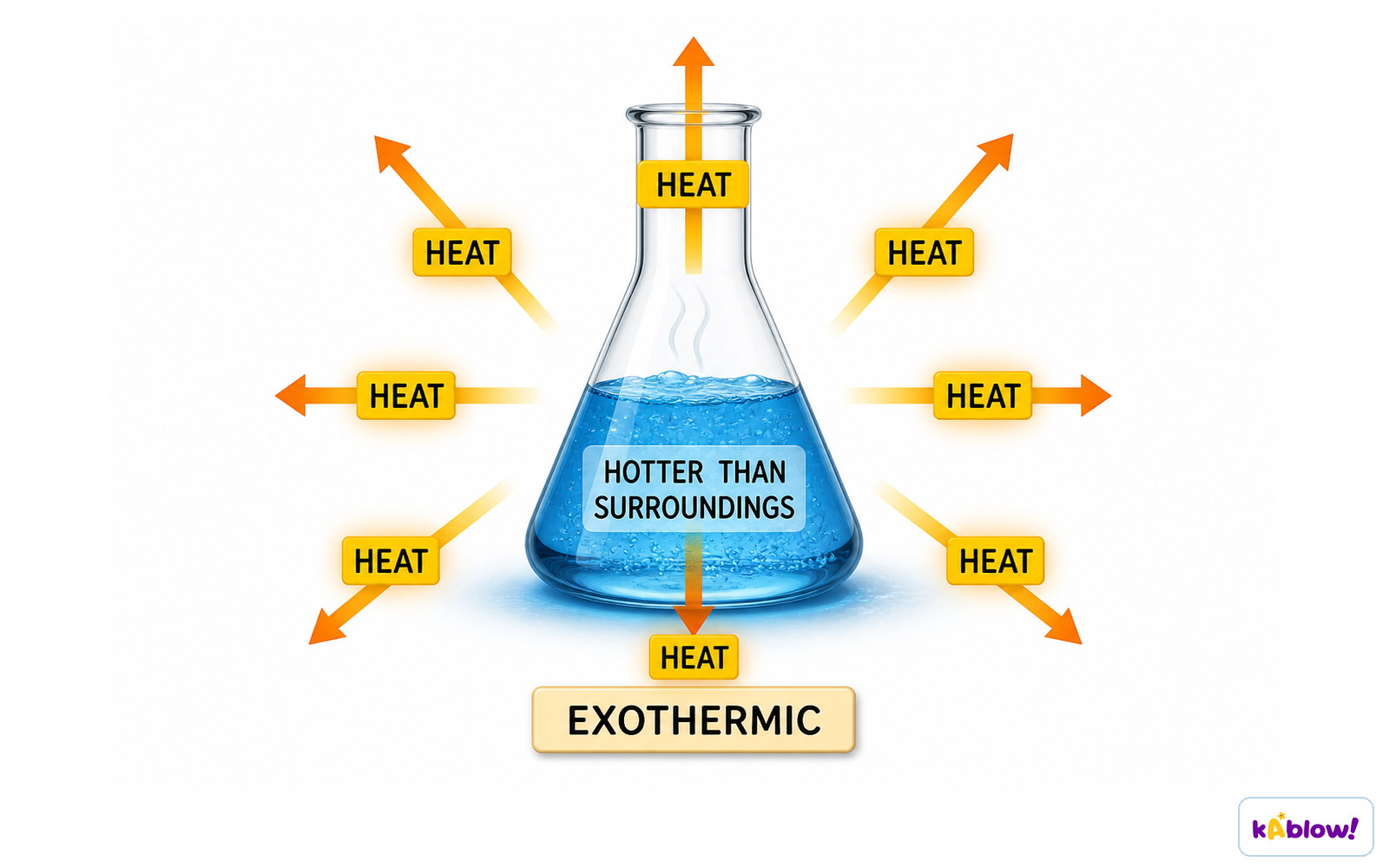
- Chemical reactions involve transfer of thermal energy between the system (reacting chemicals) and the surroundings.
- Exothermic reactions: thermal energy is transferred from the system to the surroundings; temperature of surroundings increases; energy change is negative (ΔH < 0).
- Endothermic reactions: thermal energy is transferred from the surroundings to the system; temperature of surroundings decreases; energy change is positive (ΔH > 0).
- Common exothermic examples: combustion, oxidation, neutralisation, hand warmers, self-heating cans.
- Common endothermic examples: electrolysis, thermal decomposition, first stages of photosynthesis, cold packs.
- Mnemonic: In EXothermic reactions heat Exits the system; in ENdothermic reactions heat ENters the system.
Heat transfer outwards in an exothermic reaction
Reaction Pathway Diagrams
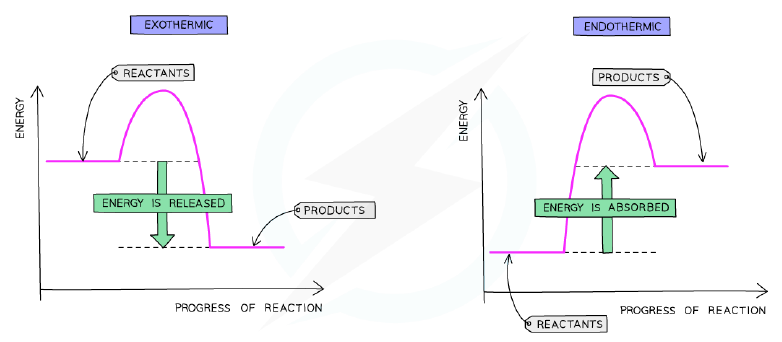
- Reaction pathway diagrams plot energy (y-axis) against progress of reaction (x-axis).
- For exothermic reactions: products have lower energy than reactants; ΔH is negative; arrow points downwards.
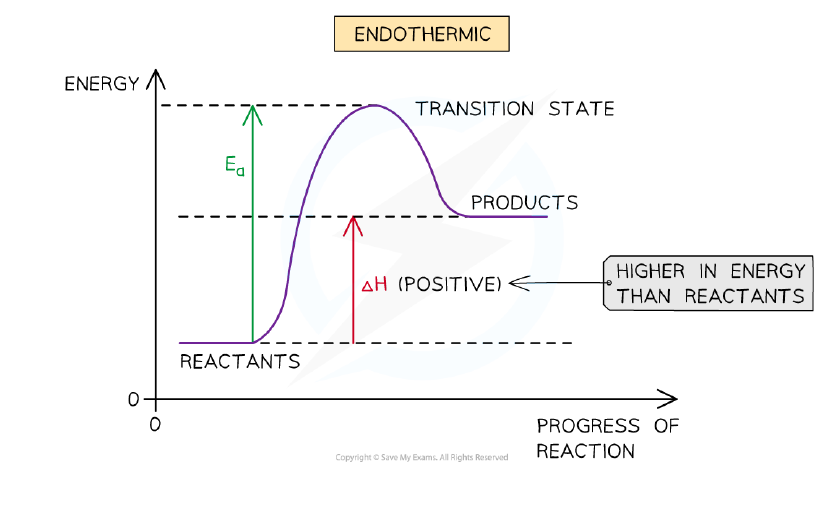
- For endothermic reactions: products have higher energy than reactants; ΔH is positive; arrow points upwards.
- The activation energy (Ea) is the minimum energy required for a successful collision; shown as the 'hump' from reactants to the transition state.
- Core candidates interpret diagrams; Extended candidates must draw and label reactants, products, ΔH, and Ea.
Reaction pathway diagrams for exothermic and endothermic reactions
Enthalpy Change & Activation Energy (Extended)
- Enthalpy change (ΔH) is the transfer of thermal energy during a reaction; negative for exothermic, positive for endothermic.
- Activation energy (Ea) is the minimum energy needed for a successful collision; varies with reaction.
- For a collision to be successful, particles must have energy ≥ Ea and correct orientation.
- Reactions with higher Ea require more energy to start.
The reaction pathway diagram for endothermic reactions
Bond Breaking & Bond Forming (Extended)
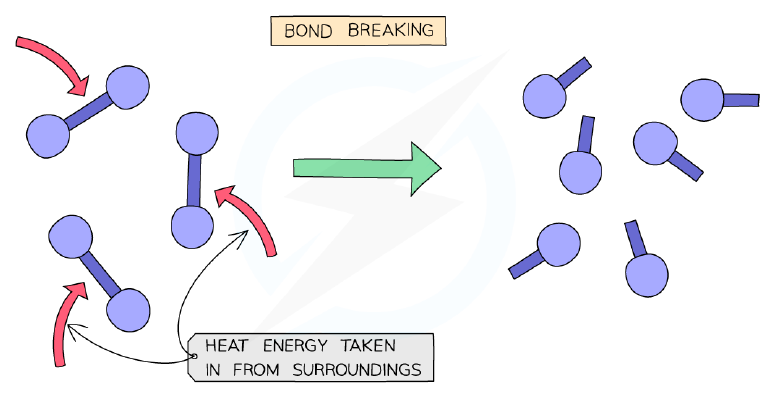
- Bond breaking is always endothermic (energy taken in).
- Bond making is always exothermic (energy released).
- If energy released in bond making > energy absorbed in bond breaking → overall exothermic (ΔH negative).
- If energy absorbed in bond breaking > energy released in bond making → overall endothermic (ΔH positive).
Bond breaking is endothermic
Bond Energy Calculations (Extended)
- Each bond has a specific bond energy (kJ/mol) – energy to break or energy released when formed.
- Method: (1) Write balanced equation. (2) Identify bonds in reactants and products. (3) Sum bond energies for reactants = energy in. (4) Sum bond energies for products = energy out. (5) ΔH = energy in – energy out.
- Negative ΔH means exothermic; positive ΔH means endothermic.
- Example: H₂ + Cl₂ → 2HCl: energy in = 436+242=678 kJ; energy out = 2×431=862 kJ; ΔH = 678–862 = –184 kJ (exothermic).
Experimental Methods & Observations
- Temperature changes are measured using a polystyrene cup (insulator) and a thermometer.
- Polystyrene cups reduce heat loss to surroundings, improving accuracy.
- Solutions should be left to stand before experiment to reach room temperature (ensure fair test).
- Greater mass of solid or larger volume of water affects temperature change; more solid increases change, more water dilutes and reduces change.
- Powdered solids dissolve faster than lumps due to larger surface area.
- After 1 hour, reaction mixture returns to room temperature (heat lost to surroundings).
Neutralisation Reactions
- Neutralisation between an acid and alkali is exothermic (temperature rises).
- Example: NaOH + HCl → NaCl + H₂O produces a temperature increase.
- The maximum temperature indicates the point of neutralisation (equal moles of acid and alkali).
Slide
Sign up free to view the lesson slides
Step through every slide for this topic — plus flashcards and revision notes — with a free account.
Soal latihan
Pratinjau gratis — 8 dari 42 soal. Daftar untuk melihat semuanya.
1.Which of the following is a correct description of an exothermic reaction?
Easy- AThermal energy is transferred from the system to the surroundings.
- BThermal energy is transferred from the surroundings to the system.
- CThe temperature of the surroundings decreases.
- DThe energy change of the system is positive.
2.Which of the following is an example of an endothermic reaction?
Easy- ACombustion
- BNeutralisation
- CThermal decomposition
- DOxidation
3.In a chemical reaction, bond breaking is always an ________ process.
Easy- Aendothermic
- Bexothermic
- Cneutral
- Dreversible
4.What is the term for the minimum amount of energy required for a successful collision between particles?
Easy- AEnthalpy change
- BActivation energy
- CBond energy
- DThermal energy
5.A student adds 4 g of solid A to 30 cm³ of water and observes a temperature decrease. What type of reaction is this?
Easy- AExothermic
- BEndothermic
- CNeutralisation
- DOxidation
6.The reaction pathway diagram for an exothermic reaction shows that the energy of the products is ________ the energy of the reactants.
Easy- Ahigher than
- Blower than
- Cequal to
- Dunrelated to
7.Given the bond energies: H–H = 436 kJ/mol, Cl–Cl = 242 kJ/mol, H–Cl = 431 kJ/mol. What is the enthalpy change for the reaction H₂ + Cl₂ → 2HCl?
Medium- A+184 kJ/mol
- B-184 kJ/mol
- C+862 kJ/mol
- D-862 kJ/mol
8.Which of the following statements about bond breaking and bond forming is correct?
Easy- ABond breaking releases energy; bond forming absorbs energy.
- BBond breaking absorbs energy; bond forming releases energy.
- CBoth bond breaking and bond forming release energy.
- DBoth bond breaking and bond forming absorb energy.
Unlock all 42 questions & more
Buat akun gratis untuk melihat setiap soal, slide, kartu flash, dan catatan ulasan topik ini.