Reactivity Series And Corrosion Of Metals
Belajar sambil bermain
Jawab soal-soal ini untuk dapat energi, lalu memancing dan menjelajah. Tanpa akun.
Catatan pelajaran
Reactivity Series
- The reactivity series lists metals in order of their reactivity based on reactions with water and acids.
- Non-metals carbon and hydrogen are included for extraction and acid reactions.
- Order (most to least reactive): Potassium > Sodium > Calcium > Magnesium > Aluminium > Carbon > Zinc > Iron > Hydrogen > Copper > Silver > Gold.
- Mnemonic: 'Please send cats, monkeys and cute zebras into hot countries signed Gordon'.
Reactions with Water and Steam
- Potassium, sodium, and calcium react with cold water to produce metal hydroxide and hydrogen gas.
- Example: 2K(s) + 2H₂O(l) → 2KOH(aq) + H₂(g).
- Magnesium reacts with steam to produce magnesium oxide and hydrogen: Mg(s) + H₂O(g) → MgO(s) + H₂(g).
- Reactivity with water decreases down the series: potassium reacts violently, sodium quickly, calcium less strongly.
Reactions with Dilute Hydrochloric Acid
- Metals above hydrogen in the series react with dilute HCl to form a salt and hydrogen gas.
- Example: Mg(s) + 2HCl(aq) → MgCl₂(aq) + H₂(g).
- The more reactive the metal, the more vigorous the reaction.
- Metals below hydrogen (copper, silver, gold) do not react with dilute HCl.
Displacement Reactions
- A more reactive metal can displace a less reactive metal from a solution of its salt.
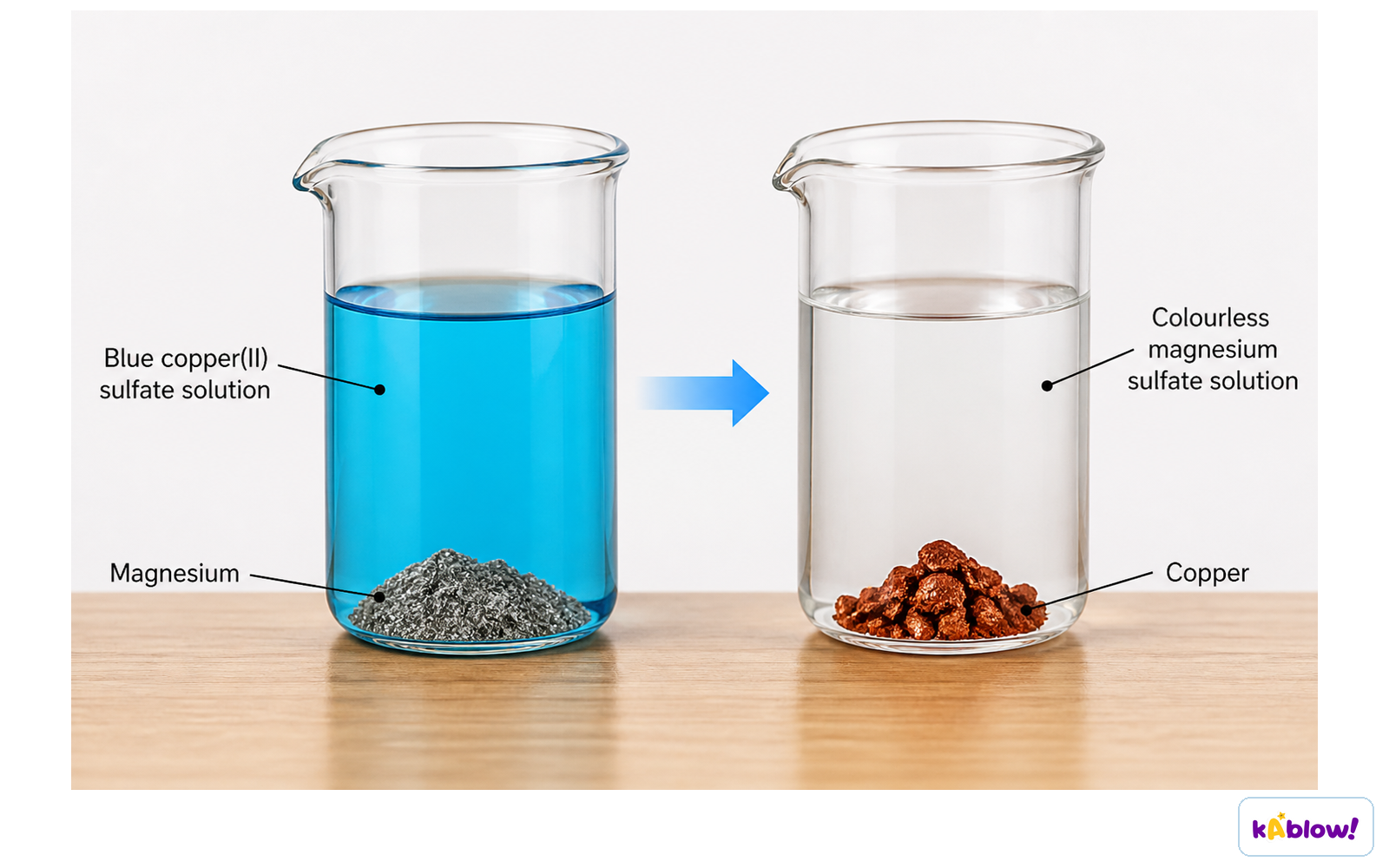
- Example: Mg(s) + CuSO₄(aq) → MgSO₄(aq) + Cu(s); blue colour fades as copper deposits.
- Displacement occurs because more reactive metals lose electrons more readily (are better reducing agents).
- Experimental displacement data can be used to deduce the relative order of reactivity.
Displacement of copper by magnesium
Explaining Reactivity (Extended)
- Reactivity depends on the tendency of a metal atom to lose electrons and form positive ions.
- Metals high in the series lose electrons easily and are strong reducing agents.
- In displacement, the less reactive metal ion gains electrons (is reduced); the more reactive metal loses electrons (is oxidised).
Rusting of Iron
- Rusting is the corrosion of iron requiring both oxygen and water.
- Rust is hydrated iron(III) oxide, a reddish-brown compound.
- Equation: iron + water + oxygen → hydrated iron(III) oxide.
- Only iron or steel rusts; other metals corrode.
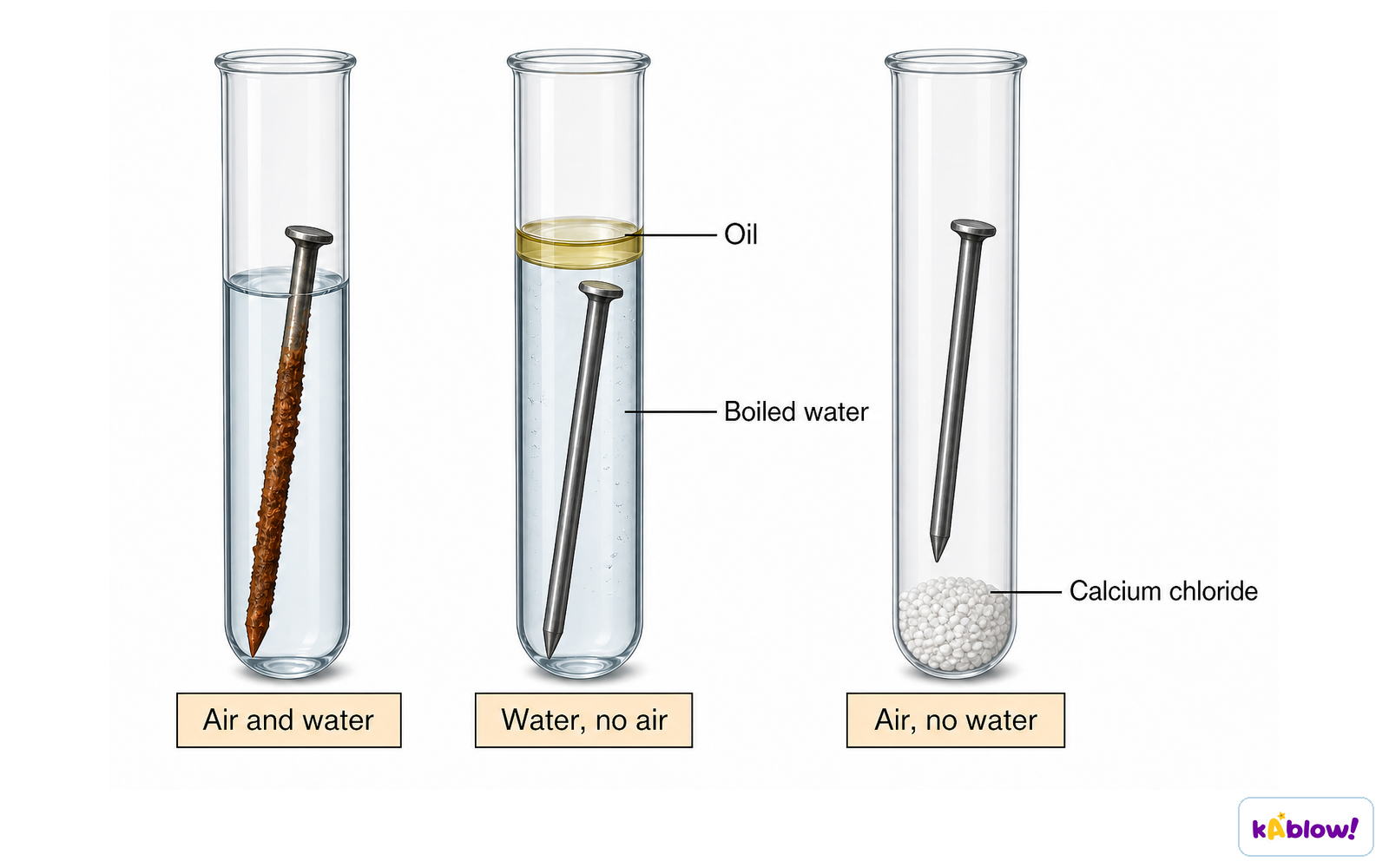
- Investigating rusting: nail in air+water rusts; nail in boiled water with oil (no air) does not; nail with calcium chloride (no water) does not.
Requirements for rusting
Rust Prevention Methods
- Barrier methods (grease, oil, paint, plastic) prevent contact with water and oxygen.
- If the barrier is scratched, iron is exposed and rusting occurs.
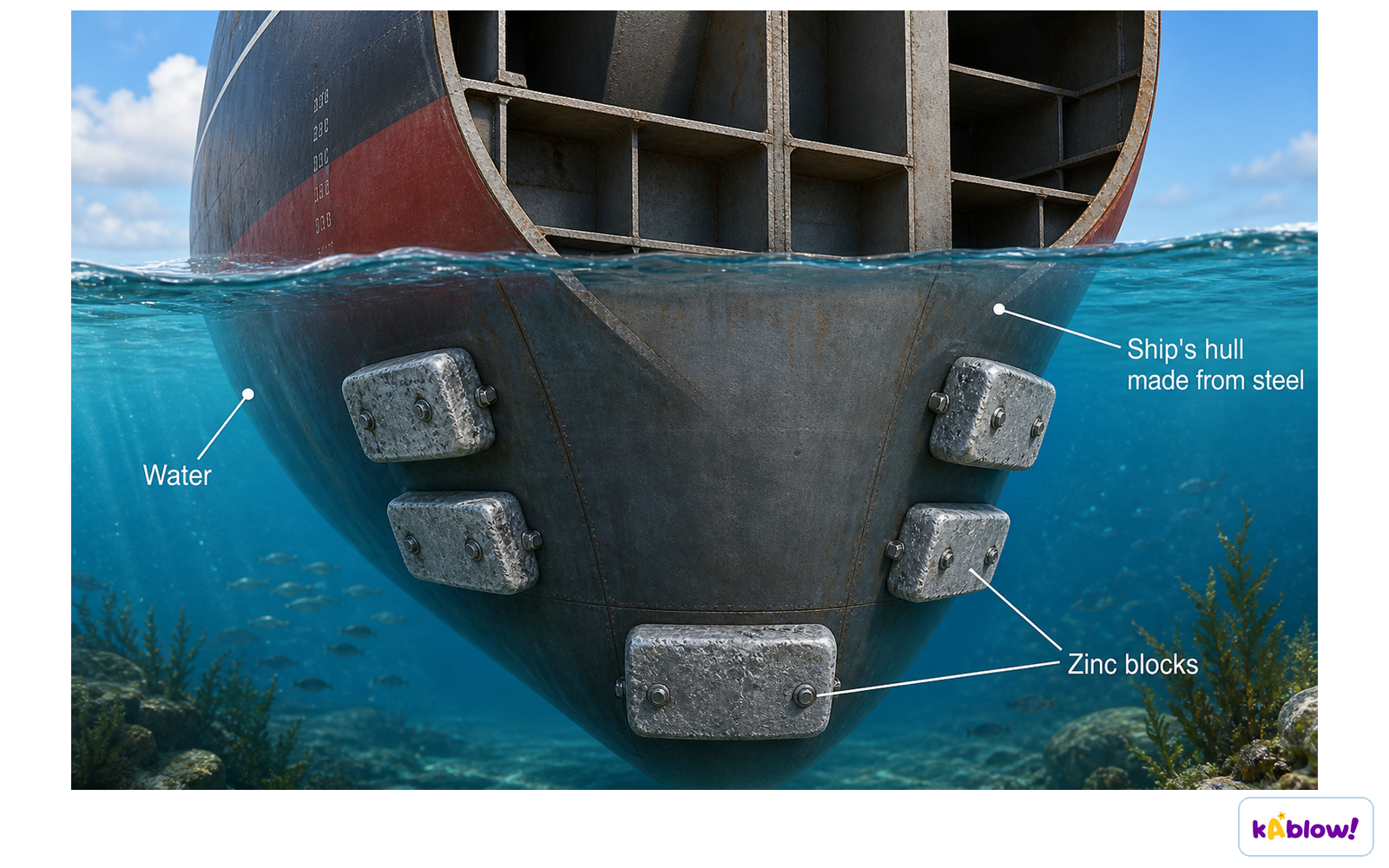
- Sacrificial protection uses a more reactive metal (e.g., zinc) attached to iron; the more reactive metal corrodes instead.
- Zinc bars on steel ships: Zn → Zn²⁺ + 2e⁻; zinc oxidises, iron is protected.
- Galvanising coats iron with zinc; acts as barrier and provides sacrificial protection if scratched.
Zinc bars on steel ship hulls
Choosing a Protective Metal (Extended)
- A metal above iron in the reactivity series is suitable for sacrificial protection (e.g., zinc, magnesium).
- A metal below iron (e.g., copper) is not suitable; iron would corrode instead.
Slide
Sign up free to view the lesson slides
Step through every slide for this topic — plus flashcards and revision notes — with a free account.
Soal latihan
Pratinjau gratis — 8 dari 51 soal. Daftar untuk melihat semuanya.
1.Which of the following is the correct order of reactivity for the metals potassium, sodium, calcium, magnesium, aluminium, zinc, iron, copper, silver, gold?
Easy- APotassium > Sodium > Calcium > Magnesium > Aluminium > Zinc > Iron > Copper > Silver > Gold
- BGold > Silver > Copper > Iron > Zinc > Aluminium > Magnesium > Calcium > Sodium > Potassium
- CPotassium > Sodium > Magnesium > Calcium > Aluminium > Zinc > Iron > Copper > Silver > Gold
- DSodium > Potassium > Calcium > Magnesium > Aluminium > Zinc > Iron > Copper > Silver > Gold
2.State the two conditions necessary for rusting to occur.
Easy3.Iron can rust in the presence of water alone, without oxygen.
EasyTrue or false?
4.Complete the sentence: In the reactivity series, carbon is placed between aluminium and zinc because it is used to extract metals from their oxides.
MediumIn the reactivity series, carbon is placed between ____ and ____ because it is used to extract metals from their oxides.
5.Match each metal with its reaction with cold water.
Medium- Potassium
- Sodium
- Calcium
- Magnesium
- Reacts violently
- Reacts quickly
- Reacts less strongly
- Does not react with cold water
6.Write the word equation for the reaction of magnesium with steam.
Medium7.In an experiment to determine the reactivity of a metal, a student measures the temperature change when the metal reacts with dilute hydrochloric acid. The temperature rises from 20.0°C to 35.0°C. What is the temperature change in °C?
Easy- A15
- B17
- C14
- D16
8.Which of the following metals will displace copper from copper(II) sulfate solution?
Easy- ASilver
- BGold
- CZinc
- DCopper
Unlock all 51 questions, flashcards & more
Buat akun gratis untuk melihat setiap soal, slide, kartu flash, dan catatan ulasan topik ini.