Prime Factors Hcf And Lcm
Belajar sambil bermain
Jawab soal-soal ini untuk dapat energi, lalu memancing dan menjelajah. Tanpa akun.
Catatan pelajaran
Prime Factor Decomposition
- A prime number has exactly two factors: itself and 1. First few primes: 2, 3, 5, 7, 11, 13, 17, 19, …
- Prime factors are the prime numbers that multiply together to give the original number.
- Use a factor tree: split the number into any pair of factors, then split each factor until all branches end in primes.
- Circle the prime numbers at the ends of branches. The same primes appear regardless of the initial split.
- Write the product of prime factors in ascending order, using indices for repeated primes (e.g., 360 = 2³ × 3² × 5).
- Always show your factor tree clearly in exams to earn full marks.
Factor Tree for 360
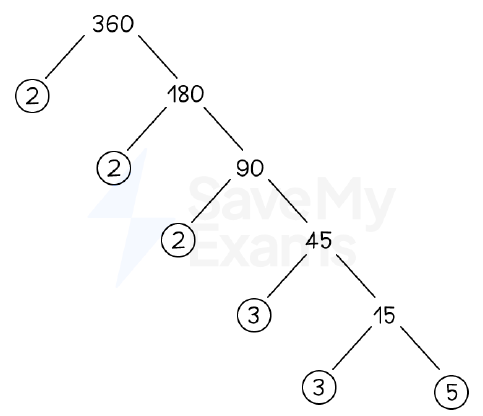
Finding HCF Using Prime Factors
- The Highest Common Factor (HCF) is the largest number that divides both given numbers exactly.
- Method 1 – Venn diagram: Write each number as a product of prime factors. Place common primes in the centre. Multiply the centre numbers to get the HCF.
- Method 2 – Powers: For each common prime, take the lowest power that appears in both numbers. Multiply these together.
- If no common prime factors exist, the HCF is 1.
- Example: HCF of 36 (2²×3²) and 120 (2³×3×5) is 2²×3 = 12.
HCF of 36 and 120
Finding HCF by Listing Factors
- List all factors of each number, then identify the largest factor appearing in both lists.
- Factors of 36: 1, 2, 3, 4, 6, 9, 12, 18, 36. Factors of 120: 1, 2, 3, 4, 5, 6, 8, 10, 12, 15, 20, 24, 30, 40, 60, 120.
- Common factors: 1, 2, 3, 4, 6, 12. The HCF is 12.
- The HCF can be one of the numbers (e.g., HCF of 4 and 12 is 4).
Finding LCM Using Prime Factors
- The Lowest Common Multiple (LCM) is the smallest number that is a multiple of both given numbers.
- Method 1 – Venn diagram: Write each number as a product of prime factors. Place common primes in the centre. Multiply all numbers in the diagram (centre and outer regions).
- Method 2 – Powers: For every prime that appears in either number, take the highest power that appears. Multiply these together.
- Example: LCM of 36 (2²×3²) and 120 (2³×3×5) is 2³×3²×5 = 360.
- The LCM can be one of the numbers (e.g., LCM of 4 and 12 is 12).
LCM of 36 and 120
Finding LCM by Listing Multiples
- List multiples of each number until a common multiple appears.
- Multiples of 36: 36, 72, 108, 144, 180, 216, 252, 288, 324, 360, … Multiples of 120: 120, 240, 360, …
- The smallest common multiple is 360.
- This method is straightforward but can be time-consuming for large numbers.
Real-World Applications (LCM & HCF)
- LCM is used to find when events that repeat at regular intervals coincide (e.g., bus schedules, runners on a track).
- Example: Red bus every 18 min, blue bus every 24 min. LCM of 18 and 24 is 72 min. If they arrive together at 10:47, next together is 10:47 + 72 min = 11:59.
- HCF is used to simplify fractions or divide items into equal groups.
- Always check whether the problem requires HCF or LCM by reading carefully.
Exam Tips and Common Mistakes
- Always show your factor tree or prime factor decomposition clearly.
- Use indices to simplify the product of prime factors (e.g., 2⁴×3³ not 2×2×2×2×3×3×3).
- When using Venn diagrams, remember to include all prime factors from both numbers, not just common ones for LCM.
- For HCF, only common primes are multiplied; for LCM, multiply every prime with the highest exponent.
- Practice with past paper questions to become familiar with the style and wording.
Slide
Sign up free to view the lesson slides
Step through every slide for this topic — plus flashcards and revision notes — with a free account.
Soal latihan
Pratinjau gratis — 8 dari 53 soal. Daftar untuk melihat semuanya.
1.Write 220 as the product of its prime factors.
Easy- A22 × 5 × 11
- B2 × 5 × 11
- C22 × 5 × 112
- D2 × 52 × 11
2.Find the highest odd number that is a factor of 60 and a factor of 90.
Medium- A15
- B30
- C45
- D5
3.Find the lowest common multiple (LCM) of 8 and 14.
Medium- A56
- B112
- C28
- D42
4.Write 54 as a product of its prime factors.
Easy- A2 × 33
- B22 × 33
- C2 × 32
- D33 × 22
5.Write 18 as the product of its prime factors.
Easy- A2 × 32
- B22 × 3
- C2 × 3
- D32
6.Find the lowest common multiple (LCM) of 15 and 27.
Medium- A135
- B45
- C270
- D405
7.Write 825 as the product of its prime factors.
Medium- A3 × 52 × 11
- B3 × 5 × 112
- C52 × 11 × 3
- D32 × 5 × 11
8.Find the lowest common multiple (LCM) of 48 and 60.
Medium- A240
- B120
- C480
- D360
Unlock all 53 questions, flashcards & more
Buat akun gratis untuk melihat setiap soal, slide, kartu flash, dan catatan ulasan topik ini.