Percentages Toolkit
Belajar sambil bermain
Jawab soal-soal ini untuk dapat energi, lalu memancing dan menjelajah. Tanpa akun.
Catatan pelajaran
Basic Percentages
- Percentage means 'out of 100' (e.g., 50% = 50/100).
- Convert a fraction to a percentage by finding an equivalent fraction with denominator 100, or by using a calculator: e.g., 234/650 = 0.36 = 36%.
- Key building blocks: 50% (halve), 25% (halve twice), 10% (divide by 10), 1% (divide by 100).
- Combine blocks: e.g., 20% = 10% × 2; 5% = 10% ÷ 2; 12% = 10% + 1% + 1%.
- With a calculator, use a multiplier (decimal equivalent): e.g., 12% of 650 = 0.12 × 650 = 78.
- To express one number as a percentage of another, write as a fraction then convert to decimal and multiply by 100.
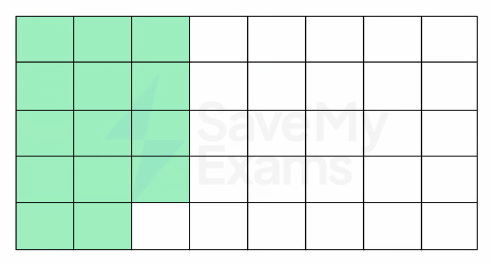
- Worked example: shade 35% of a 40-square grid — 10% = 4, so 30% = 12 and 5% = 2, total 14 squares shaded.
35% of a 40-square grid
Percentage Increases & Decreases
- To increase by a percentage, find the percentage of the original and add it on, or find (100 + x)% and use multiplier (1 + x/100).
- To decrease by a percentage, find the percentage and subtract, or find (100 - x)% and use multiplier (1 - x/100).
- For repeated percentage changes, multiply all multipliers together: e.g., increase by 10% (×1.10) then discount 15% (×0.85) gives combined multiplier 1.10 × 0.85 = 0.935.
- Percentage change = (after - before) / before × 100; positive = increase, negative = decrease.
- Percentage profit/loss = (selling price - cost price) / cost price × 100; positive = profit, negative = loss.
Reverse Percentages
- A reverse percentage question gives the value after a percentage change and asks for the original (before) value.
- Identify the multiplier p: for an increase of x%, p = 1 + x/100; for a decrease of x%, p = 1 - x/100.
- Use the equation: before × p = after, so before = after / p.
- Common mistake: a 10% increase followed by a 10% decrease does NOT return to the original (e.g., 100 → 110 → 99).
Slide
Sign up free to view the lesson slides
Step through every slide for this topic — plus flashcards and revision notes — with a free account.
Soal latihan
Pratinjau gratis — 8 dari 53 soal. Daftar untuk melihat semuanya.
1.What is 12% of 650?
Easy- A78
- B65
- C72
- D80
2.Write $1.92 as a percentage of $1.60.
Medium- A120%
- B83.3%
- C80%
- D125%
3.In a box of 80 glasses, 3 are broken. Work out the percentage of broken glasses.
Easy- A3.75%
- B2.5%
- C4%
- D3%
4.Work out 5% of $25.
Easy- A$1.25
- B$1.00
- C$1.50
- D$0.75
5.Work out $1.20 as a percentage of $16.
Medium- A7.5%
- B8%
- C6%
- D9%
6.67 of 645 parcels are damaged. Calculate the percentage of parcels that are damaged.
Medium- A10.4%
- B9.8%
- C11.2%
- D10.8%
7.Increase 42 by 16%.
Medium- A48.72
- B46.2
- C49.2
- D47.8
8.The surface area of France is 6.41 × 10⁵ km² and China is 9.60 × 10⁶ km². Find France's area as a percentage of China's.
Medium- A6.68%
- B7.5%
- C5.9%
- D8.1%
Unlock all 53 questions & more
Buat akun gratis untuk melihat setiap soal, slide, kartu flash, dan catatan ulasan topik ini.