Moments
Belajar sambil bermain
Jawab soal-soal ini untuk dapat energi, lalu memancing dan menjelajah. Tanpa akun.
Catatan pelajaran
Moments
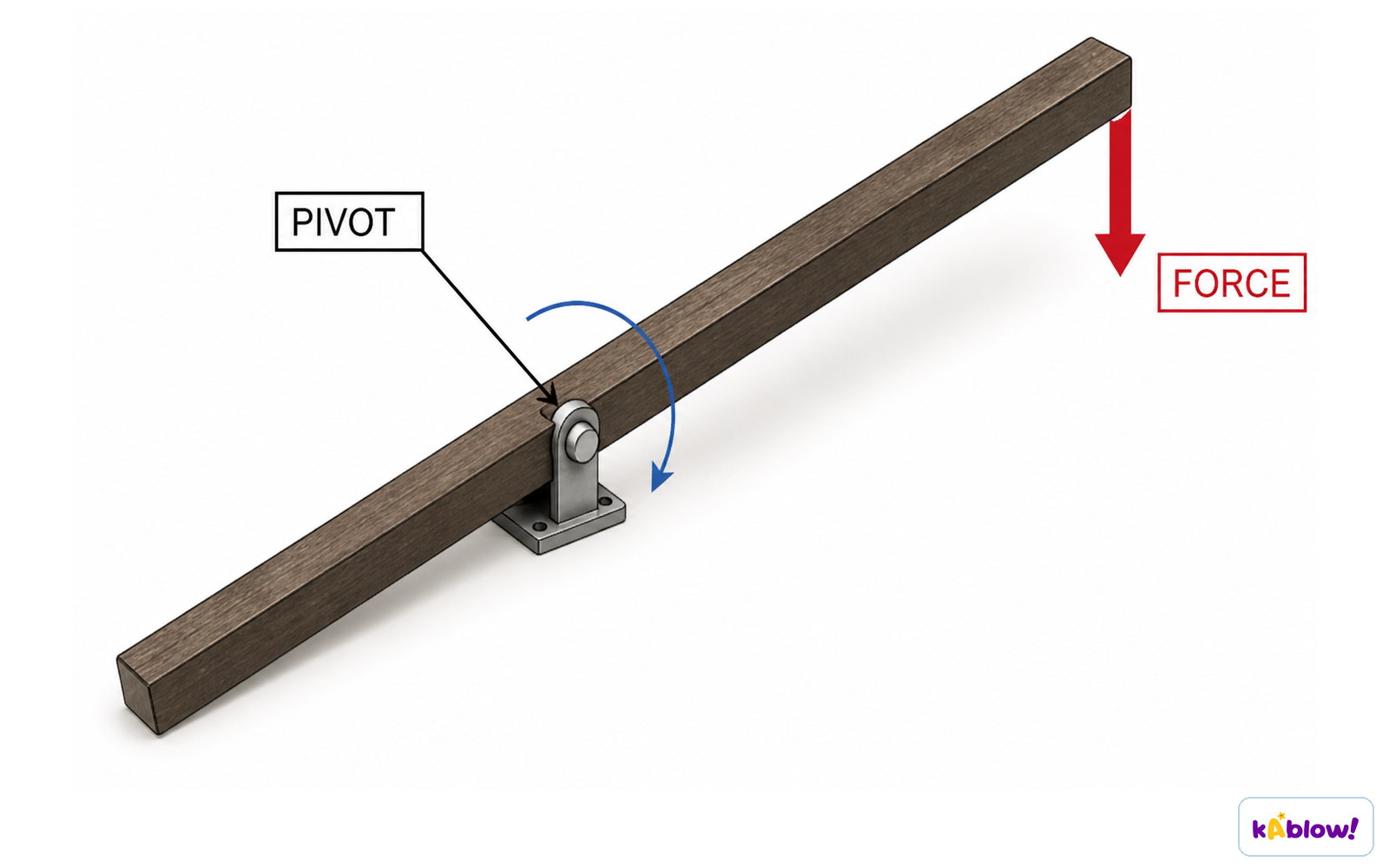
- A moment is the turning effect of a force about a pivot.
- Examples: see-saw, spanner, door, crane, screwdriver, tap, wheelbarrow, scissors.
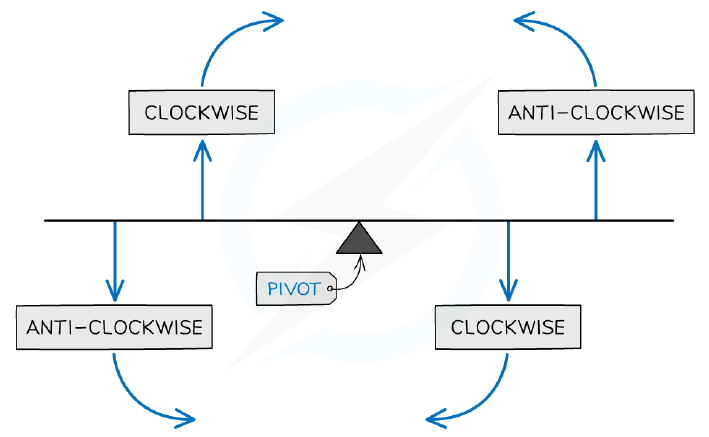
- Rotation can be clockwise or anticlockwise (use clock hands as reference).
- Equation: moment = force × perpendicular distance from pivot (M = F × d).
- Units: newton metre (N m) or newton centimetre (N cm).
- Increasing distance from pivot reduces the force needed for the same moment.
Illustration of a pivot and a force acting on a lever, demonstrating a moment.
Principle of Moments (Core)
- Principle of moments: For a balanced object, total clockwise moment equals total anticlockwise moment.
- Clockwise moment = anticlockwise moment.
- Used to solve for unknown forces or distances when the system is in equilibrium.
- Always convert distances to metres unless question specifies N cm.
Principle of moments: a beam balanced on a pivot, with the clockwise and anticlockwise turning directions labelled on each side.
Principle of Moments (Extended)
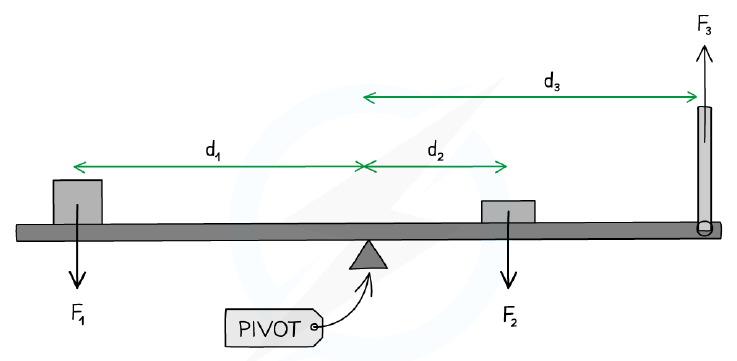
- Extended tier: multiple forces on each side of the pivot.
- Sum of clockwise moments = sum of anticlockwise moments.
- Example: F2 × d2 = (F1 × d1) + (F3 × d3).
- Ensure all distances are in the same units and directions are correctly identified.
Three forces on a beam about a pivot, with each force's perpendicular distance from the pivot labelled (d1, d2, d3).
Equilibrium
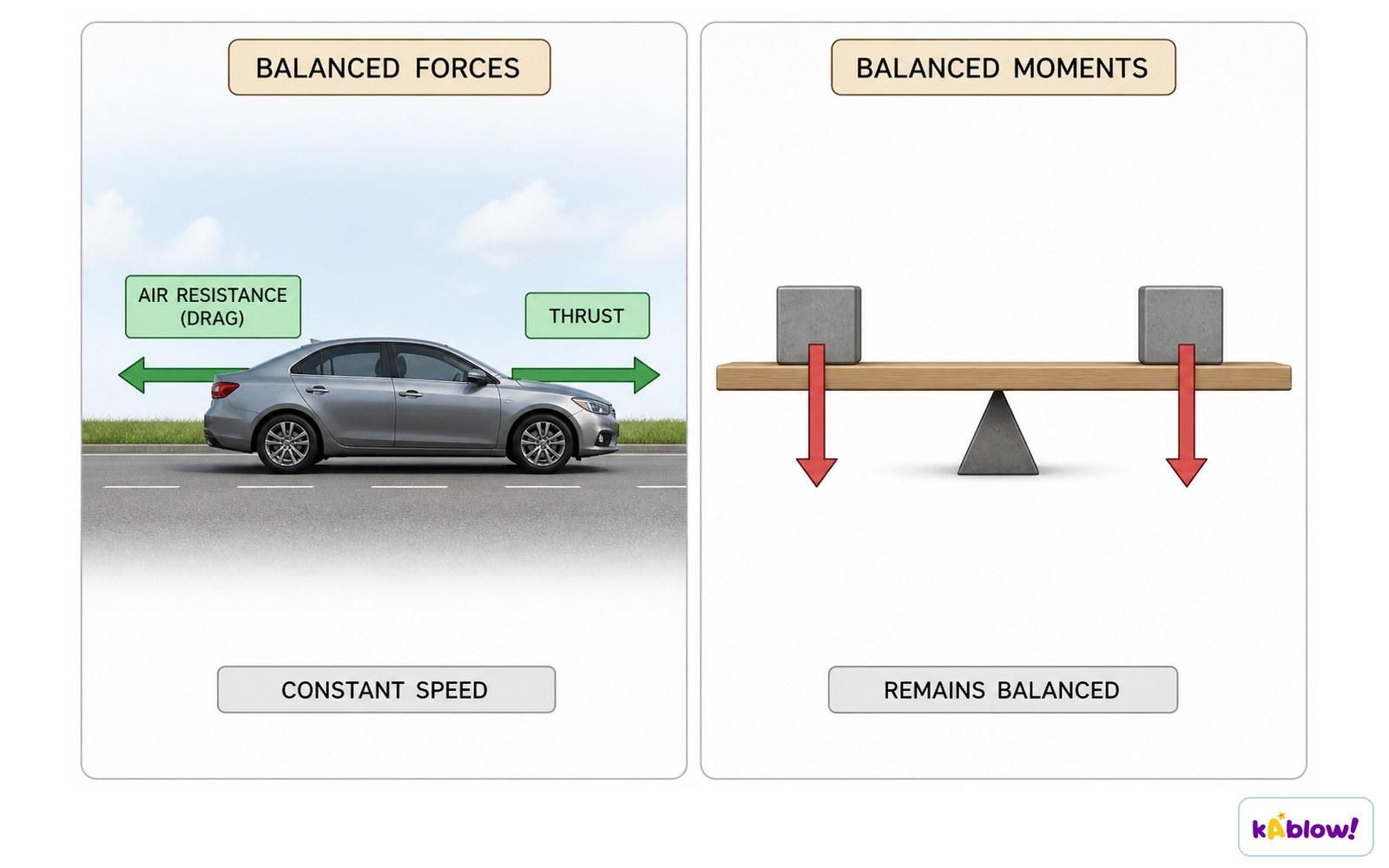
- Equilibrium means a state of balance or stability – no resultant force and no resultant moment.
- Conditions: (1) forces balanced (resultant force = 0), (2) clockwise moments = anticlockwise moments (resultant moment = 0).
- If either condition fails, the object will accelerate or rotate.
A car with balanced forces at constant speed, and a seesaw with balanced moments, illustrating equilibrium.
Centre of Gravity
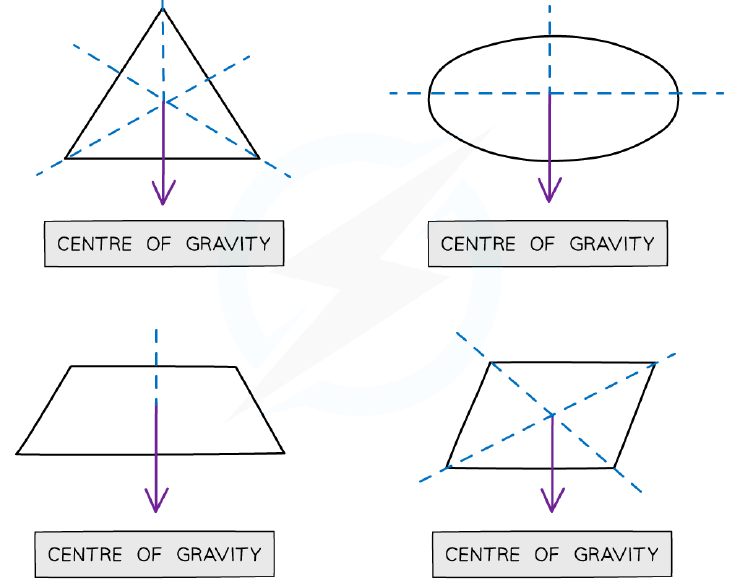
- Centre of gravity is the point through which the weight of an object acts.
- For symmetrical objects of uniform density, it lies at the centre of symmetry.
- The centre of gravity can lie inside or outside the object.
- In force diagrams, always draw weight from the centre of gravity.
Finding the centre of gravity of symmetrical shapes (triangle, ellipse, trapezium, parallelogram) using axes of symmetry.
Stability
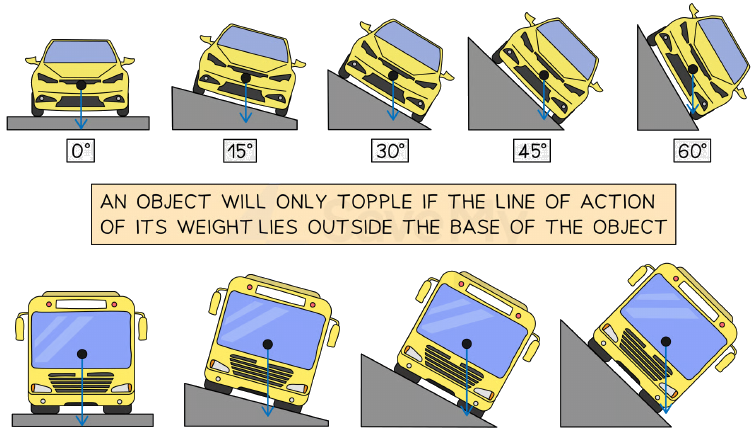
- An object is stable when its centre of gravity lies above its base.
- If the line of action of weight falls outside the base, the object topples.
- Stability increases with a low centre of gravity and a wide base.
- Tall, narrow objects (e.g., buses) are less stable and topple more easily.
Stability of vehicles on an incline
Investigating Centre of Gravity (Suspension Method)
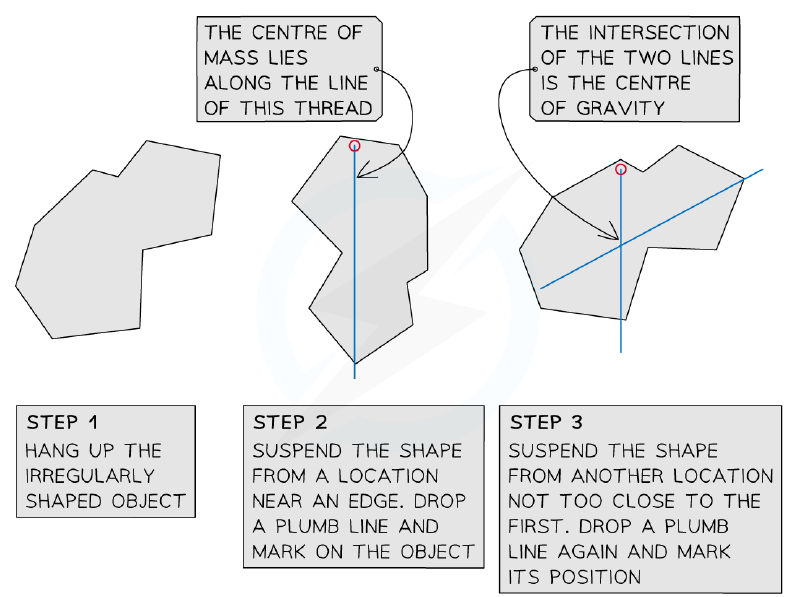
- Aim: find the centre of gravity of an irregularly shaped plane lamina.
- Method: punch 3 holes near edges, hang lamina from a clamp, use a plumb line to mark vertical line of weight.
- Repeat for each hole – the intersection of the three lines is the centre of gravity.
- When suspended, the object settles with its centre of gravity directly below the point of suspension.
- Avoid parallax error by viewing plumb line straight on; allow lamina to settle before marking.
The suspension method: an irregular lamina is hung and a plumb line marked from two different suspension points; the lines intersect at the centre of gravity.
Demonstrating Equilibrium (Extended Experiment)
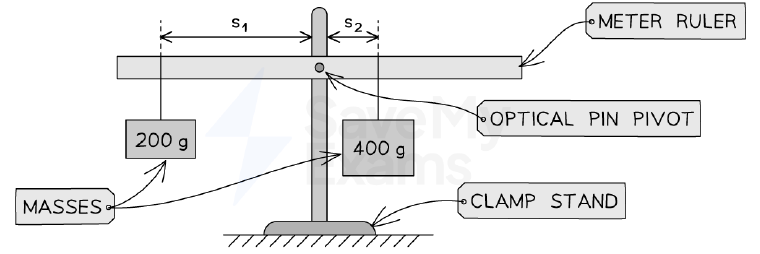
- Aim: show no resultant moment for an object in equilibrium.
- Use a metre ruler pivoted at its centre, hang unequal masses on cotton loops at different distances.
- Adjust distances until ruler is horizontal and balanced.
- Calculate anticlockwise moment (m1 × g × d1) and clockwise moment (m2 × g × d2).
- Results should show anticlockwise moment = clockwise moment for equilibrium.
- Control variables: equal cotton loop lengths, no friction at pivot.
Apparatus for the equilibrium experiment: a metre ruler balanced on an optical pin pivot with masses hung on cotton loops.
Slide
Sign up free to view the lesson slides
Step through every slide for this topic — plus flashcards and revision notes — with a free account.
Soal latihan
Pratinjau gratis — 8 dari 38 soal. Daftar untuk melihat semuanya.
1.What is the moment of a force?
Easy- AThe turning effect of a force about a pivot
- BThe speed at which a force is applied
- CThe energy transferred by a force
- DThe power output of a force
2.Which of the following is an example of the turning effect of a force?
Easy- AA child sitting on a see-saw
- BA book resting on a table
- CA ball rolling down a hill
- DA magnet attracting a nail
3.What is the unit of a moment?
Easy- Anewton metre (N m)
- Bnewton (N)
- Cmetre (m)
- Djoule (J)
4.A force of 10 N acts at a perpendicular distance of 0.5 m from a pivot. What is the moment?
Easy- A5 N m
- B20 N m
- C0.5 N m
- D10.5 N m
5.A uniform metre rule is balanced at its midpoint. A 2.0 N weight is placed 30 cm from the pivot on the left. Where must a 3.0 N weight be placed on the right to balance the rule?
Medium- A20 cm from the pivot
- B30 cm from the pivot
- C45 cm from the pivot
- D15 cm from the pivot
6.The principle of moments states that for an object in equilibrium:
Medium- Atotal clockwise moment = total anticlockwise moment
- Btotal clockwise moment > total anticlockwise moment
- Ctotal clockwise moment < total anticlockwise moment
- Dthe sum of forces is zero
7.An object will topple over when:
Medium- Aits centre of gravity lies outside its base
- Bits centre of gravity is directly above its base
- Cits base is very wide
- Dits centre of gravity is low
8.Which of the following increases the stability of an object?
Medium- ALowering its centre of gravity
- BRaising its centre of gravity
- CMaking its base narrower
- DMaking it taller
Unlock all 38 questions & more
Buat akun gratis untuk melihat setiap soal, slide, kartu flash, dan catatan ulasan topik ini.