Physical Quantities & Measurement Techniques
Belajar sambil bermain
Jawab soal-soal ini untuk dapat energi, lalu memancing dan menjelajah. Tanpa akun.
Catatan pelajaran
Measuring Length
- Use a ruler for small distances (cm), accurate to nearest millimetre (mm).
- Use a tape measure for lengths of tens of centimetres.
- Use a trundle wheel for lengths of tens of metres.
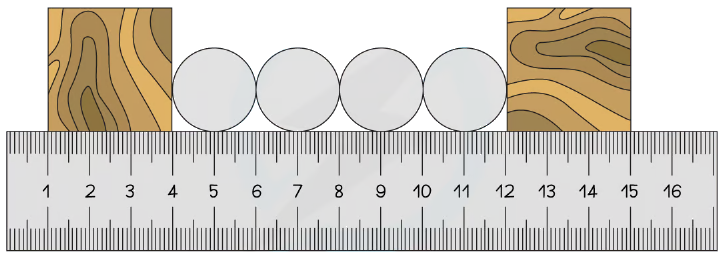
- For small objects, measure multiple (e.g., 4 ball-bearings) and divide by the number to find one diameter.
Measuring the diameter of small objects using a ruler
Measuring Volume
- Measuring cylinders measure liquid volume; read from bottom of meniscus at eye level.
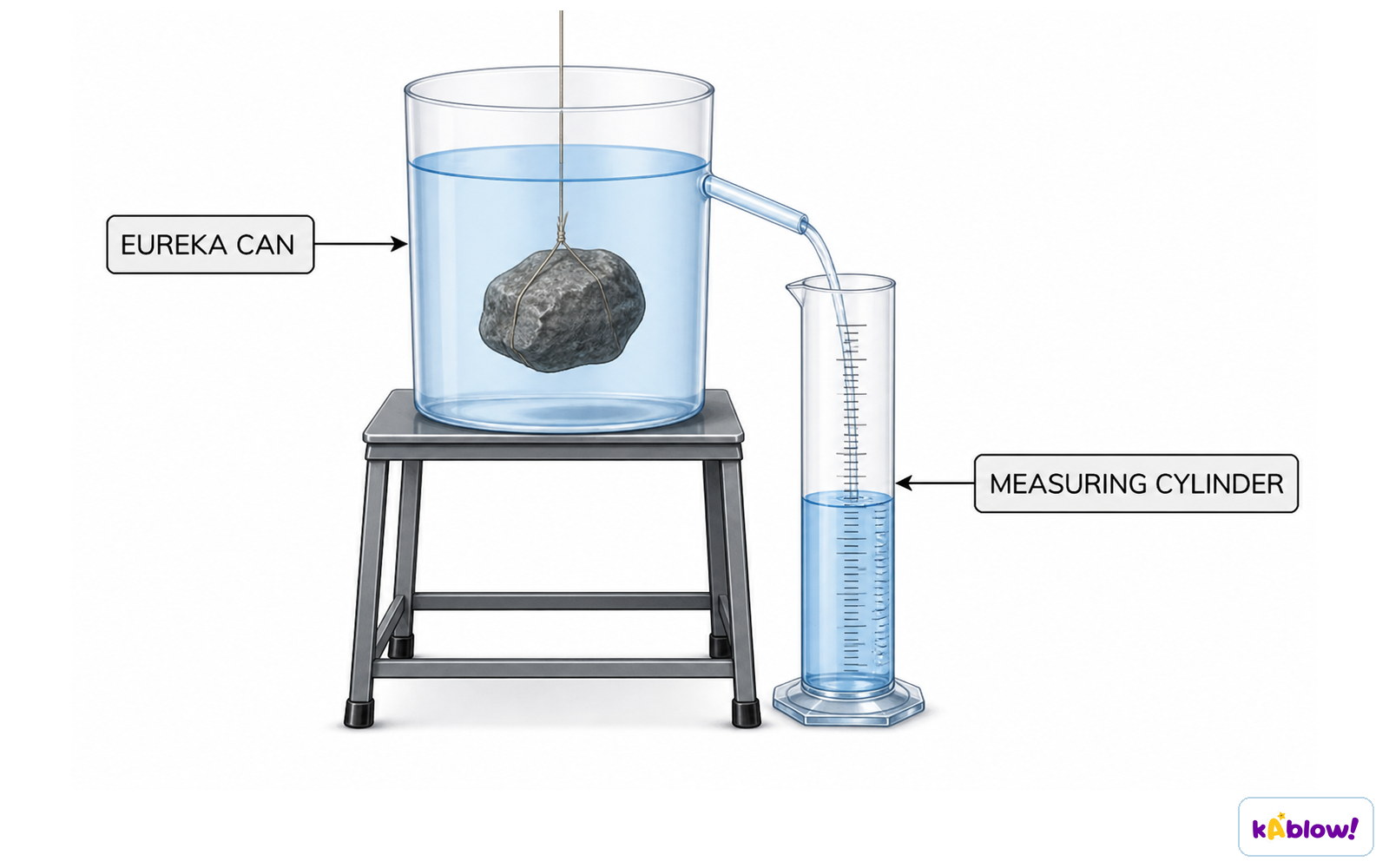
- Volume of an irregular solid is found by displacement: record initial and final water levels, subtract.
- For small objects, use a smaller cylinder for greater accuracy.
Measuring the volume of an irregular object by displacement
Measuring Time
- Use stop-clocks or stopwatches for time intervals.
- Human reaction time (~0.25 s) affects short measurements.
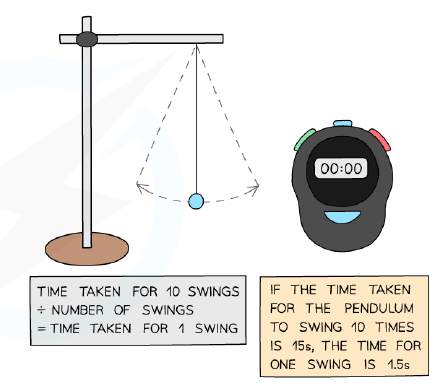
- Take multiple readings (e.g., time for 10 pendulum swings) and divide to reduce uncertainty.
- Use a fiducial marker (e.g., a dot at equilibrium) to improve timing accuracy.
Measuring time with a stopwatch and a swinging pendulum
Scalars & Vectors (Extended)
- Scalars have only magnitude (e.g., mass, distance, speed, energy).
- Vectors have both magnitude and direction (e.g., weight, displacement, velocity, force).
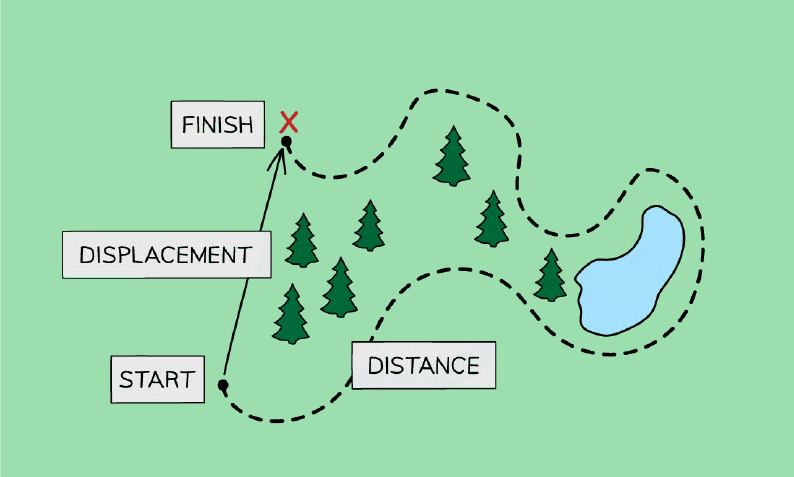
- Distance is total path length (scalar); displacement is straight line from start to finish (vector).
- Speed is distance per time (scalar); velocity is displacement per time (vector).
Illustration of distance vs. displacement
Calculating with Vectors (Extended)
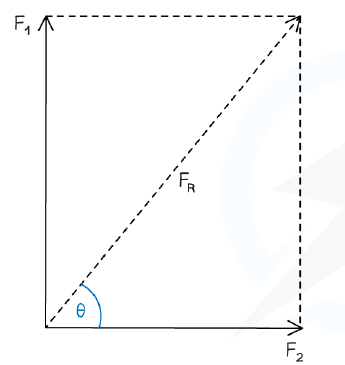
- Vectors are drawn as arrows: length = magnitude, direction = arrow direction.
- To combine two perpendicular vectors, draw a vector diagram (scale drawing) or use Pythagoras and trigonometry.
- Resultant vector = diagonal of rectangle formed by components.
- Use soh-cah-toa to find angles; Pythagoras for magnitude.
Vector diagram of two perpendicular forces resolved into a resultant force
Slide
Sign up free to view the lesson slides
Step through every slide for this topic — plus flashcards and revision notes — with a free account.
Soal latihan
Pratinjau gratis — 8 dari 40 soal. Daftar untuk melihat semuanya.
1.Which of the following is a scalar quantity?
Easy- Adistance
- Bdisplacement
- Cvelocity
- Dacceleration
2.Which instrument is most suitable for measuring the thickness of aluminium foil?
Easy- Aruler
- Btape measure
- Cmicrometer screw gauge
- Dmeasuring cylinder
3.A student measures the time for 20 oscillations of a pendulum as 30.0 s. What is the period of the pendulum?
Easy- A0.67 s
- B1.5 s
- C10.0 s
- D20.0 s
4.A geologist uses a measuring cylinder containing water to find the volume of an irregular pebble. The water level rises from 40 cm³ to 57 cm³. What is the volume of the pebble?
Medium- A17 cm³
- B23 cm³
- C40 cm³
- D57 cm³
5.A student wants to measure the volume of a liquid as accurately as possible. Which procedure would make the measurement less accurate?
Medium- AAligning her eye level with the height of the liquid
- BReading the liquid level from the bottom of the meniscus
- CUsing the largest measuring cylinder she could find
- DUsing a set-square to make sure the cylinder is vertical
6.A boat travels 30 km east then 40 km north. What is the magnitude of its displacement?
Medium- A50 km
- B70 km
- C10 km
- D1400 km
7.A student uses a stopwatch to time 40 complete swings of a pendulum. The total time is 1 minute 52 seconds. What is the period of the pendulum?
Hard- A2.8 s
- B1.4 s
- C5.6 s
- D1.9 s
8.Three blocks X, Y, Z are placed in separate measuring cylinders. The water level rises by 10 cm³ for X, 15 cm³ for Y, and 8 cm³ for Z. Which shows the blocks in order of increasing volume?
Hard- AZ, X, Y
- BX, Y, Z
- CY, X, Z
- DZ, Y, X
Unlock all 40 questions & more
Buat akun gratis untuk melihat setiap soal, slide, kartu flash, dan catatan ulasan topik ini.