Radioactivity
Belajar sambil bermain
Jawab soal-soal ini untuk dapat energi, lalu memancing dan menjelajah. Tanpa akun.
Catatan pelajaran
Background Radiation
- Background radiation is the radiation that exists around us all the time.
- Natural sources: radon gas (in air), rocks and buildings, food and drink, cosmic rays.
- Man-made sources: medical X-rays, nuclear waste, nuclear fallout, nuclear accidents.
- The count rate (decays per second) is measured using a Geiger-Müller tube.
- To correct for background radiation, measure count rate with no source and subtract from readings with source.
Types of Radiation
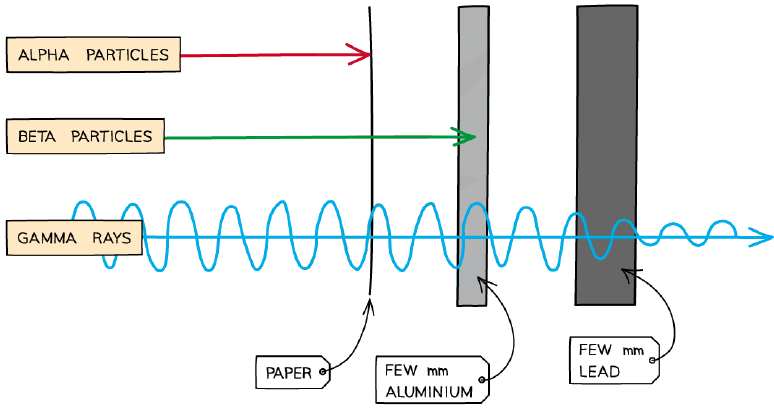
- α (α): helium nucleus (2 protons, 2 neutrons), charge +2, range a few cm in air, stopped by paper, highly ionising.
- β (β): high-speed electron, charge -1, range tens of cm in air, stopped by a few mm of aluminium, moderately ionising.
- Gamma (γ): electromagnetic wave, no charge, infinite range in air, reduced by thick lead, weakly ionising.
- Radioactive decay is spontaneous and random – cannot predict which nucleus will decay next.
Penetrating power of alpha, beta, and gamma radiation
Ionising Power & Deflection
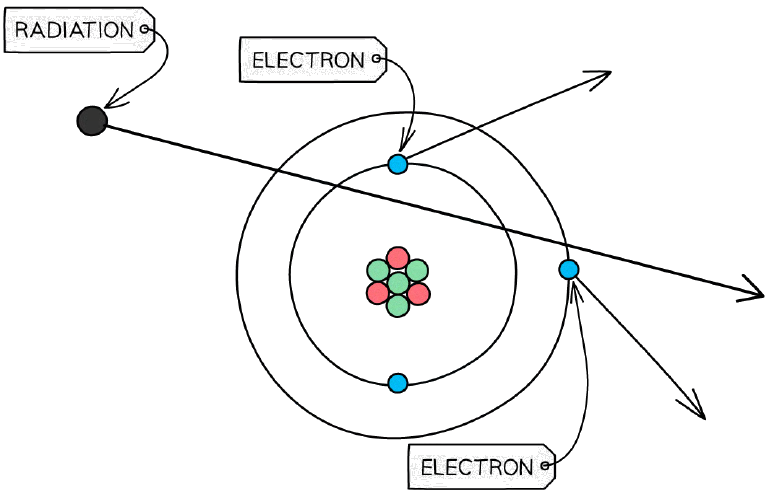
- Ionisation is the removal of an electron from an atom, creating an ion.
- α is most ionising (charge +2, large mass); β is moderate (charge -1); gamma is least (no charge).
- In an electric field: α deflects towards negative plate, β towards positive plate, γ undeflected.
- In a magnetic field: α and β deflect in opposite directions (due to opposite charges); γ undeflected.
- β deflects more than α because β has much smaller mass.
Ionisation of an atom by radiation
Radioactive Decay
- α decay: nucleus emits α-particle (₂⁴He). Mass number decreases by 4, atomic number decreases by 2.
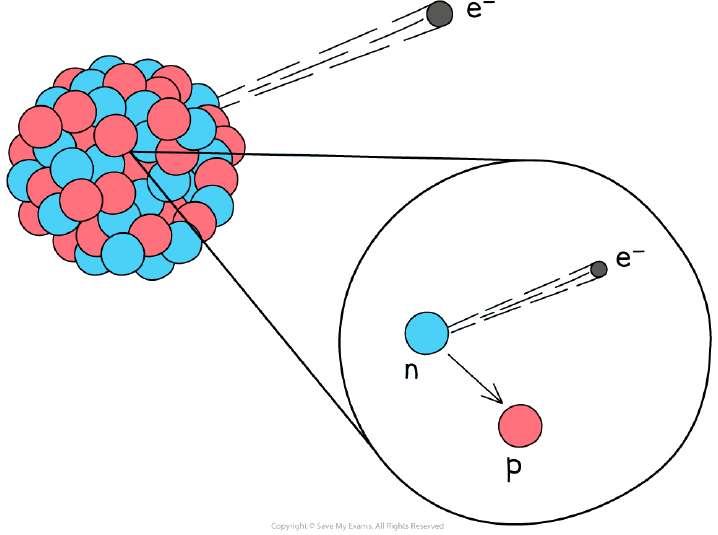
- β decay: neutron changes into proton and electron; electron (β⁻) is emitted. Atomic number increases by 1, mass number unchanged.
- Gamma decay: nucleus emits γ-ray; no change in mass or atomic number, only energy reduces.
- Decay equations must balance mass and atomic numbers on both sides.
- Example: ₈₄²¹²Po → ₈₂²⁰⁸Pb + ₂⁴α
Beta decay process showing a neutron transforming into a proton and emitting an electron
Half-Life
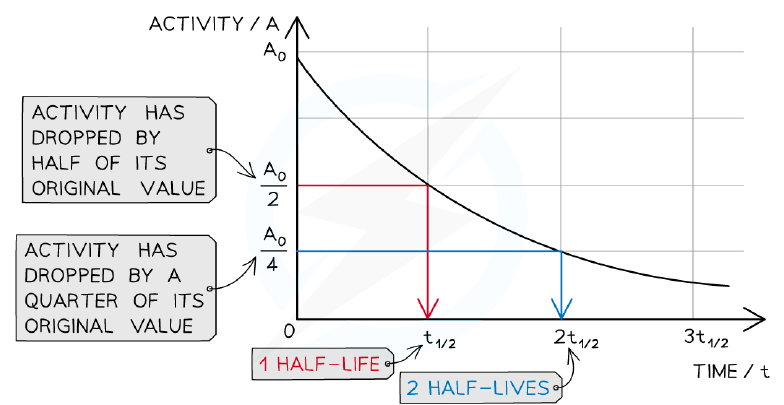
- Half-life is the time taken for half the nuclei in a sample to decay.
- It is constant for a given isotope and unaffected by conditions.
- Half-life can be found from an activity–time graph: read time for activity to halve.
- Correct for background radiation before calculating half-life.
- After n half-lives, fraction remaining = (½)ⁿ.
A half-life graph showing activity falling from A0 to A0/2 to A0/4
Uses of Radiation
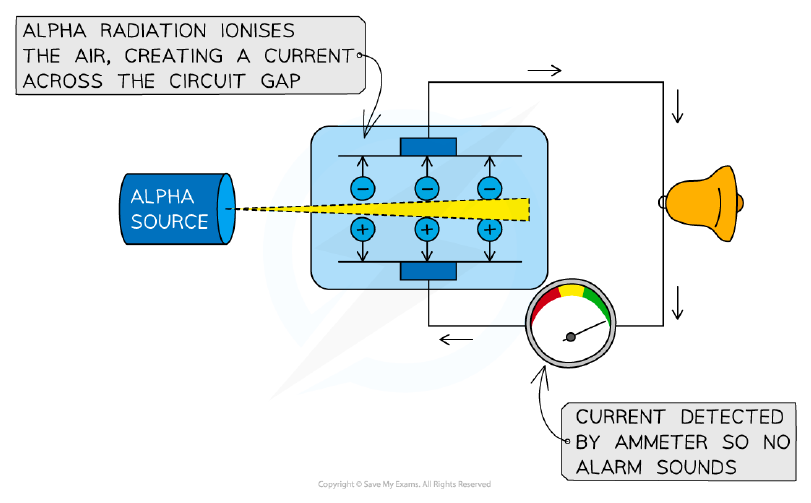
- α: smoke detectors – α ionises air, smoke absorbs α, triggers alarm.
- β: measuring thickness of thin materials (e.g., paper, aluminium foil) – absorption varies with thickness.
- Gamma: sterilising medical equipment (penetrating, kills microbes), irradiating food, radiotherapy for cancer.
- Tracers: short half-life gamma emitters used in PET scans to diagnose cancer.
How a smoke detector works using alpha radiation
Dangers of Radiation
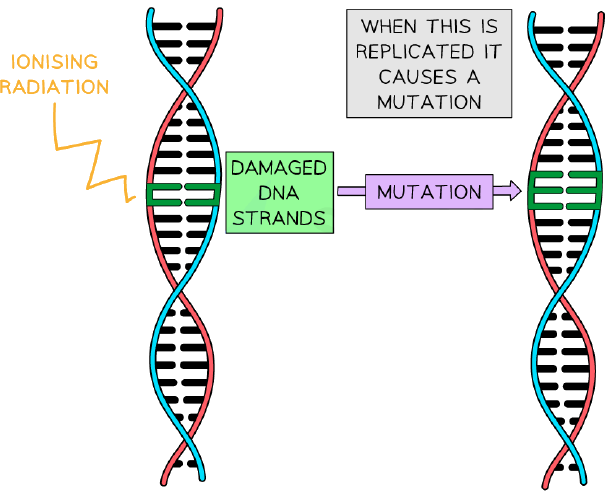
- Ionising radiation can damage DNA, causing cell death, mutations, or cancer.
- High doses cause skin burns and reduce white blood cells (weakened immune system).
- Safe handling: store in lead-lined boxes, use tongs, minimise time, maximise distance.
- Shielding (lead, concrete, water) absorbs radiation; radiologists stand behind barriers.
- Radioactive waste with long half-life is buried deep underground.
Ionising radiation damaging DNA strands and causing a mutation
Slide
Sign up free to view the lesson slides
Step through every slide for this topic — plus flashcards and revision notes — with a free account.
Soal latihan
Pratinjau gratis — 8 dari 39 soal. Daftar untuk melihat semuanya.
1.Which of the following is a natural source of background radiation?
Easy- ARadon gas
- BMedical X-rays
- CNuclear waste
- DNuclear fallout
2.What is the main reason radioactive sources are stored in lead-lined containers?
Easy- ATo reduce the amount of radiation emitted, protecting people nearby
- BTo increase the rate of radioactive decay
- CTo prevent the source from getting cold
- DTo stop the source from moving
3.Which type of radiation is the most ionising?
Easy- Aα particles
- Bβ particles
- CGamma rays
- DNeutrons
4.Which statement about radioactive decay is correct?
Easy- AIt is a random process and cannot be predicted when a particular nucleus will decay
- BThe rate of decay increases if the substance is heated
- CPlacing a radioactive substance in a lead box prevents it from decaying
- DThe decay always produces poisonous gases
5.A radioactive source has a half-life of 0.5 hours. A detector near the source shows a reading of 6000 counts per second. Background radiation can be ignored. What is the reading on the detector 1.5 hours later?
Medium- A750 counts per second
- B1500 counts per second
- C2000 counts per second
- D3000 counts per second
6.A student measures 210 counts in 3 minutes from a radioactive source. The background count rate is 20 counts per minute. What is the corrected count rate for the source?
Medium- A50 counts per minute
- B70 counts per minute
- C190 counts per minute
- D270 counts per minute
7.A nucleus of radium-226 (⁸⁸²²⁶Ra) undergoes α decay. What are the nucleon number and proton number of the new nucleus formed?
Medium- ANucleon number 222, proton number 86
- BNucleon number 222, proton number 88
- CNucleon number 224, proton number 87
- DNucleon number 230, proton number 90
8.Which type of radiation is most suitable for measuring the thickness of thin aluminium foil in a manufacturing process?
Medium- Aβ particles
- Bα particles
- CGamma rays
- DNeutrons
Unlock all 39 questions & more
Buat akun gratis untuk melihat setiap soal, slide, kartu flash, dan catatan ulasan topik ini.