Thermal Properties & Temperature
Belajar sambil bermain
Jawab soal-soal ini untuk dapat energi, lalu memancing dan menjelajah. Tanpa akun.
Catatan pelajaran
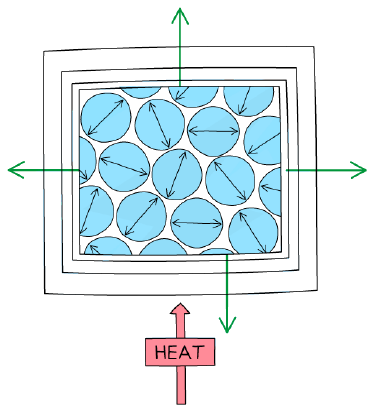
Thermal Expansion
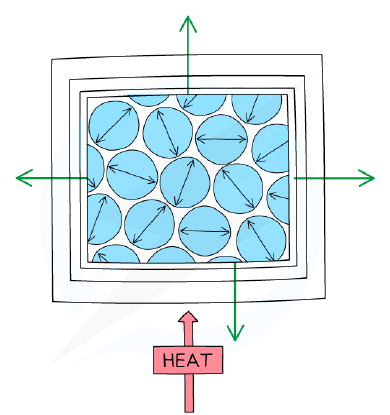
- When a material is heated at constant pressure, its temperature increases, volume expands, and density decreases.
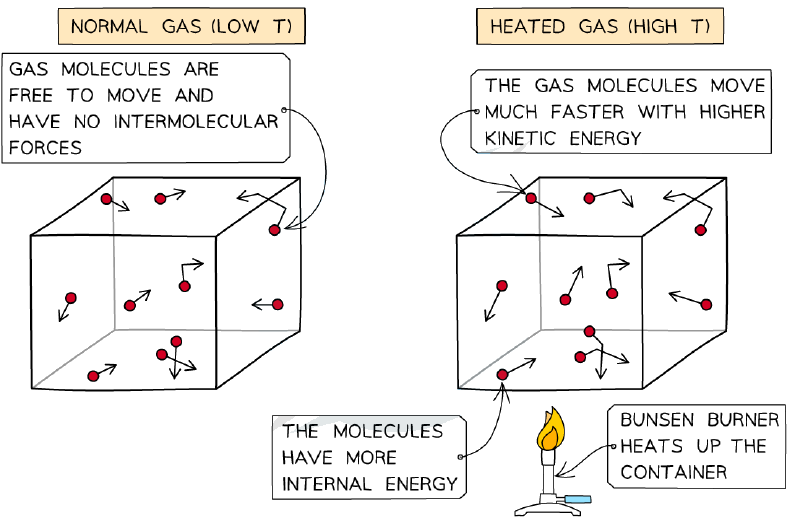
- Expansion occurs because molecules gain kinetic energy, vibrate/move faster, and push each other apart.
- Solids expand the least, gases expand the most, and liquids are in between.
- Useful applications: liquid-in-glass thermometers (liquid expands in capillary tube) and bimetallic strips (two metals expand at different rates, bending to close a circuit).
- Undesirable consequences: buckling of railway tracks, road surfaces, and bridges; gaps are built in to allow expansion.
Thermal expansion diagram
Specific Heat Capacity
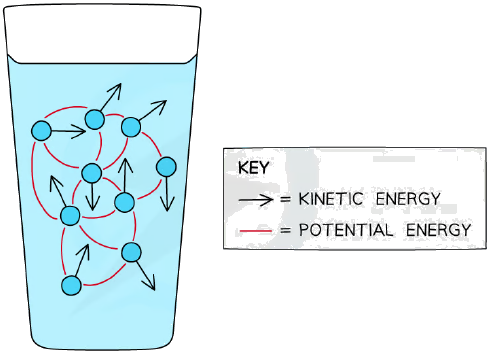
- Internal energy is the total energy stored in a system due to particle motion (kinetic) and positions (potential).
- Temperature is a measure of the average kinetic energy of particles.
- Specific heat capacity (c) is the energy required to raise the temperature of 1 kg of a substance by 1 °C.
- Low c → heats up/cools down quickly; high c → heats up/cools down slowly.
- Equation: \Delta E = m c \Delta \θ , where \Delta E in J, m in kg, c in J/kg°C, \Delta \θ in °C.
Kinetic and potential energy of particles in a liquid
Investigating Specific Heat Capacity
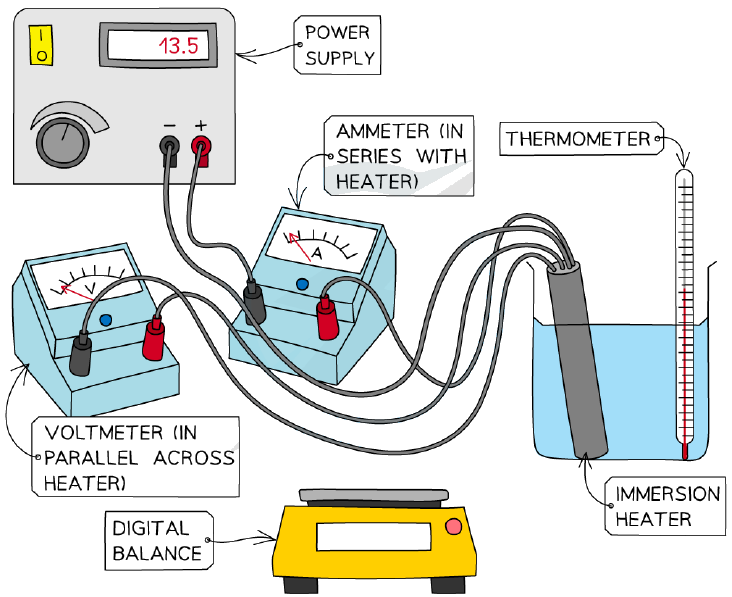
- Aim: determine specific heat capacity by measuring energy supplied (E = IVt) and temperature change.
- Independent variable: time; dependent variable: temperature; control: material, current, voltage.
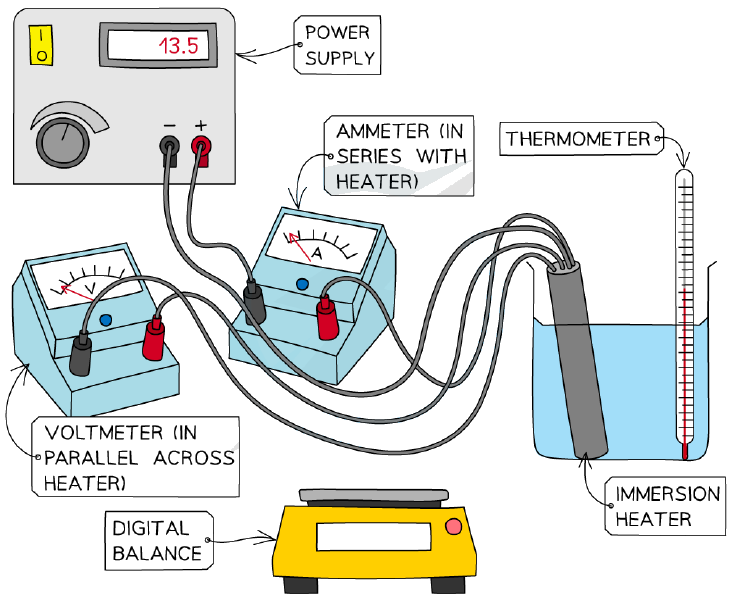
- Equipment: thermometer, immersion heater, beaker/block, ammeter, voltmeter, power supply, digital balance, stopwatch.
- Method: record mass, initial temperature, then heat while recording current, voltage, and temperature every 60 s for 10 min.
- Calculate \Delta E = IV\Delta t and c = \Delta E / (m \Delta \θ).
- Systematic errors: zero balance, account for evaporation; random errors: stir water, be consistent with fluctuating readings.
Apparatus for investigating specific heat capacity
Melting & Boiling
- Fixed points of pure water: melting point = 0 °C, boiling point = 100 °C at atmospheric pressure.
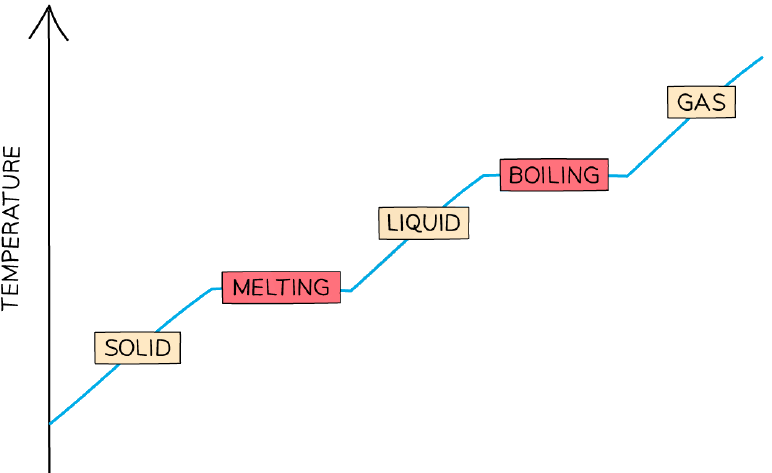
- During a change of state (melting/boiling), temperature remains constant even though energy is still being transferred.
- Energy goes into overcoming intermolecular forces (potential energy), not increasing kinetic energy.
- Boiling occurs at the boiling point throughout the liquid; melting occurs at the melting point as solid becomes liquid.
- Condensation (gas→liquid) and solidification (liquid→solid) also occur at constant temperature as energy is removed.
Heating curve showing changes of state
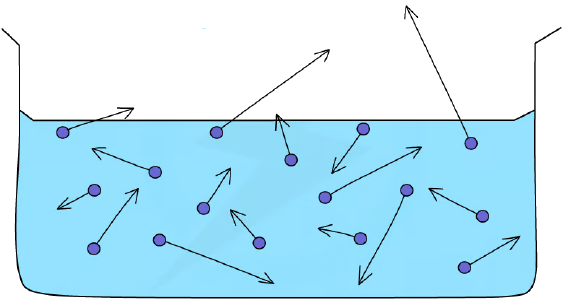
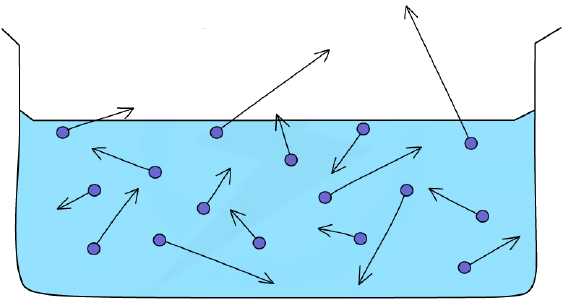
Evaporation
- Evaporation is a change from liquid to gas that occurs at any temperature and only from the surface.
- More energetic molecules near the surface escape, reducing the average kinetic energy → liquid cools.
- Rate of evaporation increases with: higher temperature, larger surface area, and greater air movement.
- Evaporation vs boiling: evaporation at any temperature, only at surface; boiling at boiling point, throughout liquid.
Evaporation of liquid molecules
Slide
Sign up free to view the lesson slides
Step through every slide for this topic — plus flashcards and revision notes — with a free account.
Soal latihan
Pratinjau gratis — 8 dari 56 soal. Daftar untuk melihat semuanya.
1.What are the upper and lower fixed points on a Celsius scale thermometer?
Easy- AThe boiling point of pure water and the freezing point of pure water
- BThe boiling point of saturated salt solution and the freezing point of salt-water
- CThe normal temperature of the human body and the freezing point of salt-water
- DThe boiling point of pure water and absolute zero
2.The diagram shows heating. If the process is reversed, what change of state occurs at the higher plateau?
Medium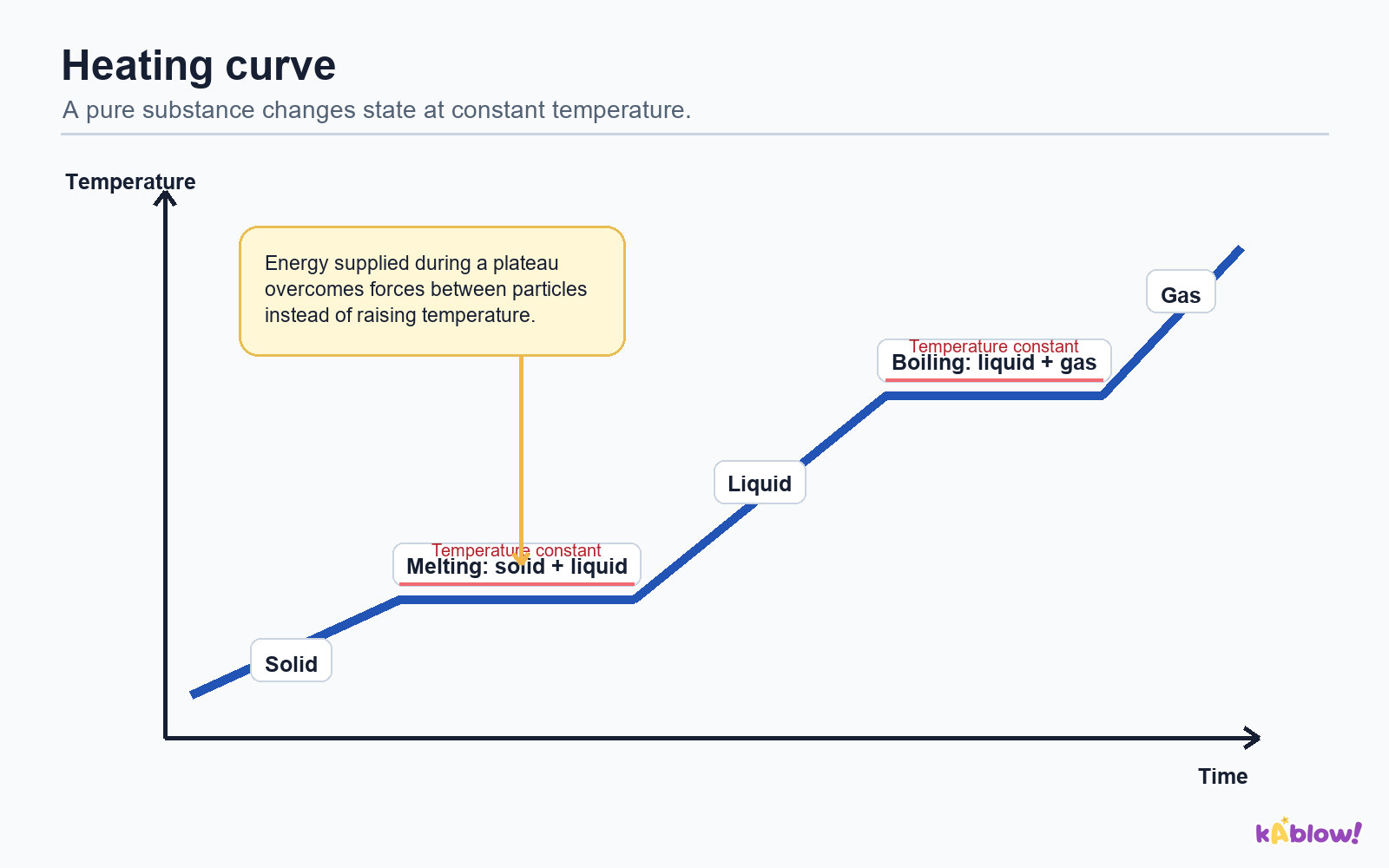
- AFreezing
- BMelting
- CCondensation
- DSublimation
3.Which statement best describes a metal experiencing thermal expansion?
Easy- AThe molecules increase in size.
- BThe molecules vibrate more and move further apart.
- CThe molecules expand and become larger.
- DThe molecules decrease in density.
4.When a substance is melting, what happens to its temperature and internal energy?
Medium- ATemperature increases, internal energy increases.
- BTemperature remains constant, internal energy increases.
- CTemperature remains constant, internal energy decreases.
- DTemperature increases, internal energy remains constant.
5.Which of the following is a correct unit for specific heat capacity?
Easy- AJ / kg
- BJ / °C
- CJ / (kg °C)
- DJ kg °C
6.The specific heat capacity of water is 4200 J/(kg °C). How much energy is required to raise the temperature of 2.0 kg of water by 5.0 °C?
Medium- A42000 J
- B21000 J
- C8400 J
- D16800 J
7.In an experiment to determine the specific heat capacity of a metal block, a student uses an immersion heater. Which of the following is the correct equation to calculate the energy supplied to the block?
Easy- AE = IVt
- BE = IRt
- CE = V/It
- DE = I2Vt
8.A student investigates the cooling of water. The results show that the rate of cooling is greater when the water is hotter. Which statement explains this?
Medium- AHotter water has a higher specific heat capacity.
- BHotter water evaporates more quickly, removing more thermal energy.
- CHotter water expands, increasing its surface area.
- DHotter water has a lower density, so it rises and cools faster.
Unlock all 56 questions & more
Buat akun gratis untuk melihat setiap soal, slide, kartu flash, dan catatan ulasan topik ini.