Rates of reaction
Belajar sambil bermain
Jawab soal-soal ini untuk dapat energi, lalu memancing dan menjelajah. Tanpa akun.
Catatan pelajaran
What is Rate of Reaction?
- Rate of reaction is how quickly a chemical reaction takes place.
- It depends on the frequency of successful collisions between reacting particles.
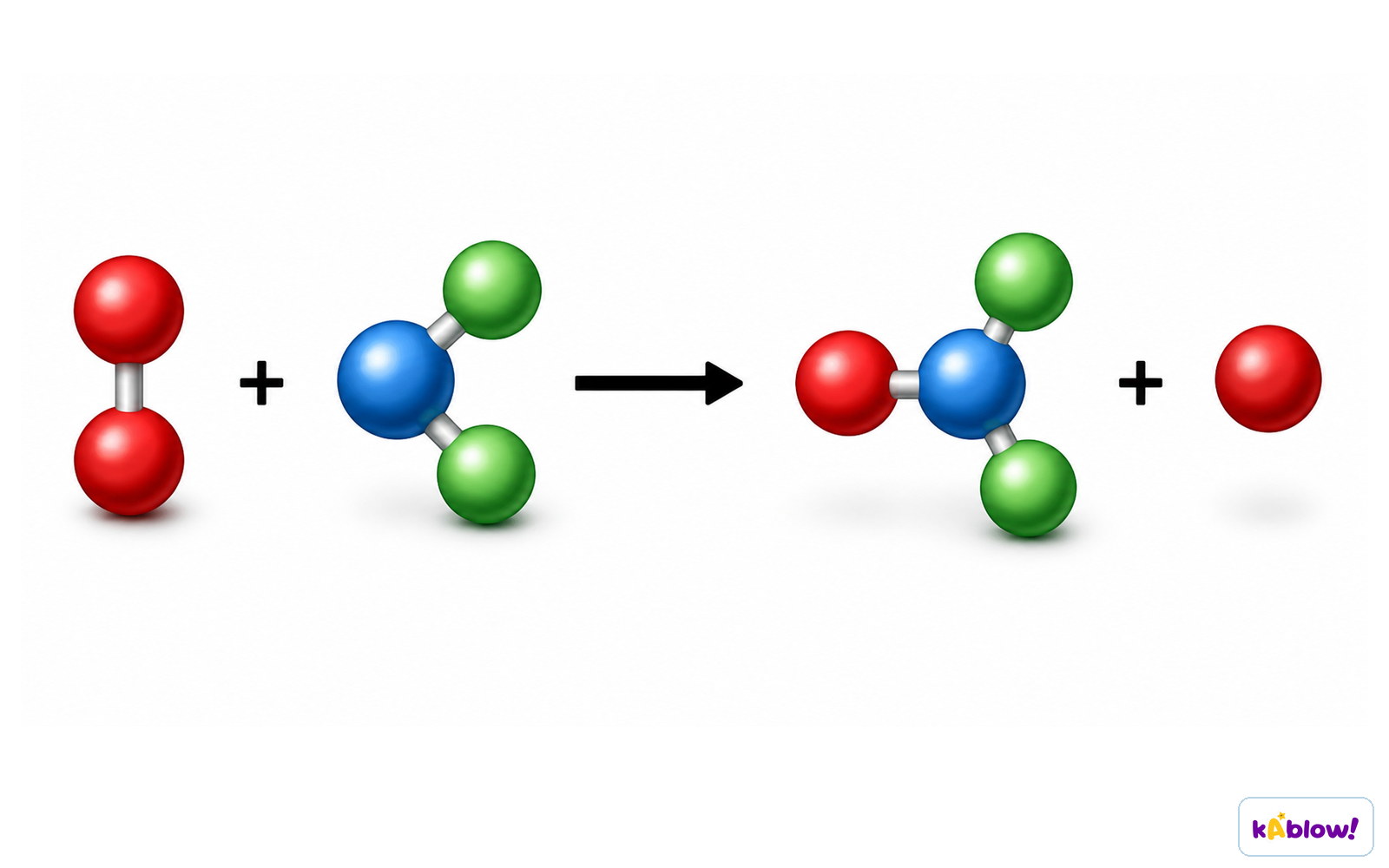
- A successful collision has enough energy and correct orientation to react.
A successful collision has enough energy to break bonds, so the reactant particles rearrange to form the products.
Factors Affecting Rate of Reaction
- Temperature: Higher temperature → particles move faster → more frequent and energetic collisions → faster rate.
- Concentration/Pressure: Higher concentration or pressure → more particles in same volume → more collisions → faster rate.
- Surface Area: Breaking solid into smaller pieces increases surface area to volume ratio → more collisions on surface → faster rate.
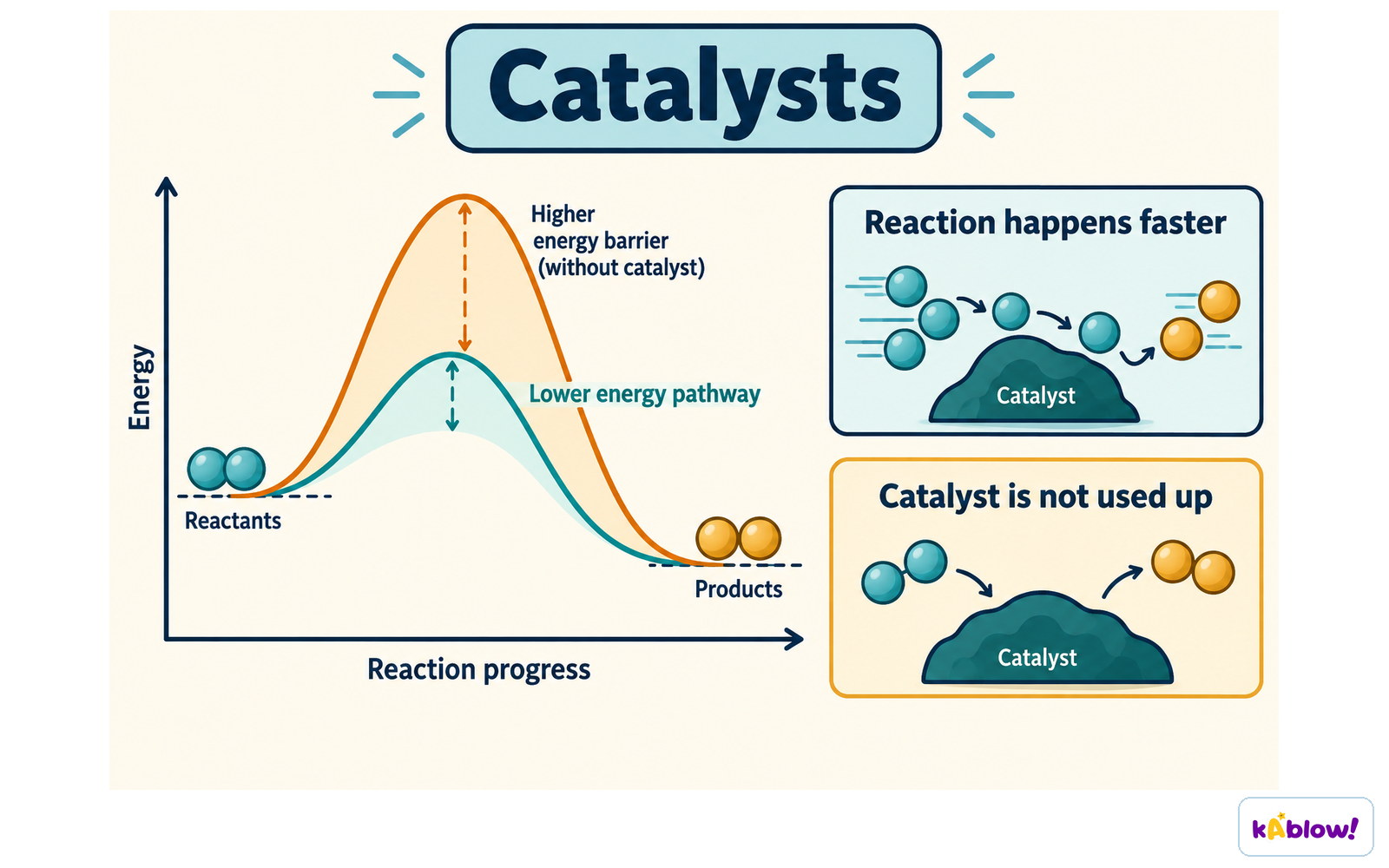
- Catalyst: A substance that increases rate without being used up; provides an alternative pathway with lower activation energy.
A catalyst provides a pathway with lower activation energy. It speeds up the reaction without being used up.
Measuring Rate of Reaction
- Change in mass: For reactions producing a gas, measure mass loss over time (e.g., magnesium + hydrochloric acid → hydrogen gas escapes).
- Volume of gas: Collect gas in a gas syringe and measure volume produced over time.
- Precipitation: Time how long for a precipitate to form (e.g., sodium thiosulfate + HCl → yellow sulfur; use a black cross to observe cloudiness).
- Colour change: Time how long for a colour change to occur.
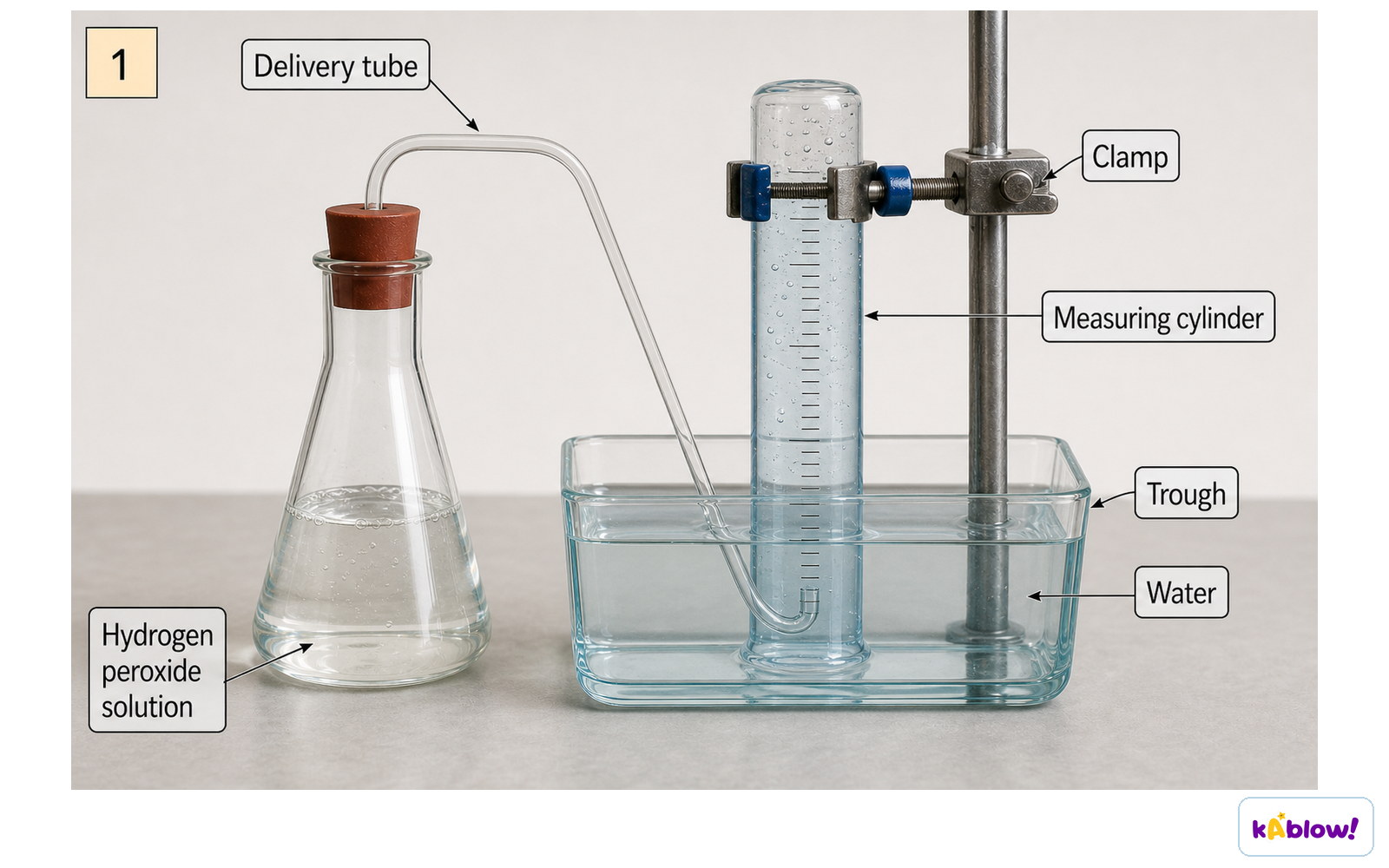
Hydrogen peroxide solution is connected by a delivery tube to an inverted, water-filled measuring cylinder so the volume of oxygen gas produced can be measured over a fixed time.
Example: Magnesium and Hydrochloric Acid
- Reaction: Mg + 2HCl → MgCl₂ + H₂ (hydrogen gas produced).
- Rate can be measured by mass loss (escaping hydrogen) or gas volume in a syringe.
- Using magnesium powder (higher surface area) gives a faster rate than large pieces.
Example: Sodium Thiosulfate and Hydrochloric Acid
- Reaction: Na₂S₂O₃ + 2HCl → 2NaCl + SO₂ + S + H₂O (yellow sulfur precipitate).
- Place flask over a black cross; time until cross is no longer visible due to cloudiness.
- Increasing concentration or temperature of HCl increases rate (faster precipitation).
Particle arrangement in solids, liquids, and gases. In solids, particles are closely packed in a regular pattern; in liquids, they are close but irregular; in gases, they are far apart and move randomly. Higher temperature increases particle speed and collision frequency.
Slide
Sign up free to view the lesson slides
Step through every slide for this topic — plus flashcards and revision notes — with a free account.
Soal latihan
Pratinjau gratis — 8 dari 54 soal. Daftar untuk melihat semuanya.
1.What is meant by the term 'rate of reaction'?
Easy- AHow quickly a chemical reaction takes place
- BThe amount of product formed in a reaction
- CThe temperature at which a reaction occurs
- DThe energy released during a reaction
2.Which of the following statements is true?
Medium- AParticles at a higher temperature move more quickly.
- BA catalyst is used up during a chemical reaction.
- CBreaking a solid into smaller pieces decreases its surface area to volume ratio.
- DThe rate of reaction does not depend on the frequency of successful collisions.
3.What is a catalyst?
Easy- AA substance that increases the rate of reaction without being used up
- BA substance that slows down a reaction
- CA substance that is consumed in a reaction
- DA substance that increases the activation energy
4.Which of the following methods can be used to measure the rate of a reaction that produces a gas?
Medium- AMeasuring the change in mass
- BObserving a colour change
- CUsing a light sensor to detect precipitate formation
- DTiming the appearance of a precipitate
5.In the reaction between sodium thiosulfate and hydrochloric acid, what is observed as the reaction proceeds?
Easy- AA yellow sulfur precipitate forms, making the solution cloudy
- BA colourless gas is produced
- CThe solution turns blue
- DThe mass of the reaction mixture increases
6.Increasing the concentration of a reactant increases the rate of reaction because:
Medium- AThere are more particles in the same volume, leading to more frequent collisions
- BThe particles move faster
- CThe activation energy is lowered
- DThe particles have more energy
7.Which of the following would increase the rate of reaction between magnesium and hydrochloric acid?
Medium- AUsing magnesium powder instead of large pieces
- BDecreasing the temperature
- CUsing a more dilute hydrochloric acid
- DUsing a larger volume of the same concentration of acid
8.In an experiment to measure the rate of reaction between magnesium and hydrochloric acid, which method would be most appropriate?
Medium- AMeasuring the volume of hydrogen gas produced over time using a gas syringe
- BObserving the colour change of the solution
- CUsing a light sensor to detect precipitate formation
- DMeasuring the increase in mass of the reaction mixture
Unlock all 54 questions, flashcards & more
Buat akun gratis untuk melihat setiap soal, slide, kartu flash, dan catatan ulasan topik ini.