Terminal velocity
Belajar sambil bermain
Jawab soal-soal ini untuk dapat energi, lalu memancing dan menjelajah. Tanpa akun.
Catatan pelajaran
Key Concepts
- Newton's first law: An object's speed stays constant unless a resultant force acts on it.
- Newton's second law: Acceleration is proportional to the resultant force; larger force → larger acceleration.
- Newton's third law: Forces between two objects are equal in size and opposite in direction.
- Terminal velocity is the maximum constant speed reached when forces are balanced.
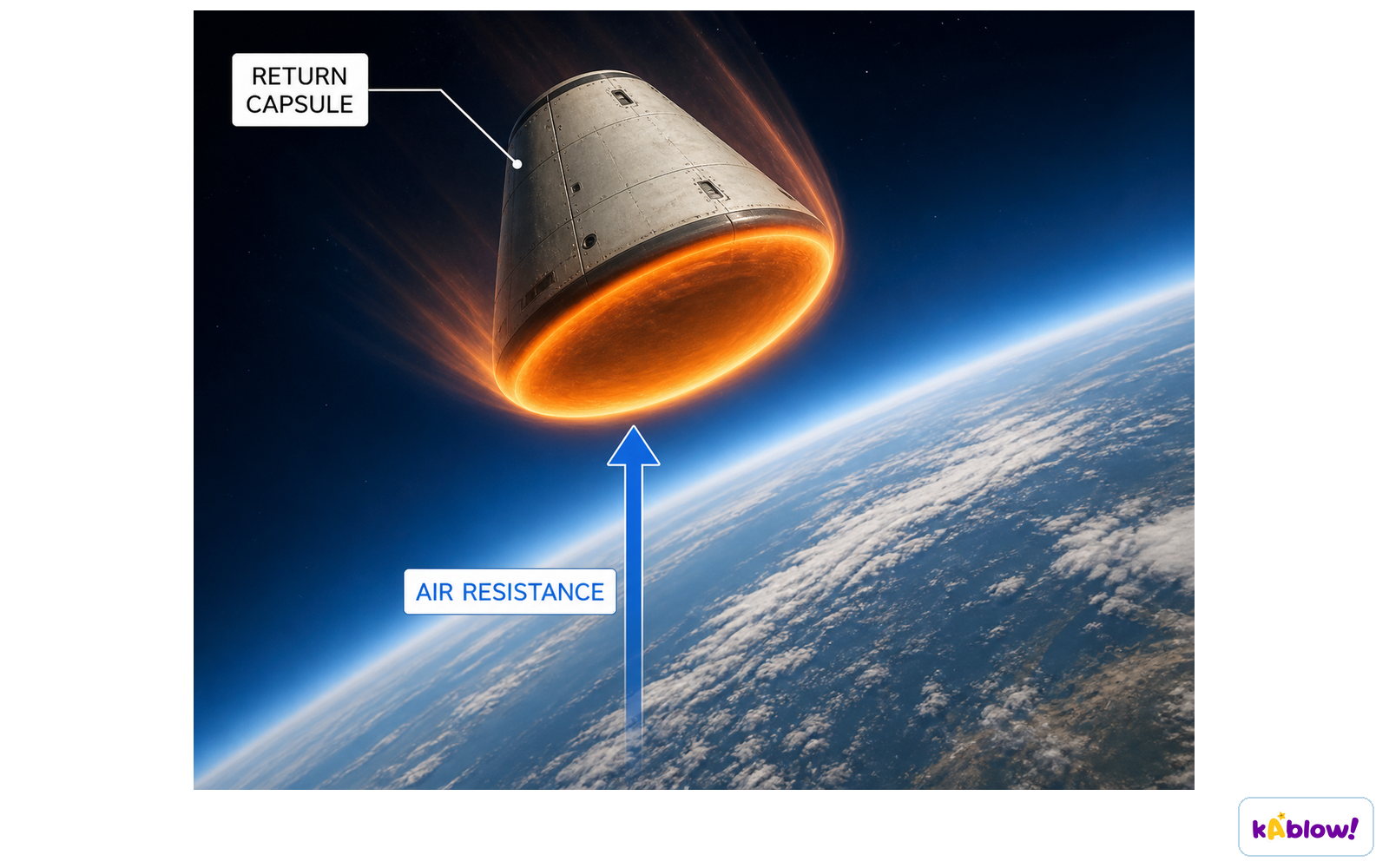
Air resistance is a type of drag: it opposes motion through a fluid and heats the object.
Stages of a Skydive
- 1. Just jumped: Only weight acts → skydiver accelerates downwards.
- 2. Speeding up: Air resistance increases with speed; resultant force decreases → acceleration decreases.
- 3. Terminal velocity: Air resistance = weight → balanced forces, no resultant force → constant speed (terminal velocity).
- 4. Parachute opens: Larger surface area → air resistance increases greatly → resultant force upwards → deceleration.
- 5. Second terminal velocity: Slower speed reduces air resistance until it equals weight again → new, slower constant speed.
Graph of a Skydive
- A speed–time graph shows speed increasing then levelling off at terminal velocity.
- After parachute opens, speed drops rapidly then becomes constant at a lower terminal velocity.
- The gradient of the graph represents acceleration (positive gradient = accelerating, negative = decelerating, flat = constant speed).
Factors Affecting Terminal Velocity
- Weight: Heavier objects have a higher terminal velocity (larger weight requires larger air resistance to balance).
- Surface area: Larger surface area increases air resistance, reducing terminal velocity (e.g., parachute).
- Shape: Streamlined shapes reduce air resistance, allowing higher terminal velocity.
Examples and Applications
- A car travelling at constant speed on a motorway has balanced forces (driving force = resistive forces).
- If a resultant forward force acts on a car, it accelerates (speeds up).
- Sky divers reach terminal velocity twice: first without parachute (fast), then with parachute (slow).
Particle arrangement in solids, liquids, and gases. In a solid, particles are closely packed in a regular pattern; in a liquid, they are close but irregular; in a gas, they are far apart and random. This model helps explain density and state changes.
Slide
Sign up free to view the lesson slides
Step through every slide for this topic — plus flashcards and revision notes — with a free account.
Soal latihan
Pratinjau gratis — 8 dari 57 soal. Daftar untuk melihat semuanya.
1.What happens to air resistance as the speed of an object increases?
Easy- AIt increases
- BIt decreases
- CIt stays the same
- DIt becomes zero
2.A car is travelling at a constant speed. All the forces on the car are balanced. What happens to the speed of the car?
Easy- AIt stays the same
- BIt increases
- CIt decreases
- DIt becomes zero
3.A car has a resultant force forwards. What happens to the speed of the car?
Easy- AIt increases
- BIt decreases
- CIt stays the same
- DIt becomes zero
4.A skydiver has just jumped out of an aeroplane. The only force acting is their weight. What is the motion of the skydiver?
Medium- AAccelerating downwards
- BConstant speed downwards
- CDecelerating downwards
- DStationary
5.A skydiver has reached terminal velocity. Which statement about the forces is correct?
Medium- AWeight equals air resistance
- BWeight is greater than air resistance
- CWeight is less than air resistance
- DThere is no weight
6.A skydiver opens their parachute. What happens to the air resistance immediately after opening?
Easy- AIt increases dramatically
- BIt decreases dramatically
- CIt stays the same
- DIt becomes zero
7.After opening the parachute, the skydiver decelerates. What is the direction of the resultant force?
Medium- AUpwards
- BDownwards
- CHorizontal
- DZero
8.A skydiver reaches a second terminal velocity after opening the parachute. How does this second terminal velocity compare to the first?
Medium- AIt is slower
- BIt is faster
- CIt is the same
- DIt is zero
Unlock all 57 questions, flashcards & more
Buat akun gratis untuk melihat setiap soal, slide, kartu flash, dan catatan ulasan topik ini.