Thermal energy transfer
Belajar sambil bermain
Jawab soal-soal ini untuk dapat energi, lalu memancing dan menjelajah. Tanpa akun.
Catatan pelajaran
Goals and a useful starting question
- Explain three mechanisms, interpret evidence and justify an insulation choice.
- Why does a metal spoon handle warm faster than a comparable wooden one in hot water? Predict, then check your explanation after reading.
Temperature and thermal energy transfer
- Temperature describes how hot or cold something is. Thermal energy is energy associated with the particles of a system; temperature alone does not tell you its total thermal energy.
- Net thermal energy transfer is from a hotter region to a cooler region. “Cold” is not a substance that flows into the hot object.
- Conduction, convection and radiation can occur together. Identify the particular route you are explaining.
Conduction: a particle model
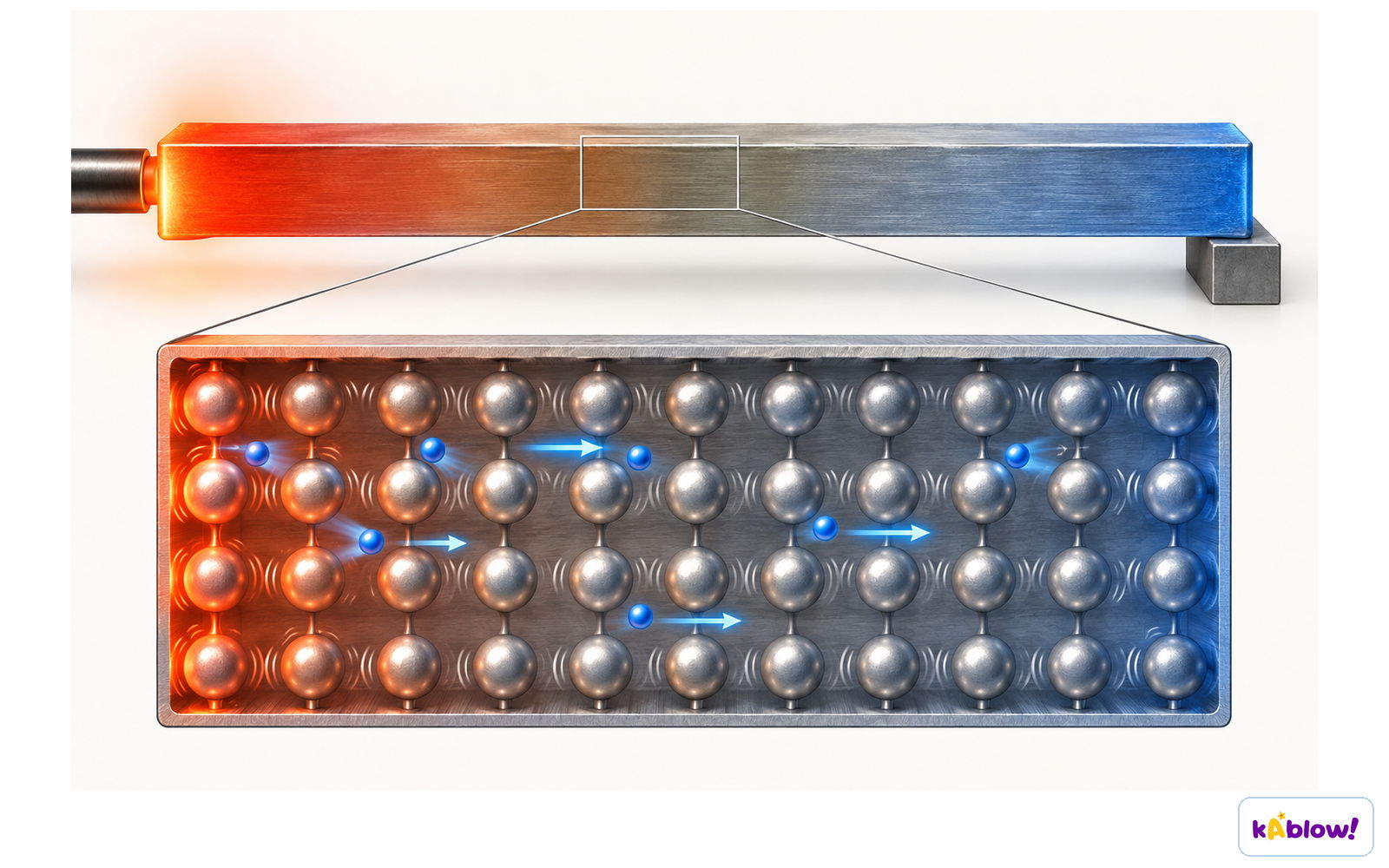
- In a solid, heated particles vibrate more energetically and transfer energy through interactions with neighbours. The particles stay near their positions; they do not flow from one end to the other.
- In metals, mobile electrons also transfer energy. Metals are usually good thermal conductors; plastic, wood and trapped air are poor conductors.
- Worked explanation: a metal spoon in hot water warms at its immersed end. Energy travels through the spoon by conduction towards the cooler handle.
- Check: a plastic handle slows conduction; it does not guarantee that the handle will always remain cool.
Conduction in a metal
Convection: explain each link
- In liquids and gases, heating usually makes a region expand. Its mass is spread over a larger volume, so that fluid region becomes less dense.
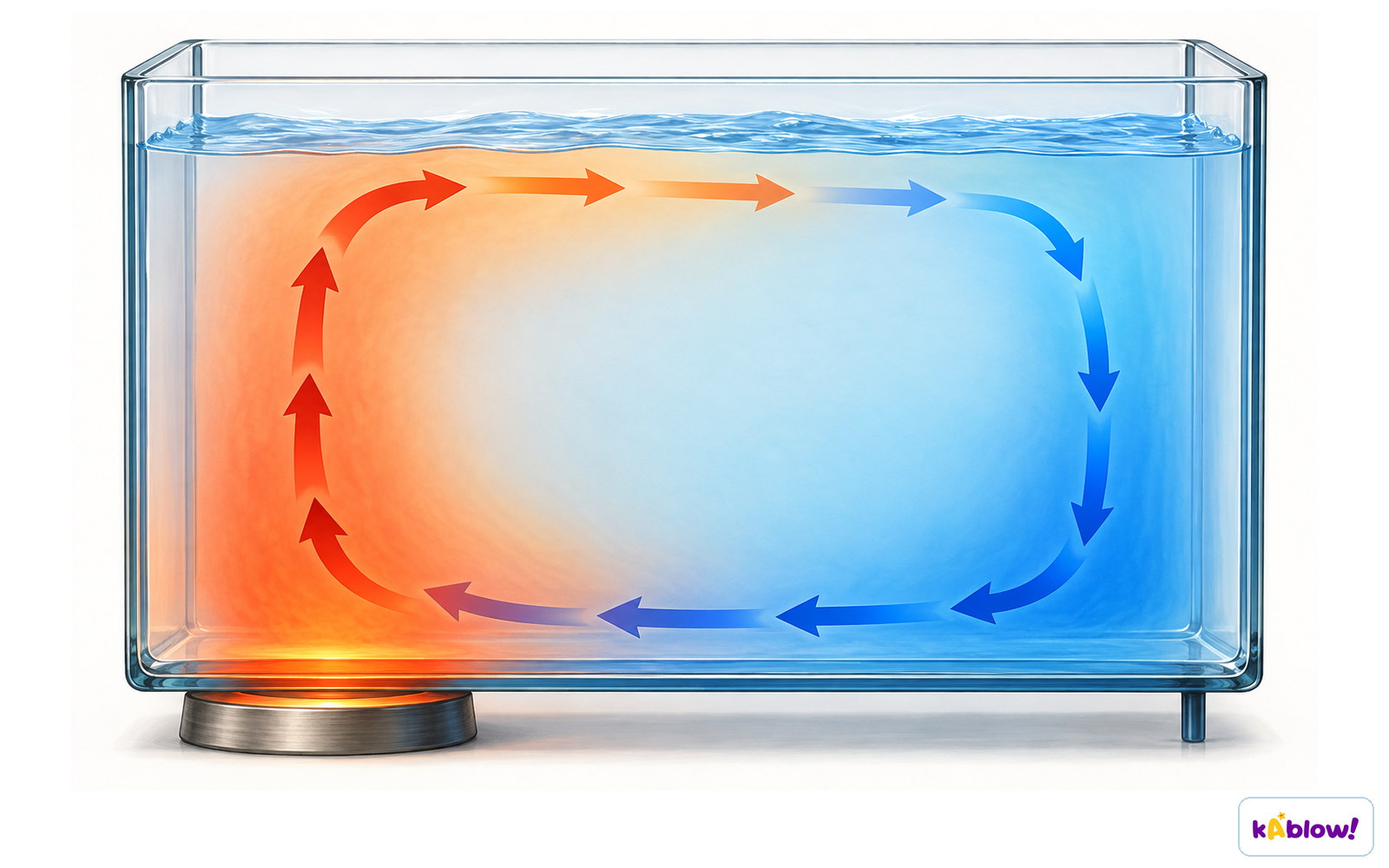
- Less dense warm fluid rises through cooler, denser fluid. Cooler fluid moves down to replace it, forming circulation that carries energy.
- It is the fluid that becomes less dense, not each particle. Ordinary solids do not circulate like a liquid or gas.
- Worked example: water heated at the bottom of a pan rises, while cooler water moves down. This is a convection current.
- Explain from memory: why can thermal energy travel sideways by conduction even though warm fluid rises in convection?
A convection current
Radiation and surfaces
- Radiation transfers energy by electromagnetic waves and can cross a vacuum. Energy from the Sun includes visible light and infrared radiation.
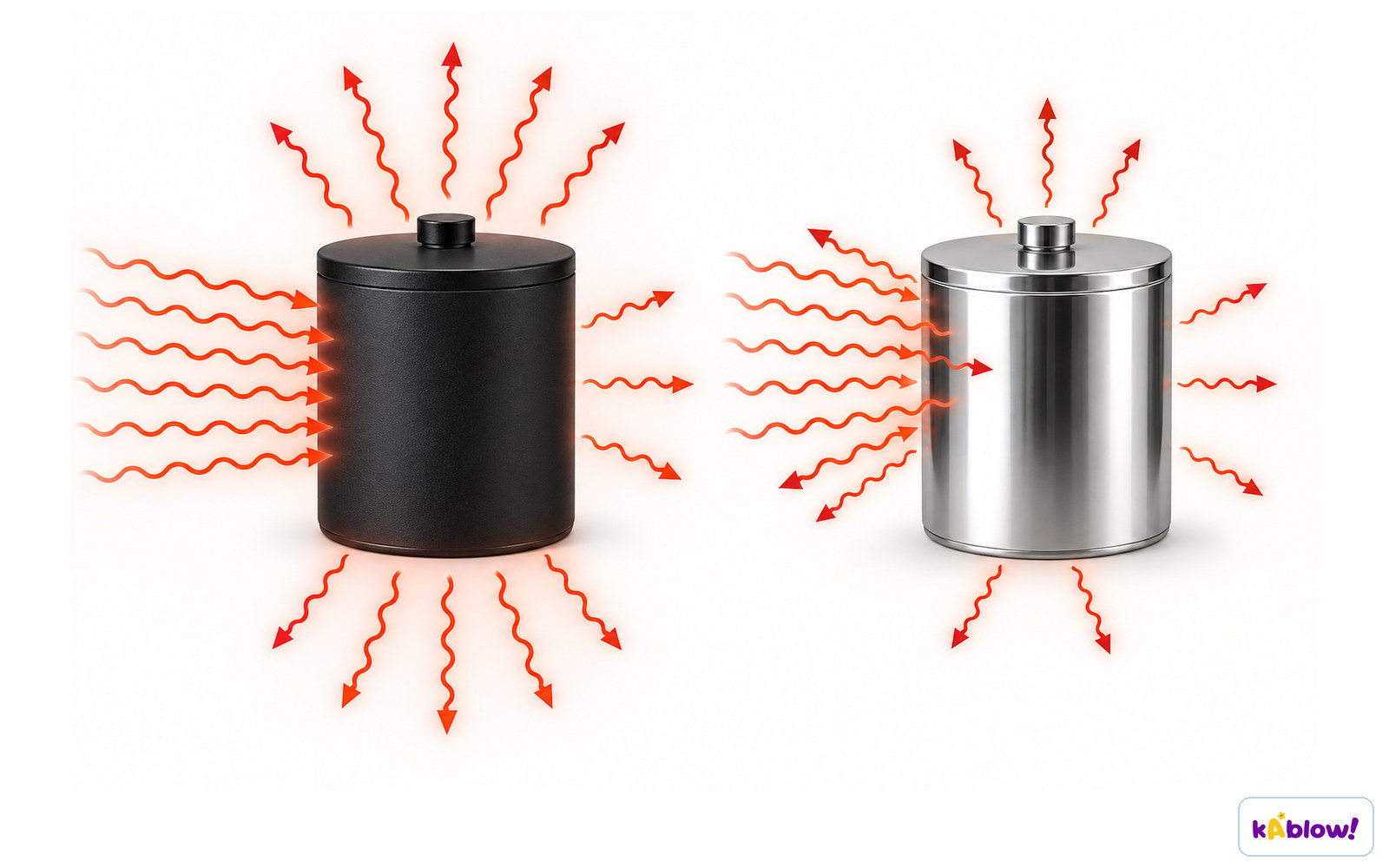
- Objects at ordinary temperatures emit infrared and absorb radiation from their surroundings. A warmer object in cooler surroundings loses energy overall.
- For comparable surfaces, matt black is generally a better infrared absorber and emitter than shiny silver. Keep temperature, area and other conditions the same in a test.
- Do not confuse: radiation needs no matter; convection needs moving fluid; conduction needs matter but no bulk movement.
Infrared radiation and surface finish
Using more than one form of insulation
- A vacuum gap prevents conduction and convection through the gap. Radiation can still cross it.
- Shiny flask walls reduce radiation; a stopper reduces transfer through the opening. Solid supports can still conduct energy.
- Trapped air reduces conduction and restricts convection. A sleeve slows cooling rather than preventing all thermal energy transfer.
- Apply: justify two design features for a container that keeps a drink warm. For each, name the mechanism and explain how the feature reduces it.
Evidence and fair tests
- In identical covered cups, equal masses of water start at 80°C. After 10 minutes, a sleeved cup is 65°C and an unsleeved cup is 52°C. The drops are 15°C and 28°C.
- The smaller temperature drop supports the sleeve reducing cooling under these conditions. Repeat the test before drawing a strong conclusion.
- Change one variable. Keep the water mass, starting temperature, cup, lid, room conditions, time and measurement method the same. When comparing sleeve materials, also match thickness and coverage.
- Avoid touching heated rods to compare conduction. Use suitable temperature measurements and follow the teacher’s practical safety instructions.
- Independent practice: propose an insulation comparison, predict its result, specify controls, and explain what evidence would support or challenge your prediction.
Slide
Sign up free to view the lesson slides
Step through every slide for this topic — plus flashcards and revision notes — with a free account.
Soal latihan
Pratinjau gratis — 8 dari 52 soal. Daftar untuk melihat semuanya.
1.Which of the following is NOT a method of thermal energy transfer?
Easy- AConduction
- BConvection
- CRadiation
- DRefraction
2.Net thermal energy transfer happens from hotter regions to cooler regions.
Easy- ATrue
- BFalse
- COnly in solids
- DOnly in liquids
3.Which of the following is the best conductor of thermal energy?
Easy- APlastic
- BAir
- CMetal
- DWood
4.In which state of matter does conduction primarily occur?
Easy- ASolids
- BLiquids
- CGases
- DAll states equally
5.Which type of thermal energy transfer can occur through a vacuum?
Easy- AConduction
- BConvection
- CRadiation
- DBoth conduction and convection
6.Why are gases good insulators?
Easy- ABecause their particles are far apart
- BBecause they are light
- CBecause they are transparent
- DBecause they have no particles
7.In a convection current, what happens to the heated liquid or gas?
Easy- AIt becomes denser and sinks
- BIt becomes less dense and rises
- CIt remains at the same density
- DIt turns into a solid
8.Which statement correctly compares identical matt black and shiny silver surfaces under the same classroom conditions?
Easy- AShiny silver always absorbs more infrared.
- BNeither absorbs infrared at room temperature.
- CMatt black generally absorbs infrared more effectively.
- DBoth must absorb exactly the same amount.
Unlock all 52 questions, flashcards & more
Buat akun gratis untuk melihat setiap soal, slide, kartu flash, dan catatan ulasan topik ini.