The water cycle
Belajar sambil bermain
Jawab soal-soal ini untuk dapat energi, lalu memancing dan menjelajah. Tanpa akun.
Catatan pelajaran
Overview of the Water Cycle
- The water cycle is a nonstop recycling process with no starting or ending point.
- Water constantly moves between living organisms (e.g., plants) and non-living things (e.g., clouds, rivers, oceans).
- It involves oceans, lakes, land surfaces, and the atmosphere.
- Water molecules can cycle through almost anywhere on Earth due to water's properties.
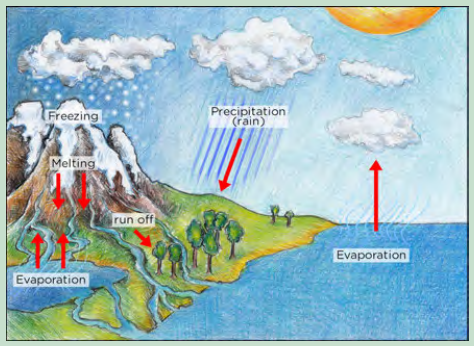
A hand-drawn water cycle diagram showing evaporation from the ocean and from mountain streams, precipitation falling as rain over the hills, and freezing, melting and runoff on the mountainside.
Key Processes in the Water Cycle
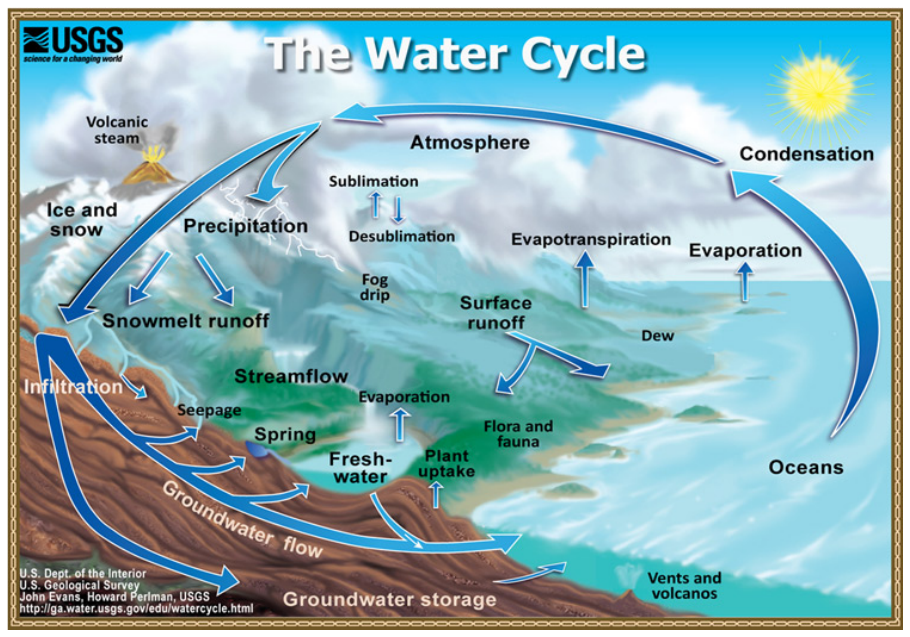
- Evaporation: Liquid water changes to gas (water vapor) when it gains energy from the Sun.
- Condensation: Water vapor loses energy, becomes denser, and changes to tiny liquid droplets, forming clouds.
- Precipitation: Cloud droplets collide and grow; when heavy enough, they fall as rain, snow, sleet, or hail.
- Runoff: Precipitation that flows over land into streams and rivers, eventually returning to oceans.
- Infiltration: Water seeping into the ground.
- Transpiration (or evapotranspiration): Water evaporates from plant leaves, returning water to the atmosphere.
The USGS water cycle diagram, showing evaporation and evapotranspiration rising from the ocean and land, condensation and precipitation over the mountains, and runoff, infiltration and groundwater flow returning water underground and across the surface to the ocean.
Forces Driving the Water Cycle
- Solar Energy: The Sun provides the energy that drives evaporation and the water cycle.
- Density: Heated air expands, becomes less dense, and rises; cooler, denser air sinks.
- Gravity: Pulls denser air downward, causing rising air; also causes water to flow downhill as runoff.
- Energy transfer: Condensation releases energy to surrounding air, heating it and causing updrafts that keep cloud droplets aloft.
Earth's Water Reservoirs
- Oceans: Store about 97% of Earth's water.
- Atmosphere: Holds water vapor, clouds, and precipitation.
- Streams and Lakes: Freshwater bodies fed by runoff and melting snow/ice.
- Soil: Holds soil moisture important for plant growth.
- Groundwater: Water stored in aquifers (porous rock layers) for centuries.
- Biosphere: Water stored in plants and animals; plants release water vapor via transpiration.
The USGS water cycle diagram, showing the ocean, groundwater storage, freshwater and plant-uptake reservoirs where water is held as it moves through the cycle.
Water Cycle and States of Matter
- Water exists in solid (ice, snow), liquid (rain, lakes), and gas (water vapor) states in the cycle.
- The hydrosphere includes all water in all states of matter.
- Condensation can form liquid droplets; if cold enough, water vapor can freeze into ice crystals.
Water Cycle and Living Things
- Plants absorb water through roots and release it via transpiration.
- Animals depend on water for survival and are part of the biosphere reservoir.
- Aquatic habitats include freshwater (streams, lakes) and saltwater (oceans, seas).
- A small percentage of Earth's water is freshwater; most is saltwater.
Slide
Sign up free to view the lesson slides
Step through every slide for this topic — plus flashcards and revision notes — with a free account.
Soal latihan
Pratinjau gratis — 8 dari 36 soal. Daftar untuk melihat semuanya.
1.What is the primary source of energy that drives the water cycle?
Easy- AThe Sun
- BThe Moon
- CEarth's internal heat
- DWind
2.Which process involves the change of water from liquid to gas?
Easy- ACondensation
- BEvaporation
- CPrecipitation
- DSublimation
3.What is the term for the movement of water through the atmosphere?
Easy- AAdvection
- BConvection
- CInfiltration
- DRunoff
4.What percentage of global evaporation occurs over the oceans?
Medium- A78%
- B86%
- C97%
- D50%
5.Which of the following is NOT a process in the water cycle?
Medium- ASublimation
- BTranspiration
- CPhotosynthesis
- DInfiltration
6.What happens to water vapor as altitude increases in the atmosphere?
Medium- AIt expands and heats up
- BIt condenses due to lower temperature
- CIt evaporates more quickly
- DIt remains unchanged
7.Which human activity is most likely to decrease infiltration of water into the ground?
Hard- APlanting trees
- BBuilding parking lots
- CCreating reservoirs
- DIrrigating crops
8.What is the term for water that flows over the ground surface and enters rivers?
Easy- AGroundwater
- BInfiltration
- CSurface runoff
- DPrecipitation
Unlock all 36 questions, flashcards & more
Buat akun gratis untuk melihat setiap soal, slide, kartu flash, dan catatan ulasan topik ini.