Adaptations, interdependence and competition
遊んで学ぼう
問題に答えてエネルギーを集めたら、釣りや探検を楽しもう。アカウント不要。
レッスンノート
Levels of Organisation in an Ecosystem
- An individual organism is a single member of a species.
- A population is a group of organisms of the same species living in the same place at the same time.
- A community includes all of the populations of different species living and interacting in the same area at the same time.
- An ecosystem is the interaction between a community (the living, biotic part) and the non-living (abiotic) parts of the environment.
- Ecosystems can vary greatly in size and scale: a small ecosystem might be a garden pond, while a large ecosystem might be the whole of Antarctica.
Competition
- Competition occurs when organisms need the same resource to survive and reproduce, but the resource is limited.
- Intraspecific competition is competition between members of the same species.
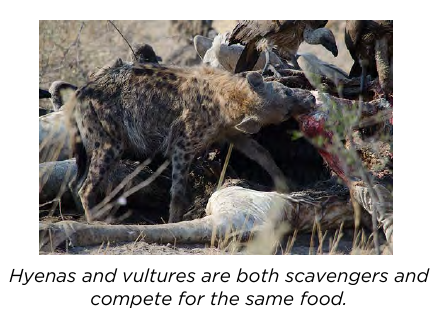
- Interspecific competition is competition between members of different species.
- Plants compete for light, space, water and mineral ions from the soil.
- Animals compete for food, mates and territory.
Interspecific competition
Interdependence
- Within a community, each species depends on other species for food, shelter, pollination, seed dispersal and more.
- If one species is removed, it can affect the whole community; this is called interdependence.
- A stable community is one where all the species and environmental factors are in balance so that population sizes remain fairly constant.
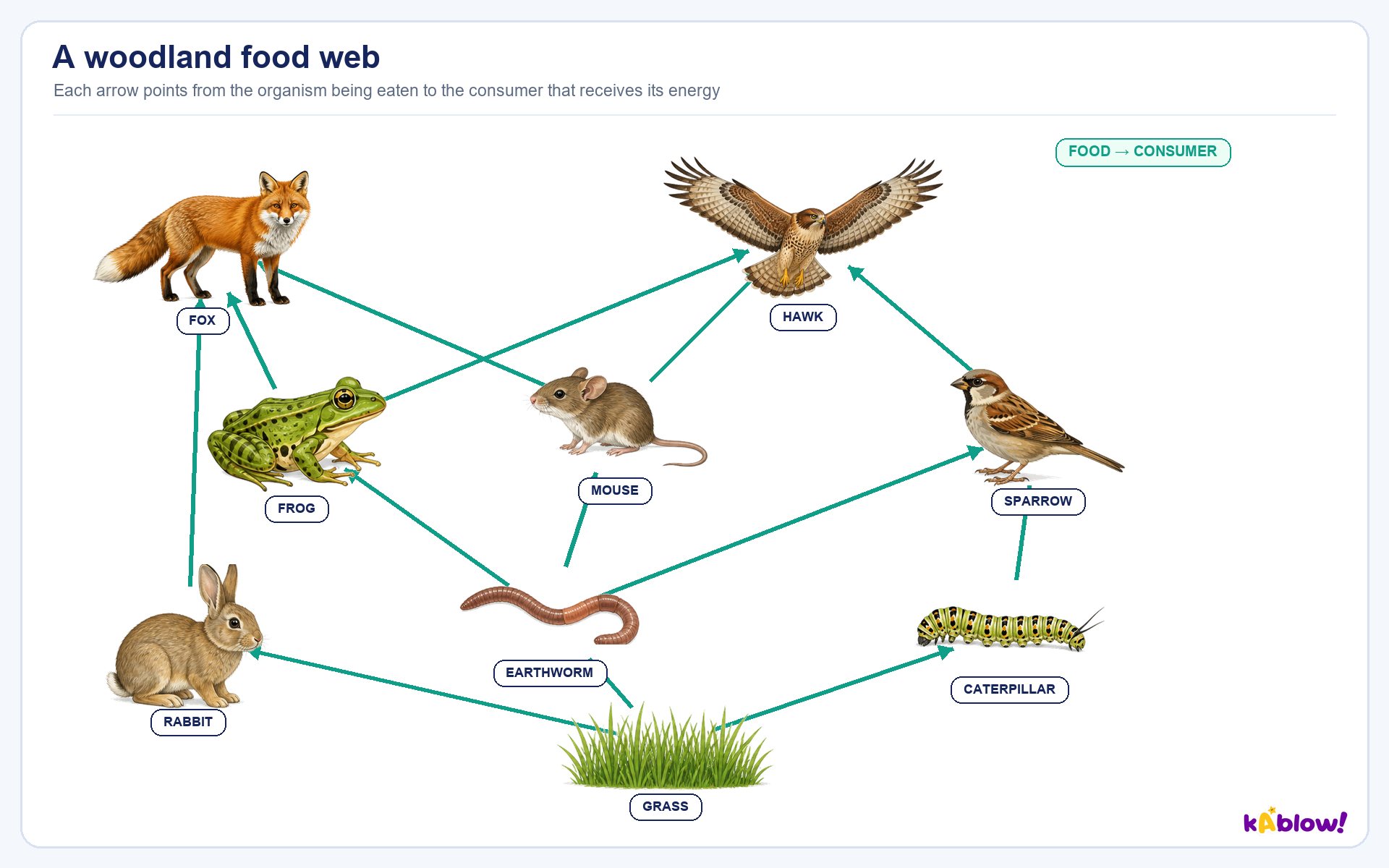
- A food web shows the interdependence of organisms.
- If the population of one species changes, it can have knock-on effects on other species in the community.
A food web shows the interdependence of organisms
Abiotic Factors
- Abiotic means non-living; an abiotic factor is a non-living factor in the environment.
- Abiotic factors that can affect a community include light intensity, temperature, moisture levels, soil pH and mineral content, wind intensity and direction, carbon dioxide levels (for plants) and oxygen levels (for aquatic animals).
- Changes in abiotic factors can affect the size and distribution of populations.
- For example, lichen are very sensitive to air pollution and cannot grow if sulphur dioxide concentration gets too high.
- When interpreting graphs or tables, reference specific figures from the data to support your answer.
Biotic Factors
- Biotic means living; a biotic factor is a living factor in the environment.
- Biotic factors that can affect a community include availability of food, new predators arriving, new pathogens, and one species outcompeting another so numbers are no longer sufficient to breed.
- For example, if grey squirrels are introduced to a habitat occupied by red squirrels, the grey squirrels may outcompete the red squirrels for the same resources, causing the red squirrel population to decrease.
- Biotic factors such as competition, predation and disease can change the size and distribution of populations.
Adaptations
- Organisms have features (adaptations) that enable them to survive in the conditions in which they normally live.
- Adaptations may be structural (e.g. body shape, fur, blubber), behavioural (e.g. being active at cooler times of day) or functional (e.g. kidneys producing concentrated urine).
- Animals in cold regions often have a small surface area : volume ratio to minimise heat loss, and a thick layer of fat or fur to insulate against the cold.
- Animals in desert regions may have a large surface area : volume ratio to aid heat loss (e.g. large ears), produce very concentrated urine, or be active only in the early mornings, late evenings or at night when it is cooler.
- A cactus has many structural adaptations to help it survive in the desert.
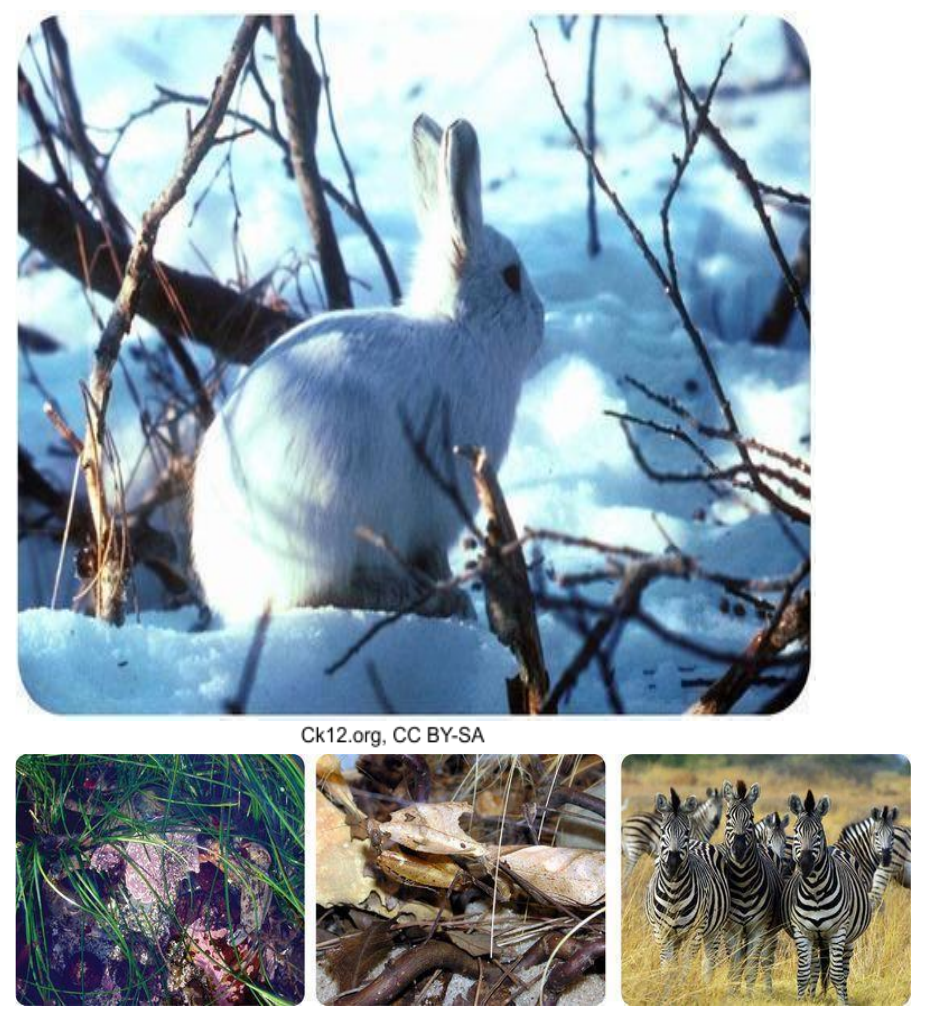
Camouflage as an adaptation
Extremophiles
- Some organisms live in environments that are very extreme, such as at very high or low temperatures, pressures, or high salt concentration.
- Organisms that can live in extreme environments are called extremophiles.
- An example of a habitat where extremophiles are found is deep-sea volcanic vents, where conditions are extremely hot, under high pressure and there is no sunlight.
- Bacteria called chemoautotrophs survive by using inorganic chemicals to obtain energy, rather than using sunlight in photosynthesis.
- Other species can then use these bacteria as a source of nutrition – the bacteria are producers in these food chains.
Sampling Organisms
- Ecology is the branch of biology that studies the abundance and distribution of species, and their interactions with each other and their environment.
- Sampling involves assessing multiple small areas within a larger habitat and using these results to represent the habitat as a whole.
- Quadrats are square frames (e.g. 0.25 m² or 1 m²) placed on the ground; the organisms within them are recorded. They are useful for investigating species that do not move around, such as plants or sessile animals.
- Quadrats must be laid randomly to avoid sampling bias; this can be done by converting the area into a grid and using a random number generator to pick sample points.
- A belt transect involves laying out a measuring tape in a straight line and placing quadrats at regular intervals along the tape to record abundance of each species.
- A line transect involves recording the identity of organisms that touch the line at equal distances along the tape; this only measures which species are present, not their abundance.
- When completing an ecological study, ensure data is random and representative by selecting quadrat positions randomly and taking a minimum of 10 readings in each survey area.
スライド
練習問題
無料プレビュー — 62問中8問。すべて見るには登録を。
1.Which term describes a group of organisms of the same species living in the same place at the same time?
Easy- ACommunity
- BPopulation
- CEcosystem
- DHabitat
2.Which term describes all of the populations of different species living and interacting in the same area?
Easy- APopulation
- BEcosystem
- CCommunity
- DHabitat
3.An ecosystem is defined as all the biotic factors and all the abiotic factors that interact within an area at one time.
EasyTrue or false?
4.Which order shows the levels of organisation in an ecosystem from lowest to highest?
Easy- ACommunity, population, organism
- BCommunity, organism, population
- COrganism, community, population
- DOrganism, population, community
5.Which of the following is an abiotic factor?
Medium- ACompetition
- BPredation
- CDisease
- DWater availability
6.Which of the following are abiotic factors that can affect a community? (select all that apply)
Medium- ALight intensity
- BTemperature
- CAvailability of food
- DNew predators arriving
- ESoil pH
7.Which term describes a species from one country that is now living in another country?
Medium- APathogenic
- BNon-pathogenic
- CIndigenous
- DNon-indigenous
8.In a mutualistic relationship, one organism benefits and the other is harmed.
EasyTrue or false?