Variation and evolution
遊んで学ぼう
問題に答えてエネルギーを集めたら、釣りや探検を楽しもう。アカウント不要。
レッスンノート
Variation
- Variation is defined as the differences between individuals of the same species.
- Phenotypic variation is the difference in features between individuals of the same species.
- Phenotypic variation can be genetic (controlled entirely by genes), environmental (caused entirely by the environment), or a combination of both.
- Examples of genetic variation in humans include blood group, eye colour, gender, ability to roll tongue, and free or fixed earlobes.
- Environmental factors that cause variation include climate, diet, accidents, culture, and lifestyle.
- An example of environmental variation is a plant in the shade of a big tree growing taller to reach more light.
- Some features, such as height, are affected by both genes and the environment: tall parents pass on genes for height, but a poor diet can prevent the child from reaching their full height potential.
Genetic Variation and Mutation
- There is usually extensive genetic variation within a population of a species.
- All genetic variants arise from mutations, which are random genetic changes that occur continuously.
- Most mutations have no effect on the phenotype because the mutated gene may still produce a working protein.
- Rarely, mutations lead to the development of new alleles and so new phenotypes; most of these only have a small effect on the organism.
- Occasionally, a new allele gives the individual a survival advantage over other members of the species.
- If the new phenotype is suited to an environmental change, it can lead to a relatively rapid change in the species.
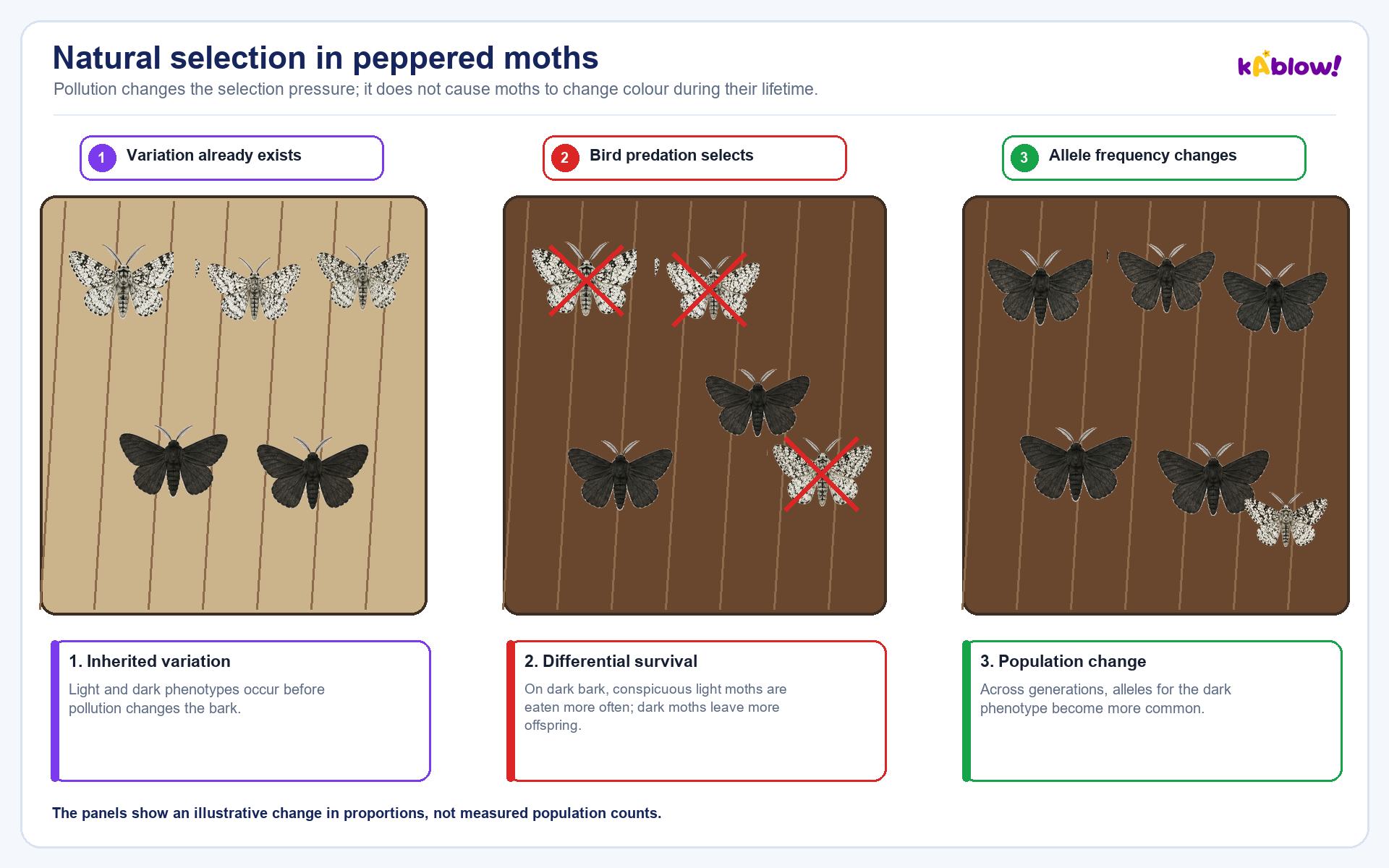
- For example, a moth with a mutation for better camouflage against tree bark is less visible to predators, survives and breeds more, so the new colour quickly spreads through the species.
Evolution by Natural Selection
- Evolution is defined as a change in the inherited characteristics of a population over time.
- Evolution occurs by a process known as natural selection.
- During natural selection, individuals with phenotypes best suited to their environment are more likely to survive and pass on their features to their offspring.
- The theory of evolution by natural selection states that all species of living things have evolved from simple life forms that first developed more than three billion years ago.
- Natural selection can lead to the development of new species by a process known as speciation.
- Speciation is said to have occurred when two populations have phenotypes so different that they can no longer breed together to produce fertile offspring.
- Remember: evolution refers to changes in species over time, while natural selection is the mechanism by which this change takes place.
Natural selection in peppered moths
Selective Breeding
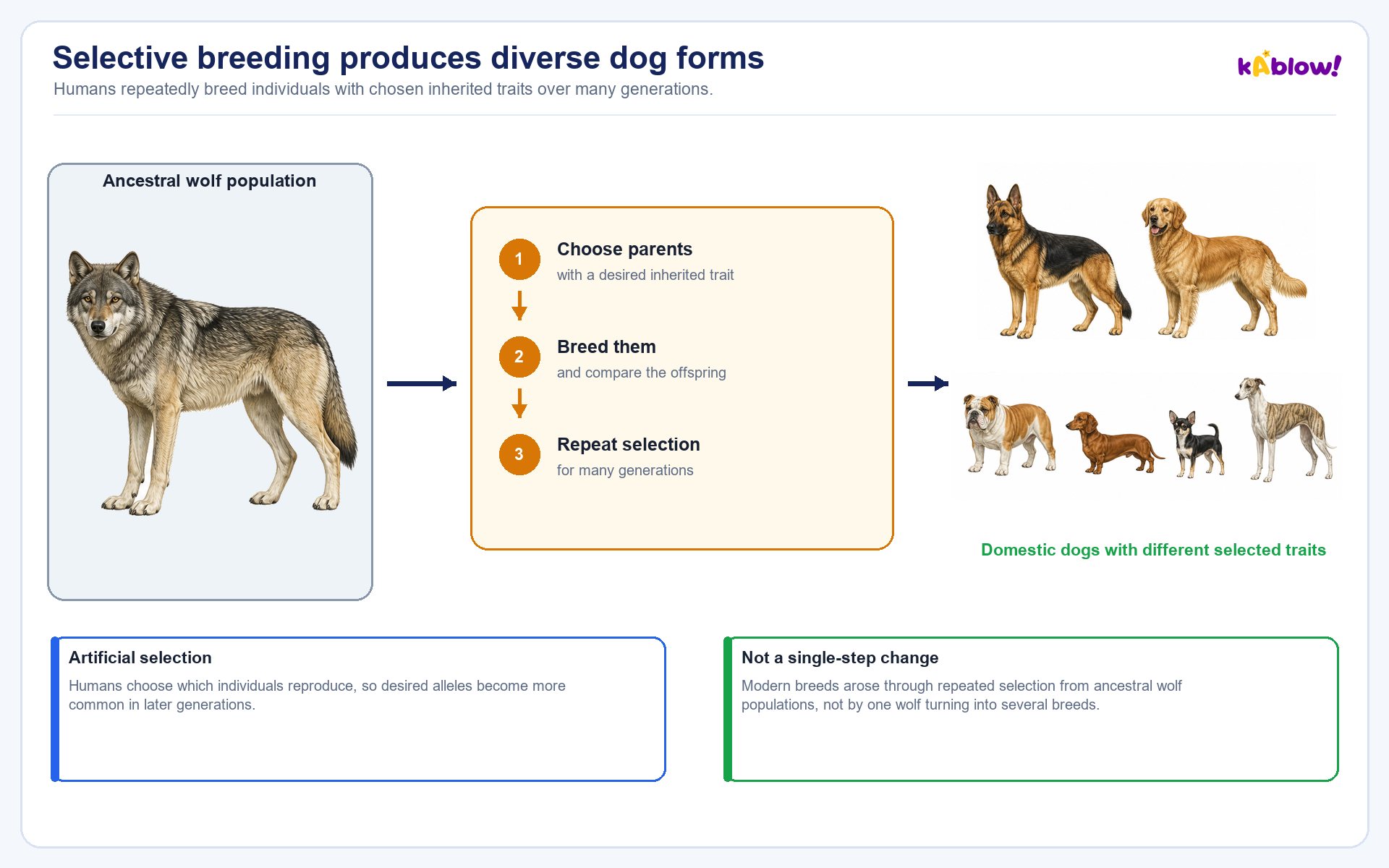
- Selective breeding (artificial selection) means to select individuals with desirable characteristics and breed them together.
- Offspring that show the desired characteristics are selected and bred together, and this process is repeated for many successive generations before a new breed reliably shows those characteristics.
- Animals are commonly selectively bred for characteristics such as cows, goats and sheep that produce lots of milk or meat, chickens that lay large eggs, domestic dogs with a gentle nature, sheep with good quality wool, and horses with fine features and a very fast pace.
- Plants are selectively bred for characteristics such as disease resistance in food crops, increased crop yield, hardiness to weather conditions, better tasting fruits, and large or unusual flowers.
- An example of selective breeding in plants is wild brassica, which has given rise to cauliflower, cabbage, broccoli, brussel sprouts, kale and kohlrabi.
- An example of selective breeding in animals is the domestic dog, all breeds of which are descended from wolves.
Selective breeding of dog breeds from wolves
Problems with Selective Breeding
- Selective breeding can lead to inbreeding, which occurs when only the 'best' animals or plants (which are closely related) are bred together.
- Inbreeding results in a reduction in the gene pool – a reduction in the number of alleles in a population.
- As inbreeding limits the size of the gene pool, there is an increased chance of organisms inheriting harmful genetic defects.
- A reduced gene pool also makes organisms more vulnerable to new diseases because there is less chance of resistant alleles being present.
Genetic Engineering
- Genetic engineering is changing the genetic material of an organism by removing or altering genes within that organism, or by inserting genes from another organism.
- The organism receiving the genetic material is said to be genetically modified or is described as a transgenic organism.
- The DNA of the organism that now contains DNA from another organism as well is known as recombinant DNA.
- Examples of genetically modified organisms include bacteria that produce human insulin, crop plants resistant to insect pests, crop plants resistant to herbicides, and crops with additional vitamins such as golden rice.
- Modern medical research is exploring gene therapy – inserting working versions of faulty genes into people with inherited disorders.
The Process of Genetic Engineering
- The gene that is to be inserted is located in the original organism.
- Restriction enzymes are used to isolate the required gene, leaving it with sticky ends (a short section of unpaired bases).
- A bacterial plasmid is cut by the same restriction enzyme leaving it with corresponding sticky ends.
- The plasmid and the isolated gene are joined together by DNA ligase enzyme.
- The genetically engineered plasmid is inserted into a bacterial cell.
- When the bacteria reproduce, the plasmids are copied as well, so the recombinant plasmid quickly spreads as the bacteria multiply and they all express the gene and make the human protein.
- The genetically engineered bacteria can be placed in a fermenter to reproduce quickly in controlled conditions and make large quantities of the human protein.
Meeting Global Food Demands
- Modern technology has increased food supply through agricultural machinery, chemical fertilisers, insecticides and herbicides, selective breeding, and more recently genetic engineering.
- Fertilisers replace mineral ions in the soil and can make crops grow faster and bigger so that yields are increased.
- Fertilisers can be organic (e.g. farmyard manure and compost) or chemical (often applied as dry granules or sprayed in liquid form).
- Chemical fertilisers mainly provide crop plants with nitrogen, phosphorus and potassium.
- A major disadvantage of fertilisers is that excess fertilisers not taken up by crops can get washed into lakes and rivers and cause problems such as eutrophication.
- Biological control introduces other species to control pests; for example, ladybirds eat aphids, cane toads were introduced to eat crop-damaging beetles, and parasitic wasps can control whitefly in glasshouse tomato crops.
- An advantage of biological control is that it can have longer-lasting effects than chemical pesticides and be less harmful to the environment.
- However, biological control does not completely remove a pest but keeps it at lower levels, and in some cases the introduced organism can itself become a pest (e.g. cane toads in Australia).
GM Crops
- GM crops are crop plants that have been genetically modified to have increased yields compared to normal crop plants.
- Crop plants have been genetically modified to be resistant to pests, resistant to herbicides, and enriched in vitamins.
- Crops such as maize (corn) and cotton have been genetically modified with a gene for a toxin that kills many insect larvae; the toxin is called Bt toxin as it was taken from the bacterium×Bacillus thuringiensis×.
- The significance of genetically engineering crops to be insect resistant is that there is an increase in yield and fewer pesticides are used, which could have ecological benefits (e.g. non-targeted invertebrates are not harmed).
- Crop plants have also been genetically modified to be resistant to certain herbicides, meaning that when the herbicide is sprayed it only kills weeds and does not affect the crop plant.
- Some crops have been genetically modified to produce additional vitamins and improved nutritional value; for example, 'golden rice' contains genes from another plant and a bacterium which make the rice grains produce a chemical that is turned into vitamin A in the human body.
- Some crops have been genetically modified to be drought-resistant (to grow better in very dry conditions), which can also improve crop yields in arid countries.
- Concerns about GM crops include the effect on populations of wildflowers and insects, and some people feel the effects of eating GM crops on human health have not been fully explored.
The Human Genome Project
- The entire set of genetic material of an organism is known as its genome.
- The Human Genome Project (completed in 2003) was the international, collaborative research effort to determine the DNA sequence of the entire human genome and record every gene in human beings.
- This was an important breakthrough for the prediction and prevention of diseases, the testing and treatment for inherited disorders, and the development of new and improved medicines.
- A greater understanding of which genes predispose people to diseases such as cancers and heart disease enables doctors to provide more specific advice on lifestyle and diet to help avoid or delay the onset of these diseases.
- The Human Genome Project has allowed doctors to identify faulty alleles (e.g. for cystic fibrosis) much more quickly, so people can be tested and treatments developed.
- A greater understanding of how genetic variations make people more susceptible to certain diseases has allowed doctors to design new medicinal drugs specifically tailored to those with genetic variations, making drugs more effective and with fewer side-effects.
- Potential drawbacks include increased anxiety and stress for someone told they have a high chance of developing a genetic disease, pressure not to have children, and discrimination by employers or insurers.
スライド
練習問題
無料プレビュー — 57問中8問。すべて見るには登録を。
1.Which of the following is a definition of variation?
Easy- ADifferences between individuals of the same species
- BDifferences between individuals of different species
- CThe process by which organisms become better adapted to their environment
- DThe process by which humans breed organisms for particular characteristics
2.Which of the following is an example of genetic variation?
Medium- AA plant grows taller because it is in the shade
- BA person has free or attached earlobes
- CA person gains weight because they eat too much
- DA person has a scar from an accident
3.A person has a scar on their skin after an accident. Which type of variation does this show?
Medium- AGenetic variation
- BEnvironmental variation
- CA combination of genetic and environmental variation
- DNo variation
4.Which of the following are examples of genetic variation in humans? (Select all that apply)
Medium- ABlood group
- BAbility to roll tongue
- CWeight gain due to diet
- DEye colour
- EScarring from an accident
5.Phenotypic variation can be caused by genes, the environment, or a combination of both.
EasyTrue or false?
6.What is the name of the process by which humans breed plants and animals for particular genetic characteristics?
Medium- ANatural selection
- BSelective breeding
- CGenetic engineering
- DEvolution
7.Which of the following are characteristics that plants are commonly selectively bred for? (Select all that apply)
Medium- ADisease resistance in food crops
- BIncreased crop yield
- CGentle nature
- DLarge or unusual flowers
- EAbility to lay large eggs
8.Which of the following is a potential problem associated with selective breeding?
Medium- AInbreeding leads to a reduction in the gene pool
- BIt always produces offspring that are genetically identical
- CIt introduces new alleles into a population
- DIt increases the number of alleles in a population