Electrolysis
遊んで学ぼう
問題に答えてエネルギーを集めたら、釣りや探検を楽しもう。アカウント不要。
教育者の方へ: Electrolysis(Science、Chemistry)向けのすぐ使えるレッスンスライド, 復習ノート — レッスンで使うか、学習者がライブゲームとして遊ぶインタラクティブなクラス活動としてトピックを実施できます。
レッスンノート
What is Electrolysis?
- Electrolysis is the breakdown of an ionic compound, when molten or in aqueous solution, by passing an electric current through it.
- Liquids and solutions that conduct electricity are called electrolytes.
- Covalent compounds cannot conduct electricity, so they do not undergo electrolysis.
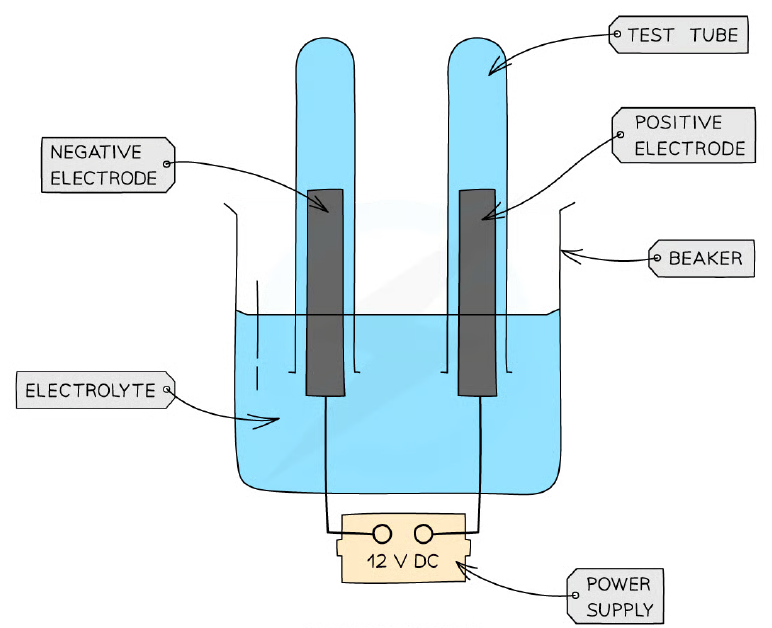
- An electrolytic cell is the apparatus used for electrolysis; it contains two electrodes (rods of metal or graphite) dipping into the electrolyte.
- The anode is the positive electrode; the cathode is the negative electrode.
- Cations (positive ions) are attracted to the cathode; anions (negative ions) are attracted to the anode.
- When a metal conducts, electrons move through it; when a salt solution conducts, ions move towards the electrodes.
Apparatus for the electrolysis of copper(II) sulfate (graphite electrodes)
Why Ionic Compounds Must Be Molten or Dissolved
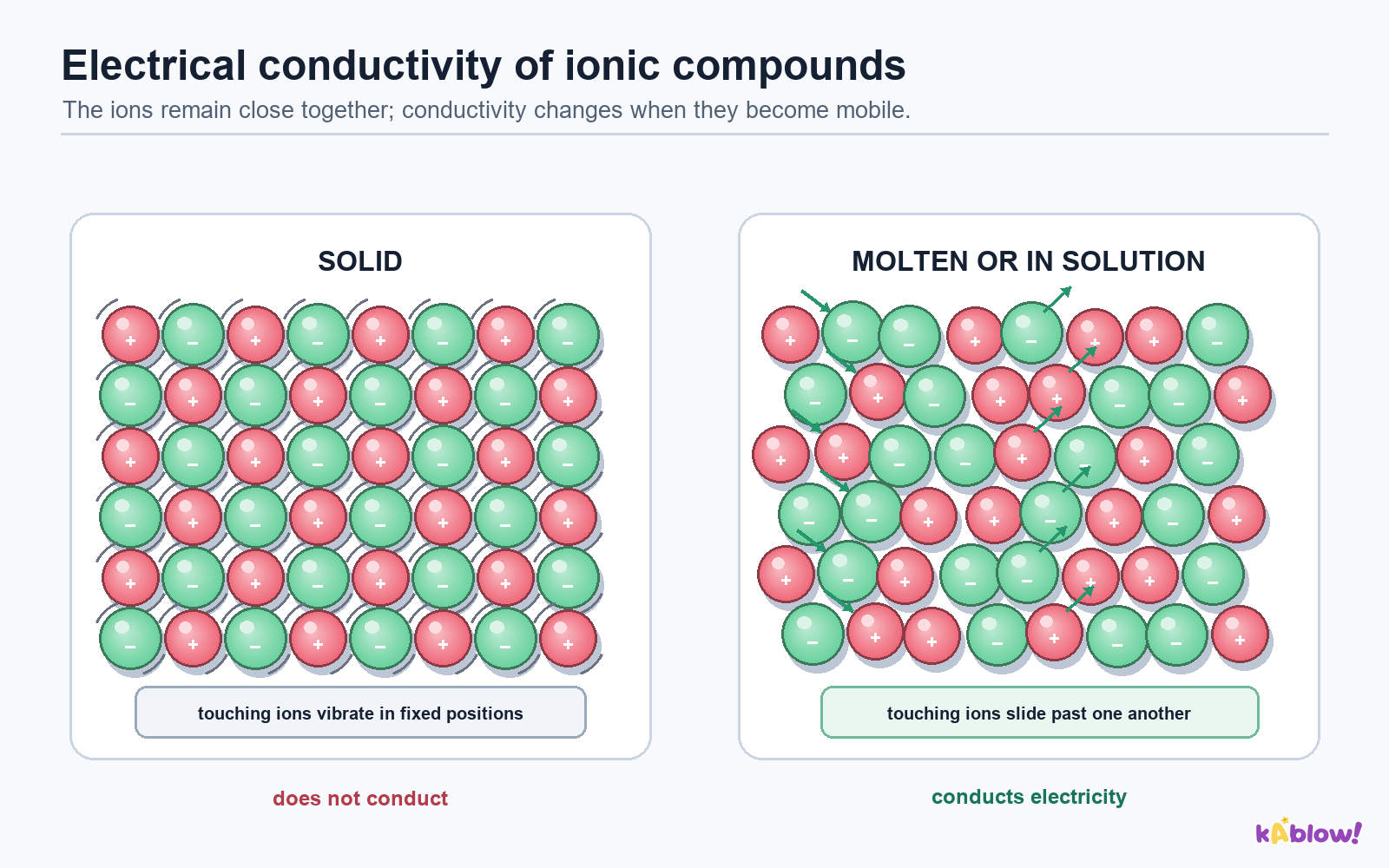
- Solid ionic compounds cannot conduct electricity because their ions are fixed in position and cannot move.
- When melted or dissolved, the ions become free to move and can carry charge.
- Ionic compounds must be molten or dissolved in solution (usually aqueous) to undergo electrolysis.
- In the molten or dissolved state, the ions migrate towards the electrodes when a current is passed.
Electrical conductivity of ionic compounds
Electrolysis of Molten Compounds
- Binary ionic compounds contain just two elements joined by ionic bonding.
- When heated beyond their melting point, they become molten and their ions can move freely, so they conduct electricity.
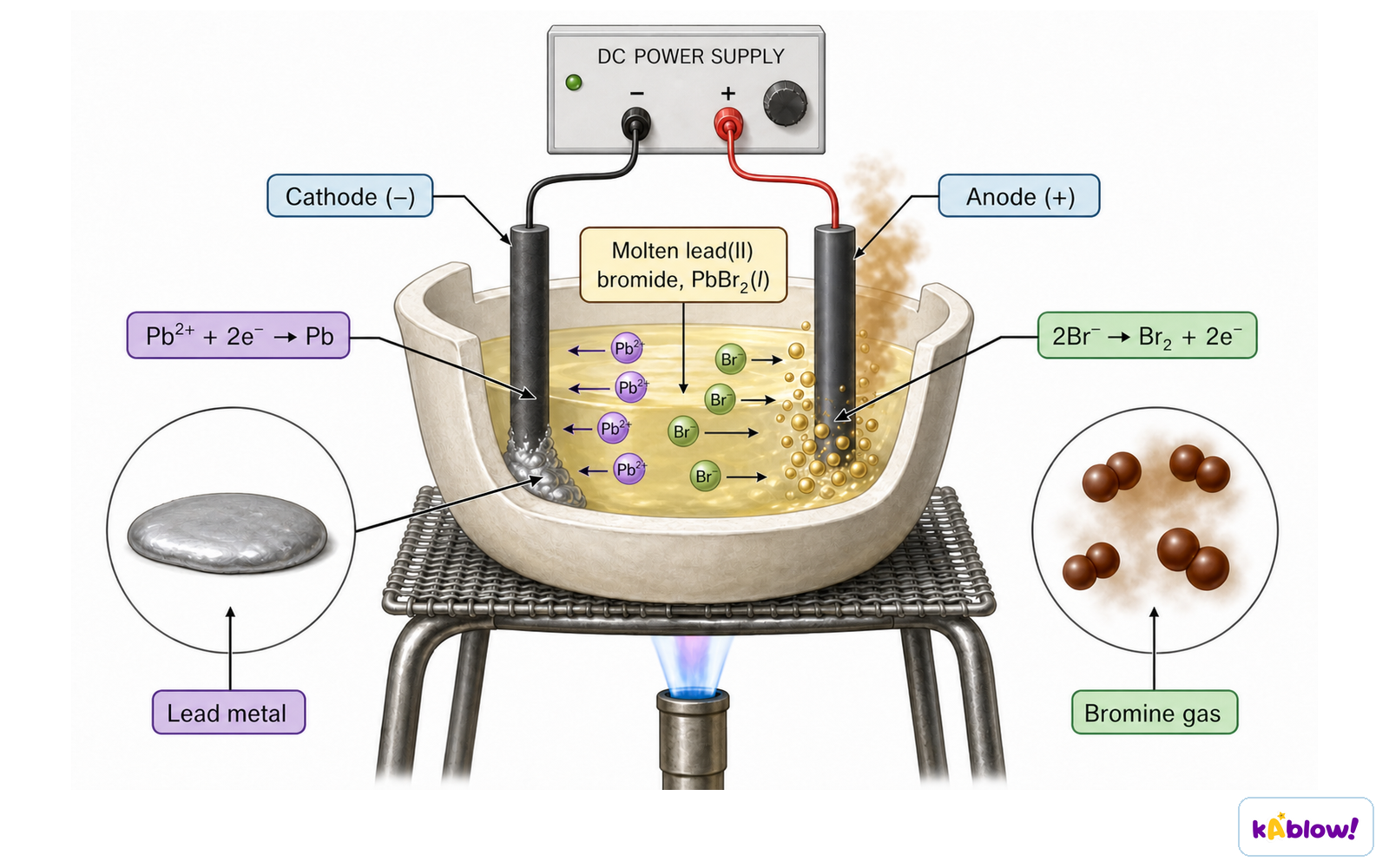
- The positive ion migrates to the cathode and the negative ion migrates to the anode.
- The product at the cathode is always the metal; the product at the anode is always the non-metal.
- For example, molten lead(II) bromide produces lead at the cathode and bromine at the anode.
- Zinc chloride produces zinc at the cathode and chlorine at the anode.
- Electrodes must be inert (e.g., graphite or platinum) so they do not react with the electrolyte.
Electrolysis of molten lead(II) bromide
Electrolysis of Aqueous Solutions
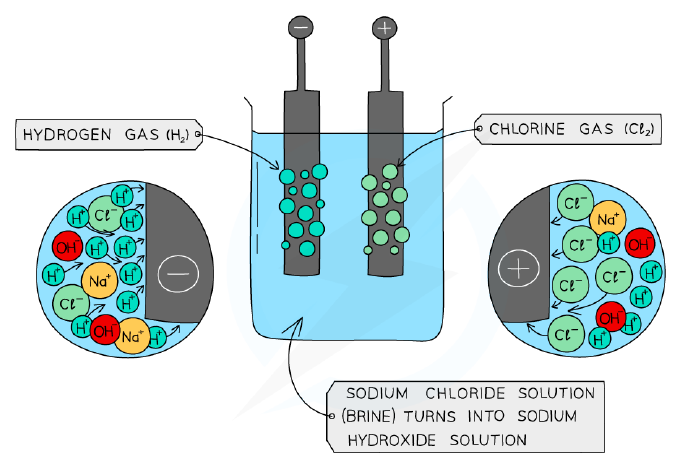
- Aqueous solutions always contain water molecules, which split into H⁺ and OH⁻ ions.
- These ions take part in electrolysis along with ions from the dissolved compound.
- At the cathode, H⁺ and metal ions are attracted; hydrogen is produced if the metal is above hydrogen in the reactivity series, otherwise the metal is produced.
- At the anode, OH⁻ and non-metal ions are attracted; if halide ions (Cl⁻, Br⁻, I⁻) are present, the halogen is produced, otherwise oxygen is produced.
- The reactivity series helps predict which ion is discharged at each electrode.
- The other ion remains in solution.
Electrolysis of aqueous sodium chloride (brine)
Predicting Products in Aqueous Solutions
- Sodium chloride solution: chlorine at the anode, hydrogen at the cathode.
- Copper(II) chloride solution: chlorine at the anode, copper at the cathode.
- Sodium sulfate solution: oxygen at the anode, hydrogen at the cathode.
- Dilute sulfuric acid: oxygen at the anode, hydrogen at the cathode.
- Copper(II) sulfate solution (with inert electrodes): oxygen at the anode, copper at the cathode.
- The products depend on the relative reactivity of the elements involved.
Using Electrolysis to Extract Metals
- Metals above carbon in the reactivity series are too reactive to be extracted by reduction with carbon; they are extracted by electrolysis of their molten compounds.
- Metals below carbon can be extracted by heating with a reducing agent such as carbon or carbon monoxide.
- Electrolysis is expensive because large amounts of energy are needed to melt the ore and produce the electric current.
- Aluminium is extracted from bauxite (aluminium oxide) by electrolysis.
- Aluminium oxide is dissolved in molten cryolite to lower the melting point and reduce energy costs.
- The cathode produces aluminium; the anode produces oxygen.
- The carbon anodes react with oxygen to form carbon dioxide, so they wear away and must be replaced regularly.
Electrolysis and Redox
- Oxidation is the loss of electrons; reduction is the gain of electrons.
- At the anode, negative ions lose electrons and are oxidised.
- At the cathode, positive ions gain electrons and are reduced.
- Half equations show the electron transfer at each electrode.
- For molten lead(II) bromide: cathode: Pb²⁺ + 2e⁻ → Pb (reduction); anode: 2Br⁻ → Br₂ + 2e⁻ (oxidation).
- For aqueous sodium chloride: cathode: 2H⁺ + 2e⁻ → H₂; anode: 2Cl⁻ → Cl₂ + 2e⁻.
- For dilute sulfuric acid: cathode: 2H⁺ + 2e⁻ → H₂; anode: 2H₂O → O₂ + 4H⁺ + 4e⁻.
- For aqueous copper(II) chloride: cathode: Cu²⁺ + 2e⁻ → Cu; anode: 2Cl⁻ → Cl₂ + 2e⁻.
Core Practical: Electrolysis of Copper(II) Sulfate
- Part 1 – Inert (graphite) electrodes: copper is formed at the cathode and oxygen at the anode.
- Part 2 – Active (copper) electrodes: the cathode increases in mass and the anode decreases in mass.
- This happens because copper atoms at the anode are oxidised to Cu²⁺ ions, and Cu²⁺ ions at the cathode are reduced to copper atoms.
- The gain in mass at the cathode equals the loss in mass at the anode, so the concentration of Cu²⁺ ions remains constant.
- Hazards: copper(II) sulfate is corrosive and harmful; propanone is flammable.
- Precautions: wear safety goggles, avoid skin contact, keep propanone away from naked flames.
Copper Refining by Electrolysis
- Electrolysis can purify copper using a pure copper cathode and an impure copper anode.
- The electrolyte is an aqueous solution of a soluble salt of the pure metal, e.g., copper(II) sulfate.
- At the anode, copper atoms lose electrons and go into solution as Cu²⁺ ions: Cu → Cu²⁺ + 2e⁻.
- Impurities fall to the bottom as anode sludge, which may contain valuable metals like silver.
- At the cathode, Cu²⁺ ions gain electrons to form pure copper atoms: Cu²⁺ + 2e⁻ → Cu.
- The cathode gradually becomes thicker as pure copper is deposited.
スライド
練習問題
無料プレビュー — 62問中8問。すべて見るには登録を。
1.Draw one line from each electrolysis keyword to its correct definition.
Medium- electrolyte
- anode
- cathode
- anion
- cation
- positive electrode
- negative electrode
- negatively charged ion attracted to the anode
- positively charged ion attracted to the cathode
- ionic compound in molten or dissolved solution that conducts electricity
2.What is another name for the copper sulfate solution in an electrolysis experiment?
Medium- AElectric
- BElectrolyte
- CElectrode
- DElectron
3.What is the name of the positive electrode?
Easy- AAnion
- BAnode
- CCation
- DCathode
4.Which row correctly names the H+ ion and the OH− ion?
Easy- AH+ ion: Hydrate; OH− ion: Oxide
- BH+ ion: Hydrate; OH− ion: Hydroxide
- CH+ ion: Hydrogen; OH− ion: Hydroxide
- DH+ ion: Hydrogen; OH− ion: Oxide
5.Place ticks by the two statements that are correct.
Medium- APositive ions move towards the negative electrode
- BNegative ions move towards the cathode
- CNegative ions remain in solution
- DPositive ions move towards the anode
- ENegative ions move towards the anode
6.Which of these solutions are electrolytes?
Medium- AK only
- BJ and L only
- CK and L only
- DJ, K and L
7.During the electrolysis of copper sulfate solution, copper ions move to the negative electrode. What is the reason for this?
Medium- ACopper is less reactive than hydrogen and consists of negatively charged ions
- BCopper is more reactive than hydrogen and consists of negatively charged ions
- CCopper is less reactive than hydrogen and consists of positively charged ions
- DCopper is more reactive than hydrogen and consists of positively charged ions
8.Which statement explains why the mass of the negative electrode increases during the electrolysis of copper sulfate solution with copper electrodes?
Medium- ACopper atoms are attracted to the anode
- BCopper ions are attracted to the anode
- CCopper atoms are attracted to the cathode
- DCopper ions are attracted to the cathode
過去問
このトピックの過去問練習は近日公開。
近日公開