Using the Earth's resources and obtaining potable water
遊んで学ぼう
問題に答えてエネルギーを集めたら、釣りや探検を楽しもう。アカウント不要。
教育者の方へ: Using the Earth's resources and obtaining potable water(Science、Chemistry)向けのすぐ使えるレッスンスライド, 復習ノート — レッスンで使うか、学習者がライブゲームとして遊ぶインタラクティブなクラス活動としてトピックを実施できます。
レッスンノート
Using the Earth's Resources
- Humans use the Earth's resources to provide warmth, shelter, food and transport.
- Natural resources can be living (plants and animals) or non-living (minerals, fossil fuels, water and air).
- Some natural products can be replaced by synthetic products, e.g. rubber from tree sap (latex) can be replaced by polymers.
- Agriculture supplements natural resources, e.g. fertilisers are used to enhance crop yield.
- Chemistry plays an important role in improving agricultural and industrial processes to provide new products and in sustainable development.
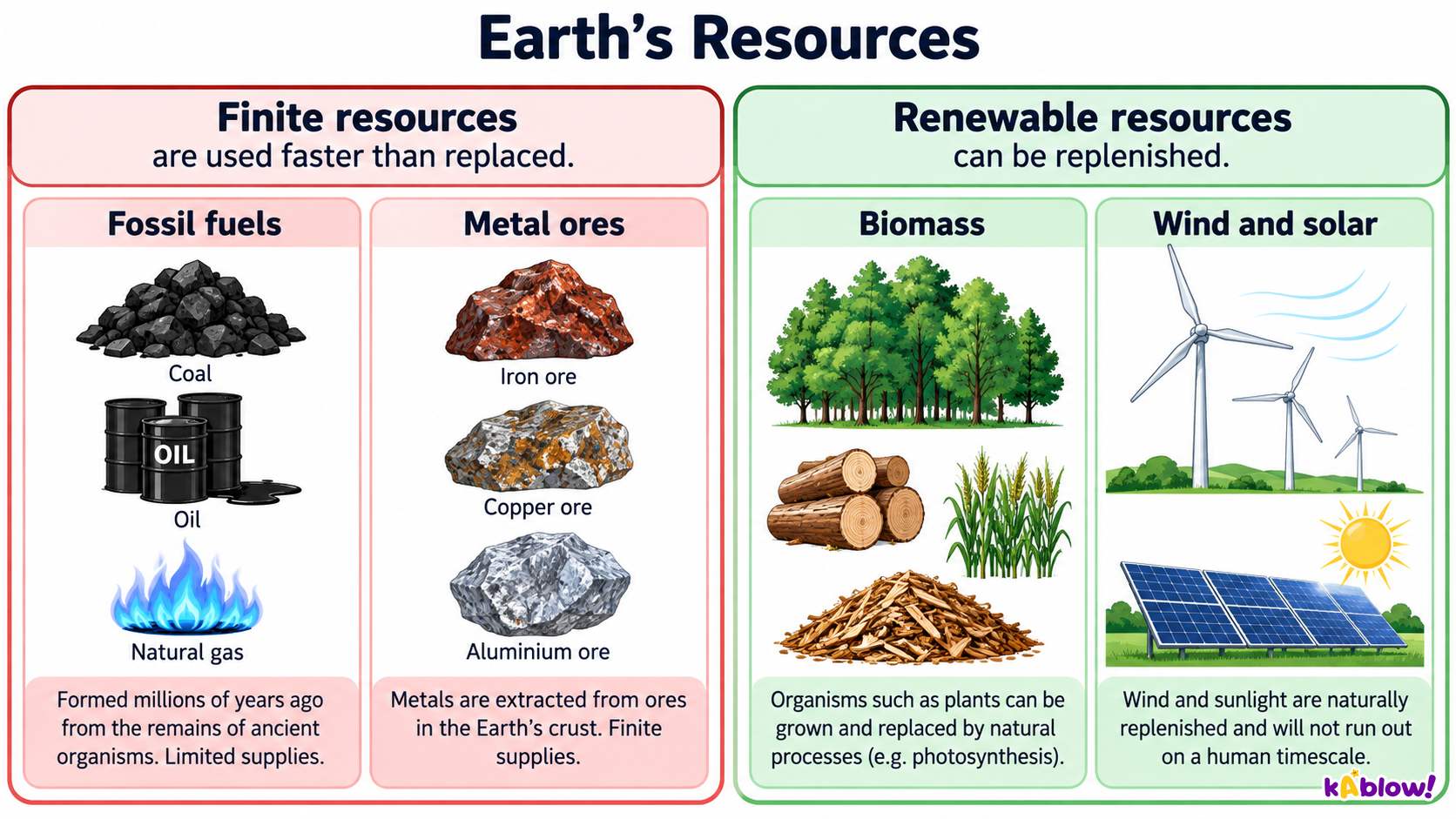
Finite and Renewable Resources
- Renewable resources can be replenished or replaced within a human timescale, e.g. timber from trees that can be replanted.
- Finite (non-renewable) resources do not reform quickly enough or do not reform at all, e.g. minerals from the Earth's crust and metal ores.
- Crude oil is a finite resource because it takes millions of years to form.
- Extracting and processing non-renewable resources requires energy and makes the process less sustainable.
- Recycling and re-using materials reduce the need to exploit finite mineral resources.
Finite and renewable resources
Sustainable Development
- Sustainable development meets the needs of current generations without compromising the ability of future generations to meet their own needs.
- Chemists design processes and materials to be more sustainable, e.g. developing polymers to replace natural rubber.
- Using recycled aluminium is more sustainable than extracting aluminium from its ore because it saves energy and conserves finite resources.
- Fertilisers are an example of scientific advancement maximising the production of natural products.
Potable Water
- Potable water is water that is safe for human consumption; it is not pure water in the chemical sense because it contains dissolved substances.
- Pure water is made up solely of H₂O molecules, whereas potable water contains dissolved minerals and salts in small regulated quantities.
- Potable water should have a pH between 6.5 and 8.5, very low levels of dissolved salts, and be free of bacteria and harmful microbes.
- Fresh water is relatively free from dissolved substances, e.g. rainwater; it collects in reservoirs, lakes and rivers (surface water) or in aquifers (groundwater).
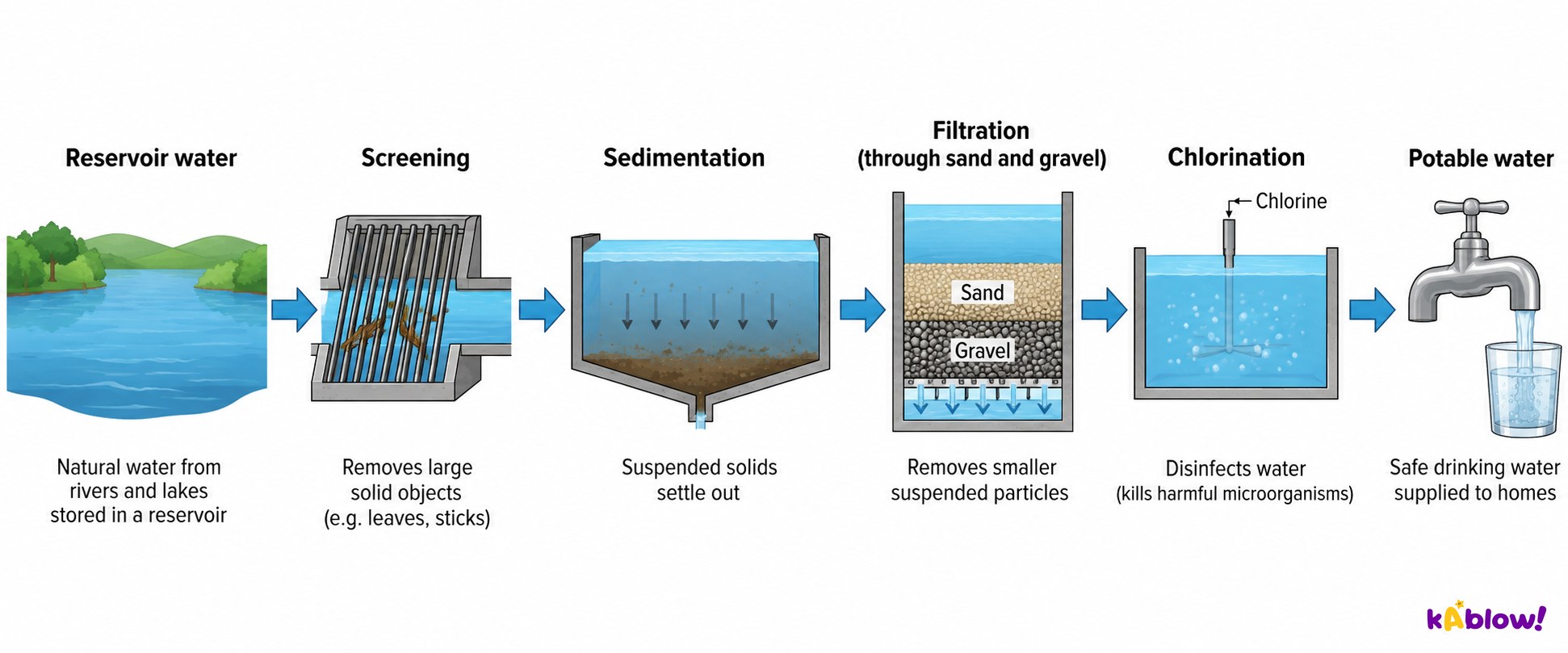
- In the UK, most potable water is produced by choosing an appropriate fresh water source, passing it through filter beds, and sterilising it.
- Sterilising agents include chlorine, ozone or ultraviolet light.
Treating fresh water to make it potable
Desalination
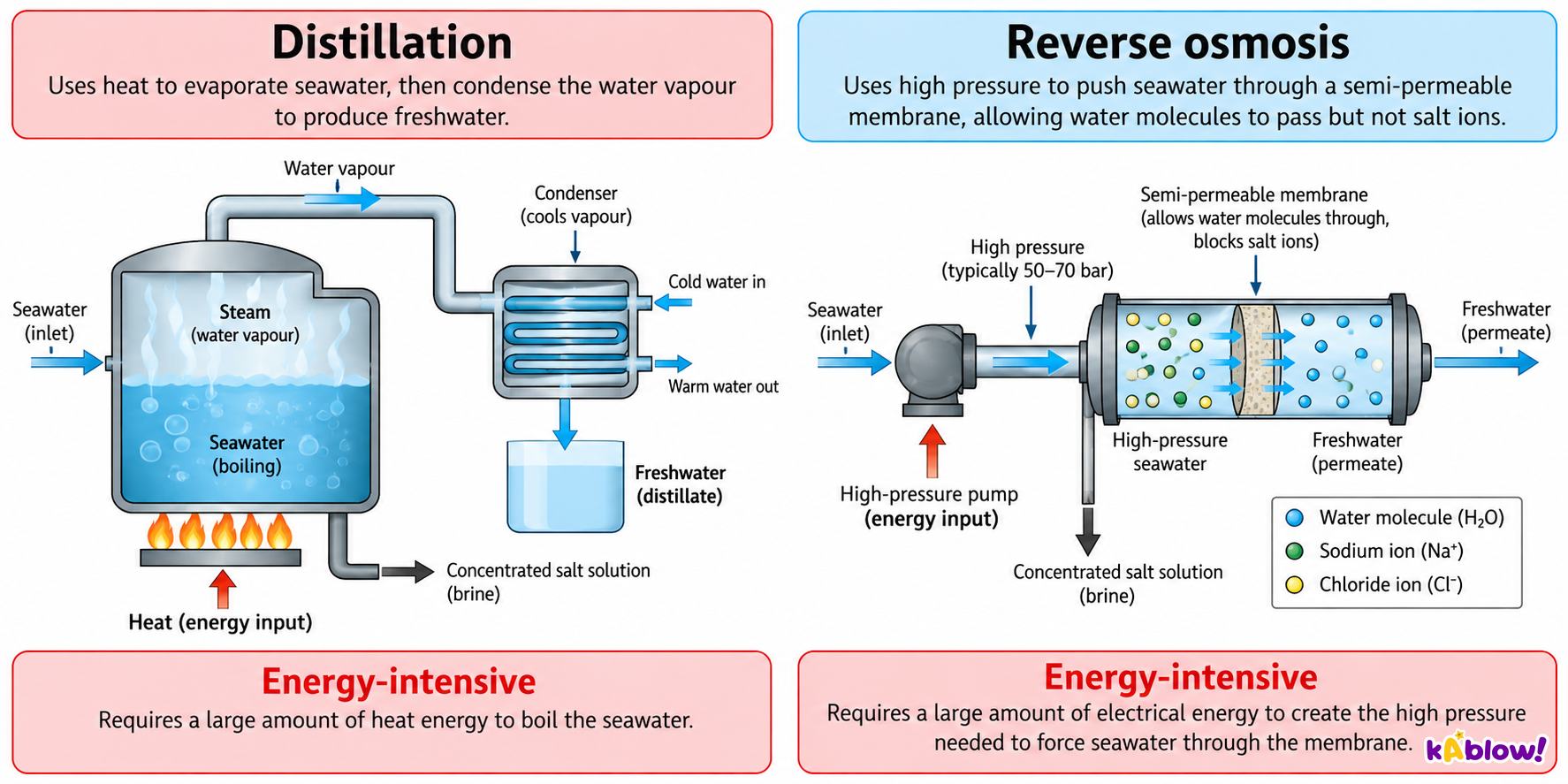
- Desalination is the treatment of seawater to remove salt, used when fresh water supplies are limited.
- Desalination can be done by distillation or by processes using membranes such as reverse osmosis.
- In reverse osmosis, salt water is forced through a semi-permeable membrane that allows only water molecules to pass, stopping larger molecules and ions.
- Desalination is expensive because it requires large amounts of energy.
- It is used in regions with very hot climates and scarce rainfall, such as Saudi Arabia and parts of the Middle East.
Desalination by distillation and reverse osmosis
Required Practical: Analysis and Purification of Water Samples
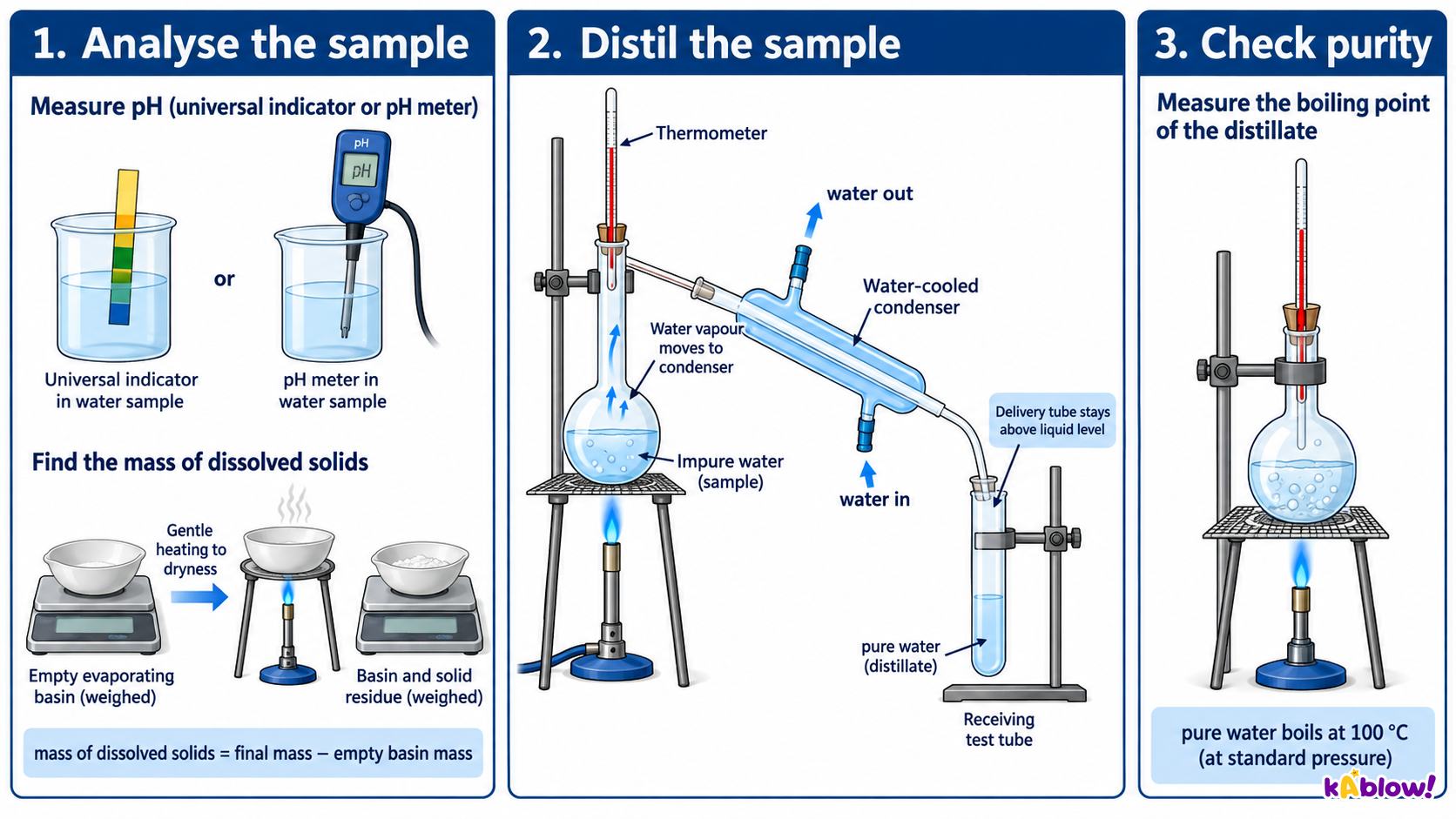
- Analysing water samples: measure pH (using a pH meter or universal indicator) and the mass of dissolved solids.
- To find dissolved solids: weigh an empty evaporating basin, add a measured volume of water, heat gently until most water evaporates, leave to fully evaporate, then reweigh.
- The mass of dissolved solids = (mass of basin + solids) − (mass of empty basin).
- Purification by distillation: set up simple distillation apparatus, heat the water sample until boiling, collect the distilled water in a cooled test tube.
- The delivery tube must sit above the filtrate level to prevent cold water being sucked back and breaking the hot glass.
- The distillate is pure water; its purity can be checked by determining its boiling point.
Analysing and distilling a water sample
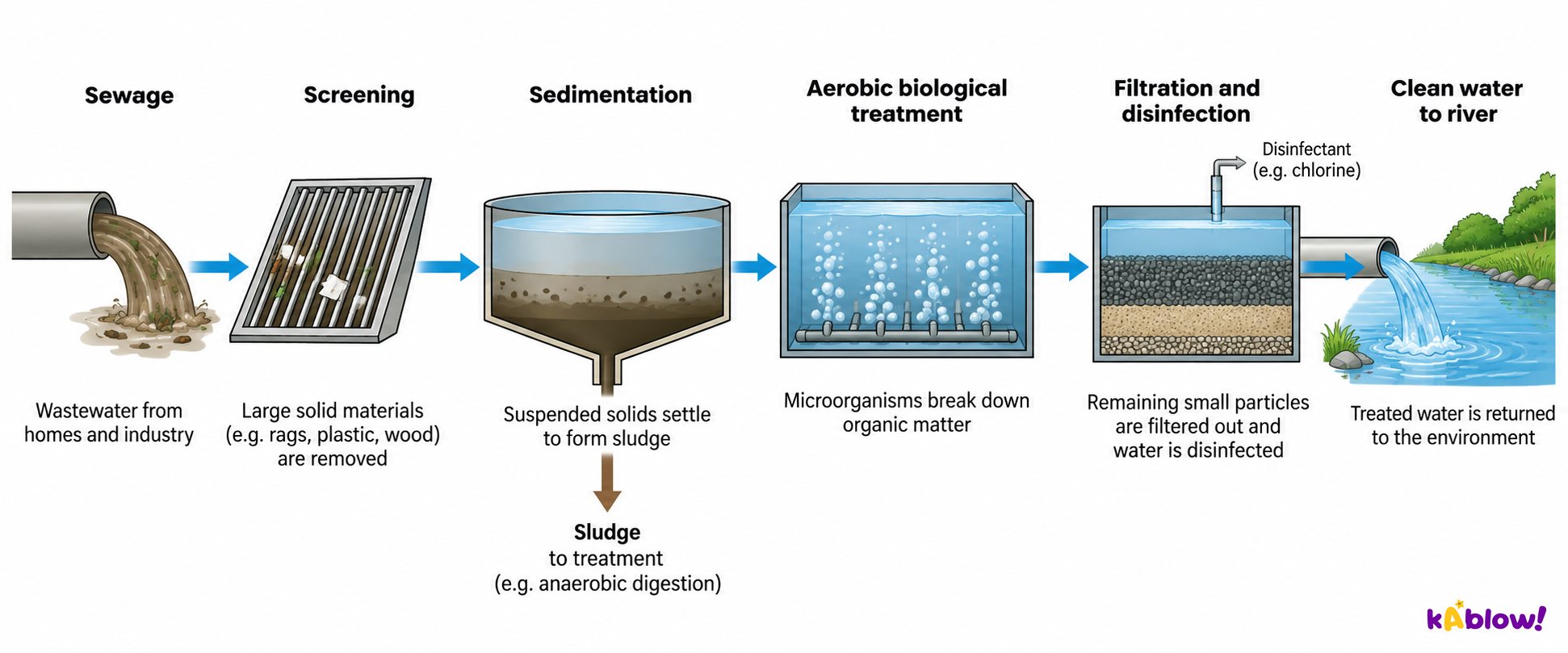
Waste Water Treatment
- Domestic and agricultural waste water require removal of organic matter and harmful microbes.
- Industrial waste water may require removal of organic matter and harmful chemicals.
- Sewage treatment stages: screening and grit removal → sedimentation → anaerobic digestion of sludge → aerobic biological treatment of effluent.
- Sedimentation produces sewage sludge (heavier solids sink) and effluent (lighter matter floats).
- Anaerobic digestion breaks down sewage sludge and releases methane gas, which can be used as an energy source; leftover digested waste can be used as fertiliser.
- Aerobic digestion pumps air into the effluent to encourage aerobic bacteria to break down organic matter and microbes.
- Additional treatment for toxic substances may include membranes, adding chemicals to precipitate metals, and UV radiation.
Waste water treatment stages
Alternative Methods of Extracting Metals
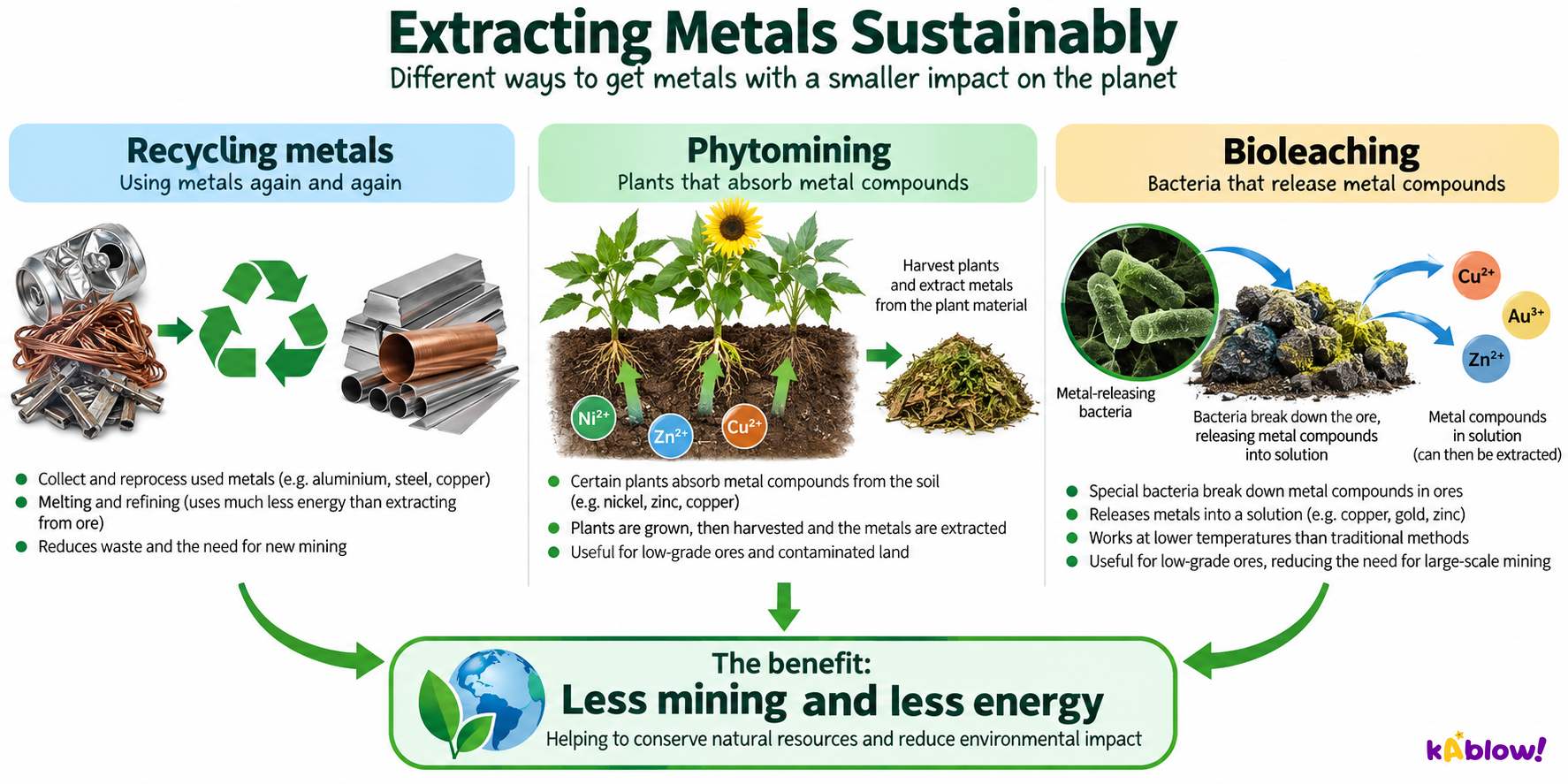
- Low-grade ores contain very low percentages of metal compounds; traditional mining is only economically viable for high-grade ores.
- Phytomining uses plants to absorb metal compounds through their roots; the plants are harvested, dried and burned to produce ash containing metal compounds.
- Bioleaching uses bacteria to produce leachate solutions containing metal ions, e.g. copper(II) ions.
- The metal compounds from phytomining and bioleaching can be processed to obtain the metal by displacement using scrap iron or by electrolysis.
- These biological methods avoid the digging, moving and disposing of large amounts of rock associated with traditional mining.
- Disadvantages: biological methods are very slow and bioleaching produces toxic substances that need treatment.
- Phytomining and bioleaching are mainly used for copper extraction because copper ores are becoming scarce, but can be applied to other metals.
Alternative methods of extracting metals
スライド
練習問題
無料プレビュー — 57問中8問。すべて見るには登録を。
1.Which of the following is NOT obtained from the Earth's resources?
Easy- AShelter
- BSunlight
- CWarmth
- DFood
2.Which of the following is an example of a synthetic product?
Easy- AWood
- BRubber
- CPoly(ethene)
- DCeramics
3.Which of these natural resources is finite?
Easy- AWood
- BCereal grains
- CCrude oil
- DTimber
4.What does potable water mean?
Easy- AWater that is safe to drink
- BWater that is chemically pure
- CWater that contains no dissolved substances
- DWater that has been distilled
5.Which of the following could NOT be used to sterilise water?
Easy- AFluoride
- BChlorine
- COzone
- DUltraviolet light
6.Which of the following is the incorrect reason for the water treatment step being carried out?
Easy- AFiltration to remove dissolved solids
- BDesalination to remove salt
- CReverse osmosis to remove salt
- DSterilisation to kill bacteria
7.What is meant by the term 'low-grade ores'?
Medium- AThe copper produced from these ores does not have a high economical value
- BThey contain very low percentages of copper compounds
- CThe copper they contain is impure
- DThey are found deep underground
8.Match each method of extraction to the substance that is used to extract copper.
Medium- Phytomining
- Bioleaching
- Plants
- Bacteria
過去問
このトピックの過去問練習は近日公開。
近日公開