Domestic uses and safety
遊んで学ぼう
問題に答えてエネルギーを集めたら、釣りや探検を楽しもう。アカウント不要。
レッスンノート
Direct and Alternating Current
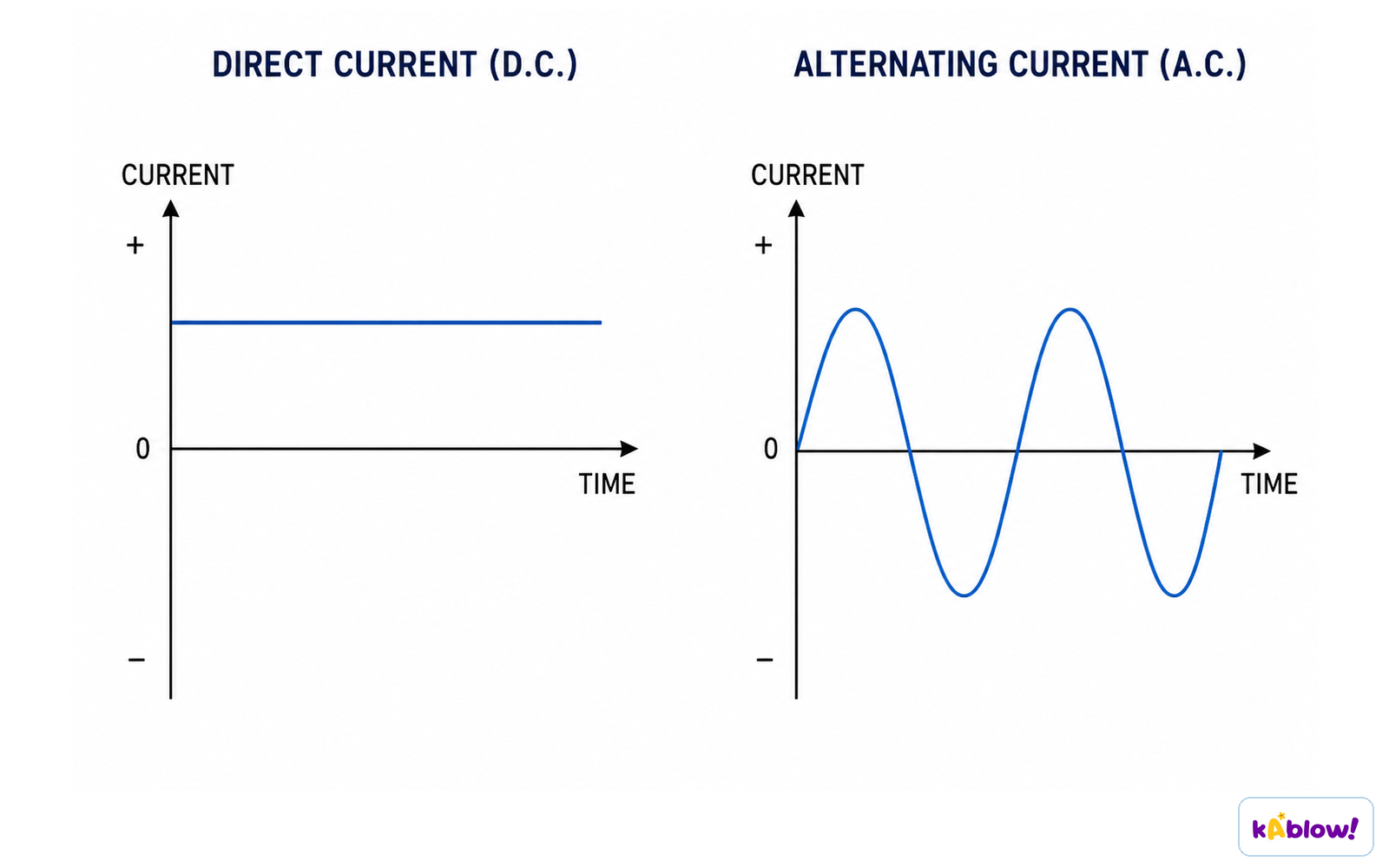
- Direct current (d.c.) flows steadily in one direction around a circuit, from positive to negative.
- A d.c. supply has a fixed positive terminal and a fixed negative terminal, so the current is always in the same direction.
- Cells and batteries produce direct current.
- Alternating current (a.c.) continuously changes direction, going back and forth around a circuit.
- An a.c. supply has two identical terminals that switch between positive and negative.
- The frequency of an alternating current is the number of times it changes direction back and forth each second.
Direct current and alternating current graphs
UK Mains Electricity
- Mains electricity is generated by power stations and transported around the country through the National Grid.
- Mains electricity is an alternating current (a.c.) supply.
- In the UK, the domestic supply has a frequency of 50 Hz and a potential difference of about 230 V.
- A frequency of 50 Hz means the current changes direction back and forth 50 times every second.
- Because mains is a.c., it does not have positive and negative sides; instead the two ends of the circuit are called live and neutral.
Three-Core Cable
- Most electrical appliances are connected to the mains using a three-core cable containing a live wire, a neutral wire and an earth wire.
- The insulation covering each wire is colour coded: live – brown, neutral – blue, earth – green and yellow stripes.
- The live wire carries the alternating potential difference from the supply to the circuit.
- The neutral wire completes the circuit and is at, or close to, earth potential (0 V).
- The earth wire is a safety wire that stops the appliance from becoming live; it only carries a current if there is a fault.
Potential Difference of the Wires
- The live wire has a potential difference of about 230 V and is the most dangerous wire.
- The neutral wire is at, or close to, 0 V and is much less dangerous than the live wire, although it can still deliver a small shock.
- The earth wire is at 0 V and normally carries no current.
- The potential difference between the live wire and earth is about 230 V.
Fuses
- A fuse is a safety device that cuts off the flow of electricity if the current becomes too large.
- A fuse usually consists of a glass cylinder containing a thin metal wire.
- If the current becomes too large, the wire heats up and melts, breaking the circuit and stopping the current.
- Fuses are always connected in the live wire so that when a fuse blows, the device is no longer connected to the live supply.
- A fuse without an earth wire protects the circuit and cabling for a double-insulated appliance.
Circuit Breakers
- A circuit breaker is an automatic electromagnet switch that breaks the circuit if the current exceeds a certain value.
- Circuit breakers have a major advantage over fuses because they do not melt and can be reset and used again.
- Circuit breakers also work much faster than fuses.
- For these reasons, circuit breakers are used in mains electricity in homes, sometimes misleadingly called 'fuse boxes'.
The Earth Wire and Safety
- Many electrical appliances have metal cases, which poses a safety hazard.
- If a live wire inside the appliance touches the metal case, the case becomes electrified and anyone touching it risks electrocution.
- The earth wire provides a low resistance path to the earth if this happens.
- This causes a surge of current in the earth wire and hence also in the live wire.
- The high current through the fuse causes it to melt and break, cutting off the supply and making the appliance safe to touch.
- The earth wire is an additional safety wire that reduces the risk of the appliance becoming live.
Dangers of Mains Electricity
- The live wire, at about 230 V, is the most dangerous wire.
- Because of the large potential difference between the live wire (230 V) and earth (0 V), connecting them together creates a very large current.
- If a person provides the connection between live and earth, a large current can pass through them, giving a potentially lethal shock.
- Even if a device is switched off but the mains supply is on, the live wire can still cause an electric shock.
- Electricians always switch off the mains supply before working on electrical appliances to avoid contact with live wires.
Switches and Fuses in the Live Wire
- Switches and fuses are always connected to the live wire.
- This means that when a switch is turned off or a fuse blows, the device is no longer connected to the live supply.
- If they were connected to the neutral wire, the device could still be live even when switched off, which is dangerous.
スライド
練習問題
無料プレビュー — 60問中8問。すべて見るには登録を。
1.Which of these correctly describes an alternating current?
Easy- AA current that is steady and flows in one direction only
- BA current that continuously changes its direction, going back and forth around a circuit
- CA current that flows only when a switch is closed
- DA current that flows only through the earth wire
2.Which row about the UK domestic supply is correct?
Easy- AType of current: a.c., frequency 50 Hz, voltage 230 V
- BType of current: a.c., frequency 230 Hz, voltage 50 V
- CType of current: d.c., frequency 50 Hz, voltage 230 V
- DType of current: d.c., frequency 230 Hz, voltage 50 V
3.Which of these electrical devices provides direct current?
Easy- AA battery
- BA mains socket
- CA generator at a power station
- DThe National Grid
4.What colour is the insulating cable of the live wire in a UK plug?
Easy- ABlue
- BGreen and yellow stripes
- CBrown
- DRed
5.An electric kettle is plugged into the mains supply. Which of these is the potential difference between the live and neutral wires?
Easy- A0 V
- B120 V
- C230 V
- D460 V
6.Which of the following correctly describes where a fuse should be fitted and how the fuse does its job?
Easy- AWhere: live wire — What it does: reduces the current to the fuse rating
- BWhere: neutral wire — What it does: breaks the circuit
- CWhere: live wire — What it does: breaks the circuit
- DWhere: neutral wire — What it does: reduces the current to the fuse rating
7.A circuit contains a fuse and each ammeter in the circuit reads 1.2 A. Which option correctly describes the fuse that should be fitted in this position?
Medium- A1.0 A
- B3.0 A
- C5.0 A
- D13.0 A
8.The earth wire carries a current in normal operation of an appliance.
EasyTrue or false?