Forces and their interactions
遊んで学ぼう
問題に答えてエネルギーを集めたら、釣りや探検を楽しもう。アカウント不要。
教育者の方へ: Forces and their interactions(Science、Physics)向けのすぐ使えるレッスンスライド, 復習ノート — レッスンで使うか、学習者がライブゲームとして遊ぶインタラクティブなクラス活動としてトピックを実施できます。
レッスンノート
Scalars and Vectors
- Scalar quantities have only a magnitude (size) and no direction.
- Vector quantities have both a magnitude and a direction.
- Examples of scalars: mass, distance, speed, time, energy, temperature.
- Examples of vectors: force, weight, velocity, acceleration, momentum, electric field strength, gravitational field strength.
- A vector can be represented by an arrow: the length shows the magnitude and the arrowhead shows the direction.
- Distance is a scalar; displacement is the corresponding vector (distance in a given direction).
- Speed is a scalar; velocity is the corresponding vector (speed in a given direction).
Contact and Non-Contact Forces
- A force is a push or a pull that acts on an object due to an interaction with another object.
- Forces can change an object's speed, direction, or shape.
- Contact forces act between objects that are physically touching.
- Examples of contact forces: friction, air resistance (drag), tension, normal contact force (reaction force).
- Non-contact forces act at a distance without the objects touching, due to a field.
- Examples of non-contact forces: gravitational force, electrostatic force, magnetic force.
- Friction opposes motion and occurs when surfaces rub together; air resistance is a type of friction acting on objects moving through air.
- Tension is the pulling force in a cable, rope or string when forces act on its ends.
Forces as Vectors and Force Pairs
- Force is a vector quantity: it has both magnitude (in newtons, N) and direction.
- The direction of a force can be described as left, right, up, down, or using an angle to the horizontal or vertical.
- When two objects interact, they exert forces on each other; these are called force pairs.
- Example: a laptop resting on a desk pushes down on the desk, and the desk pushes up on the laptop.
- Example: a person standing on the Earth pulls the Earth gravitationally, and the Earth pulls the person gravitationally.
- Force pairs can be shown using arrows in vector diagrams.
Weight, Mass and Gravity
- Mass is a measure of the amount of matter in an object; it is measured in kilograms (kg) and is a scalar.
- Weight is the force acting on an object due to gravitational attraction; it is measured in newtons (N) and is a vector.
- Weight depends on the object's mass and the gravitational field strength (g) at its location.
- The weight of an object acts at a single point called the centre of mass (or centre of gravity).
- For a symmetrical object of uniform density, the centre of mass is at the point of symmetry.
- Mass stays the same everywhere, but weight changes if the gravitational field strength changes (e.g., on the Moon).
- Weight is measured directly using a calibrated spring-balance (newton-meter); mass is measured using a top-pan balance.
Mass and Weight on Earth and the Moon
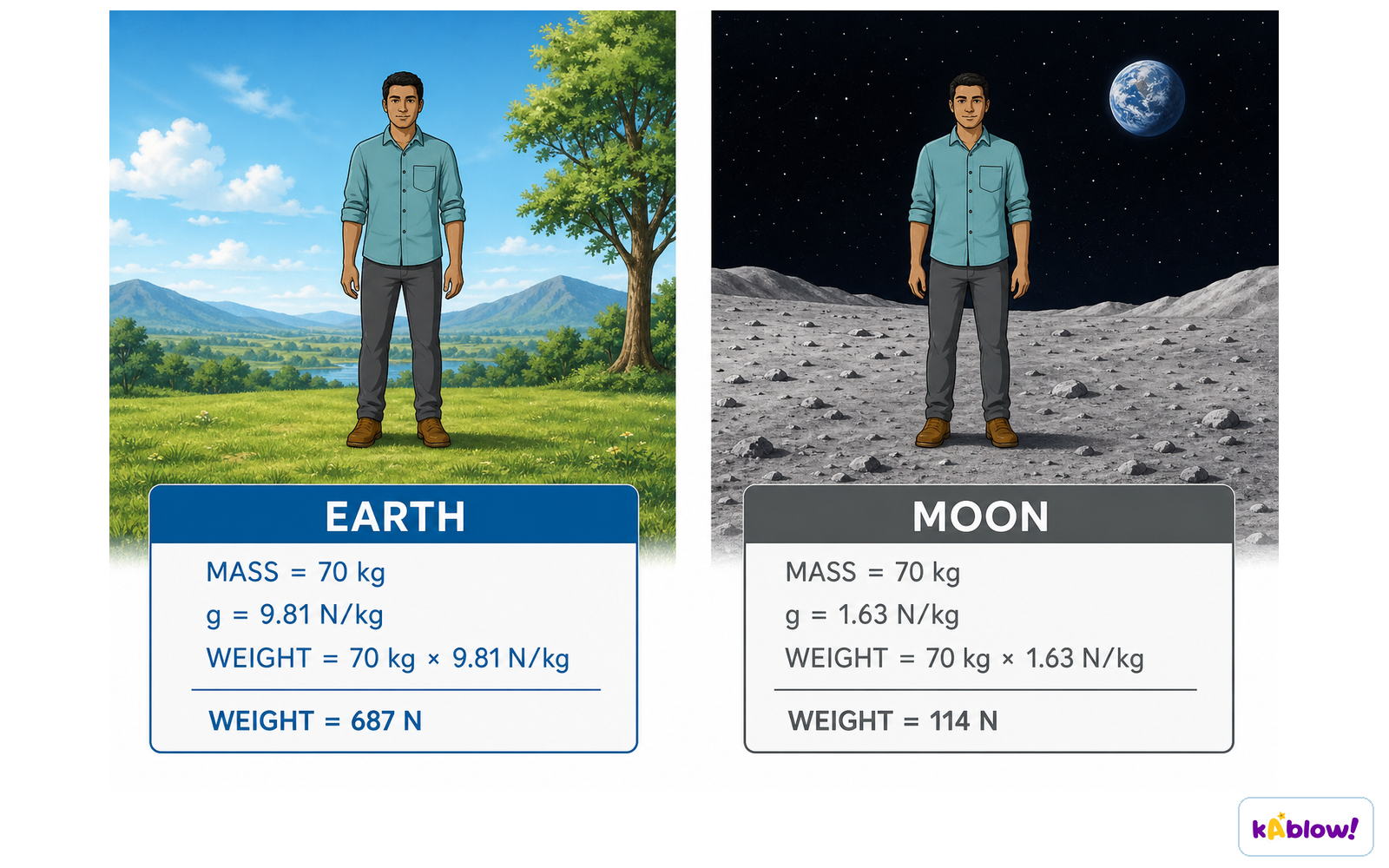
Calculating Weight
- The equation linking weight, mass and gravitational field strength is: W = m × g.
- W is weight in newtons (N), m is mass in kilograms (kg), and g is gravitational field strength in newtons per kilogram (N/kg).
- On Earth, g is approximately 9.8 N/kg (often taken as 10 N/kg for simpler calculations).
- Weight and mass are directly proportional: doubling the mass doubles the weight (for a given g).
- An object in free fall falls solely under gravity and accelerates towards Earth at about 9.8 m/s².
- To find mass from weight, rearrange: m = W ÷ g.
Resultant Forces
- A resultant force is a single force that has the same effect as all the original forces acting together.
- Forces acting in the same direction are added; forces acting in opposite directions are subtracted.
- If the forces cancel out completely, the resultant force is zero and the forces are balanced.
- If the forces do not cancel out, there is an unbalanced force (resultant force) and the object's motion changes.
- Always state both the magnitude and direction of a resultant force (e.g., '2 N to the left').
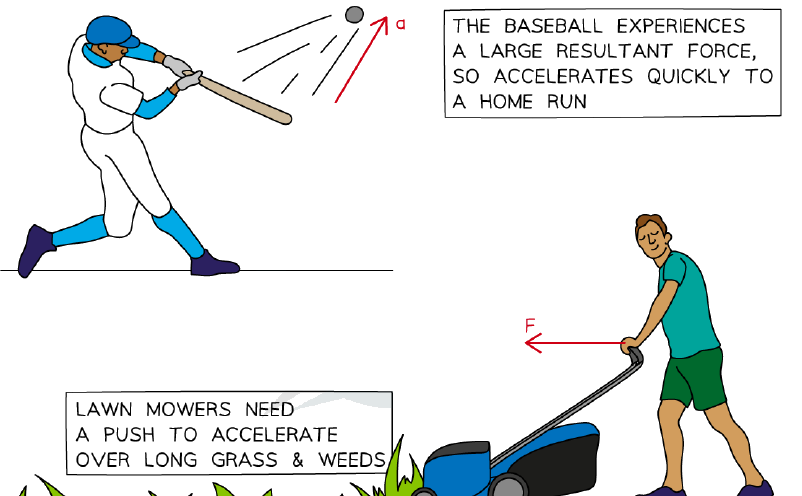
- Example: a tug-of-war with 80 N left and 100 N right gives a resultant of 20 N to the right.
Illustrations of a baseball player hitting a ball and a person pushing a lawnmower, demonstrating resultant forces and acceleration.
Free Body Diagrams
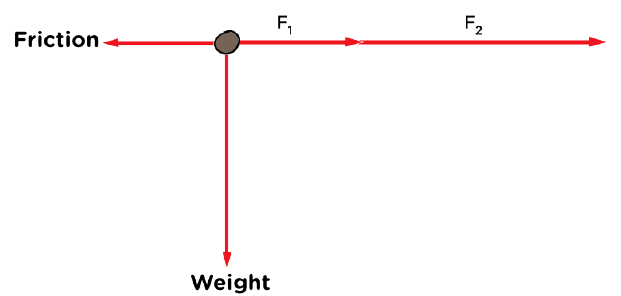
- A free body diagram shows all the forces acting on a single object as labelled arrows.
- Each arrow is scaled to the magnitude of the force and points in the direction the force acts.
- Forces are drawn acting from the centre of mass of the object.
- Common forces to include: weight (down), normal contact force (perpendicular to surface), friction (opposing motion), tension (along string/rope), upthrust (upwards in a fluid).
- Free body diagrams help identify balanced and unbalanced forces and can be used to find the resultant force.
- If the force arrows form a closed loop, the forces are balanced (no resultant force).
A free-body diagram: two applied forces (F1, F2), friction, and weight drawn as arrows from a central point representing the object.
Balanced and Unbalanced Forces
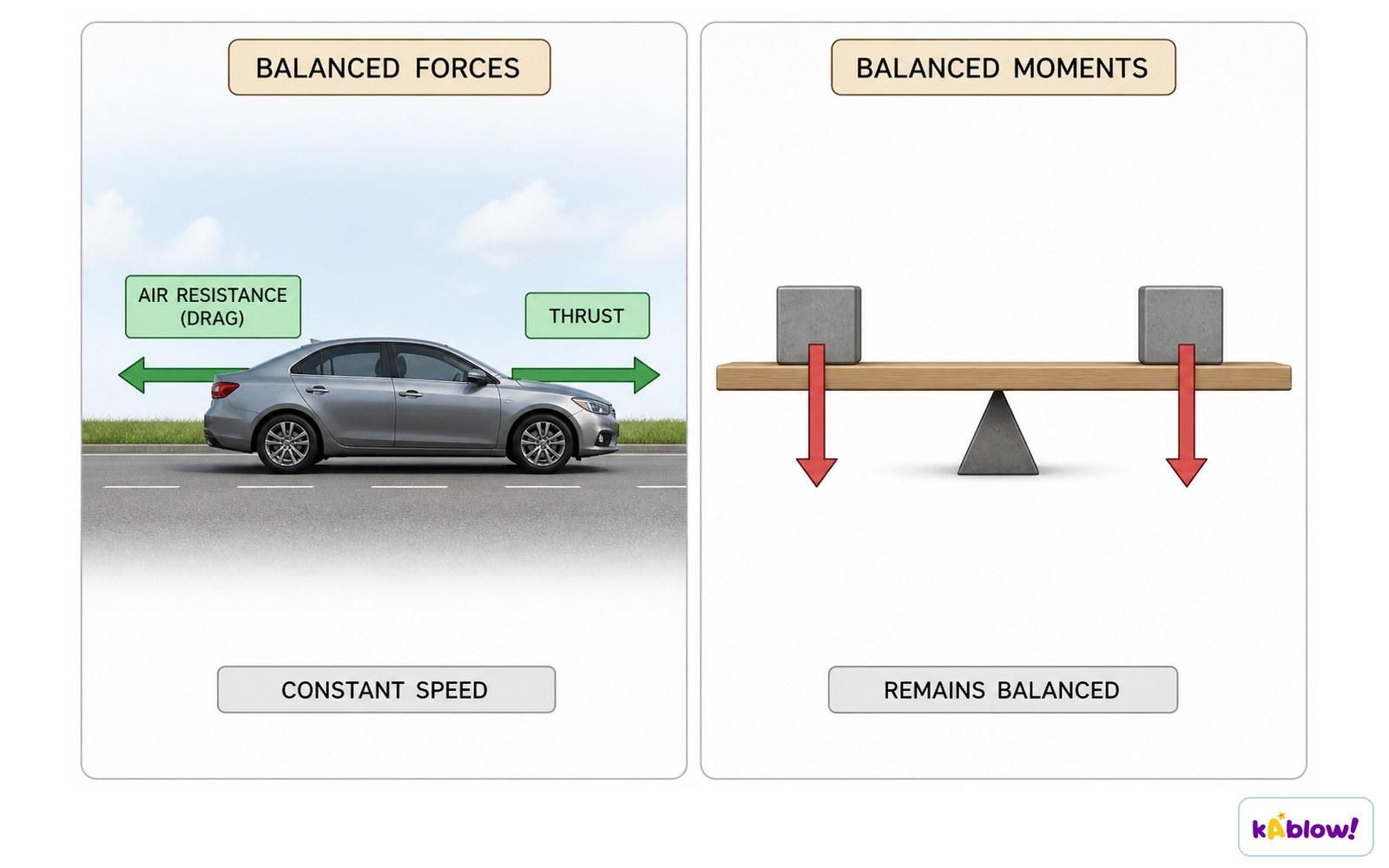
- Balanced forces produce no resultant force; the object remains at rest or moves at constant velocity.
- Unbalanced forces produce a resultant force; the object accelerates, decelerates, or changes direction.
- An object moving at constant speed in a straight line has balanced forces acting on it.
- If the resultant force on an object is zero, it is in equilibrium.
- When several forces act at angles, the resultant can be found by resolving forces into horizontal and vertical components or by using a scale drawing.
- A single force can be resolved into two perpendicular components that together have the same effect.
A car with balanced forces at constant speed, and a seesaw with balanced moments, illustrating equilibrium.
スライド
練習問題
無料プレビュー — 65問中8問。すべて見るには登録を。
1.Which of the following is a vector quantity?
Easy- AVelocity
- BSpeed
- CMass
- DDistance
2.Which of the following is a contact force?
Easy- AFriction
- BGravitational force
- CElectrostatic force
- DMagnetic force
3.A student has a mass of 50 kg. What is their weight on Earth? Use g = 9.8 N/kg.
Medium- A490 N
- B50 N
- C9.8 N
- D0.2 N
4.Mass is a scalar quantity and weight is a vector quantity.
EasyTrue or false?
5.A resultant force of zero means that no forces are acting on the object.
EasyTrue or false?
6.Which of the following are non-contact forces? (Select all that apply.)
Medium- AGravitational force
- BElectrostatic force
- CMagnetic force
- DFriction
- EAir resistance
7.Match each force with its correct description.
Medium- Weight
- Friction
- Tension
- Upthrust
- The force of gravity on a mass
- A force that opposes motion between surfaces in contact
- A pulling force transmitted through a cable or rope
- The upward force exerted by a fluid on an object
8.Place the steps for calculating the resultant force of two forces acting in opposite directions in the correct order.
Medium- Identify the direction of the larger force
- Subtract the smaller force from the larger force
- State the magnitude and direction of the resultant force
過去問
このトピックの過去問練習は近日公開。
近日公開