Internal energy and energy transfers
遊んで学ぼう
問題に答えてエネルギーを集めたら、釣りや探検を楽しもう。アカウント不要。
教育者の方へ: Internal energy and energy transfers(Science、Physics)向けのすぐ使えるレッスンスライド, 復習ノート — レッスンで使うか、学習者がライブゲームとして遊ぶインタラクティブなクラス活動としてトピックを実施できます。
レッスンノート
Internal Energy
- Internal energy is the total energy stored inside a system by the particles that make up the system due to their motion and positions.
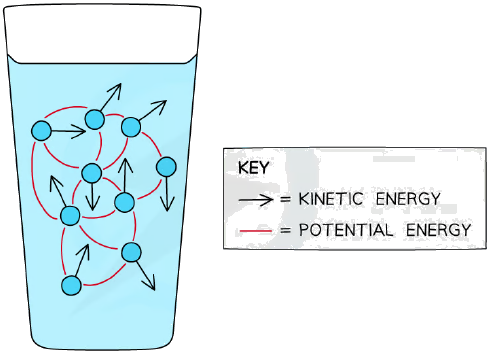
- The molecules within a substance have energy in their kinetic store (due to their random motion / vibration) and potential store (due to their position relative to each other).
- Together, these stores form the total energy that makes up the internal energy of the system.
- Heating a system increases its internal energy.
- The temperature of the material is related to the average kinetic energy of the molecules.
- The higher the temperature, the higher the kinetic energy of the molecules, and vice versa.
- The increase in internal energy from heating can cause the temperature of the system to increase, or produce a change of state (solid to liquid or liquid to gas).
Internal energy of particles in a liquid
Specific Heat Capacity
- Specific heat capacity is the amount of energy required to raise the temperature of 1 kg of a substance by 1 °C.
- The energy needed to raise the temperature of a given mass by a given amount can be calculated using: ΔE = mcΔθ.
- In this equation: ΔE = change in energy (J), m = mass (kg), c = specific heat capacity (J/kg °C), Δθ = change in temperature (°C).
- If a substance has a low specific heat capacity, it heats up and cools down quickly because it takes less energy to change its temperature.
- If a substance has a high specific heat capacity, it heats up and cools down slowly because it takes more energy to change its temperature.
- Specific heat capacity is mainly used for liquids and solids.
- The specific heat capacity of different substances determines how useful they would be for a specific purpose, e.g. choosing the best material for kitchen appliances.
- Good electrical conductors, such as copper and lead, are excellent conductors of heat due to their low specific heat capacity.
- Water has a very high specific heat capacity, making it ideal for heating homes as the water remains hot in a radiator for a long time.
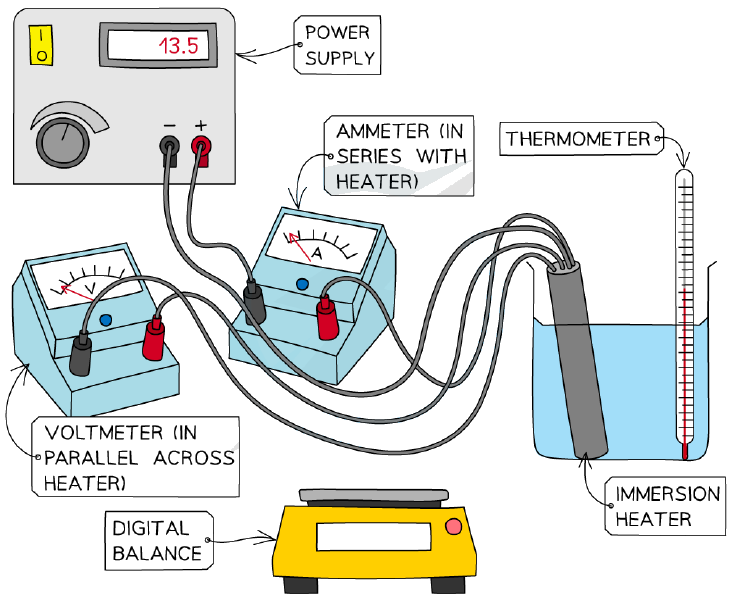
Diagram of apparatus for investigating specific heat capacity
Latent Heat
- The energy needed for a substance to change state is called latent heat.
- When a change of state occurs, the energy transferred to or away from a substance changes the internal energy of the substance but not its temperature.
- Whilst the substance is changing state (e.g. from liquid to gas), the temperature of the substance remains constant, despite the fact that energy is still being transferred to the substance.
- This is because the energy is being used to overcome intermolecular forces of attraction between the molecules instead of increasing the kinetic energy of the molecules (and hence the temperature).
- Molecules in a solid are tightly bound together, whereas, in a liquid, they are free to flow over one another.
- To change the state from solid to a liquid, the molecules need to gain enough energy to overcome intermolecular forces of attraction holding them in their rigid solid structure.
- Molecules in a liquid are less tightly bound together, whereas, in a gas, they are free to move completely apart from one another.
- To change the state from a liquid to a gas, the molecules need to gain enough energy to overcome the intermolecular forces of attraction holding them close together in their liquid structure.
Specific Latent Heat
- Specific latent heat is defined as the amount of energy required to change the state of 1 kg of a substance with no change in temperature.
- There are two types of specific latent heat: specific latent heat of fusion (solid to liquid, or liquid to solid) and specific latent heat of vaporisation (liquid to gas, or gas to liquid).
- Latent heat is represented by the symbol L with units joules per kilogram (J/kg).
- The amount of energy E required to melt or vaporise a mass m with latent heat L is: E = mL.
- In this equation: E = thermal energy required for a change in state (J), m = mass (kg), L = specific latent heat (J/kg).
- The specific latent heat of fusion is the energy required to convert 1 kg of a substance between a solid and a liquid state with no change in temperature.
- The specific latent heat of vaporisation is the energy required to convert 1 kg between a liquid and a gaseous state with no change in temperature.
- For water: specific latent heat of fusion = 330 kJ/kg; specific latent heat of vaporisation = 2.26 MJ/kg.
- Evaporating 1 kg of water requires roughly seven times more energy than melting the same amount of ice to form water.
Heating & Cooling Graphs
- Heating and cooling graphs summarise how the temperature of a substance changes when energy is transferred to or away from it, and where changes of state occur.
- Heating is when energy is transferred to the system, increasing the internal energy of the molecules.
- Cooling is when energy is transferred away from the system (or dissipated to the surroundings), decreasing the internal energy of the molecules.
- On a heating curve, the sections where the temperature is constant (plateaus) represent a change of state.
- During a plateau, energy is still being transferred, but it is used to overcome intermolecular forces of attraction rather than increasing kinetic energy.
- For heating: solid → melting → liquid → boiling → gas.
- For cooling: gas → condensing → liquid → freezing → solid.
- The temperature remains constant during melting and boiling, despite energy being transferred to the substance.
Specific Heat Capacity vs Specific Latent Heat
- Specific heat capacity is the amount of heat energy required to raise the temperature of a substance by a certain amount; the substance remains in the same state.
- Specific latent heat is the amount of heat energy needed to cause a change of state; the substance changes state but stays at the same temperature.
- Example of specific heat capacity: a liquid heated from 5 °C to 20 °C.
- Example of specific latent heat: a liquid evaporating into a gas.
- Do not confuse the two: specific heat capacity involves a temperature change, specific latent heat involves a change of state with no temperature change.
スライド
練習問題
無料プレビュー — 63問中8問。すべて見るには登録を。
1.Which of the following best defines the internal energy of a system?
Easy- AThe total kinetic and potential energy of all the particles in the system
- BThe average kinetic energy of the particles in the system
- CThe energy transferred to the system by heating
- DThe energy required to raise the temperature of 1 kg of the system by 1 °C
2.The temperature of a substance is related to the average kinetic energy of its particles.
EasyTrue or false?
3.Which of the following is the correct unit for specific heat capacity?
Easy- AJ/kg
- BJ/kg °C
- CJ/°C
- DJ
4.Which of the following is the correct unit for specific latent heat?
Easy- AJ/kg °C
- BJ
- CJ/kg
- DJ/°C
5.Which of the following statements about a heating curve are correct? (Select all that apply)
Medium- AThe plateaus on the curve represent changes of state.
- BDuring a plateau, the temperature remains constant.
- CThe temperature always increases steadily as energy is added.
- DThe sloped sections represent an increase in kinetic energy of the particles.
- EDuring a plateau, no energy is being transferred to the substance.
6.Which of the following is the correct definition of specific latent heat of fusion?
Medium- AThe energy required to raise the temperature of 1 kg of a substance by 1 °C
- BThe energy required to change 1 kg of a substance from solid to liquid with no change in temperature
- CThe energy required to change 1 kg of a substance from liquid to gas with no change in temperature
- DThe energy required to change the state of a substance without changing its temperature
7.During a change of state, the temperature of a substance remains constant even though energy is being transferred to it.
EasyTrue or false?
8.Match each term with its correct definition.
Medium- Internal energy
- Specific heat capacity
- Specific latent heat of vaporisation
- The energy required to change 1 kg of a substance from liquid to gas with no change in temperature
- The total energy stored by the particles in a system due to their motion and positions
- The energy required to raise the temperature of 1 kg of a substance by 1 °C
過去問
このトピックの過去問練習は近日公開。
近日公開