Momentum
遊んで学ぼう
問題に答えてエネルギーを集めたら、釣りや探検を楽しもう。アカウント不要。
教育者の方へ: Momentum(Science、Physics)向けのすぐ使えるレッスンスライド, 復習ノート — レッスンで使うか、学習者がライブゲームとして遊ぶインタラクティブなクラス活動としてトピックを実施できます。
レッスンノート
Momentum Basics
- Momentum is a property of moving objects, defined by the equation p = m v.
- p = momentum in kilogram metre per second (kg m/s), m = mass in kilograms (kg), v = velocity in metres per second (m/s).
- An object at rest has v = 0, so its momentum is zero.
- Momentum is a vector quantity: it has both size and direction, so it can be positive or negative.
- If an object moves to the right, its momentum is positive; if it moves to the left, its momentum is negative.
- Momentum changes if an object speeds up, slows down, changes direction, or its mass changes.
- The units of momentum are kg m/s, which come from multiplying mass (kg) by velocity (m/s).
Conservation of Momentum
- The law of conservation of momentum states: in a closed system, the total momentum before an event equals the total momentum after the event.
- A closed system means no external forces act (e.g. friction is absent) and the total energy remains constant.
- For a collision: total momentum before = total momentum after.
- Momentum is always conserved over time, in every collision or explosion.
- Because momentum is a vector, objects moving in opposite directions at the same speed have an overall momentum of zero (they cancel out).
- In calculations, choose a positive direction (usually right or upwards) and give opposite directions a negative sign.
Conservation of momentum
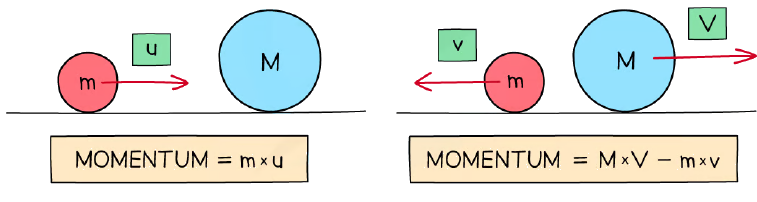
Collisions
- In a collision, objects either bounce apart and move in opposite directions, or stick together and move in the same direction.
- When objects move in opposite directions, each has a different velocity depending on its mass and the initial momentum of the system.
- When objects stick together, they have a combined mass and a combined velocity after the collision.
- An elastic collision is one where the objects move in opposite directions; an inelastic collision is one where the objects stick together and move in the same direction.
- In a perfectly elastic collision, kinetic energy is the same before and after; in an inelastic collision, kinetic energy is not conserved (it may become heat, sound, etc.).
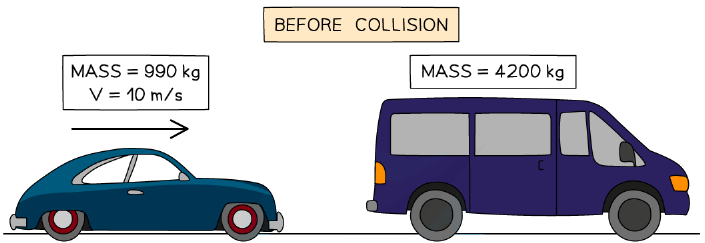
- To solve collision problems, use conservation of momentum: set total momentum before equal to total momentum after and solve for the unknown velocity or mass.
A car moving towards a stationary van before a collision.
Force and Momentum
- When a force acts on a moving object (or one able to move), it accelerates or decelerates, causing a change in momentum.
- Force is the rate of change of momentum: F = Δp / Δt, where Δp is the change in momentum and Δt is the time taken.
- The change in momentum is final momentum minus initial momentum: Δp = mv – mu (where u is initial velocity and v is final velocity).
- This equation comes from combining F = m a and a = (v – u) / t.
- Force and momentum are vectors, so they can be positive or negative depending on direction.
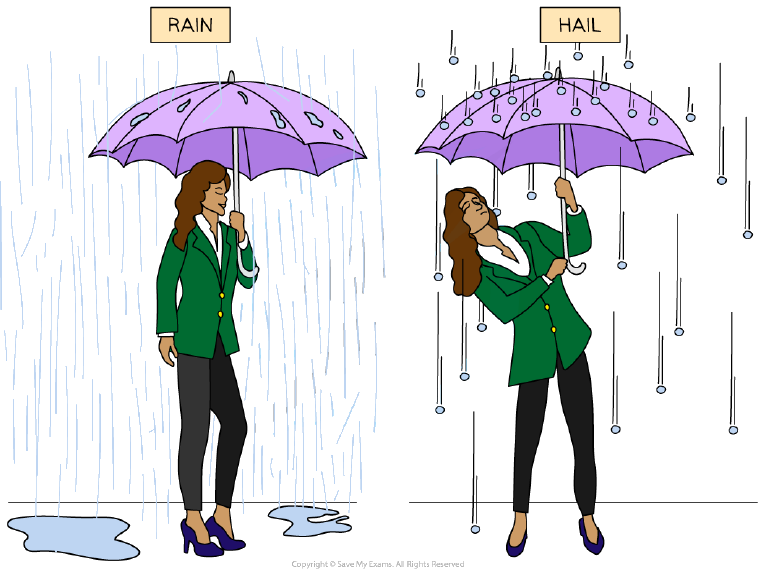
- For a given change in momentum, a longer contact time means a smaller force; a shorter contact time means a larger force.
A person holding an umbrella in rain versus hail, illustrating the difference in force and momentum change.
Momentum and Safety
- Safety features increase the contact time during an impact, which reduces the force on the person because force is the rate of change of momentum.
- Seat belts stretch slightly to increase the time for the passenger's momentum to reach zero, reducing the force on them.
- Airbags deploy on impact and act as a soft cushion, increasing the time over which the passenger's momentum changes.
- Crumple zones at the front and back of vehicles are designed to crush in a controlled way, increasing the time for the vehicle to come to rest and lowering the impact force.
- Crash mats in gymnasiums and bouldering mats are thick and soft, increasing contact time when a person lands, reducing the impact force.
- Cushioned playground surfaces increase contact time when a child falls, reducing the risk of severe injury.
- The effectiveness of safety equipment depends on mass and velocity: a large mass moving fast has a large momentum, so a very long contact time is needed to reduce the force.
Explosions and Recoil
- In an explosion starting from rest, the total momentum before is zero, so the total momentum after must also be zero.
- This means the objects move apart in opposite directions with equal and opposite momenta.
- For example, when a gun fires a bullet, the bullet moves forward and the gun recoils backwards.
- The momentum of the bullet forward equals the momentum of the gun backwards in size, but opposite in direction.
- This principle also explains why a person jumping off a trolley causes the trolley to move in the opposite direction.
Newton's Third Law and Momentum
- Newton's third law states: whenever two bodies interact, the forces they exert on each other are equal and opposite.
- In a collision, when object A exerts a force on object B, object B exerts an equal force on object A in the opposite direction.
- These forces cause one object to gain momentum and the other to lose momentum.
- For objects of equal mass, the accelerations are equal; for unequal masses, the accelerations are unequal (the lighter object accelerates more).
- The two forces in Newton's third law always act on different objects.
Key Skills and Common Mistakes
- Always draw a before-and-after diagram to keep track of masses, velocities, and directions.
- Choose a positive direction and stick to it; give opposite velocities negative signs.
- Remember that momentum is a vector – do not treat it as a scalar.
- Momentum is conserved in all collisions and explosions, not just elastic ones.
- Do not confuse momentum with kinetic energy or force – they are different quantities.
- When calculating force from momentum change, use F = Δp / Δt and ensure Δt is the contact time.
- Double-check signs in your final answer – sign errors are the most common mistake.
スライド
練習問題
無料プレビュー — 65問中8問。すべて見るには登録を。
1.Which equation correctly relates momentum (p), mass (m) and velocity (v)?
Easy- Ap = mv
- Bp = m/v
- Cp = v/m
- Dp = m + v
2.What are the correct units for momentum?
Easy- Akg m/s
- Bkg/m/s
- CN m
- Dkg m/s²
3.A tennis ball and a brick are compared. The brick is much heavier, but the ball travels much faster. If they have the same momentum, what can be said about the force they exert on impact?
Medium- AThey would exert a similar force if they take the same time to come to rest
- BThe brick always exerts a greater force because it is heavier
- CThe ball always exerts a greater force because it is faster
- DNeither exerts any force because momentum is the same
4.Which statement best describes the principle of conservation of momentum?
Medium- AIn a closed system, total momentum before an event equals total momentum after the event
- BMomentum is only conserved when objects bounce off each other
- CMomentum is always conserved, even when external forces act on the system
- DTotal momentum before a collision is always greater than after
5.Which of the following are true about momentum? (Select all that apply)
Medium- AMomentum is a vector quantity
- BMomentum can be negative if the object moves in the opposite direction to the positive direction
- CAn object at rest has zero momentum
- DMomentum is the same as kinetic energy
- EMomentum is measured in newtons
6.Momentum is a scalar quantity.
EasyTrue or false?
7.Match each term with its correct definition.
Medium- Momentum
- Conservation of momentum
- Closed system
- Impulse
- The product of mass and velocity
- Total momentum before an event equals total momentum after
- A system with no external forces and constant energy
- Force multiplied by the time for which it acts
8.A car of mass 860 kg is travelling at 30 m/s. Calculate its momentum.
Medium- A25 800 kg m/s
- B28.7 kg m/s
- C860 kg m/s
- D25 800 N
過去問
このトピックの過去問練習は近日公開。
近日公開