Particle model and pressure
遊んで学ぼう
問題に答えてエネルギーを集めたら、釣りや探検を楽しもう。アカウント不要。
教育者の方へ: Particle model and pressure(Science、Physics)向けのすぐ使えるレッスンスライド, 復習ノート — レッスンで使うか、学習者がライブゲームとして遊ぶインタラクティブなクラス活動としてトピックを実施できます。
レッスンノート
Kinetic Theory and Gas Pressure
- Gas molecules are in constant random motion at high speeds.
- Random motion means molecules travel in no specific path and change direction when they collide with the container walls or other molecules.
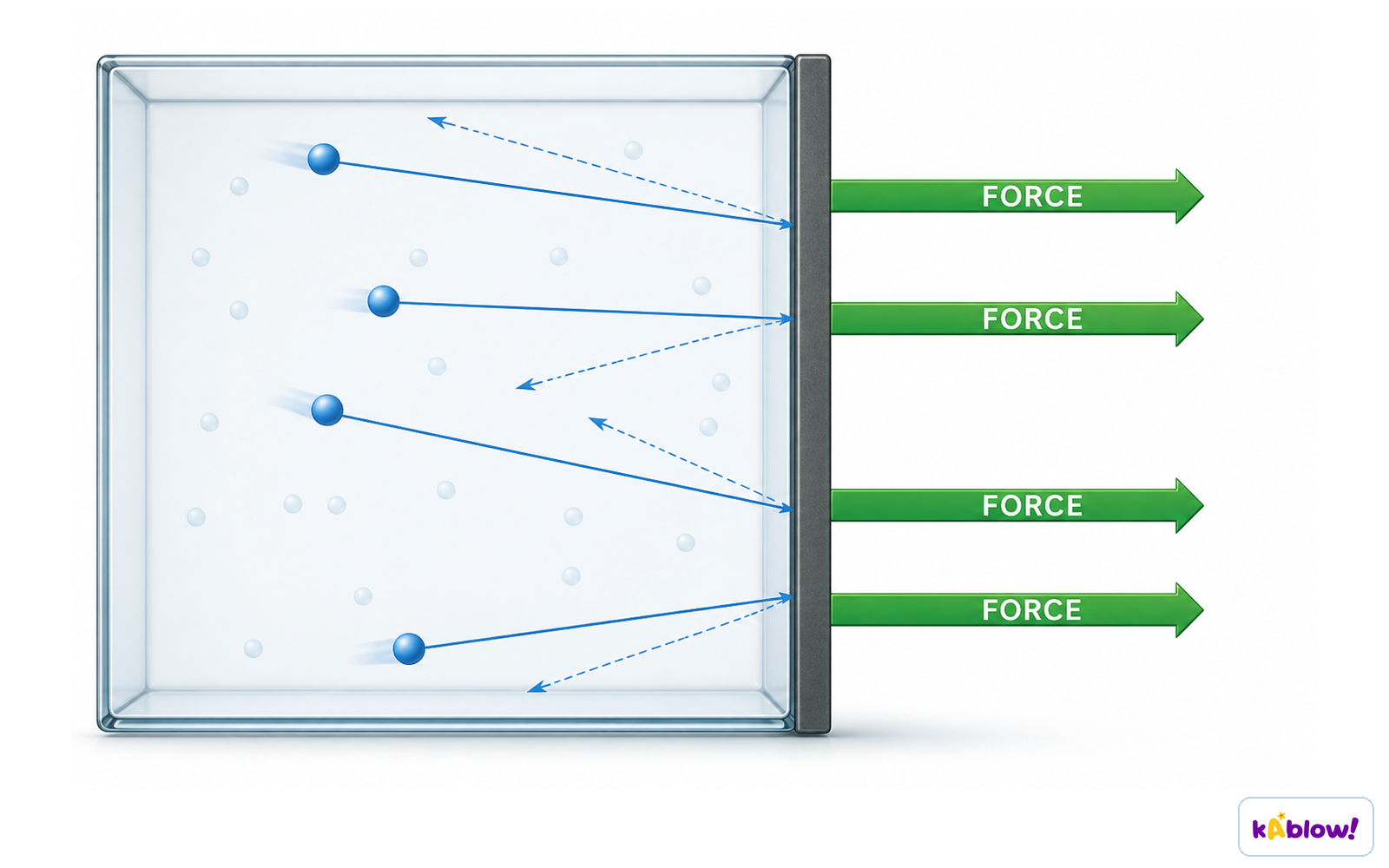
- Gas pressure is the force exerted per unit area on the container walls, caused by molecules colliding with them.
- The collisions produce a net force at right angles to the surface.
- A gas at higher pressure has more frequent collisions and therefore a greater force per unit area.
- The random motion of tiny particles in a fluid is called Brownian motion.
Gas particles colliding with a container wall
Temperature and Kinetic Energy
- The temperature of a gas is related to the average kinetic energy of its molecules.
- The hotter the gas, the higher the average kinetic energy and the faster the molecules move.
- The cooler the gas, the lower the average kinetic energy and the slower the molecules move.
- As temperature increases, molecules collide with the walls more frequently and with more force, increasing pressure.
- At constant volume, an increase in temperature increases the pressure of a gas, and vice versa.
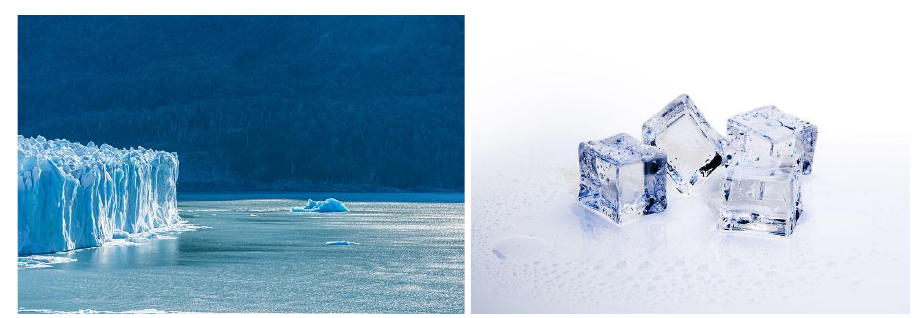
A large iceberg has more total kinetic (thermal) energy than a few small ice cubes of the same substance and temperature, because it is made of far more particles.
Absolute Zero and the Kelvin Scale
- Absolute zero is the temperature at which particles have zero kinetic energy and exert no pressure.
- Absolute zero is equal to −273 °C or 0 K.
- It is not possible to have a temperature lower than 0 K; a Kelvin temperature is never negative.
- The Kelvin scale starts at absolute zero, and a change of 1 K equals a change of 1 °C.
- Convert Celsius to Kelvin: T(K) = θ(°C) + 273.
- Convert Kelvin to Celsius: θ(°C) = T(K) − 273.
Pressure and Volume (Boyle's Law)
- For a fixed mass of gas at constant temperature, pressure × volume = constant: pV = constant.
- Pressure and volume are inversely proportional.
- When volume decreases (compression), pressure increases.
- When volume increases (expansion), pressure decreases.
- The equation can be written for before and after a change: P₁V₁ = P₂V₂.
- Key assumptions: temperature and mass (number of particles) remain constant.
- Pressure is measured in pascals (Pa) and volume in metres cubed (m³).
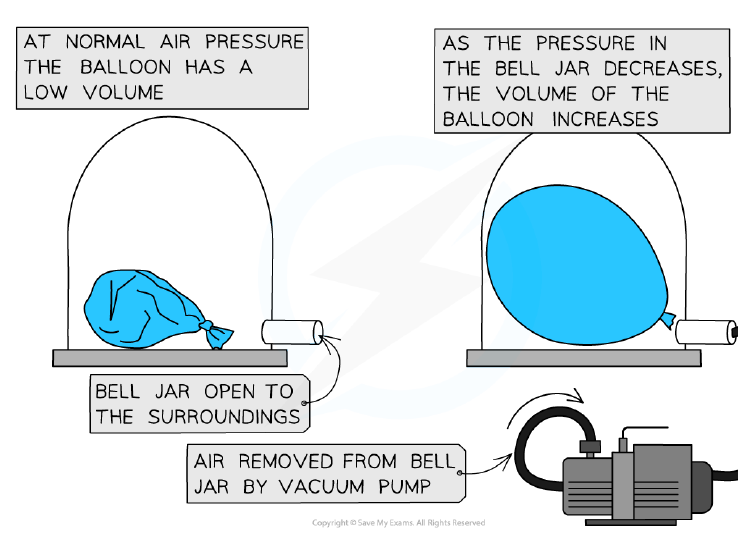
Illustration of Boyle's Law showing a balloon expanding as pressure decreases in a bell jar.
Explaining Pressure Changes with the Particle Model
- When a gas is compressed, the same number of particles occupy a smaller volume.
- The density of the gas increases, so particles collide with the walls more frequently.
- Each collision exerts the same force, but more frequent collisions give a greater force per unit area (pressure).
- When a gas expands, particles collide with the walls less frequently, so pressure decreases.
- The pressure produces a net force at right angles to the container walls.
Doing Work on a Gas
- Work is the transfer of energy by a force.
- Doing work on a gas increases its internal energy and can increase its temperature.
- Compressing a gas with a piston does work on it, decreasing its volume.
- The molecules move faster and have higher kinetic energy, so temperature rises.
- If a gas expands, it does work and loses energy, so its temperature falls.
- Example: a bicycle pump gets warm when compressed because work is done on the gas.
- Example: releasing pressurised carbon dioxide causes it to expand, do work, and cool, forming dry ice.
Common Misconceptions to Avoid
- Gas pressure is caused by collisions with the container walls, not by particles repelling each other.
- Use kelvin for proportionality with pressure or volume, not degrees Celsius.
- Particles do not lose energy when they collide with the walls.
- Absolute zero is the point of minimum internal energy, not just 'very cold'.
- Do not reverse the pressure–volume relationship: compression increases pressure.
スライド
練習問題
無料プレビュー — 64問中8問。すべて見るには登録を。
1.Which statement best describes the motion of the molecules in a gas?
Easy- AThey are in constant random motion at high speeds
- BThey are stationary and held in fixed positions
- CThey vibrate about fixed positions but do not move around
- DThey move in straight lines only, never changing direction
2.The temperature of a gas is related to the average kinetic energy of its molecules.
EasyTrue or false?
3.A sealed container holds a fixed mass of gas at constant volume. What happens to the pressure of the gas when its temperature is increased?
Easy- AThe pressure increases because the molecules collide with the walls more often
- BThe pressure decreases because the molecules collide with the walls less often
- CThe pressure stays the same because the volume is constant
- DThe pressure increases because the molecules repel each other
4.What is absolute zero?
Easy- AThe temperature at which the molecules in a substance have zero kinetic energy
- BThe temperature at which water freezes
- CThe lowest temperature ever recorded on Earth
- DThe temperature at which a gas turns into a liquid
5.A fixed mass of gas is held at constant temperature. Its volume is decreased. What happens to its pressure, and why?
Medium- AThe pressure increases because the molecules collide with the walls more frequently
- BThe pressure decreases because the molecules collide with the walls less frequently
- CThe pressure increases because the molecules push each other apart
- DThe pressure decreases because the molecules lose energy on collision with the walls
6.Which of the following statements about gas pressure are correct? (select all that apply)
Medium- APressure is the force exerted per unit area
- BGas pressure is caused by molecules colliding with the walls of the container
- CGas pressure is caused by molecules repelling each other
- DThe force from the gas acts at right angles to the container walls
- EMolecules lose all their kinetic energy when they collide with the walls
7.A gas is compressed at a constant temperature. What happens to the density of the gas and why?
Medium- AThe density increases because the same number of molecules occupies a smaller volume
- BThe density decreases because the molecules get smaller
- CThe density stays the same because the number of molecules is unchanged
- DThe density increases because new molecules are created
8.Match each term about gases to its correct definition.
Medium- Pressure
- Absolute zero
- Brownian motion
- Boyle's Law
- The force exerted per unit area
- The temperature at which molecules have zero kinetic energy
- The random motion of tiny particles in a fluid
- pV = constant for a fixed mass of gas at constant temperature
過去問
このトピックの過去問練習は近日公開。
近日公開