Permanent and induced magnetism, magnetic forces and fields
遊んで学ぼう
問題に答えてエネルギーを集めたら、釣りや探検を楽しもう。アカウント不要。
教育者の方へ: Permanent and induced magnetism, magnetic forces and fields(Science、Physics)向けのすぐ使えるレッスンスライド, 復習ノート — レッスンで使うか、学習者がライブゲームとして遊ぶインタラクティブなクラス活動としてトピックを実施できます。
レッスンノート
Poles of a Magnet and the Law of Magnetism
- The ends of a magnet are called poles; every magnet has a north pole and a south pole.
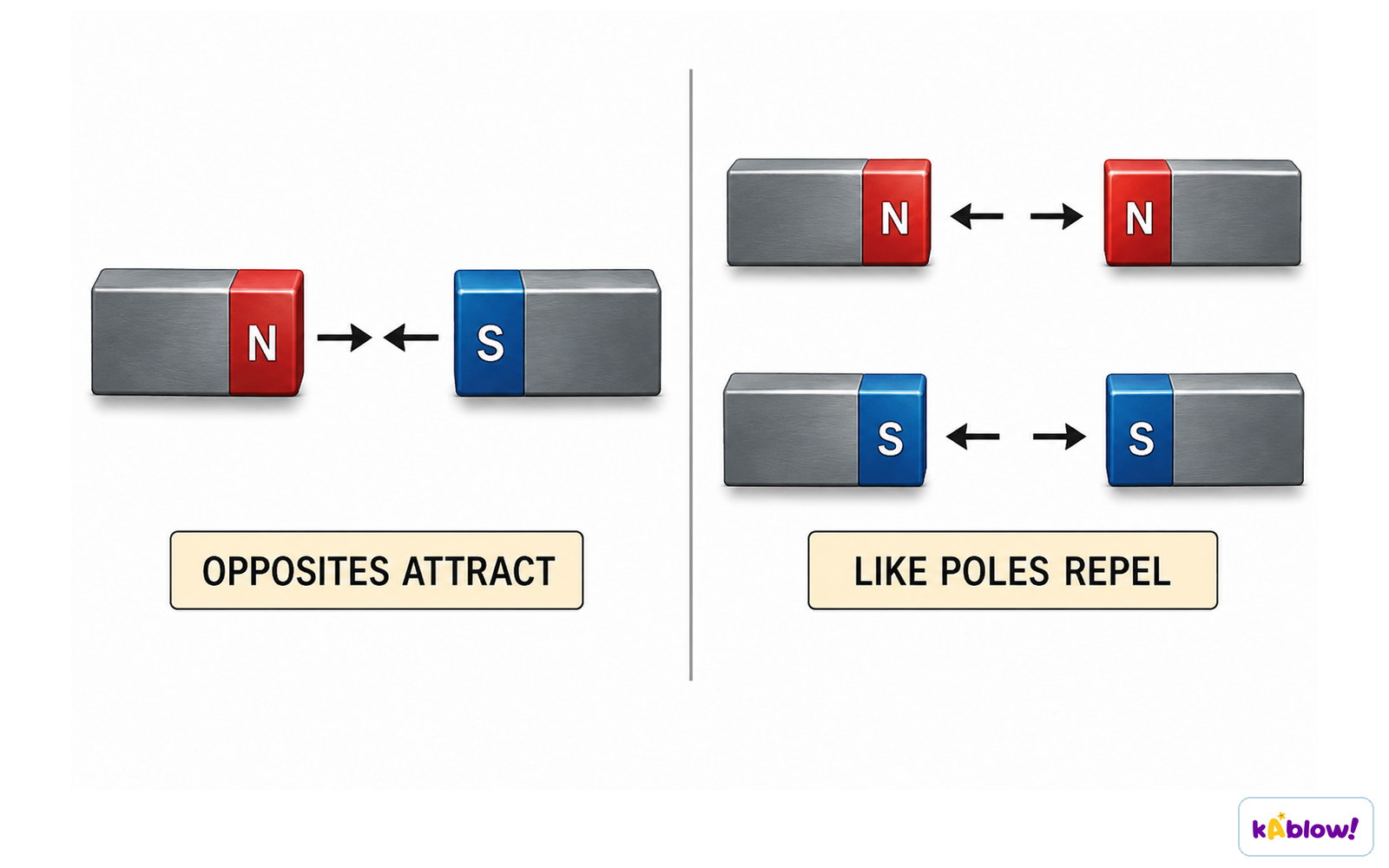
- The Law of Magnetism states that two like poles (N and N, or S and S) repel each other, while two unlike poles (N and S) attract each other.
- The force between two magnetic poles is a non-contact force – the magnets do not need to touch to exert a force.
- The magnetic force is strongest at the poles of a magnet.
- When two magnets are held close together, they exert an attractive or repulsive force depending on which poles face each other.
Diagram showing two attracting bar magnets and two repelling bar magnets, illustrating the interaction of magnetic poles and magnetic fields.
Magnetic Materials
- Magnetic materials are attracted to a magnet; non-magnetic materials are not.
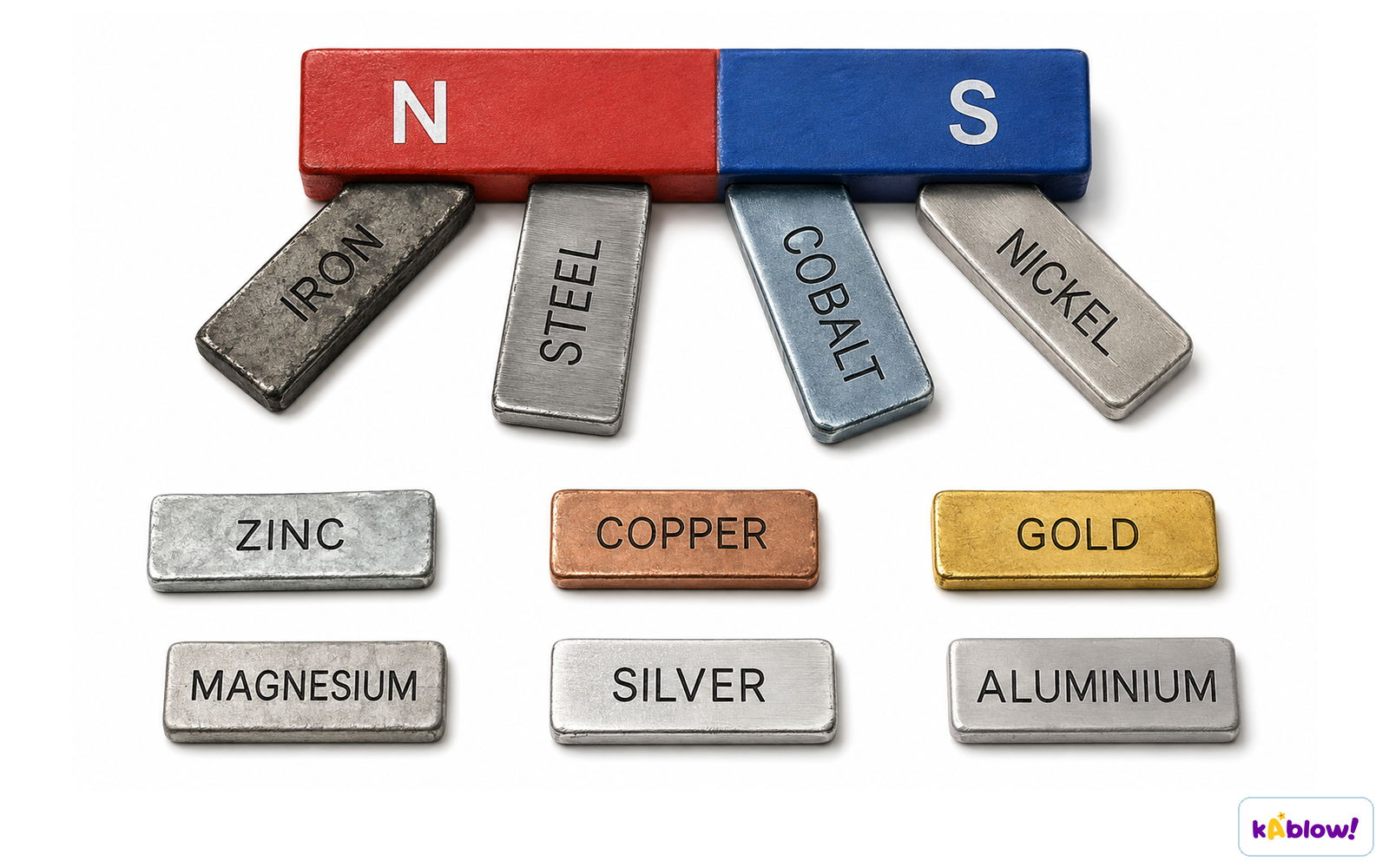
- Only a few metals are magnetic: iron, cobalt and nickel.
- Steel is an alloy that contains iron, so it is also magnetic.
- A magnetic material that is not itself a magnet will always be attracted to a magnet, regardless of which pole is brought close to it.
- To test whether an object is a magnet, bring it close to a known magnet: if it is repelled, it is a magnet; if it is only attracted, it is a magnetic material.
Magnetic materials (iron, steel, cobalt, nickel) are attracted to a magnet; non-magnetic materials (zinc, copper, gold, silver, magnesium, aluminium) are not.
Permanent Magnets
- A permanent magnet produces its own magnetic field.
- Permanent magnets are made from permanent magnetic materials, for example steel.
- A permanent magnet does not lose its magnetism.
- Permanent magnets can attract or repel other permanent magnets, depending on the poles that face each other.
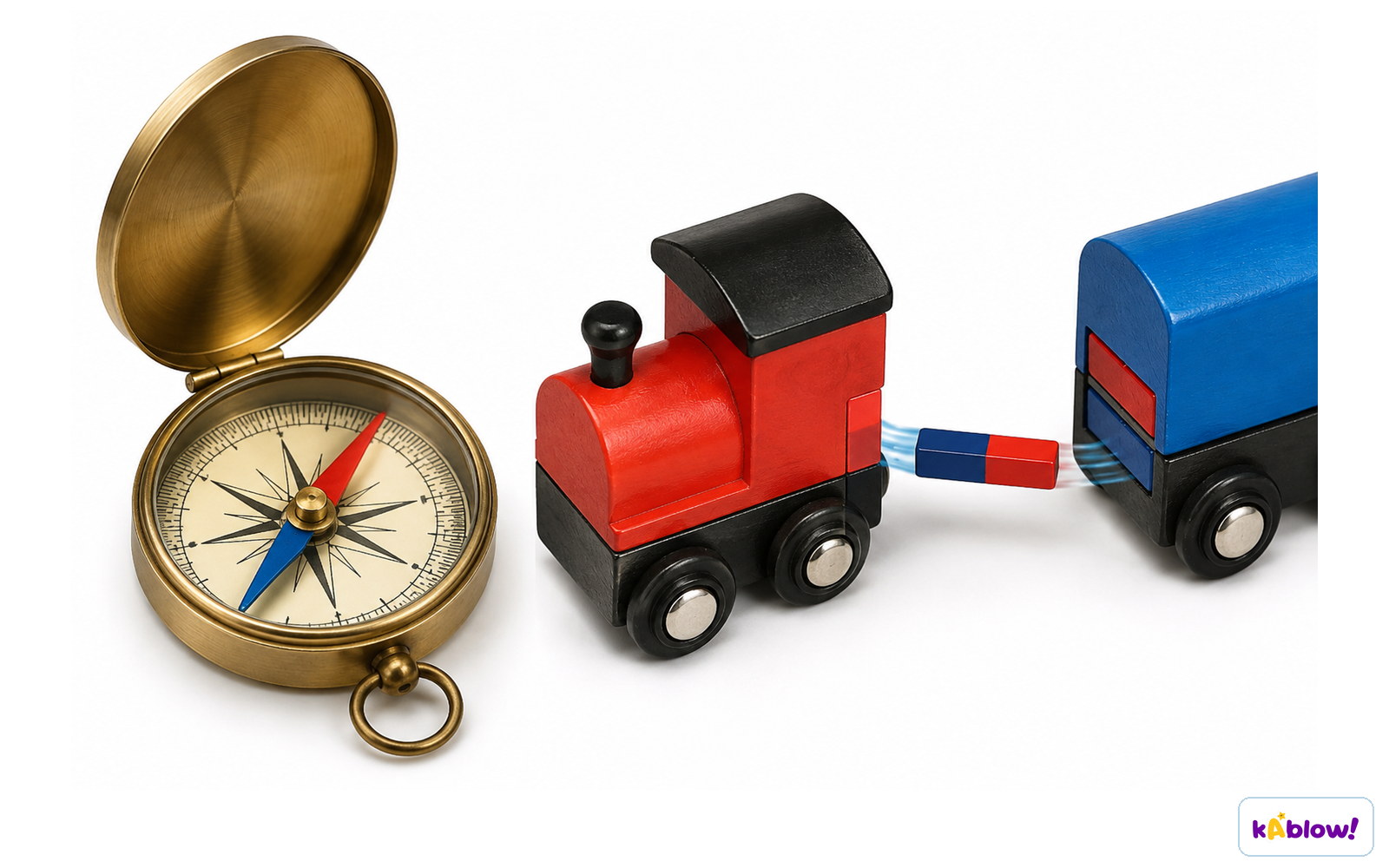
Compasses and toy trains are two examples of the use of permanent magnets.
Induced Magnets
- Induced magnetism occurs when a magnetic material is placed in a magnetic field and temporarily becomes a magnet.
- When magnetism is induced, one end of the material becomes a north pole and the other end becomes a south pole.
- The end of the induced magnet closest to the permanent magnet will have the opposite pole to the pole of the permanent magnet nearest to it.
- Induced magnetism always causes a force of attraction between the permanent magnet and the magnetic material.
- When the magnetic material is removed from the magnetic field, it loses most or all of its magnetism quickly.
- An induced magnet is temporary, unlike a permanent magnet which keeps its magnetism.
Magnetic Fields
- A magnetic field is the region around a magnet where a force acts on another magnet or on a magnetic material (such as iron, steel, cobalt and nickel).
- All magnets are surrounded by a magnetic field.
- Magnetic field lines are used to represent the strength and direction of a magnetic field.
- The direction of the magnetic field is shown by arrows on the field lines; the field always goes from north to south.
- The strength of the magnetic field is shown by the spacing of the field lines: close together means a strong field, far apart means a weak field.
- Magnetic field lines must never touch or cross each other.
- The direction of the magnetic field at any point is the direction of the force that would act on a north pole placed at that point.
Magnetic field lines
Magnetic Field Around a Bar Magnet
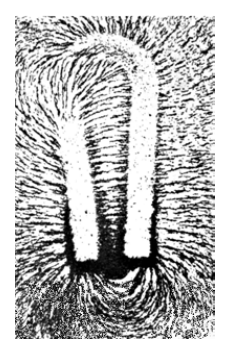
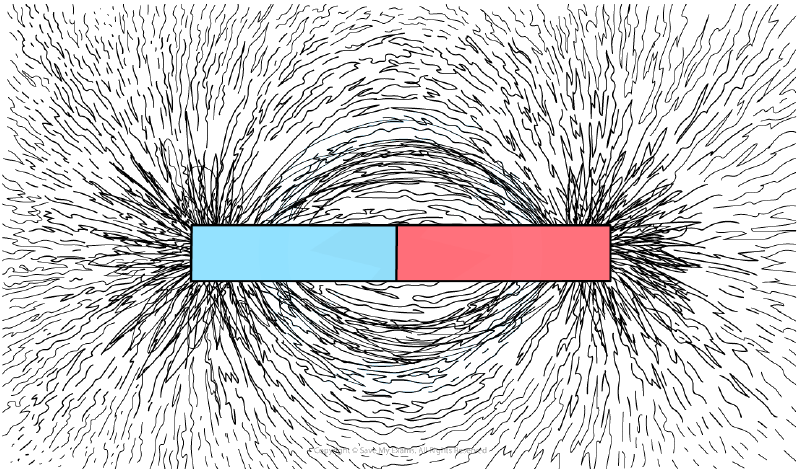
- The magnetic field is strongest at the poles, where the field lines are closest together.
- The magnetic field becomes weaker as the distance from the magnet increases, because the field lines get further apart.
- When drawing the field around a bar magnet, add arrows pointing away from the north pole and towards the south pole.
- Make sure the field lines are drawn further apart as the distance from the magnet increases to show the field getting weaker.
- Two bar magnets can attract or repel each other, and the field line patterns look different for each case.
Magnetic field lines around a bar magnet shown using iron filings.
Uniform Magnetic Fields
- A uniform magnetic field has the same strength and direction at all points.
- A uniform field is produced in the gap between two opposite poles held close together.
- In a uniform field, the magnetic field lines are equally spaced and parallel.
- Each field line has an arrow pointing from the north pole to the south pole.
- Outside the gap between the poles, the field is not uniform.
Plotting Magnetic Fields with a Compass
- A plotting compass is a small bar magnet with a north and south pole; the arrow of the compass represents the north pole.
- To plot a field line: place the magnet on paper, draw a dot near one pole, then place the compass so one end of the needle points away from the dot.
- Draw a new dot at the other side of the compass needle, then move the compass so it points away from the new dot and repeat.
- Continue until you have a chain of dots from one end of the magnet to the other, then remove the compass and join the dots with a smooth curve.
- Repeat the whole process several times to plot several magnetic field lines.
- The compass needle always points in the direction of the magnetic field at that point.
The Earth's Magnetic Field
- In the absence of any magnet or magnetic material, a magnetic compass always points north.
- This is evidence that the core of the Earth is magnetic and creates its own magnetic field.
- The Earth's magnetic field is similar to that of a bar magnet.
- The geographic North Pole (in the Arctic Ocean) acts like a magnetic south pole, so the north pole of a compass is attracted to it.
- The geographic South Pole (in Antarctica) acts like a magnetic north pole, so the north pole of a compass is repelled from it.
- The north pole of a compass points towards the geographic North Pole because it is attracted to the Earth's magnetic south pole.
スライド
練習問題
無料プレビュー — 50問中8問。すべて見るには登録を。
1.Which of the following is the correct definition of the poles of a magnet?
Easy- AThe places where the magnetic forces are strongest
- BThe places where the magnetic forces are weakest
- CThe centre of the magnet where there is no magnetic force
- DThe places where the magnetic field lines cross
2.Two magnets are held close together. Which statement describes the force between two like poles?
Easy- AThey attract each other
- BThey repel each other
- CThere is no force between them
- DThey attract if one is a permanent magnet and the other is induced
3.The attraction or repulsion between two magnetic poles is an example of a non-contact force.
EasyTrue or false?
4.Which of the following materials are magnetic? (Select all that apply.)
Medium- AIron
- BCobalt
- CNickel
- DCopper
- EAluminium
5.A student wants to test whether an unknown metal bar is a magnet. Which test is correct?
Medium- ABring it close to a known magnet; if it is repelled, it is a magnet
- BBring it close to a known magnet; if it is attracted, it is a magnet
- CBring it close to a known magnet; if it is attracted, it is a magnetic material
- DBring it close to a known magnet; if it is repelled, it is a magnetic material
6.Which statement correctly describes the difference between a permanent magnet and an induced magnet?
Medium- AA permanent magnet produces its own magnetic field and does not lose its magnetism, while an induced magnet only becomes magnetic in a magnetic field and loses most/all of its magnetism when removed
- BA permanent magnet only becomes magnetic in a magnetic field, while an induced magnet produces its own magnetic field
- CBoth permanent and induced magnets lose their magnetism quickly when removed from a magnetic field
- DA permanent magnet is always made of soft iron, while an induced magnet is always made of steel
7.An induced magnet always causes a force of attraction.
EasyTrue or false?
8.What is the definition of a magnetic field?
Easy- AThe region around a magnet where a force acts on another magnet or on a magnetic material
- BThe region around a magnet where the magnetic force is zero
- CThe space inside a magnet where the magnetic poles are located
- DThe path that a magnetic material takes when attracted to a magnet
過去問
このトピックの過去問練習は近日公開。
近日公開