Cells: the building blocks of life
遊んで学ぼう
問題に答えてエネルギーを集めたら、釣りや探検を楽しもう。アカウント不要。
教育者の方へ: Cells: the building blocks of life(MYP Biology、Year 1)向けのすぐ使えるレッスンスライド, 復習ノート — レッスンで使うか、学習者がライブゲームとして遊ぶインタラクティブなクラス活動としてトピックを実施できます。
レッスンノート
Big idea: cells as systems
- Big idea. Key concept: Systems. A cell is a tiny system, with many small parts working together to keep the cell alive.
- Related concept: Structure. The shape and make-up of each part suits the job it does.
- Global context: Scientific and technical innovation. We only know about cells because people invented microscopes and kept improving them.
- Cells are the building blocks of life. Every living thing is made of one or more cells, and new cells are made from cells that already exist.
- Most cells are far too small to see without a microscope. A single leaf contains millions of them.
- The small working parts inside a cell are called organelles, which means “little organs”.
Animal cells and their parts
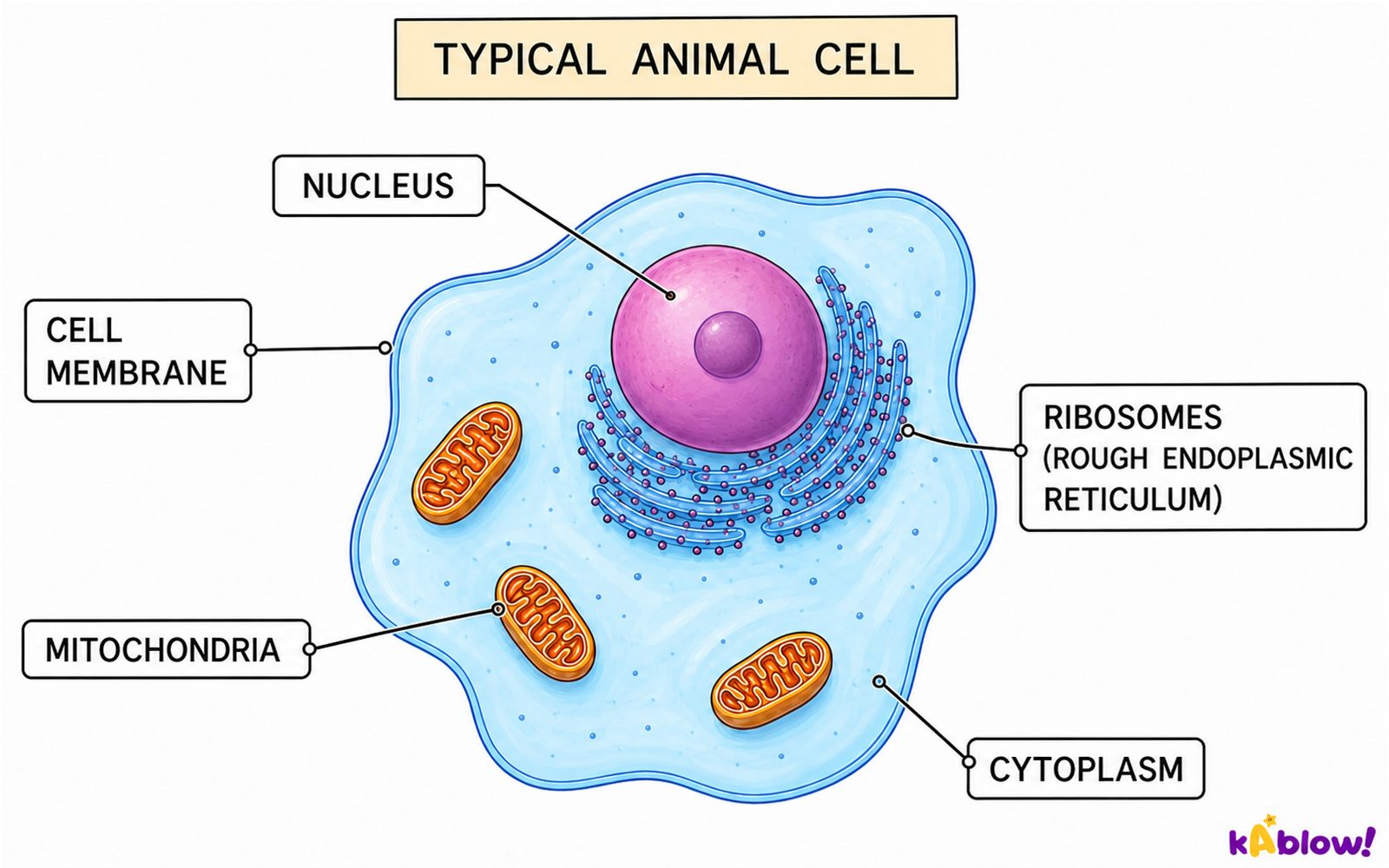
- The nucleus contains the cell’s DNA, its instructions. It controls what the cell does.
- The cell membrane is a thin, flexible layer around the cell. It controls which substances go in and out.
- The cytoplasm is a jelly-like liquid. Many of the cell’s chemical reactions happen here.
- Mitochondria release energy from glucose in a process called respiration. Cells that use a lot of energy, such as muscle cells, have many of them.
- Ribosomes are tiny structures that make proteins.
A typical animal cell
Plant cells: three extra parts
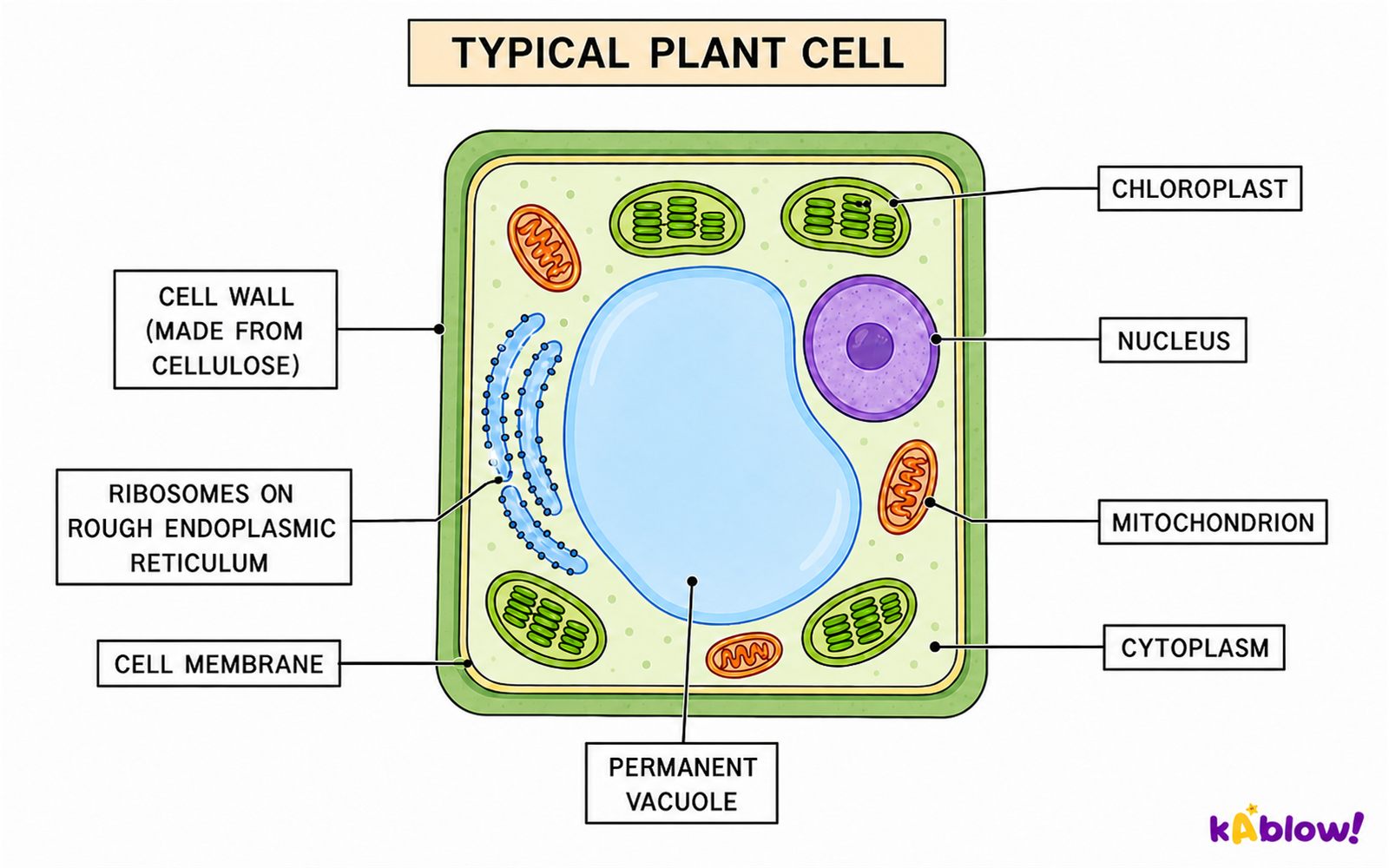
- A plant cell has a nucleus, cell membrane, cytoplasm, mitochondria and ribosomes, just like an animal cell. It also has three extra structures.
- The cell wall is a tough outer layer made of cellulose. It supports the cell and helps the whole plant stay upright. It lies outside the cell membrane.
- Chloroplasts contain green chlorophyll. They absorb light for photosynthesis, which makes glucose. Cells in parts of the plant that get no light, such as roots, usually have no chloroplasts.
- The permanent vacuole is a large space filled with cell sap, which is water with sugars and salts dissolved in it. It keeps the cell firm.
A typical plant cell
Plant cells and animal cells compared
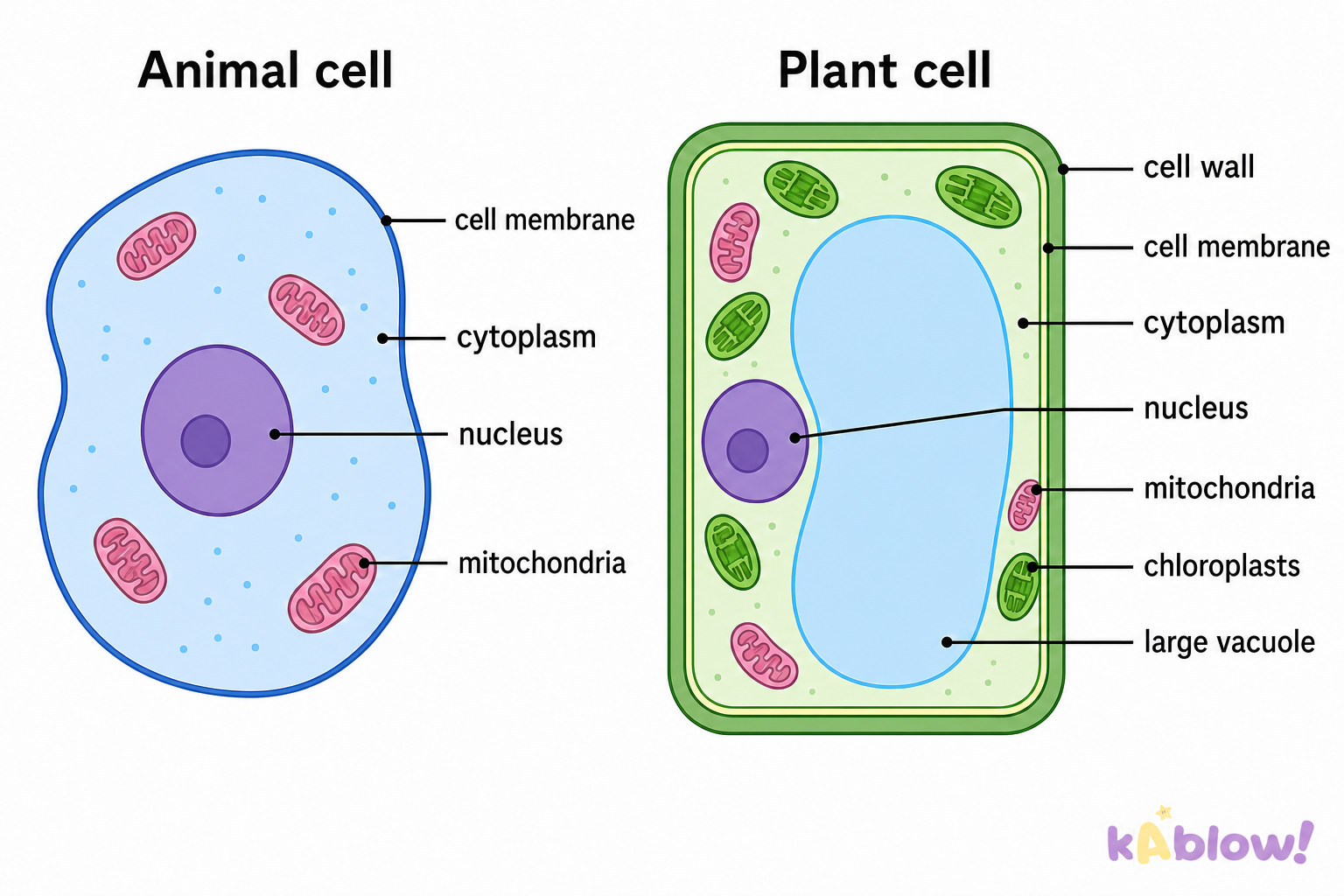
- Both have a nucleus, cell membrane, cytoplasm, mitochondria and ribosomes.
- Only plant cells have a cell wall, chloroplasts and a large permanent vacuole.
- Plant cells usually have a fixed, box-like shape because of the cell wall. Animal cells often have a rounder or more irregular shape.
- Plant cells can make their own food using chloroplasts. Animal cells cannot, so animals must eat.
- A plant cell has a cell wall and a cell membrane. The wall does not replace the membrane.
Plant and animal cells compared
Single-celled organisms
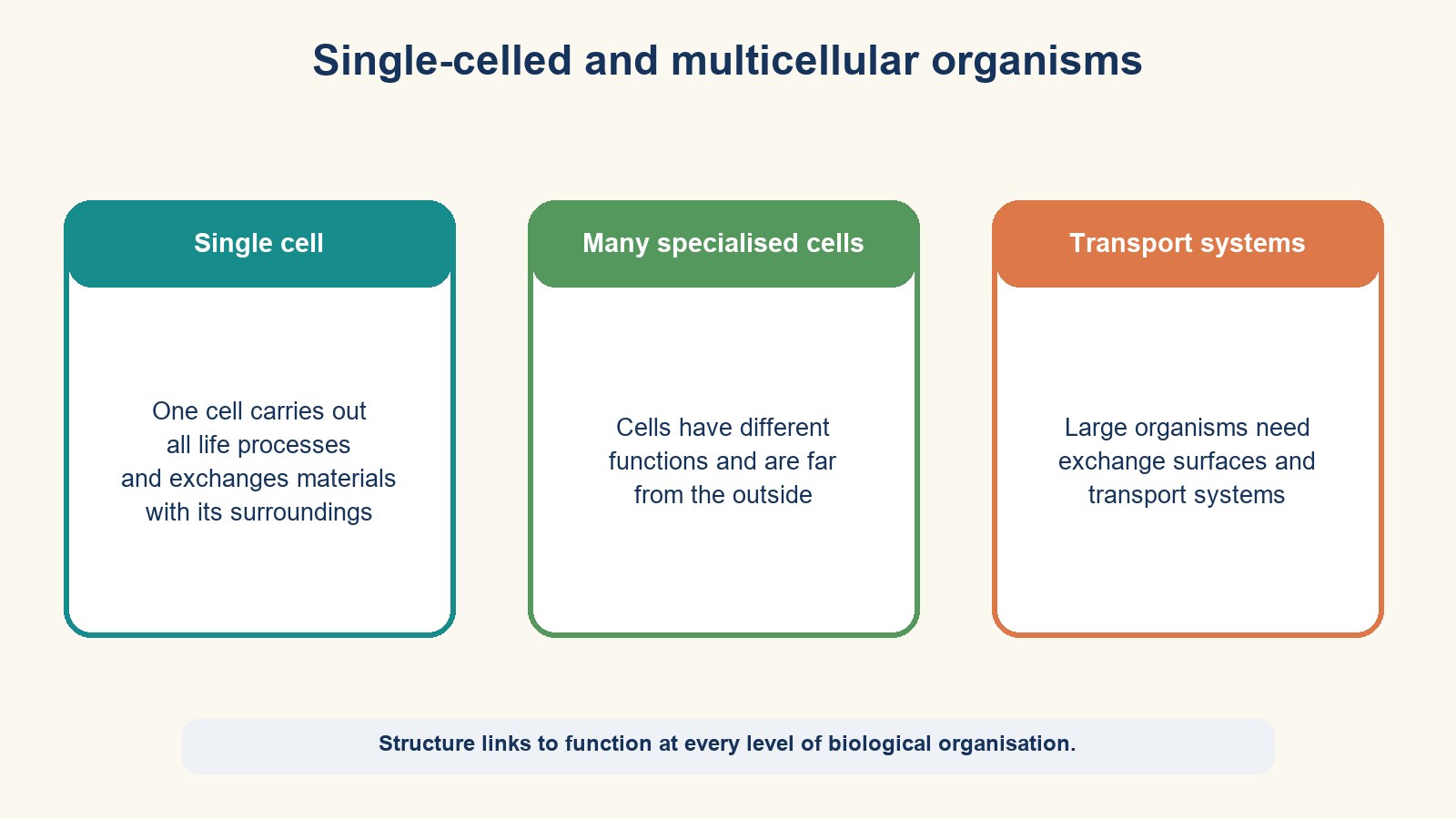
- An organism made of one cell is unicellular. An organism made of many cells is multicellular.
- A unicellular organism must carry out all seven life processes inside its one cell: it moves, respires, senses, grows, reproduces, excretes and feeds.
- Amoeba changes shape and wraps around its food. Paramecium swims by beating tiny hairs called cilia. Euglena has chloroplasts and a whip-like tail called a flagellum.
- Yeast is a single-celled fungus. Bacteria are single cells too, but they are simpler, with no nucleus.
- Multicellular organisms such as humans and oak trees are built from many cells, which do different jobs.
Single-celled and multicellular organisms
Think like a scientist: chloroplasts in leaves and roots
- Question: do leaf cells contain more chloroplasts than root cells?
- The independent variable is the type of cell (leaf or root). The dependent variable is the number of chloroplasts counted in each cell.
- Control variables include using the same microscope and magnification, the same type of plant and equally thin pieces of tissue.
- Count several cells from each part, for example 10, and work out an average. One cell may not be typical.
- A good prediction comes with a reason. Here, leaf cells should have more chloroplasts because leaves receive light.
- Inquiry task: plan your own investigation comparing cells from two parts of a plant. Write your question, name the independent, dependent and control variables, say how many cells you will count, and explain one thing that could make your results unreliable.
スライド
練習問題
無料プレビュー — 51問中8問。すべて見るには登録を。
1.What is the basic unit of all living things?
Easy- AThe atom
- BThe organ
- CThe cell
- DThe tissue
2.Which part of a cell contains the genetic material, DNA?
Easy- AThe nucleus
- BThe cytoplasm
- CThe cell membrane
- DThe vacuole
3.What does the cell membrane do?
Easy- AIt makes sugar from carbon dioxide and water
- BIt stores the cell’s genetic information
- CIt gives the whole cell a stiff, fixed shape and outline
- DIt controls which substances enter and leave the cell
4.Where do most of a cell’s chemical reactions take place?
Easy- AIn the nucleus
- BIn the cytoplasm
- CIn the cell wall
- DIn the chloroplast
5.Which structure releases energy from glucose during respiration?
Easy- AThe ribosomes
- BThe nucleus
- CThe cell membrane
- DThe mitochondria
6.Which part of a plant cell carries out photosynthesis?
Easy- AThe mitochondrion
- BThe chloroplast
- CThe permanent vacuole
- DThe nucleus
7.Which structure is found in plant cells but not in animal cells?
Easy- AThe cell wall
- BThe nucleus
- CThe cytoplasm
- DThe cell membrane
8.What is the plant cell wall made of?
Easy- AProtein
- BFat
- CCellulose
- DChlorophyll
過去問
このトピックの過去問練習は近日公開。
近日公開