Evidence for evolution and extinction
遊んで学ぼう
問題に答えてエネルギーを集めたら、釣りや探検を楽しもう。アカウント不要。
教育者の方へ: Evidence for evolution and extinction(MYP Biology、Year 3)向けのすぐ使えるレッスンスライド, 復習ノート — レッスンで使うか、学習者がライブゲームとして遊ぶインタラクティブなクラス活動としてトピックを実施できます。
レッスンノート
Big idea: how do we know life has changed?
- Big idea (key concept): Change. Living things today are different from living things in the past. Evolution is the story of how that change happened, and this lesson is about the evidence for it.
- Related concept: Evidence. A scientific idea is only as strong as the evidence behind it. The more separate kinds of evidence that point the same way, the more confident scientists become.
- Global context: Orientation in space and time. Fossils let us travel back through millions of years and see how life, climate and continents have changed on Earth.
- Evolution is the change in the inherited features of a population over many generations. It happens to populations over long periods, not to a single animal during its life.
- There are four main kinds of evidence: fossils, comparative anatomy (body structures), DNA and evolution we can watch today, such as bacteria becoming resistant to antibiotics.
- All of them support common ancestry: different species descend from shared ancestors. Humans did not evolve from chimpanzees. Humans and chimpanzees both descend from a common ancestor that lived millions of years ago.
How fossils form
- A fossil is the preserved remains or traces of an organism that lived long ago. Palaeontologists are the scientists who study them.
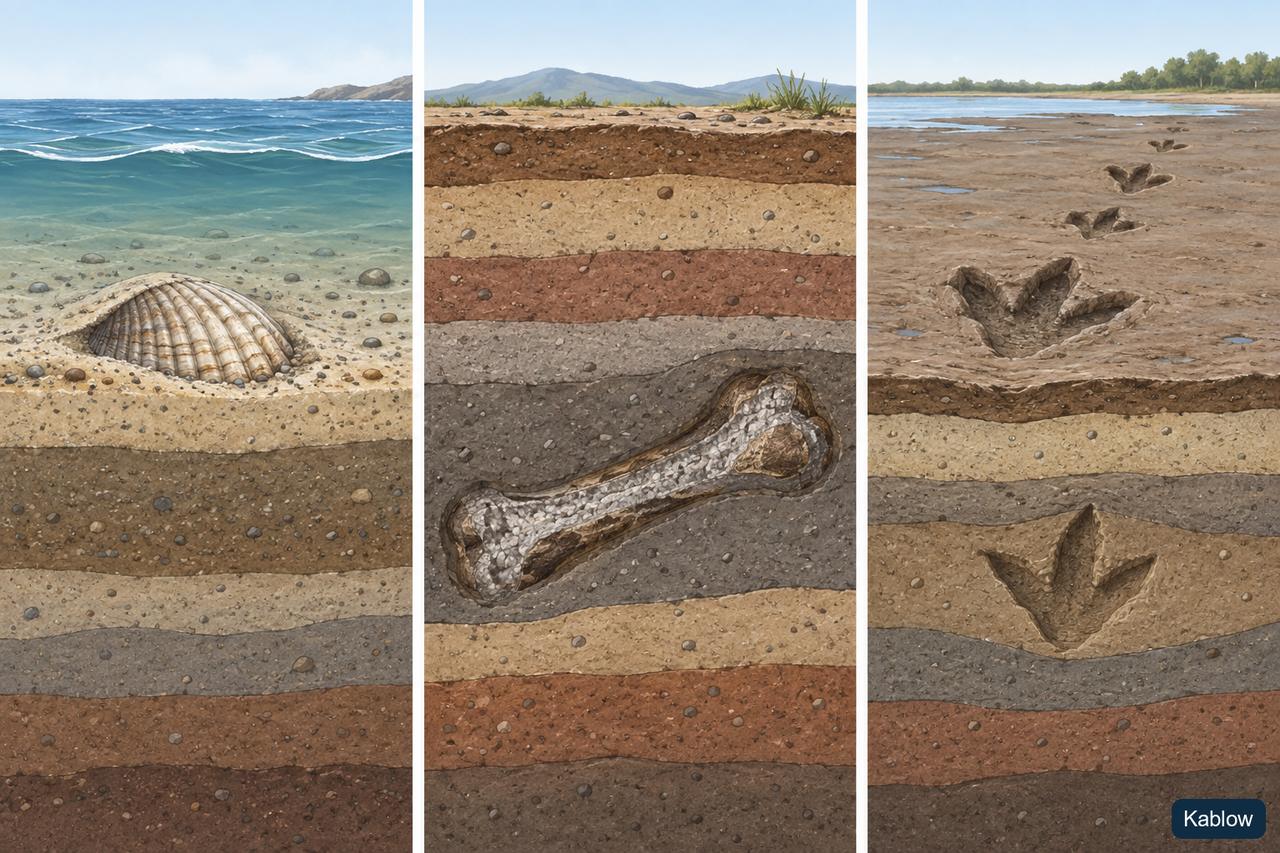
- Most fossils form when an organism dies and is buried quickly in mud or sand. Burial protects it from scavengers and from decay.
- In one common route, the hard parts (bones, teeth, shells) are slowly replaced by minerals from the water in the rock. The mineral copies the original shape, so the fossil is stone.
- Other fossils are impressions and casts: a leaf, a skin pattern or a shell leaves its shape in mud that hardens into rock. Trace fossils such as footprints and burrows show how an animal behaved.
- Sometimes the whole organism is kept almost unchanged: insects in amber (hardened tree resin), animals frozen in ice, or bodies in acidic peat bogs where decay is very slow.
- Soft-bodied organisms such as jellyfish rot away before they can be buried, so they rarely fossilise. This is one reason the fossil record is incomplete.
A shell, a bone and a footprint buried in layers of rock
Reading the rock layers and dating fossils
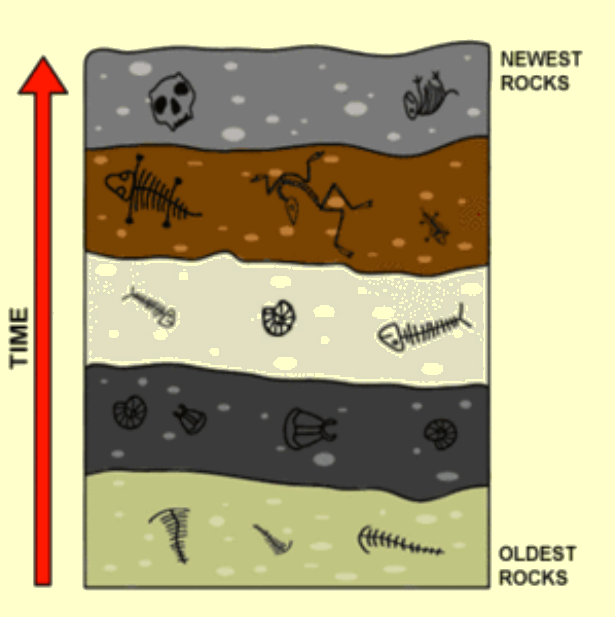
- Fossils are found in sedimentary rock, which forms in layers. In undisturbed rock the oldest layer is at the bottom and the newest is at the top, so deeper fossils are usually older. This is relative dating.
- Comparing layers shows an order of life: the oldest rocks hold the simplest organisms, and more complex animals and plants appear in younger rocks.
- To find an actual age, scientists use radiometric dating. Some atoms are radioactive and decay into other atoms at a steady rate. The half-life is the time taken for half of the radioactive atoms in a sample to decay.
- Carbon-14 has a half-life of about 5,700 years, so it is used for remains up to roughly 50,000 years old. For rocks millions of years old, scientists use isotopes with much longer half-lives, such as uranium.
- Example: a rock starts with 80 g of an isotope with a half-life of 10 million years. After 10 million years 40 g is left, after 20 million years 20 g, and after 30 million years 10 g.
- Fossil sequences show change over time. Horse fossils run from small×Hyracotherium×, with four toes on each front foot, to modern×Equus×, which is much larger and stands on one toe. Transitional fossils such as×Archaeopteryx×(feathers, but also teeth and a bony tail) show features of two groups.
Fossils in rock layers, oldest at the bottom
Comparative anatomy, DNA and common ancestry
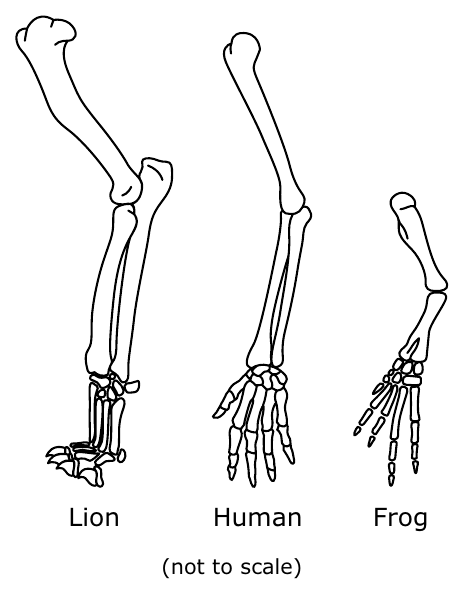
- Homologous structures have the same basic bone pattern in different species, even when they do different jobs. The front limbs of a lion, a human and a frog all have one upper bone, lower-arm bones, then wrist and finger bones.
- The best explanation is that these species inherited the pattern from a common ancestor, and each lineage adapted it for walking, grasping or swimming.
- Analogous structures do the same job but have different origins. Bird wings and insect wings both allow flight, yet they are built differently. They do not show close relationship.
- Vestigial structures are reduced features with little or no use now, such as the tiny leg bones inside a whale or the coccyx (tailbone) in humans. They are leftovers from ancestors.
- DNA evidence: all living things use DNA with the same four bases and almost the same genetic code, which supports one origin of life. The more similar two species' DNA sequences, the more recently they shared an ancestor.
- Scientists show these relationships as an evolutionary tree. Each branch point is a common ancestor, and two species that split from a branch point more recently are more closely related.
The front limbs of a lion, a human and a frog
Extinction and mass extinction
- A species is extinct when no living individuals remain. Extinction is normal in the history of life: most species that have ever lived have died out.
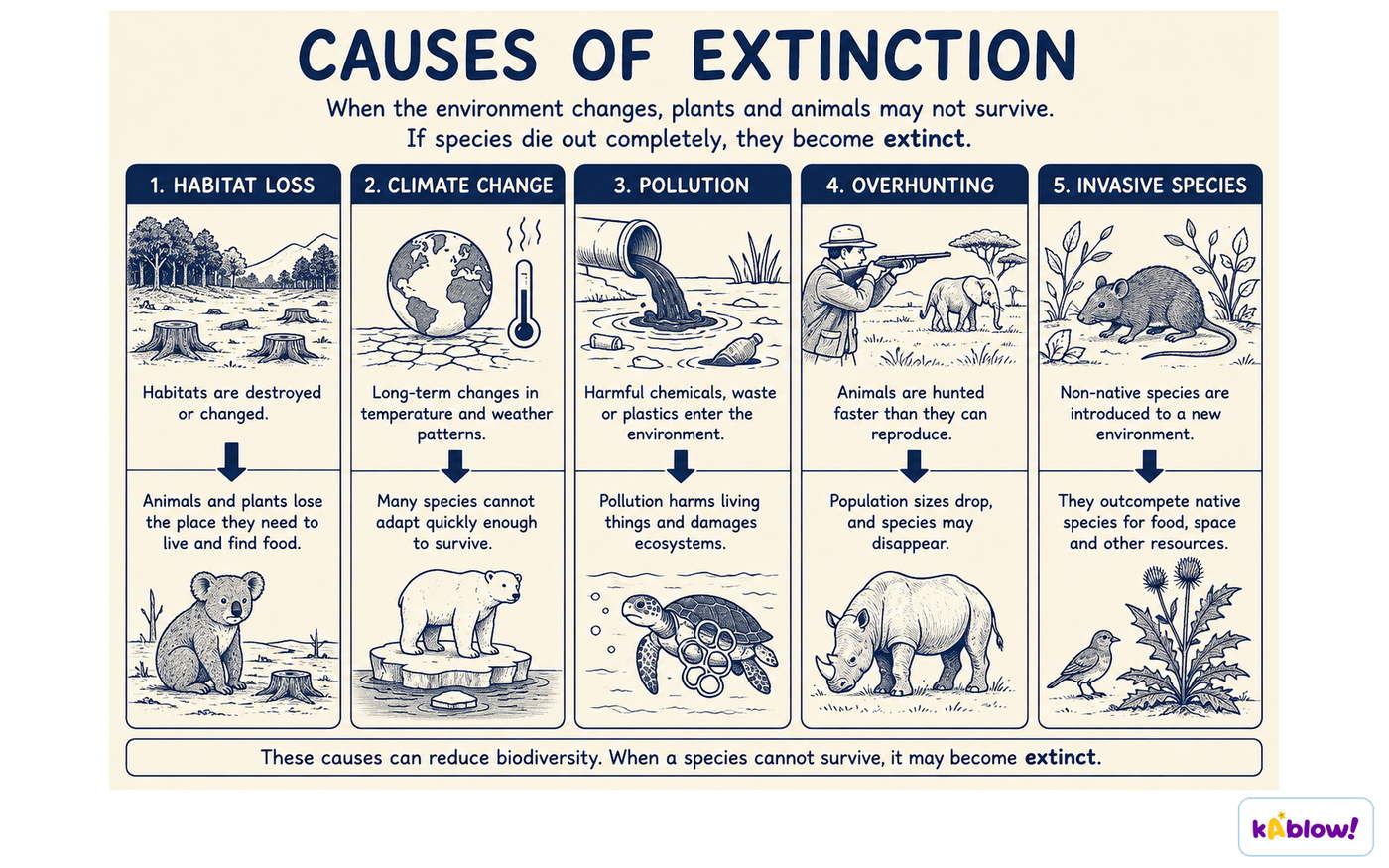
- Common causes are habitat loss, climate change, pollution, overhunting, invasive species and disease. Often several act together.
- Species with small populations, specialised diets or that live on islands are most at risk. If their food or habitat goes, or a new predator arrives, they cannot adapt fast enough. The dodo of Mauritius died out in the late 1600s after humans and the animals they brought arrived.
- A mass extinction is when a large share of the world's species die out within a short time on a geological scale. Scientists recognise five major ones in the last 500 million years.
- About 252 million years ago, at the end of the Permian, most marine species vanished. About 66 million years ago, at the end of the Cretaceous, the non-bird dinosaurs died out. Evidence includes a worldwide clay layer rich in iridium, an element rare in Earth's crust but common in asteroids, and a huge crater in Mexico.
- After a mass extinction, surviving groups spread into the empty habitats. Many scientists argue that human activity is now driving extinctions much faster than normal, so conservation matters.
Five causes of extinction
Think like a scientist: a model of half-life, and weighing evidence
- Model a half-life. Put 100 small cubes, each with one face marked, in a tray with a lid. Shake the tray and tip them out. Remove every cube that lands with the mark facing up, count what is left and record it. Repeat until few are left.
- Each shake stands for one half-life, because about half of the cubes are removed each time. The independent variable is the number of shakes (time) and the dependent variable is the number of cubes remaining.
- Inquiry task: plan how to make the results reliable. Keep the same number of cubes at the start, the same tray, the same shaking, and repeat the whole run three times so you can calculate a mean for each shake.
- Evaluate the model: real atoms are not shaken and removed, so what does the model show well and what does it hide? Why do your results not fall exactly 100, 50, 25, 12.5? (Decay is random, so small samples vary.)
- Weighing evidence. One fossil in one layer proves little, because the record is incomplete. Scientists are confident in evolution because fossils, body structures, DNA and observations today all agree.
- When you judge a claim, ask: How much evidence is there? Is it from independent sources? Could there be another explanation? Is the sample large enough?
スライド
練習問題
無料プレビュー — 50問中8問。すべて見るには登録を。
1.What is evolution?
Easy- AAn animal changing its body during its own lifetime
- BA change in the inherited features of a species over many generations
- CA species deciding to adapt to its surroundings
- DFossils slowly turning into stone over time
2.A single animal evolves into a new form during its own lifetime.
EasyTrue or false?
3.What is a fossil?
Easy- AAny rock that is older than a million years
- BThe skeleton of an animal that died last week
- CThe preserved remains or traces of an organism from long ago
- DA living organism that has not changed for ages
4.Which part of an animal is most likely to become a fossil?
Easy- AIts skin and the muscles beneath it
- BIts blood and other body fluids
- CIts stomach and the food inside it
- DIts hard parts, such as bones, teeth and shell
5.A fossilised footprint is an example of a trace fossil.
EasyTrue or false?
6.In undisturbed layers of sedimentary rock, where are the oldest fossils usually found?
Easy- AIn the lowest layers
- BIn the top layer
- CIn the middle layer only
- DThey are found evenly in every layer
7.Match each way of preserving an organism to its description.
Easy- An insect trapped in amber
- A footprint in mud that hardened
- A bone slowly replaced by minerals
- A trace fossil that shows behaviour
- Preserved whole in hardened resin
- Hard part turned to stone
8.What are homologous structures?
Easy- ABody parts that always do exactly the same job
- BBody parts with the same basic bone pattern in different species
- CBody parts that only fossils can show us
- DBody parts found only in species that are extinct
過去問
このトピックの過去問練習は近日公開。
近日公開