Elements, compounds and mixtures
遊んで学ぼう
問題に答えてエネルギーを集めたら、釣りや探検を楽しもう。アカウント不要。
教育者の方へ: Elements, compounds and mixtures(MYP Chemistry、Year 1)向けのすぐ使えるレッスンスライド, 復習ノート — レッスンで使うか、学習者がライブゲームとして遊ぶインタラクティブなクラス活動としてトピックを実施できます。
レッスンノート
Big idea: everything is made of elements
- Big idea (key concept): Relationships. The way atoms are linked, or not linked, decides what a substance is and how it behaves.
- Related concept: Patterns. Sorting substances into elements, compounds and mixtures shows patterns in the way matter is built.
- Global context: Orientation in space and time. Every material in the universe, from a star to a school desk, is built from the same small set of elements.
- An element is a substance made of only one kind of atom. Gold, oxygen, iron and carbon are all elements.
- More than 100 elements are known (118 so far). You cannot break an element down into anything simpler by chemical reactions.
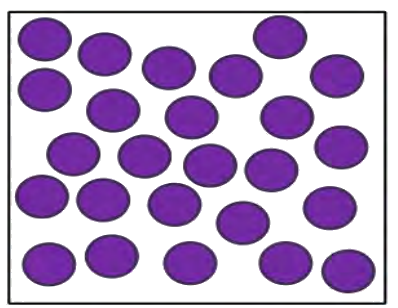
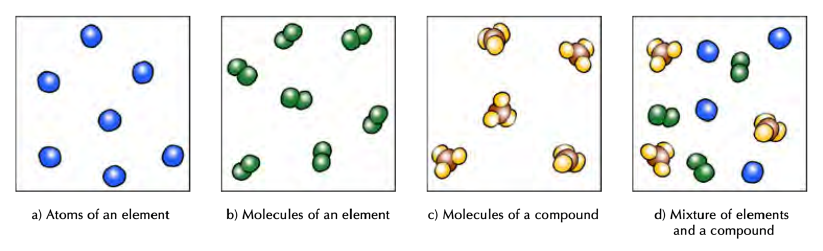
- In a particle picture of an element, every particle is the same kind of atom.
An element: a collection of identical atoms
Atoms, molecules and chemical symbols
- An atom is a tiny particle, far too small to see. Atoms are the building blocks of all matter.
- Some atoms stay on their own. Other atoms join together in groups. A molecule is two or more atoms joined together.
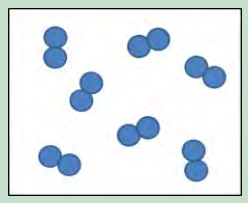
- Some elements exist as molecules. Oxygen gas is made of molecules with two oxygen atoms joined together. Hydrogen, nitrogen and chlorine are the same. These are still elements, because both atoms in each molecule are the same kind.
- Every element has a chemical symbol of one or two letters. The first letter is always a capital and the second is small: H is hydrogen, O is oxygen, C is carbon, Na is sodium, Fe is iron, Cu is copper and Au is gold.
- Some symbols come from old Latin names, which is why iron is Fe (from ferrum) and sodium is Na (from natrium).
Molecules of an element: pairs of joined atoms
Compounds: atoms of different elements joined together
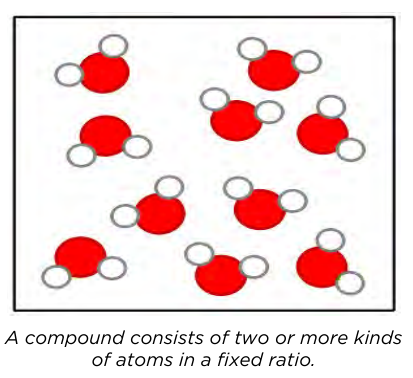
- A compound is a substance in which two or more kinds of atom are joined together in a fixed ratio.
- Water is a compound. Every water molecule has two hydrogen atoms joined to one oxygen atom, so its formula is H₂O. A formula tells you which atoms are in a substance and how many of each.
- Carbon dioxide is CO₂ (one carbon atom and two oxygen atoms). Sodium chloride, which is table salt, is NaCl (sodium and chlorine in a 1 to 1 ratio).
- The ratio is always the same. Water is always two hydrogen atoms for each oxygen atom, wherever it comes from.
- A compound is made in a chemical reaction. The atoms are joined together, so you cannot separate them again with simple methods such as filtering or picking them out.
- Names help: a compound name that ends in -ide, such as sodium chloride, usually contains just two elements. A name ending in -ate, such as copper sulfate, also contains oxygen.
A compound: water molecules
Mixtures: substances together but not joined
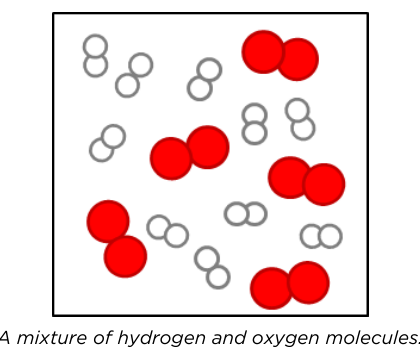
- A mixture contains two or more substances that are together but are not joined to each other. The substances can be elements, compounds, or both.
- In a mixture, each substance keeps its own properties. Sand mixed with salt still has gritty sand and salty salt in it.
- A mixture can have any proportions. You can stir in a little salt or a lot of salt in water, and both are mixtures. Compounds have a fixed ratio.
- Mixtures can usually be separated by physical methods, such as filtering, evaporating or using a magnet. No chemical reaction is needed.
- Air is a mixture of gases: about 78% nitrogen and 21% oxygen, with small amounts of argon, carbon dioxide and others. The gases are not joined to each other.
- Other everyday mixtures are sea water, soil, orange juice and the metal brass. Brass is a mixture of copper and zinc.
A mixture of two elements: separate hydrogen and oxygen molecules
Telling elements, compounds and mixtures apart
- Element: one kind of atom only, such as O₂ or iron. Compound: different kinds of atom joined in a fixed ratio, such as H₂O. Mixture: different substances together, not joined.
- Elements and compounds are both pure substances, because each contains only one substance. A mixture is not pure, because it contains more than one substance.
- In a particle diagram, look at two things: are the particles all the same, and are different atoms joined together? All identical single atoms or identical pairs of the same atom is an element. Identical molecules made of different atoms is a compound. Different kinds of particle that are not joined to each other is a mixture.
- A compound has different properties from the elements in it. Sodium is a soft, very reactive metal and chlorine is a poisonous gas, but together they make sodium chloride, the harmless salt on food. Hydrogen and oxygen are gases, but water is a liquid.
- In a teacher demonstration, iron filings and sulfur powder are mixed. A magnet can pull the iron out, so it is a mixture. When the teacher heats the mixture strongly, a new dark substance, iron sulfide, forms. The iron and sulfur are now joined together in a compound.
- In everyday talk, "pure" can mean "nothing added", such as pure orange juice. In chemistry, pure means only one substance. Pure orange juice is still a mixture.
Particle diagrams of elements, a compound and a mixture
Think like a scientist: investigating substances
- A scientist can use simple tests to sort substances. Examples are: does it dissolve in water, does a magnet pick it up, does it melt at one fixed temperature?
- Suppose you test how much salt dissolves in 100 cm³ of water at different temperatures. The independent variable is the one you change: the temperature of the water. The dependent variable is the one you measure: the mass of salt that dissolves.
- The control variables are kept the same so the test is fair: the volume of water, the type of salt, the amount of stirring and the time. Add the salt a little at a time until no more dissolves.
- To make your results more reliable, repeat each test and use the mean. Spot any anomaly, a result that does not fit the pattern, and think about why it happened.
- Safe practice: wear eye protection, never taste or smell chemicals, wash your hands after practical work and leave any heating of chemicals to the teacher. Look at hazard symbols before you start.
- Your task: a teacher gives you three white powders labelled A, B and C. Plan an investigation to find out which powder dissolves best in water. Name the independent, dependent and control variables, list your equipment, say how you will decide the result, and explain how you will make it reliable.
スライド
練習問題
無料プレビュー — 52問中8問。すべて見るには登録を。
1.Which of these describes an element?
Easy- ATwo or more kinds of atom joined together
- BA substance made of only one kind of atom
- CTwo or more substances mixed but not joined
- DAny substance that is a liquid
2.Which of these is an element?
Easy- AWater
- BSalt
- COxygen
- DAir
3.What is the chemical symbol for iron?
Easy- AIr
- BIn
- CI
- DFe
4.Which element has the symbol Na?
Easy- ANitrogen
- BSodium
- CNeon
- DNickel
5.What do we call two or more atoms joined together?
Easy- AA mixture
- BA metal
- CAn element
- DA molecule
6.What is a compound?
Easy- ATwo or more different substances that are mixed but not joined together
- BOne kind of atom arranged in a regular pattern
- CTwo or more kinds of atom joined together in a fixed ratio
- DA substance that can always be separated by filtering
7.Carbon dioxide has the formula CO₂. What does the formula tell you?
Easy- AEach molecule has one carbon atom and two oxygen atoms
- BIt is a mixture of carbon and oxygen
- CEach molecule has two carbon atoms and one oxygen atom
- DIt is an element made only of carbon
8.Which of these is a mixture?
Easy- APure water
- BAir
- CCarbon dioxide
- DSodium chloride
過去問
このトピックの過去問練習は近日公開。
近日公開