Acids, bases and neutralisation
遊んで学ぼう
問題に答えてエネルギーを集めたら、釣りや探検を楽しもう。アカウント不要。
教育者の方へ: Acids, bases and neutralisation(MYP Chemistry、Year 3)向けのすぐ使えるレッスンスライド, 復習ノート — レッスンで使うか、学習者がライブゲームとして遊ぶインタラクティブなクラス活動としてトピックを実施できます。
レッスンノート
Big idea: acids, bases and neutralisation
- Key concept: Change. Acids provide hydrogen ions in water; alkalis provide hydroxide ions. Neutralisation forms water, while the remaining ions form a salt.
- Related concepts: Models and evidence. Use a scientific explanation to make predictions, then test it against observations.
- Global context: Scientific and technical innovation. Neutralisation can adjust the acidity of industrial wastewater.
Properties of Acids
- Acids have pH < 7, sour taste (if edible), and are corrosive.
- Acids neutralise bases to form a salt and water.
- In water, acids produce H⁺ ions (e.g., HCl → H⁺ + Cl⁻).
- Acids react with metals (above H in reactivity series) to give salt + hydrogen.
- Acids react with metal carbonates to give salt + CO₂ + water.
- Acids react with bases (metal oxides/hydroxides) to give salt + water (neutralisation).
Properties of Bases & Alkalis
- Bases have pH > 7; a water‑soluble base is an alkali.
- Bases neutralise acids to form a salt and water.
- In water, alkalis produce OH⁻ ions (e.g., NaOH → Na⁺ + OH⁻).
- Alkalis react with ammonium salts on warming to produce ammonia gas (damp red litmus turns blue).
- Common bases are metal oxides and metal hydroxides.
Indicators
- Indicators change colour in acid or alkali; litmus (red in acid, blue in alkali) is from lichens.
- Methyl orange: red in acid, yellow in alkali.
- Thymolphthalein: colourless in acid, blue in alkali.
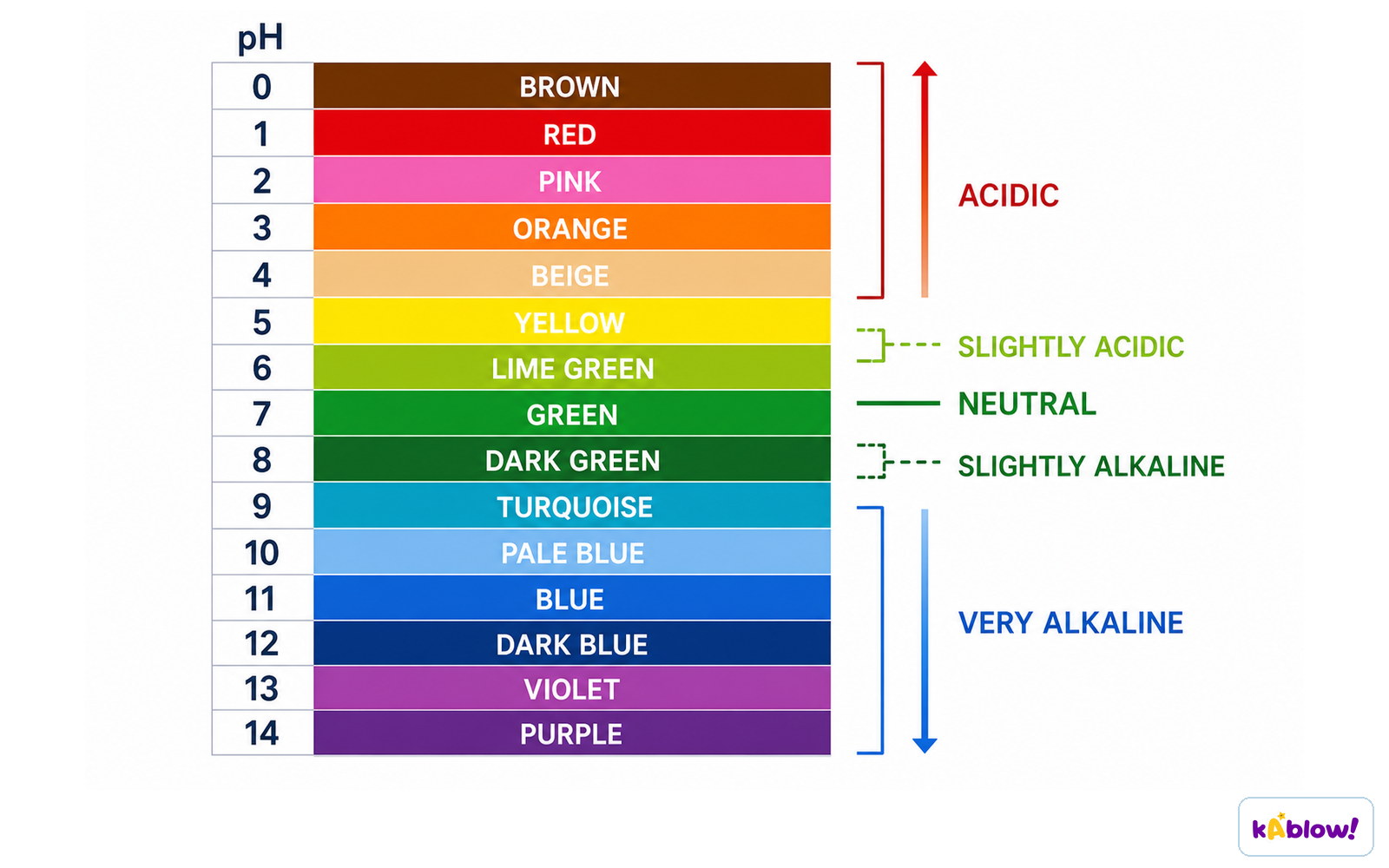
- Universal indicator is a mixture giving a range of colours to estimate pH.
- Synthetic indicators (methyl orange, thymolphthalein) have sharp colour changes for titrations; litmus is not suitable for titrations.
Universal indicator colours across the pH scale
The Ions in Acids & Alkalis & Neutralisation
- Acids are sources of H⁺ ions; alkalis are sources of OH⁻ ions.
- Neutralisation: H⁺(aq) + OH⁻(aq) → H₂O(l).
- Not all acid reactions are neutralisations (e.g., acid + metal produces no water).
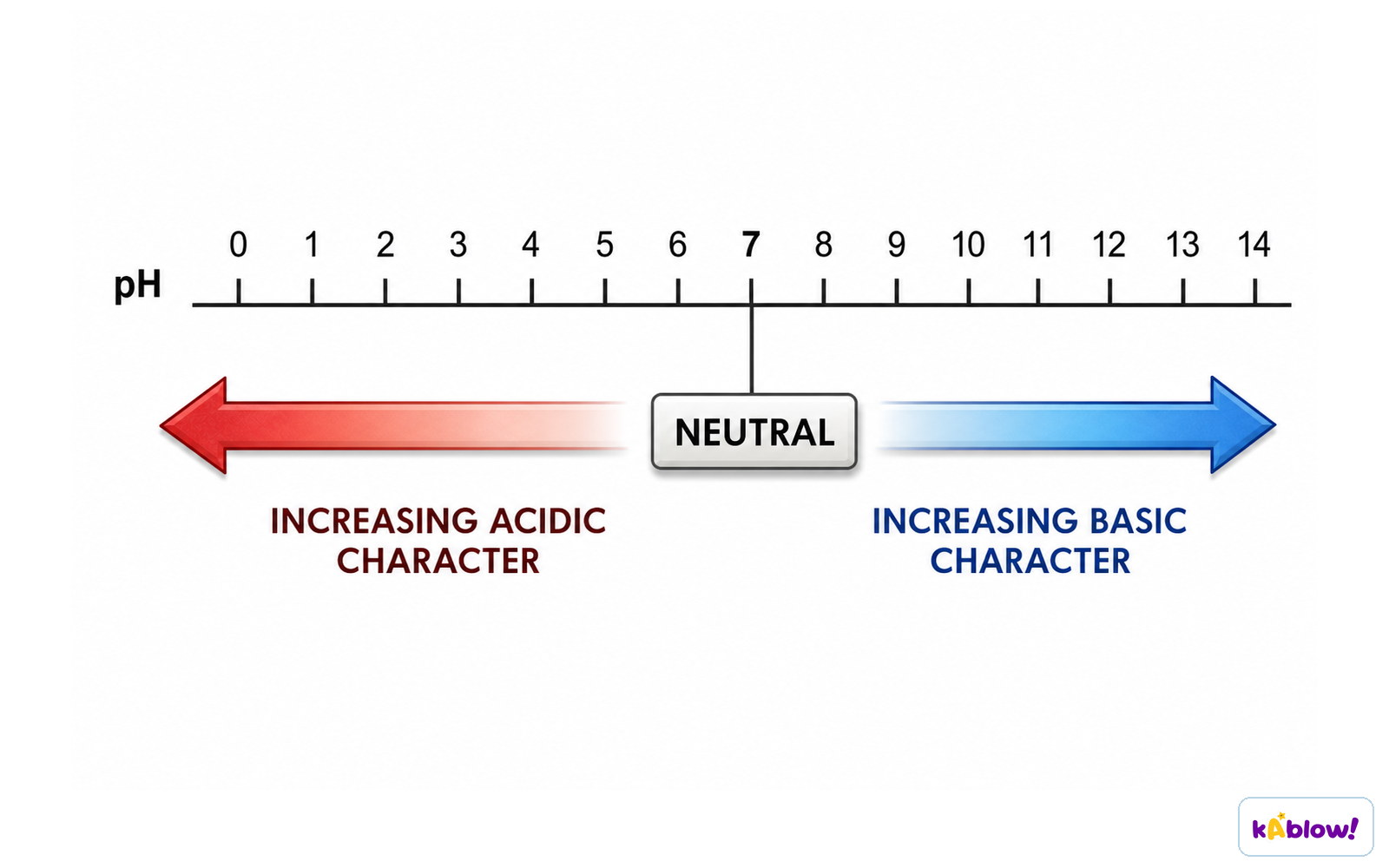
- The pH scale runs 0–14; pH < 7 = acid, pH = 7 = neutral, pH > 7 = alkali.
- pH is a logarithmic measure of H⁺ concentration: a change of 1 pH unit = ×10 change in [H⁺].
- Strong acids have pH 0–2; weak acids pH 3–6; weak alkalis pH 8–11; strong alkalis pH 12–14.
The pH scale showing acidity, neutrality and alkalinity
Proton Transfer
- Acids are proton donors (H⁺ = proton).
- Bases are proton acceptors.
- In water, HCl donates a proton to H₂O, forming H₃O⁺ and Cl⁻.
Strong & Weak Acids
- Strong acids completely dissociate in water (e.g., HCl, H₂SO₄).
- Weak acids partially dissociate; an equilibrium exists (e.g., CH₃CH₂COOH ⇌ H⁺ + CH₃CH₂COO⁻).
- Concentration ≠ strength: a dilute strong acid can be more acidic than a concentrated weak acid.
- Weak acids have pH closer to 7 (e.g., propanoic acid pH ≈ 5).
Classifying Oxides
- Acidic oxides (non‑metal + oxygen): react with bases to form salt + water; produce acidic solutions (e.g., CO₂, SO₂).
- Basic oxides (metal + oxygen): react with acids to form salt + water; produce alkaline solutions (e.g., CuO, CaO).
- Amphoteric oxides (e.g., ZnO, Al₂O₃) react with both acids and bases to give salt + water.
- Neutral oxides (e.g., N₂O, NO, CO) do not react with acids or bases.
- Al₂O₃ + 6HCl → 2AlCl₃ + 3H₂O (as base); Al₂O₃ + 2NaOH → 2NaAlO₂ + H₂O (as acid).
Think like a scientist
- In a supervised school experiment, add dilute alkali to a fixed volume of dilute acid and measure pH.
- Comparison: the volume of alkali added. Outcome: the pH of the mixture.
- Control: keep the starting acid volume and concentration constant. Explain why this makes the comparison fairer.
- Evidence: Use a consistent method, repeated observations where appropriate and a table with labelled quantities and units. Keep unexpected results and investigate their cause.
- Safety: Practical activities need teacher supervision and an appropriate risk assessment. Use the provided data or simulation where the investigation specifies it.
- Inquiry task: State a testable question, predict the outcome using the science, then explain how your observations would support or challenge the prediction.
Evaluate the science
- Neutralisation can adjust the acidity of industrial wastewater.
- An indicator estimates pH over a range; it does not give a precise continuous pH measurement.
- Evaluation task: Link your conclusion to evidence, identify a limitation and suggest a specific improvement. Distinguish a measured result from an explanation of its cause.
スライド
練習問題
無料プレビュー — 52問中8問。すべて見るには登録を。
1.Which of the following is a property of acids?
Easy- AThey have a pH greater than 7
- BThey turn blue litmus red
- CThey are proton acceptors
- DThey release hydroxide ions in water
2.Which ion is present in aqueous solutions of alkalis?
Easy- AH⁺
- BOH⁻
- CCl⁻
- DNa⁺
3.What is the colour of methyl orange in an alkaline solution?
Easy- ARed
- BYellow
- CBlue
- DColourless
4.Which of the following statements about strong and weak acids is correct?
Medium- AA strong acid has a higher pH than a weak acid of the same concentration
- BA weak acid partially dissociates in water
- CA strong acid has a lower concentration of hydrogen ions than a weak acid
- DA weak acid completely dissociates in water
5.Which type of oxide is formed when a non-metal combines with oxygen?
Medium- ABasic oxide
- BAcidic oxide
- CAmphoteric oxide
- DNeutral oxide
6.Which substance could be used to neutralise an acid?
Medium- ALemon juice (pH 2)
- BBattery acid (pH 1)
- CToothpaste (pH 8)
- DVinegar (pH 3)
7.Which gas is produced when an acid reacts with a metal carbonate?
Medium- AHydrogen
- BOxygen
- CCarbon dioxide
- DAmmonia
8.The pH of acid X is 6 and the pH of acid Y is 3. Which statement is correct?
Hard- AThe hydrogen ion concentration of acid X is 1000 times greater than acid Y
- BThe hydrogen ion concentration of acid Y is 3 times greater than acid X
- CThe hydrogen ion concentration of acid Y is 1000 times greater than acid X
- DThe hydrogen ion concentration of acid X is 100 times greater than acid Y
過去問
このトピックの過去問練習は近日公開。
近日公開