Metal extraction and resource choices
遊んで学ぼう
問題に答えてエネルギーを集めたら、釣りや探検を楽しもう。アカウント不要。
レッスンノート
Big idea: metal extraction and resource choices
- Key concept: Systems. Metals below carbon in the reactivity series can often be extracted by reduction with carbon. More reactive metals such as aluminium require electrolysis of suitable compounds.
- Related concepts: Models and evidence. Use a scientific explanation to make predictions, then test it against observations.
- Global context: Scientific and technical innovation. Recycling can reduce demand for fresh ore and extraction energy.
Metals and Ores
- The Earth’s crust contains metals and metal compounds.
- A metal ore is a rock that contains enough of the metal to make extraction worthwhile.
- Many metal ores are oxides (e.g., hematite for iron, bauxite for aluminium).
- Extraction is a reduction process because oxygen is removed from the ore.
- Very unreactive metals like gold and platinum are found native (as uncombined elements).
Reactivity Series and Extraction Method
- The extraction method depends on the metal's position in the reactivity series.
- Metals above carbon must be extracted by electrolysis (e.g., aluminium).
- Metals below carbon can be extracted by heating with carbon or carbon monoxide (e.g., iron).
- Metals lower in the series are easier to extract than those higher up.
- Electrolysis uses large amounts of electricity, making it expensive.
Extraction of Iron from Hematite – Blast Furnace
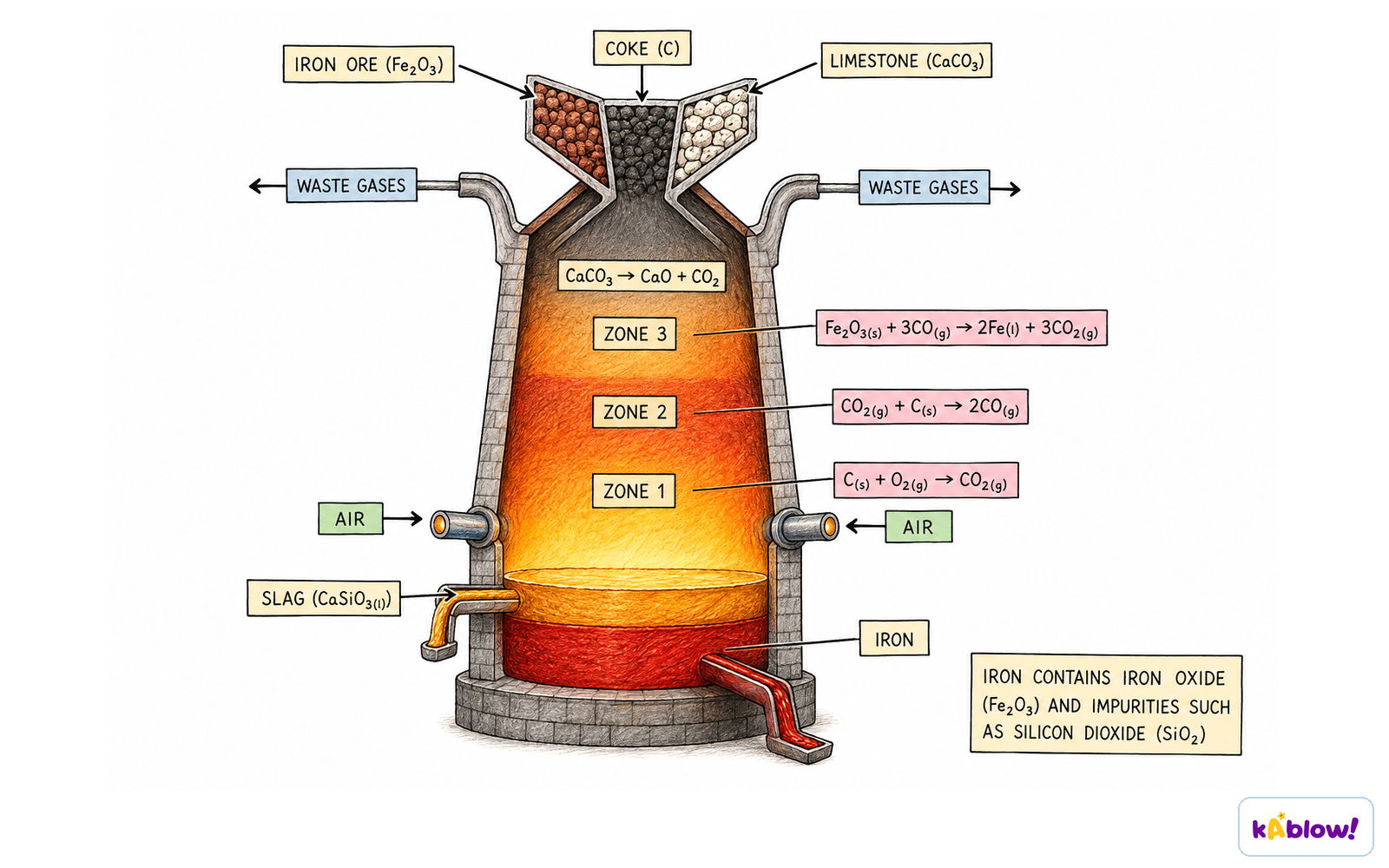
- Iron is extracted from its ore hematite (Fe₂O₃) in a blast furnace.
- Raw materials: iron ore, coke (impure carbon), and limestone (CaCO₃).
- Hot air is blown into the bottom of the furnace.
The blast furnace
Reactions in the Blast Furnace
- Zone 1: Coke burns: C + O₂ → CO₂ (exothermic, provides heat).
- Zone 2: CO₂ + C → 2CO (carbon monoxide is the main reducing agent).
- Zone 3: Fe₂O₃ + 3CO → 2Fe + 3CO₂ (reduction of iron ore).
- Limestone decomposes: CaCO₃ → CaO + CO₂ (thermal decomposition).
- CaO removes SiO₂ impurity: CaO + SiO₂ → CaSiO₃ (slag).
- Molten iron is tapped from the bottom; slag floats on top and is removed separately.
Extraction of Aluminium from Bauxite – Electrolysis
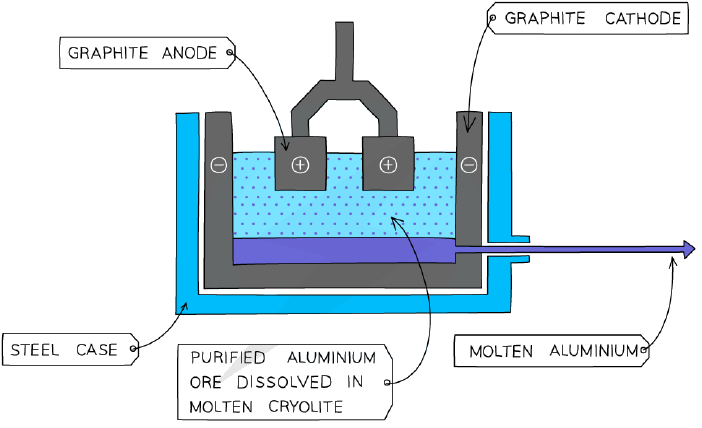
- Aluminium is extracted from bauxite (Al₂O₃) by electrolysis.
- Aluminium is above carbon in the reactivity series, so carbon reduction is not possible.
- Al₂O₃ is dissolved in molten cryolite to lower the melting point (from >2000°C to ~950°C).
- The electrolysis cell has a graphite lining (cathode) and graphite anodes.
- At cathode: Al³⁺ + 3e⁻ → Al (reduction).
- At anode: 2O²⁻ → O₂ + 4e⁻ (oxidation).
- Overall: 2Al₂O₃ → 4Al + 3O₂.
- Oxygen reacts with the carbon anodes to form CO₂, so anodes wear away and must be replaced.
Electrolysis of aluminium oxide
Explaining and applying the science
- Remember OIL RIG: Oxidation Is Loss (of electrons), Reduction Is Gain (of electrons).
- For iron extraction, know the three zones and the role of limestone.
- For aluminium, explain why cryolite is used and why anodes need replacing.
- Unreactive metals (Cu, Ag, Au) may be found native or extracted by simple heating.
Think like a scientist
- Use industrial datasets to compare the energy inputs of alternative extraction routes for a specified metal.
- Comparison: the extraction route. Outcome: energy used per kilogram of metal produced.
- Control: compare the same metal and the same product purity. Explain why this makes the comparison fairer.
- Evidence: Use a consistent method, repeated observations where appropriate and a table with labelled quantities and units. Keep unexpected results and investigate their cause.
- Safety: Practical activities need teacher supervision and an appropriate risk assessment. Use the provided data or simulation where the investigation specifies it.
- Inquiry task: State a testable question, predict the outcome using the science, then explain how your observations would support or challenge the prediction.
Evaluate the science
- Recycling can reduce demand for fresh ore and extraction energy.
- Compare collection, transport, sorting, purity and energy together; one energy figure is not a complete environmental assessment.
- Evaluation task: Link your conclusion to evidence, identify a limitation and suggest a specific improvement. Distinguish a measured result from an explanation of its cause.
スライド
練習問題
無料プレビュー — 52問中8問。すべて見るには登録を。
1.Which of the following is the main ore of aluminium?
Easy- ABauxite
- BHematite
- CMalachite
- DLimestone
2.Which of the following metals is found native (as the uncombined element) in the Earth's crust?
Easy- AGold
- BIron
- CAluminium
- DZinc
3.What is the main reducing agent in the blast furnace for the extraction of iron?
Easy- ACarbon monoxide
- BCarbon dioxide
- CCoke
- DLimestone
4.In the extraction of aluminium by electrolysis, why is aluminium oxide dissolved in molten cryolite?
Medium- ATo lower the melting point of the mixture
- BTo provide a source of aluminium ions
- CTo act as a reducing agent
- DTo increase the conductivity of the solution
5.In the blast furnace, which substance is added to remove impurities such as silicon dioxide?
Easy- ALimestone
- BCoke
- CIron ore
- DCarbon monoxide
6.Which of the following statements about transition elements is correct?
Easy- ATheir compounds are highly coloured
- BThey have low melting points
- CTheir compounds are colourless
- DThey have only one oxidation state
7.The overall equation for the extraction of aluminium is 2Al2O3 → 4Al + 3O2. At the anode, oxygen reacts with the graphite electrodes. What is the main reason the anodes need to be replaced periodically?
Medium- AThe graphite reacts with oxygen to form CO2, wearing away the anode
- BThe aluminium produced attacks the anode
- CThe cryolite dissolves the graphite
- DThe high temperature melts the graphite
8.In the blast furnace, which reaction is an example of thermal decomposition?
Easy- ACaCO3 → CaO + CO2
- BC + O2 → CO2
- CCO2 + C → 2CO
- DFe2O3 + 3CO → 2Fe + 3CO2