Oxidation, reduction and electron transfer
遊んで学ぼう
問題に答えてエネルギーを集めたら、釣りや探検を楽しもう。アカウント不要。
教育者の方へ: Oxidation, reduction and electron transfer(MYP Chemistry、Year 4)向けのすぐ使えるレッスンスライド, 復習ノート — レッスンで使うか、学習者がライブゲームとして遊ぶインタラクティブなクラス活動としてトピックを実施できます。
レッスンノート
Big idea: oxidation, reduction and electron transfer
- Key concept: Change. Oxidation is loss of electrons and reduction is gain of electrons. In a displacement reaction, the more reactive metal is oxidised and the metal ions are reduced.
- Related concepts: Models and evidence. Use a scientific explanation to make predictions, then test it against observations.
- Global context: Scientific and technical innovation. Redox reactions underpin metal extraction and electrochemical cells.
Oxidation & Reduction (Oxygen Definition)
- Oxidation is the gain of oxygen by an element or compound.
- Reduction is the loss of oxygen from an element or compound.
- A redox reaction is one where oxidation and reduction occur simultaneously.
- Example: ZnO + C → Zn + CO – zinc oxide is reduced (loses O), carbon is oxidised (gains O).
Oxidation & Reduction (Electron Definition – Extended)
- Oxidation is the loss of electrons; reduction is the gain of electrons (OIL RIG).
- Oxidation increases the oxidation number; reduction decreases it.
- Half-equations show electron transfer: e.g., Ag → Ag⁺ + e⁻ (oxidation); O₂ + 4e⁻ → 2O²⁻ (reduction).
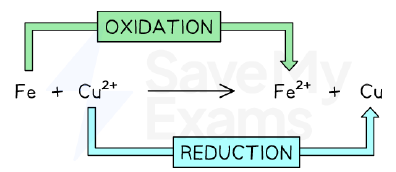
- Example: Fe + Cu²⁺ → Fe²⁺ + Cu – Fe loses electrons (oxidised), Cu²⁺ gains electrons (reduced).
Redox reaction between Fe and Cu2+ shown by electron transfer
Oxidation Numbers & Roman Numerals
- Oxidation number (state) shows the charge an atom would have if electrons were completely transferred.
- Roman numerals in names indicate oxidation number: e.g., iron(II) = Fe²⁺, iron(III) = Fe³⁺.
- Rules: uncombined elements = 0; monatomic ion = its charge; sum in compound = 0; sum in ion = charge.
- Group 1 always +1, Group 2 always +2, F always –1, H usually +1, O usually –2.
Identifying Redox Reactions by Colour Changes
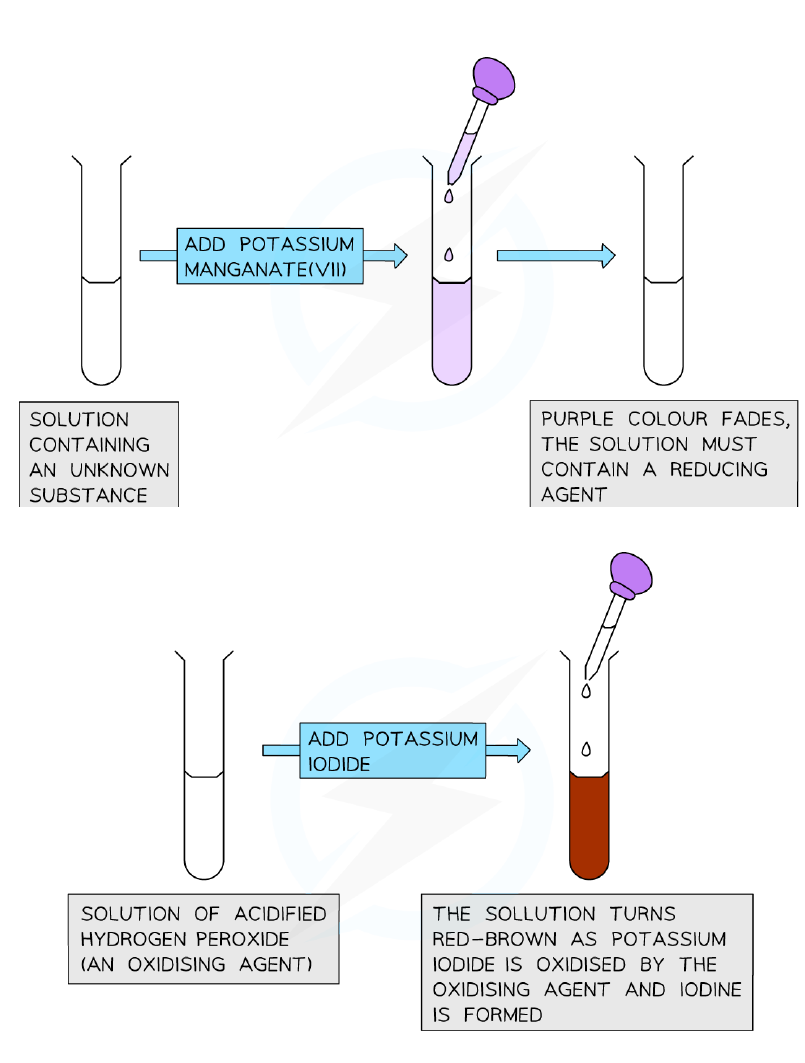
- Potassium manganate(VII) (KMnO₄) is a purple oxidising agent; with a reducing agent it turns colourless.
- Potassium iodide (KI) is a colourless reducing agent; with an oxidising agent it turns red-brown (I₂ formed).
- These colour tests are used to detect oxidising or reducing agents.
Colour-change tests for oxidising and reducing agents
Oxidising & Reducing Agents
- An oxidising agent oxidises another substance and is itself reduced (gains electrons).
- A reducing agent reduces another substance and is itself oxidised (loses electrons).
- Common oxidising agents: O₂, Cl₂, KMnO₄, H₂O₂. Common reducing agents: C, H₂, KI.
- Example: CuO + H₂ → Cu + H₂O – CuO is oxidising agent (reduced), H₂ is reducing agent (oxidised).
Displacement Reactions & Redox
- In displacement reactions, the more reactive metal loses electrons (oxidised) and the less reactive metal ion gains electrons (reduced).
- Example: Fe + CuSO₄ → FeSO₄ + Cu – Fe is oxidised, Cu²⁺ is reduced.
- Ionic equation: Fe + Cu²⁺ → Fe²⁺ + Cu.
Half-Equations & Balancing
- Half-equations show either oxidation or reduction separately with electrons.
- Oxidation half: atoms/ions lose electrons (e.g., Ni → Ni²⁺ + 2e⁻).
- Reduction half: atoms/ions gain electrons (e.g., Ni³⁺ + e⁻ → Ni²⁺).
- Balance atoms and charge: e.g., O₂ + 4e⁻ → 2O²⁻.
Extraction of Metals & Redox
- Carbon is used to reduce metal oxides (e.g., ZnO + C → Zn + CO).
- The metal oxide is reduced (loses oxygen), carbon is oxidised (gains oxygen).
- Metals below carbon in the reactivity series can be extracted by reduction with carbon.
Think like a scientist
- Compare teacher-provided observations of different metals placed in the same copper sulfate solution.
- Comparison: the metal placed in the solution. Outcome: whether copper forms and the solution colour changes.
- Control: keep solution concentration and exposed metal area constant. Explain why this makes the comparison fairer.
- Evidence: Use a consistent method, repeated observations where appropriate and a table with labelled quantities and units. Keep unexpected results and investigate their cause.
- Safety: Practical activities need teacher supervision and an appropriate risk assessment. Use the provided data or simulation where the investigation specifies it.
- Inquiry task: State a testable question, predict the outcome using the science, then explain how your observations would support or challenge the prediction.
Evaluate the science
- Redox reactions underpin metal extraction and electrochemical cells.
- A colour change supports a reaction but does not identify every product without further tests.
- Evaluation task: Link your conclusion to evidence, identify a limitation and suggest a specific improvement. Distinguish a measured result from an explanation of its cause.
スライド
練習問題
無料プレビュー — 52問中8問。すべて見るには登録を。
1.In terms of oxygen, what is oxidation?
Easy- AGain of oxygen
- BLoss of oxygen
- CLoss of electrons
- DGain of electrons
2.In terms of oxygen, what is reduction?
Easy- ALoss of oxygen
- BGain of oxygen
- CLoss of electrons
- DGain of electrons
3.What is a redox reaction?
Easy- AA reaction where oxidation and reduction occur simultaneously
- BA reaction where only oxidation occurs
- CA reaction where only reduction occurs
- DA reaction where no electron transfer occurs
4.In the reaction ZnO + C → Zn + CO, which substance is reduced?
Easy- AZinc oxide (ZnO)
- BCarbon (C)
- CZinc (Zn)
- DCarbon monoxide (CO)
5.In terms of electron transfer, oxidation is the:
Easy- ALoss of electrons
- BGain of electrons
- CGain of oxygen
- DLoss of oxygen
6.What is the oxidation number of iron in iron(III) oxide (Fe₂O₃)?
Easy- A+3
- B+2
- C-3
- D0
7.Which change in oxidation number indicates that the species has been reduced?
Easy- ADecrease from +3 to +2
- BIncrease from 0 to +2
- CIncrease from -1 to 0
- DNo change
8.In the reaction Cl₂ + 2KI → 2KCl + I₂, which species is reduced?
Medium- AChlorine (Cl₂)
- BPotassium iodide (KI)
- CIodine (I₂)
- DPotassium chloride (KCl)
過去問
このトピックの過去問練習は近日公開。
近日公開