Cell Respiration
遊んで学ぼう
問題に答えてエネルギーを集めたら、釣りや探検を楽しもう。アカウント不要。
レッスンノート
ATP: The Universal Energy Currency
- ATP (adenosine triphosphate) is a small, soluble molecule that provides a short-term store of chemical energy for cells.
- It is described as a universal energy currency because it is used in all organisms and can be reused countless times for different reactions.
- ATP links energy-requiring and energy-yielding reactions in cells.
- Its solubility and small size allow it to move easily within cells and organisms by facilitated diffusion.
- ATP is a phosphorylated nucleotide made of ribose sugar, an adenine base, and three phosphate groups.
- ATP is relatively stable at cellular pH and only breaks down when the enzyme ATPase is present, preventing wasted energy.
- Hydrolysis of ATP releases a useful, not too large, quantity of energy, reducing waste while giving the cell control over which processes occur.
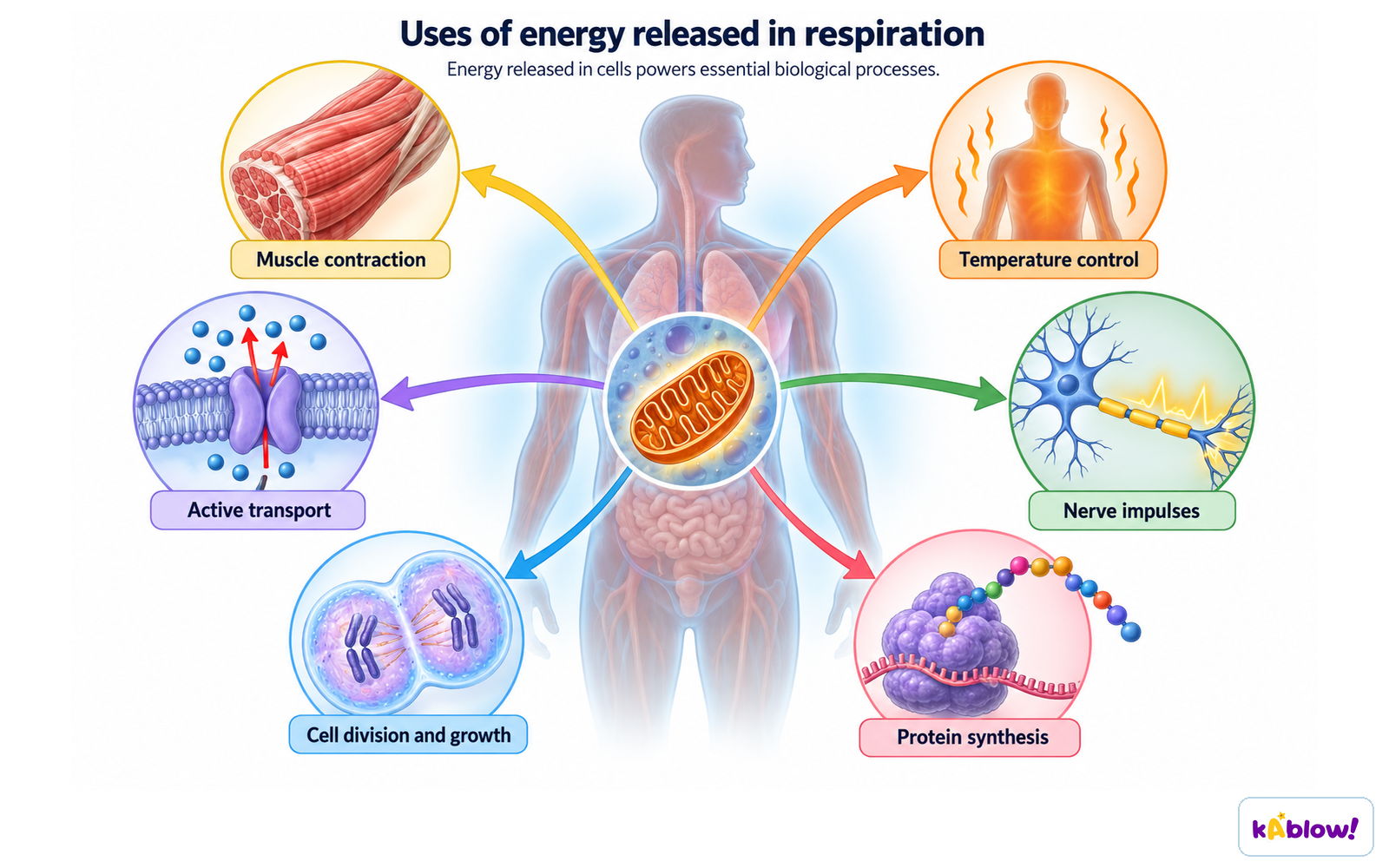
Uses of energy from respiration
ATP Hydrolysis and Synthesis
- When ATP is hydrolysed, it forms ADP (adenosine diphosphate) and a phosphate ion (π), releasing free energy.
- Removal of one phosphate from ATP releases approximately 30.5 kJ mol⁻¹, forming ADP; removal of a second releases another 30.5 kJ mol⁻¹, forming AMP.
- Removal of the third phosphate from AMP releases 14.2 kJ mol⁻¹, forming adenosine.
- ATP is re-synthesised when ADP combines with an inorganic phosphate (π) group; this is an energy-requiring reaction.
- ATP synthesis is a condensation reaction because water is released as a waste product.
- Humans use more than 50 kg of ATP per day but have only about 200 g in the body at any time, so ATP must be made continuously as needed.
- ATP is not stored in living organisms because it is very reactive; glucose and fatty acids act as short-term energy stores, while glycogen, starch and triglycerides are long-term stores.
Uses of ATP in Cells
- ATP provides energy for anabolic reactions that synthesise larger molecules from smaller ones.
- ATP fuels active transport, moving molecules across the cell membrane against their concentration gradient.
- ATP enables movement of the entire cell and movement of cell components such as chromosomes within the cell.
- ATP is used for muscle contraction and for fuelling active transport.
- ATP provides energy for moving molecules around the cell.
- In warm-blooded animals, ATP helps generate heat to maintain body temperature.
Cell Respiration: Definition and Purpose
- Cell respiration is the controlled release of energy from organic compounds to produce ATP.
- It is a series of chemical reactions that happens in every cell and is a catabolic process.
- Glucose is the main respiratory fuel used in cells; lipids and proteins can also be used but must undergo several changes first.
- Glucose can enter glycolysis directly, making it easier to oxidise than lipids and proteins.
- Proteins are primarily structural molecules, so they are used as respiratory fuel only when glucose and lipids are not available.
- Energy is released in small, enzyme-controlled steps rather than one uncontrolled step, which would cause cell damage and tissue death.
- To make ATP, a phosphate group is linked to ADP, using energy from the breakdown of organic molecules.
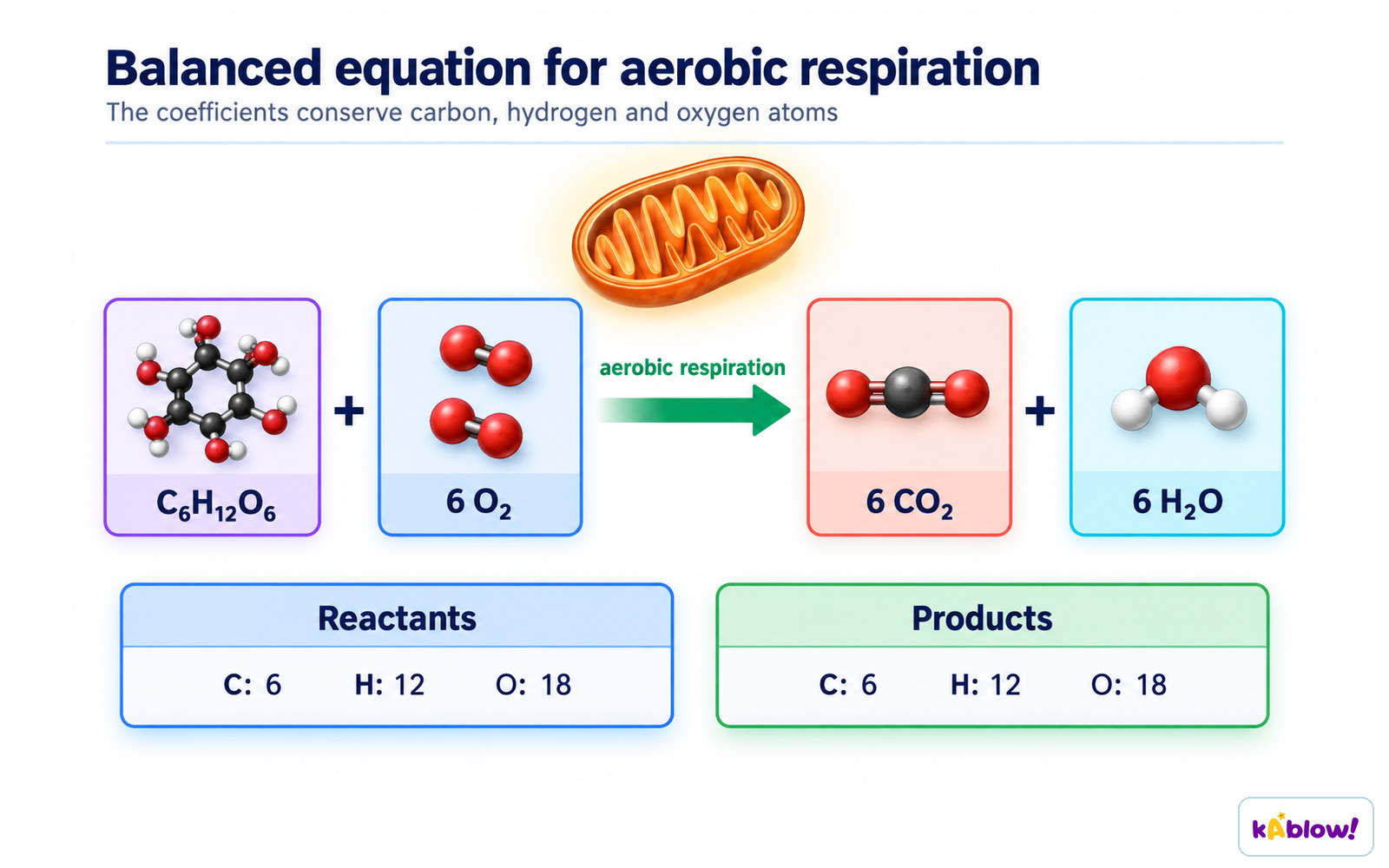
Balanced equation for aerobic respiration
Aerobic Respiration
- Aerobic respiration is the breakdown of a respiratory substrate to produce ATP using oxygen.
- The substrate is completely oxidised, releasing a large amount of energy.
- Glucose is broken down fully into carbon dioxide and water.
- Aerobic respiration yields approximately 36 ATP molecules per glucose molecule.
- CO₂ is a waste product that must be excreted, except in plants where it is used for photosynthesis.
- Water is a by-product and contributes to the organism's water needs; some desert animals survive on very little drinking water because of this.
- In eukaryotes, most reactions of aerobic respiration take place in the mitochondria.
Balanced equation for aerobic respiration
Anaerobic Respiration
- Anaerobic respiration takes place in the absence of oxygen and breaks down a respiratory substrate, producing less ATP.
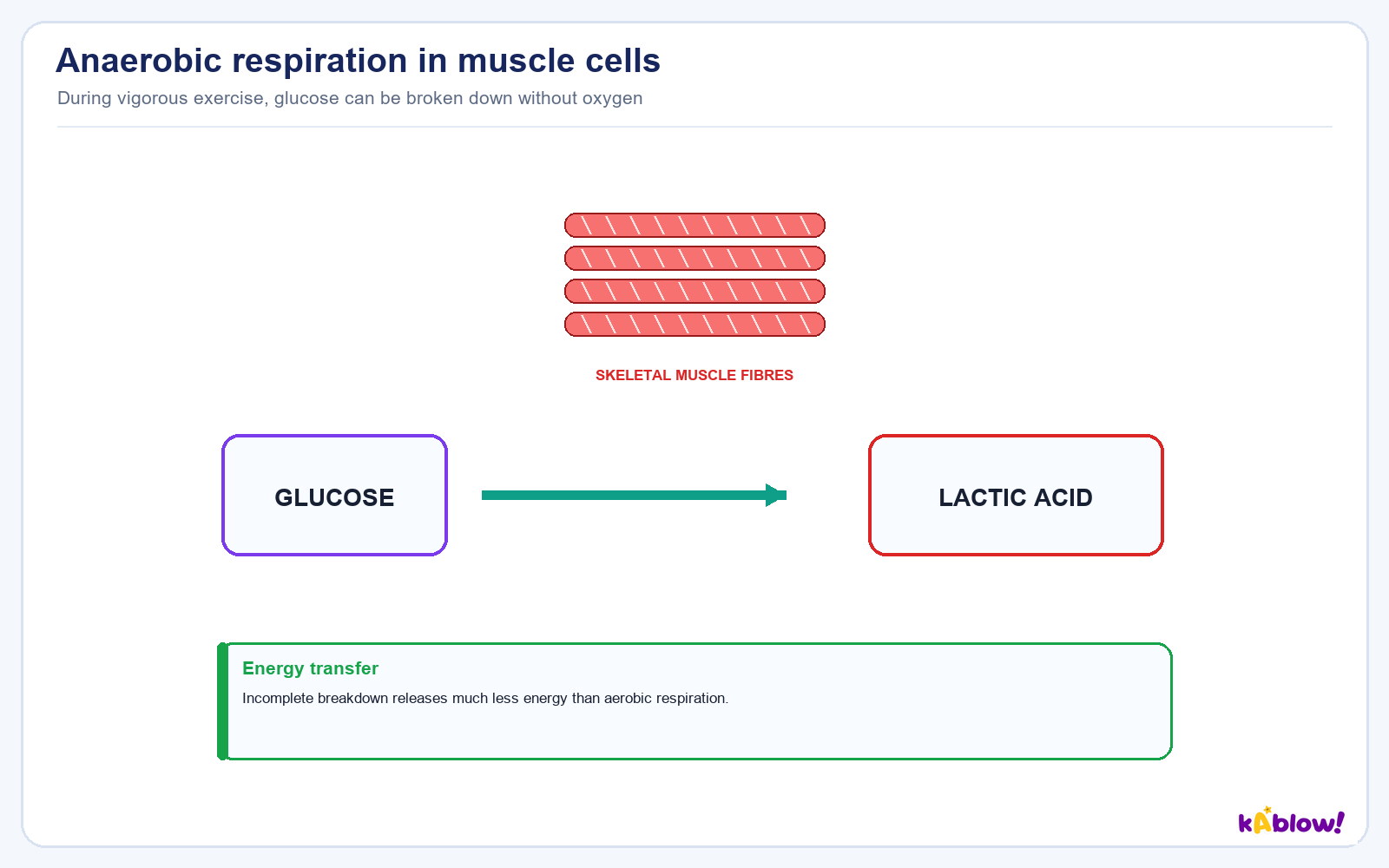
- Glucose is only partially oxidised, so only a small part of its chemical energy is released and transferred to ATP.
- The only ATP-producing reaction that continues is the first stage of respiration, yielding around 2 ATP molecules per glucose molecule.
- Around 36 ATP molecules that would be produced aerobically are not produced anaerobically.
- Anaerobic respiration occurs in the cytoplasm and does not involve the mitochondria.
- Different organisms produce different products: plants and yeasts produce ethanol and CO₂, while animals produce lactate.
- Anaerobic respiration gives a short discharge of energy when oxygen runs out, which is better than zero ATP.
Anaerobic respiration in muscle
Comparing Aerobic and Anaerobic Respiration in Humans
- Oxidation of glucose: complete in aerobic respiration, incomplete in anaerobic respiration.
- Oxygen required: yes for aerobic, no for anaerobic.
- Relative ATP yield: high (∼36 molecules) in aerobic, low (2 molecules) in anaerobic.
- Products: CO₂ and H₂O in aerobic respiration; lactate in anaerobic respiration.
- Location of reactions: cytoplasm and mitochondria in aerobic respiration; cytoplasm only in anaerobic respiration.
Factors Affecting the Rate of Cell Respiration
- Metabolic activity of the cell: muscle cells have a higher rate of respiration than adipose cells due to higher energy needs.
- Size of the organism: smaller organisms have a higher surface area : volume ratio and a higher rate of respiration to compensate for greater heat loss.
- Oxygen supply: when oxygen availability is low, cells respire anaerobically.
- Supply of respiratory substrates: glucose availability is particularly important; lower substrate supply means a lower rate of respiration.
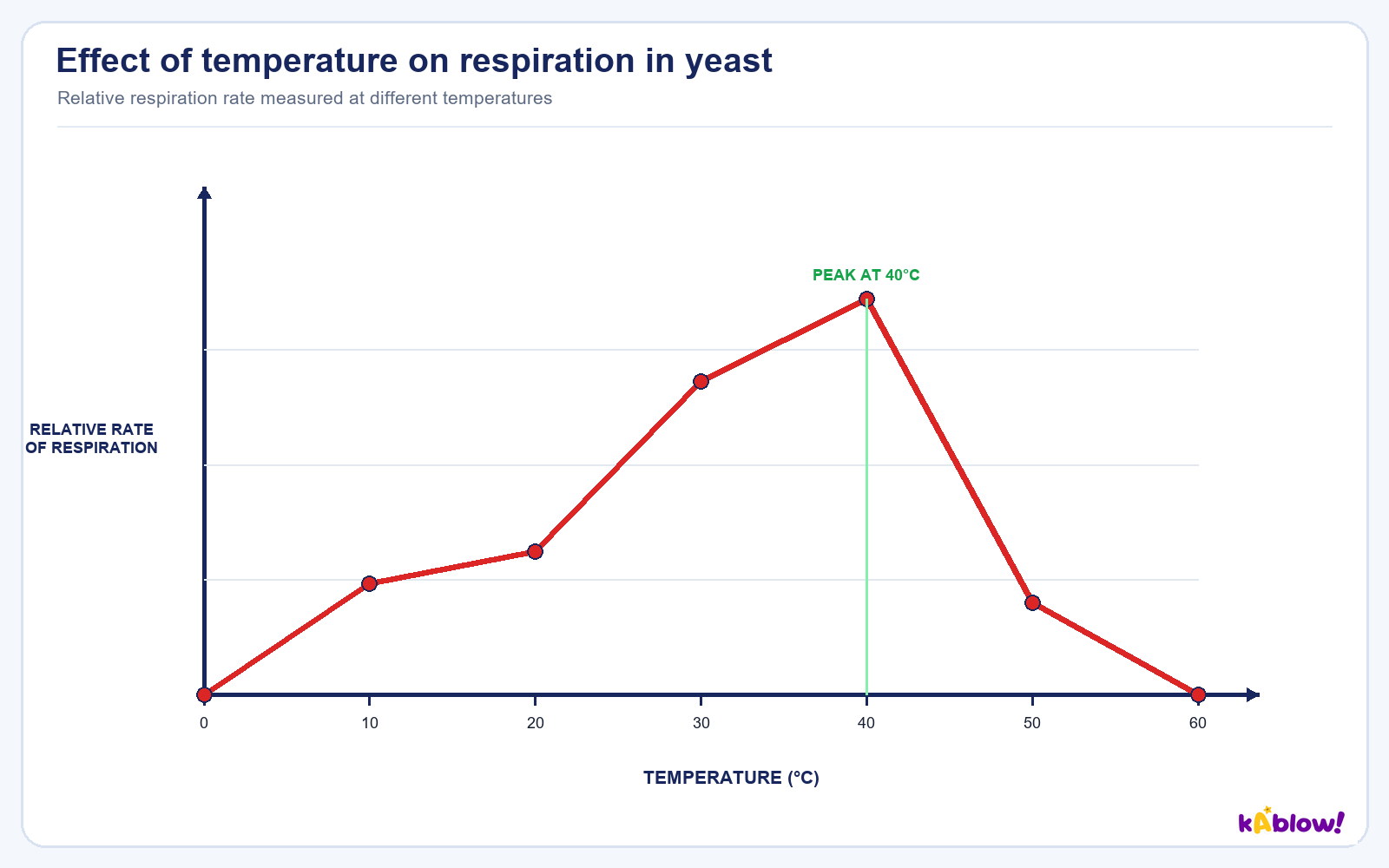
- Temperature: the rate increases up to the optimum temperature of the enzymes, then drops as enzymes denature.
- pH: CO₂ released during respiration decreases pH, which may denature enzymes involved in respiration.
Rate of respiration and temperature
Respirometers and Measuring Respiration Rate
- Respirometers measure and investigate the rate of oxygen consumption during respiration in organisms.
- Experiments usually use live organisms such as seeds or invertebrates; use of animals should be minimised when seeds can provide excellent data.
- Common features include a sealed container with live organisms and air, an alkaline solution (e.g. potassium hydroxide) to absorb CO₂, and a capillary tube against a graduated scale (a manometer).
- Organisms respire aerobically and absorb oxygen; the CO₂ they release is absorbed by the alkali, reducing air pressure inside the sealed chamber.
- The manometer fluid moves towards the organisms because of the pressure drop inside the chamber.
- The respirometer must be kept in very temperature-controlled conditions (e.g. a thermostatically controlled water bath) because slight temperature fluctuations affect air pressure.
- Repeat readings should be carried out for each set of conditions to identify and eliminate anomalies and give a reliable mean.
- Oxygen sensors and CO₂ monitors can measure concentrations in real-time without exposing subjects to hazards such as strong alkalis, and dataloggers can record data over time for later analysis.
Calculating the Rate of Respiration
- The volume of oxygen consumed (mm³ min⁻¹) can be calculated using the radius of the lumen of the capillary tube r (mm) and the distance moved by the manometer fluid h (mm) in a minute using the formula: πr²h.
- First calculate the cross-sectional area of the capillary tube using πr².
- Then calculate the volume of oxygen taken up by multiplying the cross-sectional area by the distance moved by the liquid.
- Finally, calculate the average rate of oxygen consumption per minute by dividing the volume by the time in minutes.
- The volume of oxygen consumed can then be used to determine the average rate of respiration per unit time.
スライド
練習問題
無料プレビュー — 64問中8問。すべて見るには登録を。
1.ATP is described as a universal energy currency. What is the best explanation for this description?
Easy- AIt is used in all organisms and can be used for different reactions and reused many times.
- BIt is stored in large amounts in every cell for long-term energy supply.
- CIt is only found in animals and used for muscle contraction.
- DIt is an enzyme that speeds up all energy-releasing reactions.
2.Which of the following correctly describes the structure of ATP?
Easy- AA phosphorylated nucleotide made of ribose sugar, adenine base, and three phosphate groups.
- BA nucleotide made of deoxyribose sugar, adenine base, and three phosphate groups.
- CA molecule made of ribose sugar, adenine base, and two phosphate groups.
- DA protein made of three amino acids and a phosphate group.
3.When ATP is hydrolysed, it is converted to ADP and a phosphate ion. Which of the following best describes the energy change during this process?
Medium- AEnergy is released and can be used for processes within a cell.
- BEnergy is taken in from the surroundings to break the bond.
- CEnergy is released only if oxygen is present.
- DEnergy is stored as heat and cannot be used by the cell.
4.Which of the following is NOT a feature that makes ATP suitable as an immediate energy source for cells?
Medium- AIt is a very stable molecule that can be stored for long periods.
- BIt releases a small but sufficient quantity of energy.
- CIt can be hydrolysed quickly and easily by a single enzyme.
- DIt is soluble and can move easily within cells.
5.Which of the following are uses of ATP in the human body? (Select all that apply.)
Medium- AActive transport of molecules across cell membranes
- BMuscle contraction
- CAnabolic reactions to synthesise macromolecules
- DLong-term storage of energy in adipose tissue
- EMovement of chromosomes within the cell
6.Which of the following statements about aerobic and anaerobic respiration in humans are correct? (Select all that apply.)
Medium- AAerobic respiration completely oxidises glucose, while anaerobic respiration partially oxidises it.
- BAerobic respiration produces approximately 36 ATP molecules per glucose, while anaerobic respiration produces 2 ATP molecules per glucose.
- CAnaerobic respiration in humans produces lactate, while aerobic respiration produces carbon dioxide and water.
- DAerobic respiration takes place only in the cytoplasm, while anaerobic respiration takes place in the mitochondria.
- EAnaerobic respiration requires oxygen, while aerobic respiration does not.
7.ATP is a very reactive molecule and is not stored in large amounts in living organisms.
EasyTrue or false?
8.Anaerobic respiration in plants and yeasts produces lactate.
EasyTrue or false?