Evolution & Speciation
遊んで学ぼう
問題に答えてエネルギーを集めたら、釣りや探検を楽しもう。アカウント不要。
教育者の方へ: Evolution & Speciation(Biology、SL)向けのすぐ使えるレッスンスライド, 復習ノート — レッスンで使うか、学習者がライブゲームとして遊ぶインタラクティブなクラス活動としてトピックを実施できます。
レッスンノート
Evolution
- Evolution is defined as changes in the heritable characteristics of organisms over generations.
- Heritable characteristics are determined by the alleles of genes and can be passed on to offspring.
- Changes in non-inherited characteristics, such as a plant having its leaves eaten, do not lead to evolution.
- Random mutation can produce new alleles that may be more or less advantageous.
- Advantageous heritable characteristics are more likely to be passed on, leading to gradual change in a species over time.
- The process by which advantageous alleles become more frequent in a population is natural selection.
- Evolution can lead to the development of completely new species, resulting in the great diversity of species on Earth.
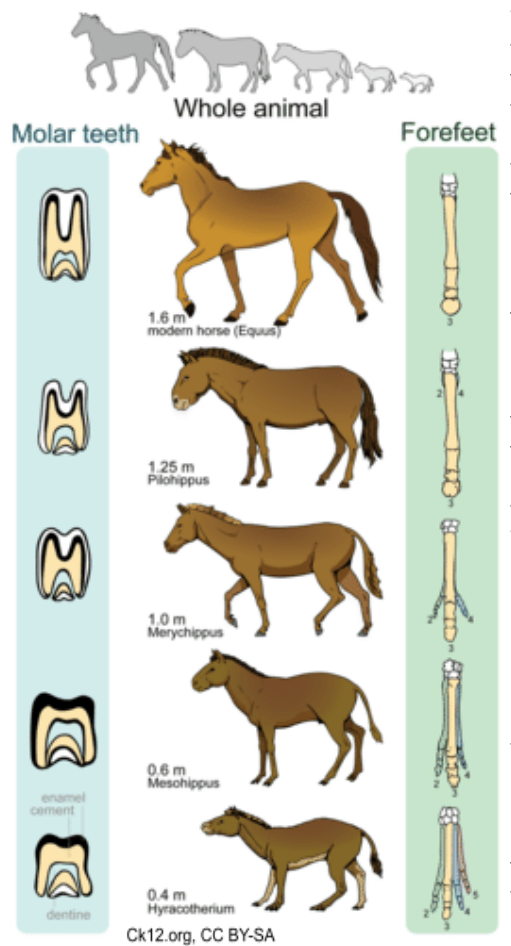
Evolution of the horse
Darwinian Evolution
- Charles Darwin proposed the theory of evolution by natural selection based on observations and experimentation.
- Individuals in a species show a wide range of variation due to random mutations in their DNA.
- Individuals within a population must compete for survival due to selection pressures.
- Individuals with characteristics most suited to the environment have a higher chance of survival and are more likely to reproduce.
- Advantageous alleles are passed down to offspring and become more frequent in the population over many generations.
- Darwinian evolution by natural selection requires that characteristics are heritable.
Lamarckian Evolution
- Jean-Baptiste Lamarck proposed a theory of evolution based on the idea that changes acquired during an organism's lifetime can be inherited.
- Such changes are known as acquired characteristics.
- Lamarck suggested that characteristics used frequently become better and stronger, while unused characteristics gradually disappear.
- For example, he proposed that giraffes stretched their necks to reach high branches, and this elongated neck was passed to offspring.
- Lamarck's ideas were incorrect because acquired characteristics are not passed on to offspring.
- The new science of epigenetics may provide an exception, but such changes are unlikely to be major drivers of natural selection.
Evidence of Evolution: Sequence Data
- Sequence data can be obtained from DNA, RNA, and proteins.
- Similarities in sequence data between species suggest that all species share a common ancestor.
- Comparisons must be made between the same part of the DNA, often from highly conserved regions that have changed very little over time.
- Conserved sequences are likely to exist in a wide range of species and code for essential proteins, e.g. haemoglobin or enzymes involved in respiration.
- DNA can be extracted from blood, skin, or fossilised remains, and its base sequence compared to that of other organisms.
- The more similarities in DNA base sequences, the more closely related the species are.
- For example, humans and chimpanzees share almost 99% of their DNA sequences, making them our closest living relatives.
- Data from multiple sources, such as several different genes, can be used to build an evolutionary tree.
Evidence of Evolution: Selective Breeding
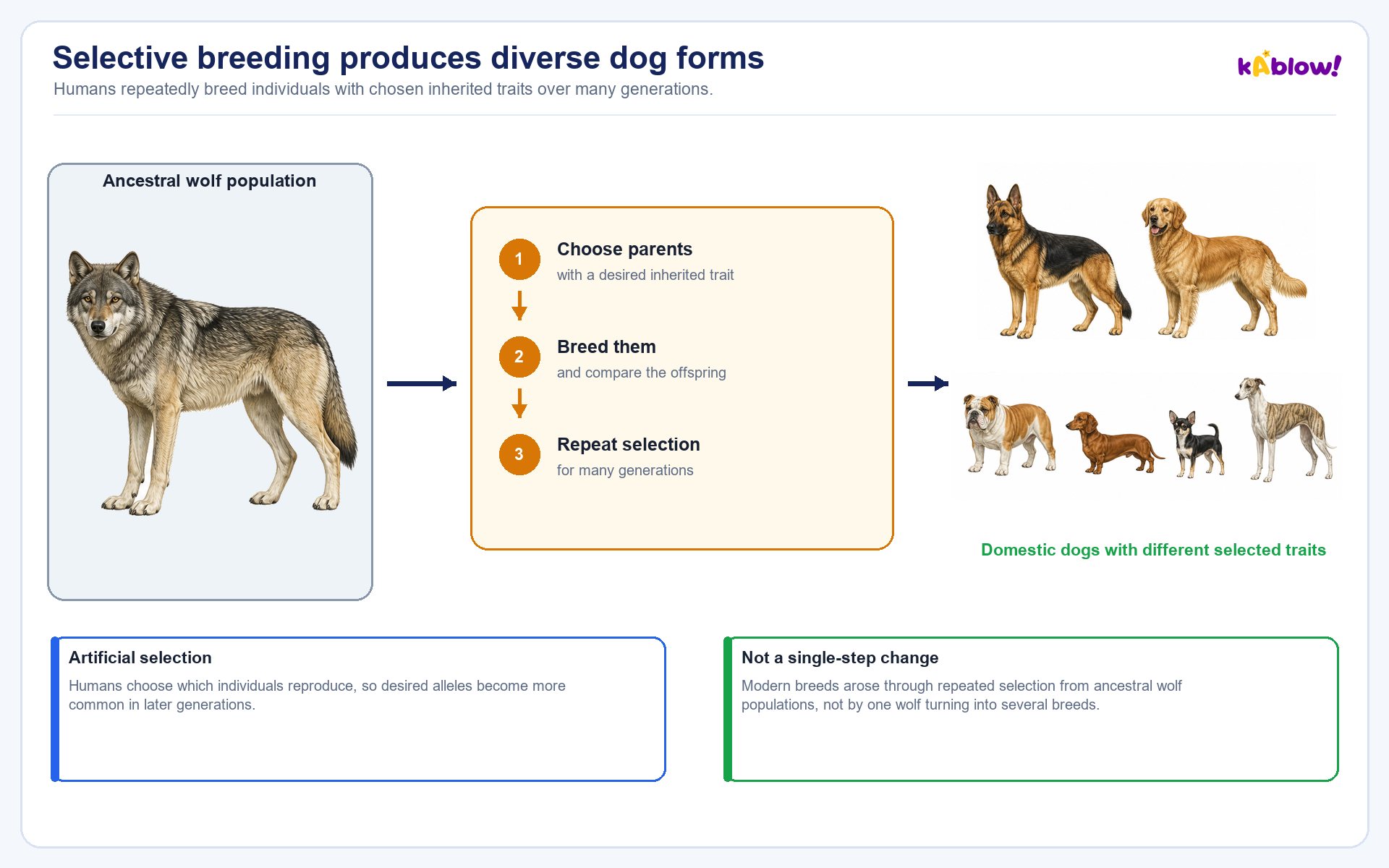
- Selective breeding is a process in which humans choose organisms with desirable characteristics and breed them together repeatedly.
- It is also known as artificial selection and makes use of the principles of natural selection, but is carried out by humans.
- In natural selection, advantageous alleles are passed on because they increase survival chances; in artificial selection, desirable alleles are passed on because humans decide which individuals breed.
- Selective breeding leads to faster change than natural selection because only selected individuals are allowed to breed together.
- The process involves: variation in the population, selection of desired individuals, breeding, testing offspring, and repeating over many generations.
- Selective breeding provides evidence that evolution occurs due to the accumulation of small changes to DNA over time.
Selective breeding in dogs
Evidence of Evolution: Homologous Structures
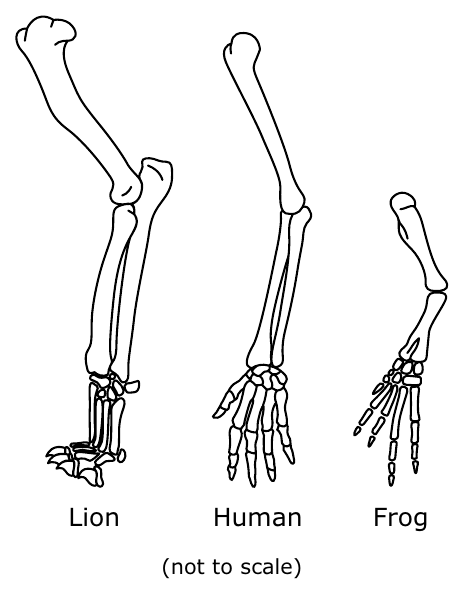
- Homologous structures are body parts that may look and function very differently but share structural similarities.
- The limbs of birds, bats, crocodiles, whales, horses, and monkeys are used differently and look different, but are structurally similar.
- One explanation is adaptive radiation: organisms with homologous structures evolved from a shared common ancestor and adapted to different environments.
- A pentadactyl limb is any limb with five digits (fingers or toes).
- Pentadactyl limbs are present in many species, including mammals, birds, amphibians, and reptiles.
- In different species, the pentadactyl limb has a similar bone structure but enables different modes of movement, e.g. human foot for upright walking, whale flipper for swimming, bird wing for flight.
- The individual bones of the pentadactyl limb differ in shape and size due to different functions, but their layout is almost exactly the same.
Homologous limb structures
Convergent Evolution
- Analogous structures are characteristics with similar form and function but different evolutionary origins.
- Analogous structures arise as a result of convergent evolution.
- Convergent evolution occurs when two distantly related species live in habitats with similar selection pressures, so similar characteristics provide a survival advantage.
- Advantageous characteristics evolve separately, rather than from a single common ancestor.
- Example: dolphins (mammals) and sharks (fish) share a similar streamlined body shape, but evolved separately.
- Example: cacti (Americas) and euphorbias (Africa) are desert plants with spiny leaves and succulent stems, but belong to different orders and evolved separately.
- Analogous structures provide evidence for the passing on of advantageous characteristics during natural selection.
Speciation
- Speciation is defined as the development of new species from pre-existing species over time.
- Speciation increases diversity; extinction reduces diversity.
- Speciation can occur when gene flow between populations of a species is prevented, e.g. due to separation on different islands.
- When gene flow stops, genetic differences can accumulate between the two populations, especially if different selection pressures act on them.
- A speciation split has occurred when the two populations can no longer interbreed to produce fertile offspring; they are then reproductively isolated.
- Reproductive isolation is essential for speciation; gradual evolutionary change alone is not enough.
- Theoretically, at the origin of life there was one single species, which evolved into separate new species over millions of years, leading to the millions of species today.
Reproductive Isolation & Differential Selection
- Reproductive isolation occurs when changes in alleles and phenotypes prevent individuals from successfully breeding with others that do not have these changes.
- Examples of changes leading to reproductive isolation include seasonal changes (different mating or flowering seasons) and behavioural changes (different courtship behaviours).
- Geographical isolation occurs when populations become separated by geographical barriers, such as a body of water, a mountain range, or a man-made barrier like a motorway.
- Geographical isolation creates two populations between which no gene exchange can occur.
- The two populations may experience different selection pressures, so natural selection may act differently on them; this is known as differential selection.
- Over time, the two populations may become so different that they are reproductively isolated, and speciation has occurred.
- Example: bonobos (south of the Congo river) and chimpanzees (north of the Congo river) evolved from a geographically isolated ancestor species; different selection pressures led to differences such as aggression and social structure.
- Geographical isolation prevents gene flow but may be temporary, while reproductive isolation means speciation has occurred and the two species can no longer breed successfully even if they live in the same habitat.
スライド
練習問題
無料プレビュー — 63問中8問。すべて見るには登録を。
1.Which of the following best defines evolution?
Easy- AChanges in the heritable characteristics of organisms over generations
- BAny change in an organism's characteristics during its lifetime
- CA change in the geographic distribution of a species
- DAn increase in the total number of alleles in a population
2.Which mechanism drives evolution by causing advantageous alleles to become more frequent in a population over generations?
Easy- ANatural selection
- BSelective breeding
- CMutation
- DGeographical isolation
3.What is speciation?
Easy- AThe development of new species from pre-existing species over time
- BThe process of separating organisms into species groups
- CThe absence of gene flow between two populations
- DThe exposure of two separate populations to different selection pressures
4.Which of the following is a source of evidence for evolution?
Easy- ASequence data from DNA, RNA and proteins
- BThe number of chromosomes in a species
- CThe total mass of an organism
- DThe colour of an organism's eyes
5.Which of the following is an example of a homologous structure?
Medium- AThe pentadactyl limb of a human and a whale
- BThe wing of a butterfly and the wing of a bat
- CThe streamlined body of a dolphin and a shark
- DThe spiny leaves of a cactus and a euphorbia
6.Which of the following is an example of convergent evolution?
Medium- AThe streamlined body shape of dolphins and sharks
- BThe pentadactyl limb of a human and a whale
- CThe similar bone structure of bird wings and alligator limbs
- DThe inheritance of acquired characteristics in giraffes
7.Which of the following are sources of evidence for evolution? (select all that apply)
Medium- ASequence data from DNA
- BSelective breeding
- CHomologous structures
- DThe number of legs an organism has
- EThe colour of an organism's skin
8.Which of the following can lead to reproductive isolation between populations? (select all that apply)
Medium- ASeasonal changes in mating or flowering times
- BBehavioural changes in courtship
- CGeographical isolation by a mountain range
- DA change in the number of chromosomes
- EAn increase in the size of the population
過去問
このトピックの過去問練習は近日公開。
近日公開