The Nuclear Atom
遊んで学ぼう
問題に答えてエネルギーを集めたら、釣りや探検を楽しもう。アカウント不要。
レッスンノート
The Nuclear Atom
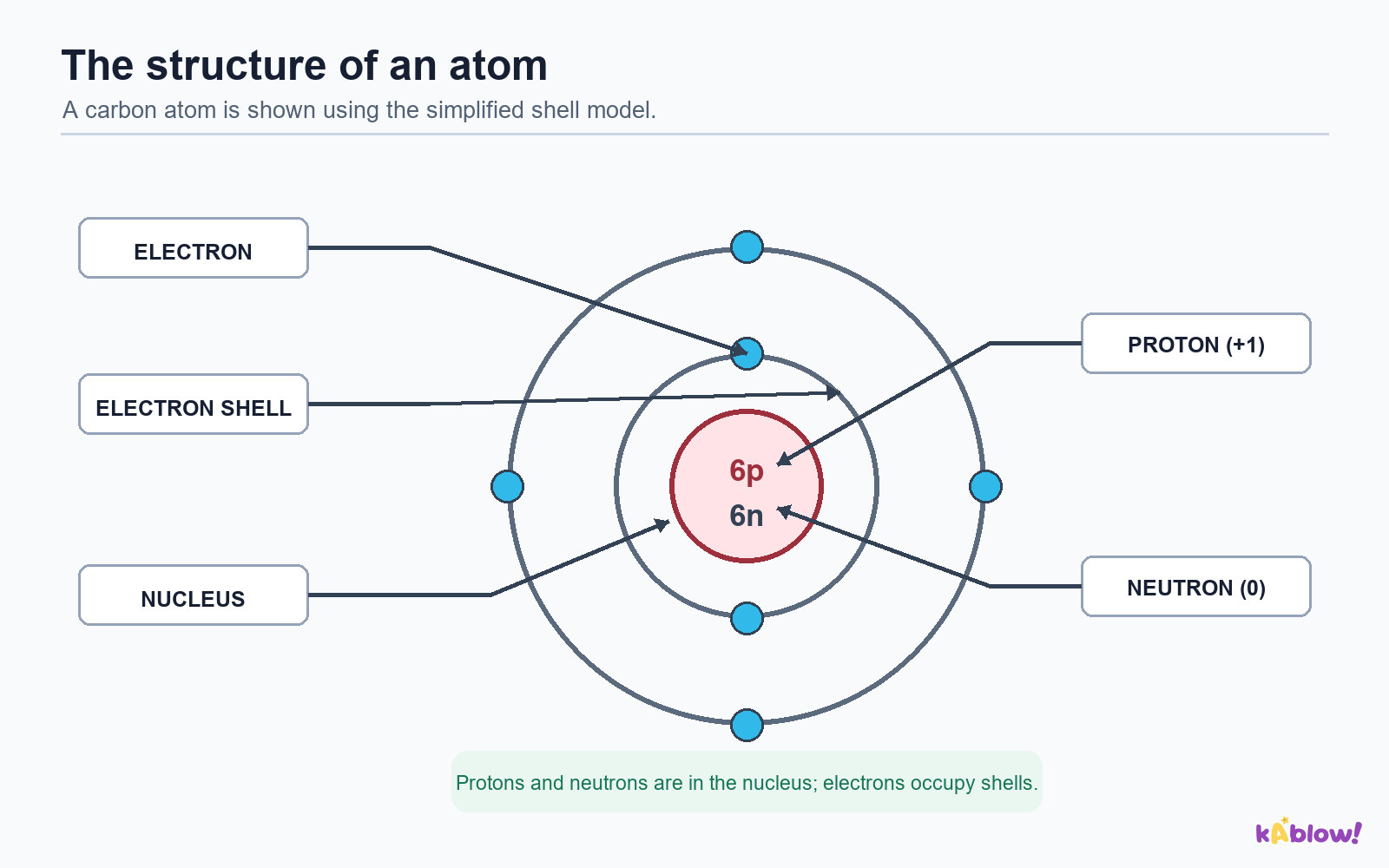
- Atoms consist of a small, dense, positively charged nucleus surrounded by electrons.
- The nucleus contains protons and neutrons, collectively called nucleons.
- Almost all of the atom's mass is concentrated in the nucleus because protons and neutrons are much heavier than electrons.
- Electrons occupy the space outside the nucleus, often described as a cloud of negative charge.
- The atom is held together by the electrostatic attraction between the positive nucleus and the negative electrons.
- The nucleus is very small compared to the overall size of the atom, so most of the atom is empty space.
The structure of an atom
Subatomic Particles
- Protons have a relative charge of +1 and a relative mass of 1.
- Neutrons have a relative charge of 0 and a relative mass of 1.
- Electrons have a relative charge of –1 and a relative mass that is negligible (about 1/1836 of a proton).
- The actual charge on an electron is –1.602189 × 10⁻¹⁹ C and on a proton is +1.602189 × 10⁻¹⁹ C.
- Relative masses and charges are used because the actual values are extremely small.
- These values can be found in the IB Data Booklet.
Atomic Number and Mass Number
- The atomic number (Z) is the number of protons in the nucleus of an atom.
- In a neutral atom, the atomic number is also equal to the number of electrons.
- The mass number (A) is the total number of protons and neutrons (nucleons) in the nucleus.
- Number of neutrons = mass number – atomic number.
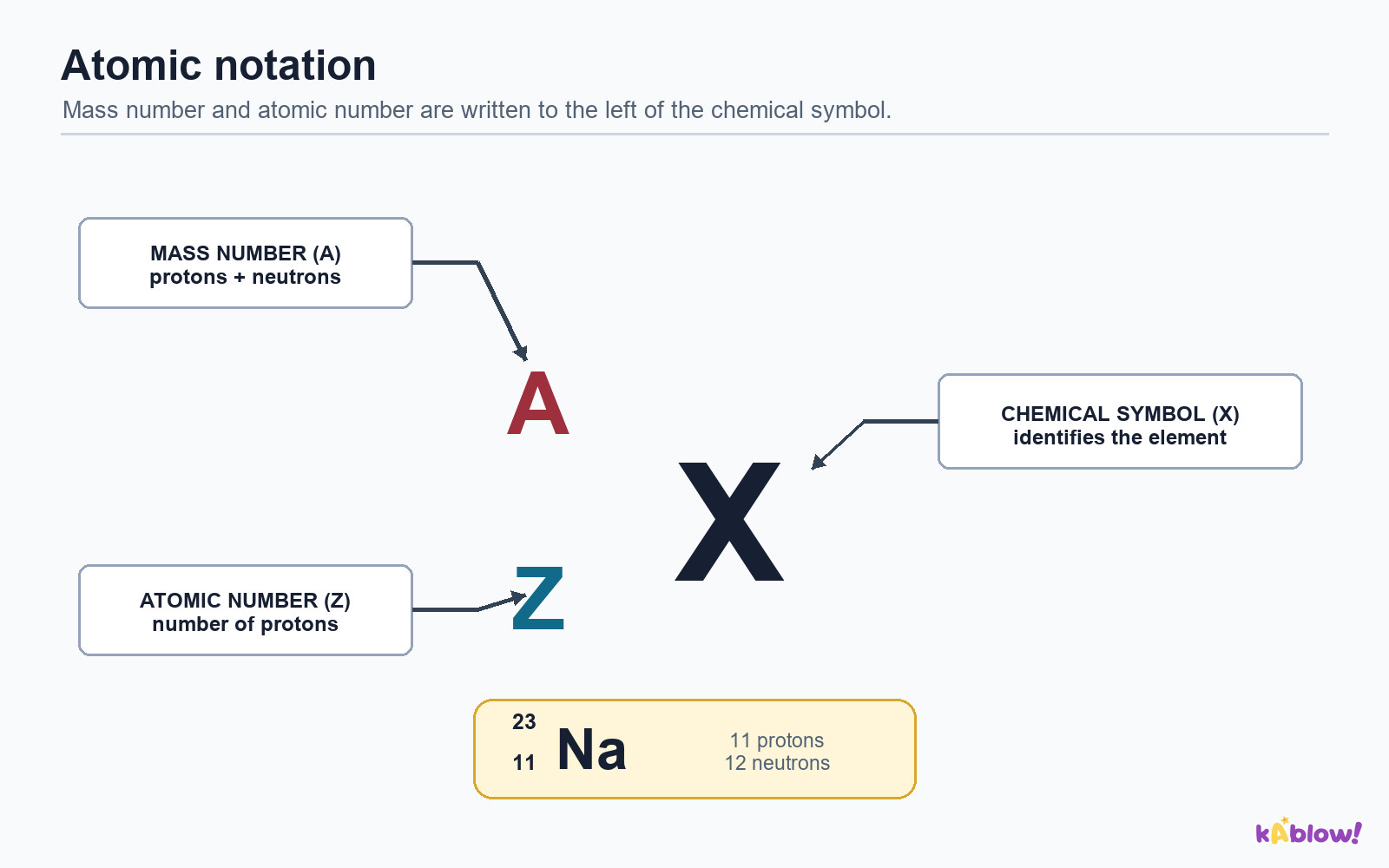
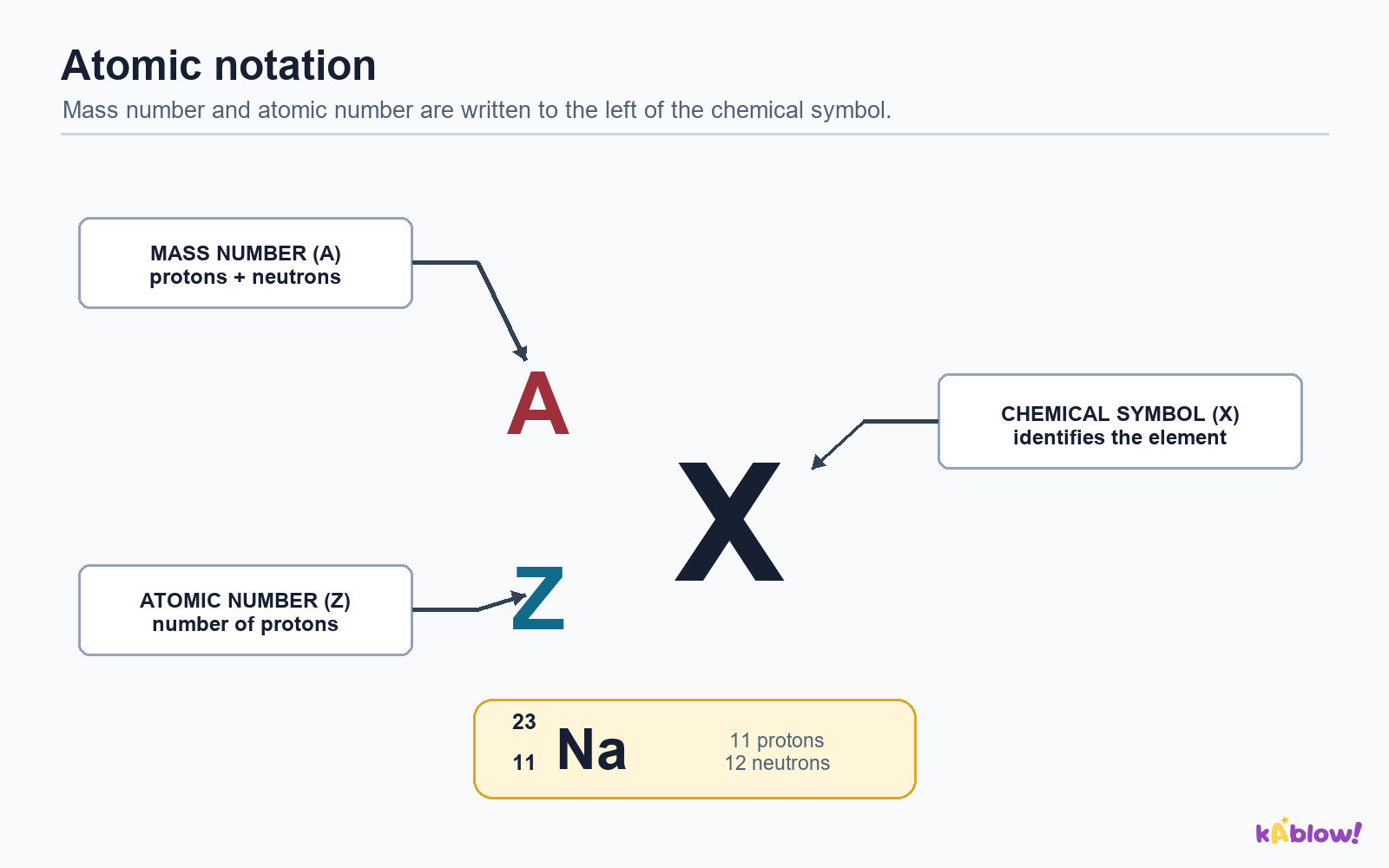
- Each element is represented by its chemical symbol with the mass number as a superscript and atomic number as a subscript.
- The mass (nucleon) number and atomic (proton) number are given for each element in the Periodic Table.
Mass number (A) and atomic number (Z) notation with the chemical symbol (X).
Protons, Neutrons and Electrons in Atoms and Ions
- All atoms and ions of the same element have the same number of protons.
- A neutral atom has equal numbers of protons and electrons, so it has no overall charge.
- A positive ion (cation) forms when electrons are lost, so it has fewer electrons than protons.
- A negative ion (anion) forms when electrons are gained, so it has more electrons than protons.
- The charge on an ion is the difference between the number of protons and electrons.
- Number of protons = mass number – number of neutrons.
- Number of electrons in an ion = atomic number – charge (for positive ions) or + charge (for negative ions).
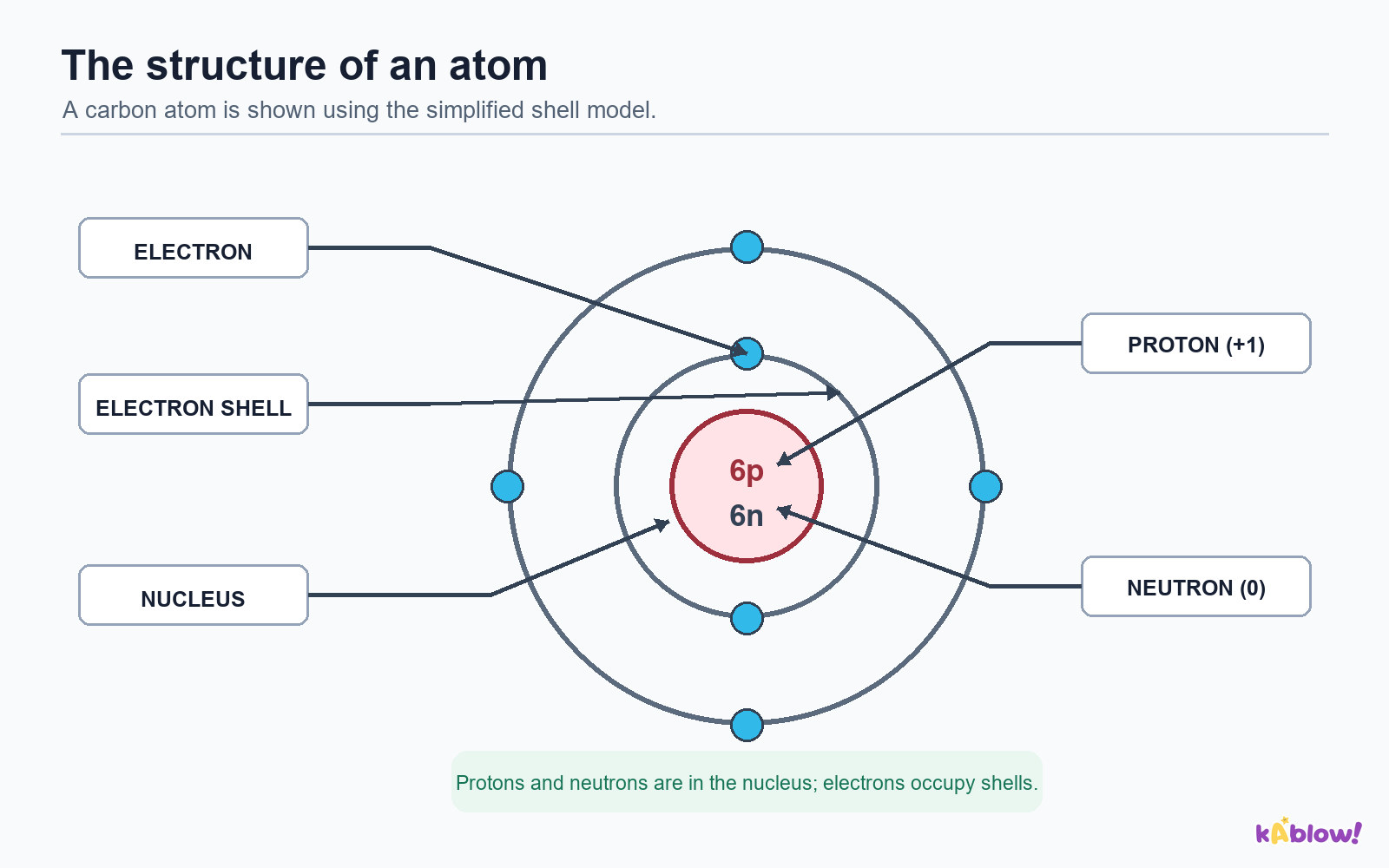
The structure of the carbon atom
Isotopes
- Isotopes are atoms of the same element with the same number of protons and electrons but different numbers of neutrons.
- Isotopes have the same atomic number but different mass numbers.
- For example, carbon-12 and carbon-14 both have 6 protons but contain 6 and 8 neutrons respectively.
- Isotopes have the same chemical properties because they have the same electron configuration.
- Isotopes have different physical properties due to differences in mass, such as density, melting/boiling point, and rate of diffusion.
- Isotopes can be represented as carbon-12 or ¹²C, and carbon-14 or ¹⁴C.
Atomic number and mass number
Relative Atomic Mass
- The relative atomic mass (Ar) is the ratio of the average mass of the atoms of an element to the unified atomic mass unit.
- It is defined as the average mass of one atom of an element compared to one twelfth of the mass of an atom of carbon-12.
- The relative atomic mass is calculated using the percentage abundances of the isotopes.
- The equation is: Ar = (percentage abundance × mass) + (percentage abundance × mass) + … ÷ 100.
- Percentage abundances are either given or can be read from a mass spectrum.
- Round the final answer only after completing the full calculation, to the required number of decimal places.
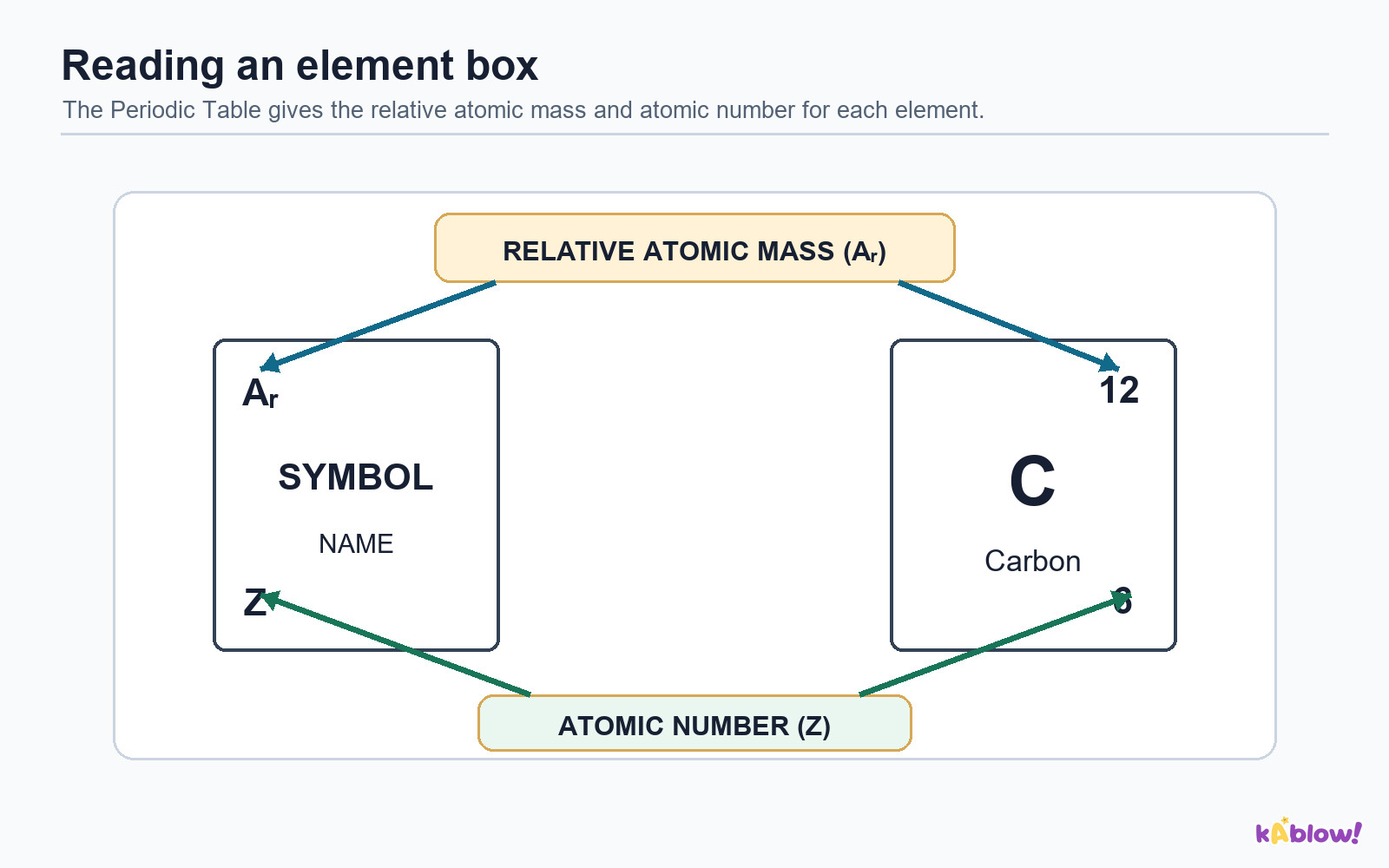
The Periodic Table key showing where relative atomic mass (Ar) and atomic number (Z) are given for each element, using carbon as the example.
Mass Spectrometry (HL)
- A mass spectrometer is used to find the percentage abundance of isotopes in an element.
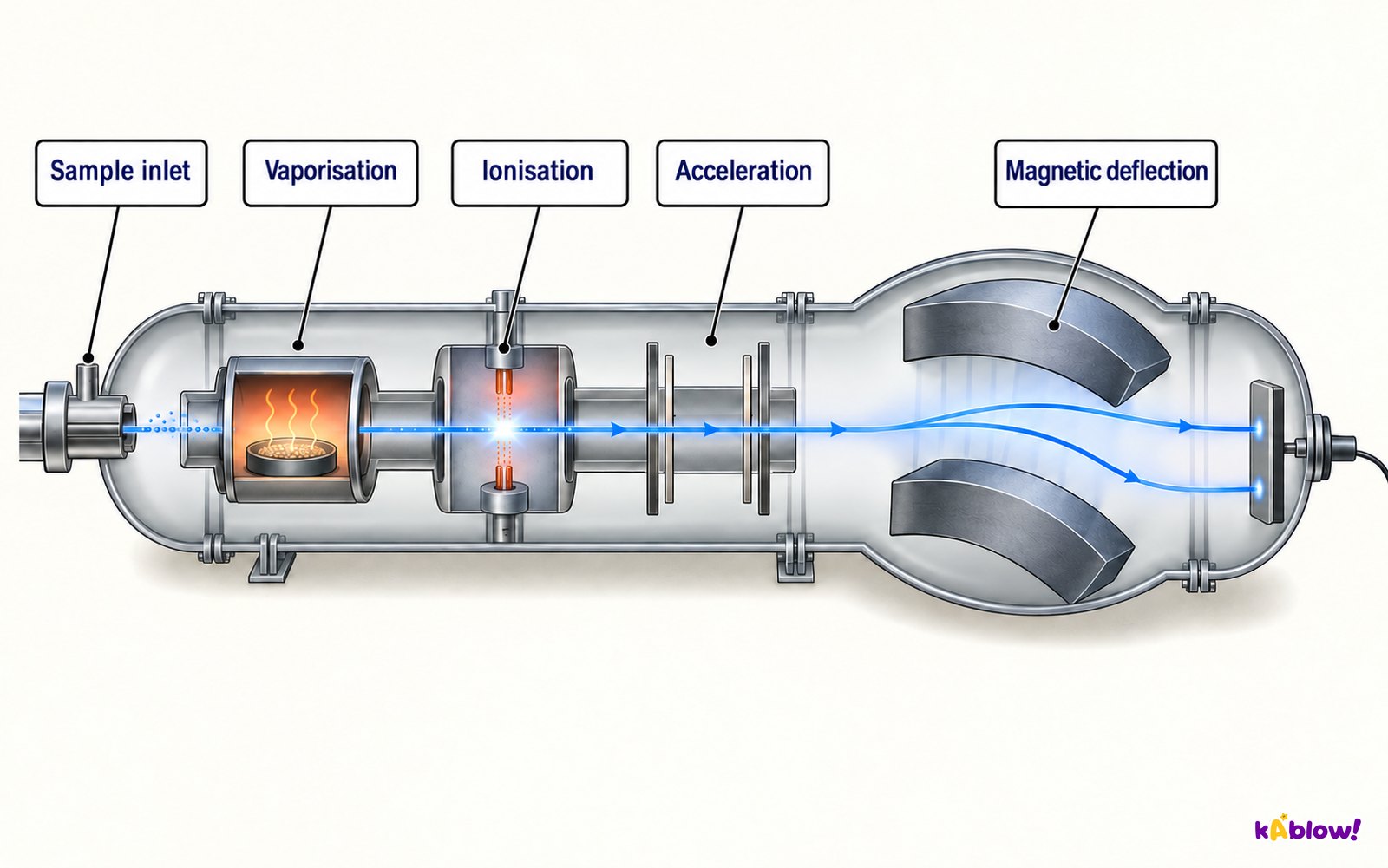
- The basic processes are: vaporisation, ionisation to form positive ions, acceleration, and detection.
- Ions are detected as a mass-to-charge ratio (m/z).
- The mass spectrum shows peaks corresponding to different isotopes.
- The relative atomic mass can be calculated from the mass spectrum using the percentage abundances.
- Specific details of the processes in mass spectrometry are not assessed.
Stages in a mass spectrometer
スライド
練習問題
無料プレビュー — 61問中8問。すべて見るには登録を。
1.Which statement correctly defines the atomic number of an element?
Easy- AThe number of protons in the nucleus of an atom
- BThe total number of protons and neutrons in an atom
- CThe number of electrons in the outermost shell of an atom
- DThe number of neutrons in the nucleus of an atom
2.Which row correctly describes the relative charge and relative mass of a proton, neutron, and electron?
Easy- AProton: +1, 1; Neutron: 0, 1; Electron: –1, negligible
- BProton: +1, 1; Neutron: 0, 0; Electron: –1, negligible
- CProton: +1, 1; Neutron: 0, 1; Electron: –1, 1
- DProton: 0, 1; Neutron: +1, 1; Electron: –1, negligible
3.The phosphide ion, ³²₁₅P³⁻, is used in medicine as a radiotherapy treatment for some forms of cancer. What is the composition of the phosphide ion?
Easy- A15 protons, 17 neutrons, 18 electrons
- B15 protons, 17 neutrons, 15 electrons
- C17 protons, 15 neutrons, 18 electrons
- D15 protons, 32 neutrons, 18 electrons
4.Which row correctly describes the characteristics of the nucleus and surrounding space in an atom?
Easy- ANucleus: small, dense and positive; Surrounding space: mainly empty space
- BNucleus: large, dense and positive; Surrounding space: densely populated with electrons
- CNucleus: small, dense and neutral; Surrounding space: mainly empty space
- DNucleus: small, dense and positive; Surrounding space: densely populated with electrons
5.A neutral atom contains both positive protons and negative electrons. Which statement best explains why the atom has no overall charge?
Medium- AThe charge on an electron is equal and opposite to the charge on a proton.
- BOne proton has a mass 1840 times greater than one electron.
- CThe difference in charge between electrons and protons is balanced by the neutrons.
- DElectrons are spread out in shells around the nucleus while protons are concentrated inside the nucleus.
6.The isotope ⁶⁰₂₇Co is used in the treatment of cancer cells in the body. Which statements about this isotope are correct? I. The charge on the nucleus is +27. II. There are 33 neutrons in the nucleus. III. It has the same number of neutrons as other isotopes of cobalt.
Medium- AI and II only
- BI and III only
- CII only
- DI, II and III
7.Which row correctly describes the subatomic particles found in ²⁶Mg²⁺?
Medium- AProtons: 12, Neutrons: 14, Electrons: 10
- BProtons: 10, Neutrons: 14, Electrons: 12
- CProtons: 12, Neutrons: 26, Electrons: 10
- DProtons: 14, Neutrons: 12, Electrons: 12
8.An element consists of two isotopes, ⁶⁹X and ⁷¹X, with abundances of 60% and 40% respectively. What is the relative atomic mass of element X?
Medium- A69.8
- B69.2
- C70.0
- D70.2