Electronic Configurations
遊んで学ぼう
問題に答えてエネルギーを集めたら、釣りや探検を楽しもう。アカウント不要。
教育者の方へ: Electronic Configurations(Chemistry、SL)向けのすぐ使えるレッスンスライド, 復習ノート — レッスンで使うか、学習者がライブゲームとして遊ぶインタラクティブなクラス活動としてトピックを実施できます。
レッスンノート
The Electromagnetic Spectrum
- The electromagnetic spectrum is a range of frequencies covering all electromagnetic radiation, divided into regions such as radio, infrared, visible, ultraviolet, X-rays and gamma rays.
- All electromagnetic waves travel at the same speed in a vacuum: the speed of light, c = 3.00 × 10⁸ m s⁻¹.
- Waves differ in frequency (f) and wavelength (λ); frequency is the number of waves passing per second, and wavelength is the distance between two consecutive peaks.
- Frequency and wavelength are inversely related: higher frequency means shorter wavelength, and lower frequency means longer wavelength.
- The key relationship is c = fλ; since c is constant, frequency can be calculated from wavelength, or vice versa.
- Gamma rays, X-rays and UV are high frequency, high energy radiation that can damage cells and are hazardous to health.
Continuous vs Line Spectra
- A continuous spectrum contains all colours of visible light, blending smoothly without gaps in frequency or wavelength.
- A continuous spectrum is produced when white light is refracted through a prism or water droplets, as in a rainbow.
- A line spectrum shows only certain fixed frequencies of light, indicating that emitted light from atoms is quantised (quanta means 'little packet').
- The line spectrum of an element is characteristic of that element, such as the helium spectrum which shows only certain frequencies.
Emission Spectra
- Electrons move in energy levels around the nucleus; when they absorb energy they move to higher levels, and they release energy when returning to lower levels.
- The frequency of emitted energy matches the frequency of energy absorbed.
- If emitted energy is in the visible region, it can be analysed using a diffraction grating to produce a line emission spectrum.
- Each line in an emission spectrum corresponds to a specific energy value, suggesting electrons can only possess a limited choice of allowed energies.
- In the hydrogen emission spectrum, lines get closer together towards the blue end; this is called convergence, converging towards the higher energy end, corresponding to the ionisation energy.
- The visible lines of hydrogen were first observed by Johannes Balmer and are named after him; they correspond to electron jumps from higher levels down to n = 2.
- Niels Bohr applied Quantum Theory in 1913, proposing that electrons exist only in fixed energy levels; the hydrogen line spectrum provided evidence for these levels.
Electron Transitions and Regions
- Transition from n = ∞ to n = 3: infrared region, low energy.
- Transition from n = ∞ to n = 2: visible region, medium energy.
- Transition from n = ∞ to n = 1: ultraviolet region, high energy.
- Emission in the visible region occurs for an electron jumping from any higher energy level to n = 2.
Energy Levels and Subshells
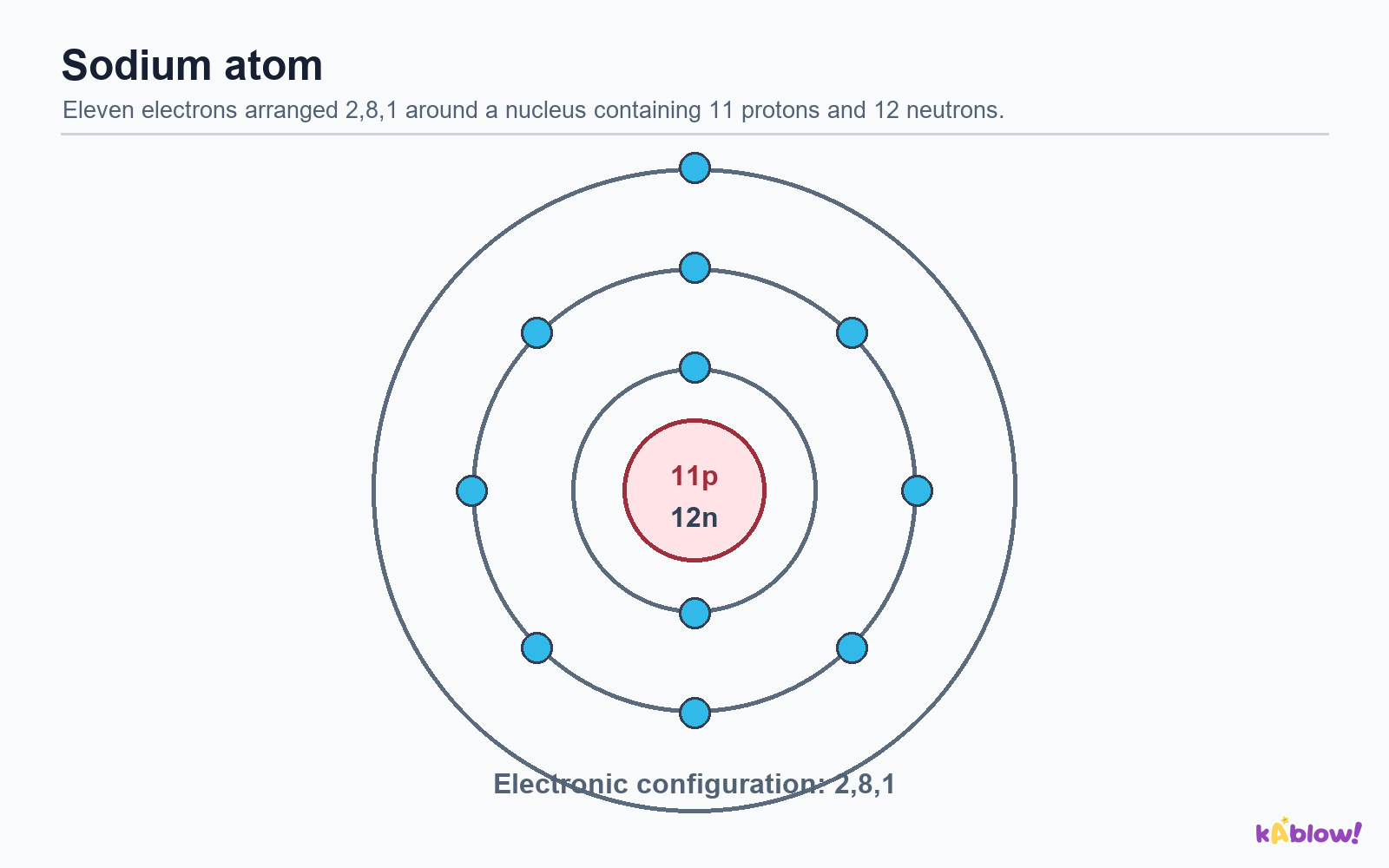
- Electrons are arranged around the nucleus in principal energy levels or principal quantum shells, numbered by principal quantum numbers (n).
- The lower the principal quantum number, the closer the shell is to the nucleus; the higher the principal quantum number, the greater the energy of electrons in that shell.
- Each principal quantum number can hold a fixed number of electrons: n = 1 up to 2, n = 2 up to 8, n = 3 up to 18, n = 4 up to 32; the relationship is 2n².
- Principal quantum shells are split into subshells labelled s, p and d; elements with more than 57 electrons also have an f subshell.
- The energy of electrons in subshells increases in the order s < p < d < f.
- The order of subshells overlaps for higher principal quantum shells; the only exception is that the 3d orbital has slightly higher energy than the 4s orbital, so 4s is filled before 3d.
Orbitals
- Subshells contain one or more atomic orbitals; orbitals exist at specific energy levels and electrons can only be found at these levels, not in between.
- Each atomic orbital can be occupied by a maximum of two electrons.
- An s subshell has 1 orbital, a p subshell has 3 orbitals (px, py, pz), a d subshell has 5 orbitals, and an f subshell has 7 orbitals.
- The maximum number of electrons in each subshell is: s = 2, p = 6, d = 10, f = 14.
- In the ground state, orbitals in the same subshell have the same energy and are said to be degenerate (e.g. px, py and pz have the same energy).
- s orbitals are spherical in shape; their size increases with increasing shell number.
- p orbitals are dumbbell-shaped; every shell has three p orbitals except n = 1, and they occupy the x, y and z axes, pointing at right angles to each other.
- The lobes of p orbitals become larger and longer with increasing shell number.
Ground State and the Aufbau Principle
- The ground state is the most stable electronic configuration of an atom, with the lowest amount of energy.
- This is achieved by filling the subshells of lowest energy first (1s), known as the Aufbau Principle.
- The order of subshells in terms of increasing energy does not follow a regular pattern at n = 3 and higher.
- The principal quantum shells increase in energy with increasing principal quantum number (e.g. n = 4 is higher in energy than n = 2).
- Following the Aufbau diagram arrows gives the filling order of subshells.
Writing Electron Configurations
- The electron configuration gives information about the number of electrons in each shell, subshell and orbital of an atom.
- Electrons can be imagined as small spinning charges rotating clockwise or anticlockwise; electrons with the same spin repel each other (spin–pair repulsion).
- Hund's rule: electrons fill degenerate orbitals singly first, with parallel spins, to minimise repulsion; they pair only after all orbitals are singly occupied, with opposite spins.
- Pauli Exclusion Principle: an orbital holds two electrons with opposite spins only; electrons pair only when no empty orbital of the same energy is available, as pairing costs less energy than jumping to a higher orbital.
- There are two formats: full configuration lists all electrons from 1s onward; shorthand configuration uses the nearest noble gas symbol in brackets (e.g. [Ar]) to represent inner electrons.
- Ions form when atoms gain or lose electrons: anions (negative) form by adding electrons to the outer shell; cations (positive) form by removing electrons from the outer shell.
- For transition metals: fill 4s before 3d when neutral; lose electrons from 4s first, not 3d, when forming ions.
- In the Periodic Table, elements are grouped into blocks based on their valence subshell: s-block, p-block, d-block and f-block.
Electron shells and the Periodic Table
Examples and Exceptions
- Fe (Z = 26): full configuration 1s² 2s² 2p⁶ 3s² 3p⁶ 4s² 3d⁶; shorthand [Ar] 4s² 3d⁶.
- Fe²⁺ ion: electrons removed from 4s before 3d; full configuration 1s² 2s² 2p⁶ 3s² 3p⁶ 3d⁶; shorthand [Ar] 3d⁶.
- Cr is [Ar] 3d⁵ 4s¹ not [Ar] 3d⁴ 4s²; Cu is [Ar] 3d¹⁰ 4s¹ not [Ar] 3d⁹ 4s².
- These exceptions occur because promoting an electron from 4s to 3d achieves a half-full or full d-subshell, which is energetically favourable.
- Potassium (Z = 19): full 1s² 2s² 2p⁶ 3s² 3p⁶ 4s¹; shorthand [Ar] 4s¹.
- Calcium (Z = 20): full 1s² 2s² 2p⁶ 3s² 3p⁶ 4s²; shorthand [Ar] 4s².
- Gallium (Z = 31): full 1s² 2s² 2p⁶ 3s² 3p⁶ 3d¹⁰ 4s² 4p¹; shorthand [Ar] 3d¹⁰ 4s² 4p¹.
- Ca²⁺ ion: loses two 4s electrons; full 1s² 2s² 2p⁶ 3s² 3p⁶; shorthand [Ar], same configuration as argon.
スライド
練習問題
無料プレビュー — 63問中8問。すべて見るには登録を。
1.What is the shape of an s orbital?
Easy- ASpherical
- BDumbbell-shaped
- CTetrahedral
- DLinear
2.How many orbitals are there in a p subshell?
Easy- A1
- B3
- C5
- D7
3.What is the maximum number of electrons that can occupy the n = 3 energy level?
Medium- A8
- B18
- C32
- D2
4.Which electron transition would emit radiation of the longest wavelength?
Medium- An = 4 to n = 2
- Bn = 3 to n = 2
- Cn = 2 to n = 1
- Dn = 5 to n = 1
5.What is the correct sequence for the orbitals shown in an atom of vanadium in order of decreasing energy?
Medium- A3s > 3p > 4s > 3d
- B4s > 3d > 3s > 3p
- C4s > 3d > 3p > 3s
- D3d > 4s > 3p > 3s
6.Which of the following statements about the electromagnetic spectrum are correct? (select all that apply)
Medium- AAll electromagnetic waves travel at the same speed in a vacuum.
- BFrequency and wavelength are inversely related.
- CGamma rays have lower energy than radio waves.
- DThe speed of light in a vacuum is 3.00 × 10⁸ m s⁻¹.
- EHigher frequency means longer wavelength.
7.A continuous spectrum contains all colours of visible light with no gaps.
EasyTrue or false?
8.In the ground state, the 4s orbital is filled before the 3d orbital.
EasyTrue or false?
過去問
このトピックの過去問練習は近日公開。
近日公開