Energy From Fuels
遊んで学ぼう
問題に答えてエネルギーを集めたら、釣りや探検を楽しもう。アカウント不要。
教育者の方へ: Energy From Fuels(Chemistry、SL)向けのすぐ使えるレッスンスライド, 復習ノート — レッスンで使うか、学習者がライブゲームとして遊ぶインタラクティブなクラス活動としてトピックを実施できます。
レッスンノート
Combustion Reactions
- Combustion is a rapid, exothermic reaction involving a fuel, oxygen, and an ignition source, commonly called burning.
- It produces heat and light, so it is exothermic.
- Complete combustion occurs with sufficient oxygen, while incomplete combustion occurs with limited oxygen.
- Metals can combust to form metal oxides; reactive metals like magnesium burn with a bright white flame: 2Mg(s) + O₂(g) → 2MgO(s).
- Non-metals such as sulfur burn to form covalent oxides like sulfur dioxide: S(s) + O₂(g) → SO₂(g).
- Organic fuels include hydrocarbons (especially alkanes) and alcohols; they release large amounts of energy when combusted.
- Complete combustion of organic compounds produces carbon dioxide and water: fuel + oxygen → carbon dioxide + water.
- For example, methane: CH₄(g) + 2O₂(g) → CO₂(g) + 2H₂O(l); ethanol: C₂H₅OH(l) + 3O₂(g) → 2CO₂(g) + 3H₂O(l).
Incomplete Combustion
- Incomplete combustion occurs when oxygen is limited; it still produces water but forms carbon monoxide (CO) or carbon (C) instead of carbon dioxide.
- In a Bunsen burner, complete combustion gives a blue, non-luminous flame; incomplete combustion gives a yellow, luminous flame.
- Carbon monoxide is colourless and odourless, making it hard to detect without a sensor.
- CO is toxic because it binds irreversibly to haemoglobin, preventing oxygen transport; this can cause dizziness, loss of consciousness, and death.
- With very limited oxygen, carbon (soot) is produced; a yellow, sooty flame indicates incomplete combustion.
- Hydrocarbons with higher carbon content are more likely to produce soot; for example, naphthalene (94% C) produces more soot than nitrobenzene (59% C).
- Incomplete combustion never produces hydrogen; hydrogen is always preferentially oxidised by any available oxygen.
- Example: incomplete combustion of propane to carbon: C₃H₈(l) + 2O₂(g) → 3C(s) + 4H₂O(l).
Fossil Fuels: Advantages and Disadvantages
- Fossil fuels include coal, oil, and natural gas; they are made of hydrocarbons formed from buried dead plants and animals.
- They are non-renewable (finite) and cannot be replaced quickly once used.
- Coal is cheap, widely available, long-lasting, and safe to store; by-products like ash can be used in road construction.
- Oil is easy to store and transport, has high energy density, and can be separated by fractional distillation and cracking.
- Natural gas is the cheapest fossil fuel, easy to transport in pipelines, and burns with a blue flame producing minimal harmful emissions.
- Combustion of fossil fuels releases carbon dioxide (global warming), sulfur dioxide (acid rain), and particulates (global dimming).
- Coal mining causes habitat destruction, noise pollution, and health risks; oil spills harm habitats; natural gas is expensive to extract and store under pressure.
Amount of Carbon Dioxide Produced When Fuels Burn
- Specific energy is a measure of the energy stored in a substance; different fuels release different amounts of energy when combusted.
- As the hydrocarbon chain length increases, carbon content increases, so more carbon dioxide and carbon monoxide/carbon are produced.
- Longer chains have stronger London dispersion forces, making the hydrocarbon less volatile.
- Longer chains release less energy per unit mass of fuel; methane releases the most energy per unit mass.
- As chain length increases, incomplete combustion becomes more likely.
- To calculate CO₂ produced, use the balanced equation and mole ratios; for example, 1.00 g butane produces 3.03 g CO₂.
Carbon Dioxide Levels & the Greenhouse Effect
- Atmospheric carbon dioxide is rising due to human activities: combustion of fossil fuels (electricity, transport, construction), deforestation, and livestock farming.
- The main driver is combustion of fossil fuels, which releases carbon stored for millions of years.
- Greenhouse gases include carbon dioxide (CO₂), methane (CH₄), nitrous oxides (NOₓ), and water vapour (H₂O).
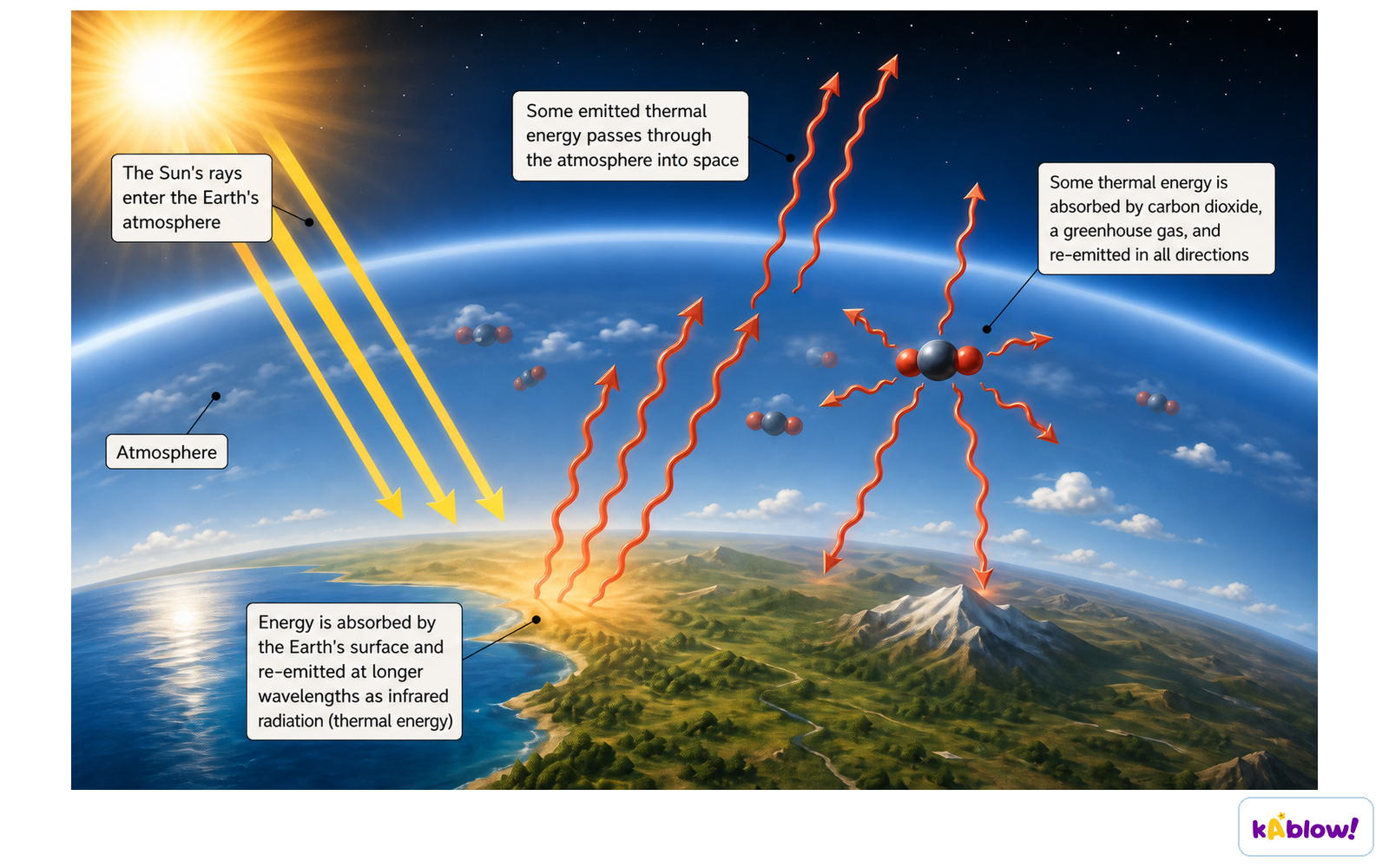
- The greenhouse effect keeps Earth warm: shortwave radiation from the sun is absorbed and re-emitted as longwave infrared radiation, which is absorbed by greenhouse gases and re-radiated in all directions.
- Human activities increase greenhouse gas levels, leading to the enhanced greenhouse effect and global warming.
- Mauna Loa Observatory has recorded CO₂ data since 1958 and methane data since 1984; the graph shows annual fluctuations due to seasonal photosynthesis.
- Photosynthesis removes CO₂ from the atmosphere, causing seasonal changes in CO₂ levels.
The greenhouse effect
Biofuels
- Renewable resources will not run out in the foreseeable future and are sustainable; non-renewable resources are finite and will run out.
- The three main biofuels are bioethanol, biodiesel, and biogas; they are made from organic compounds produced by biological carbon fixation.
- Bioethanol is ethanol made from a biological source; plants absorb CO₂ via photosynthesis: 6CO₂(g) + 6H₂O(l) → C₆H₁₂O₆(aq) + 6O₂(g), then glucose is fermented to ethanol.
- Bioethanol can be carbon neutral if the CO₂ absorbed during photosynthesis equals the CO₂ released when burned.
- Biodiesel is made from renewable vegetable oils via transesterification with methanol, catalysed by acid or alkali (e.g. NaOH or KOH); excess methanol shifts equilibrium to products, yield up to 98%.
- Biogas is made when organic matter is broken down by microorganisms in anaerobic conditions; it is mainly methane and carbon dioxide.
- Advantages of biofuels: carbon neutral, renewable, reduce greenhouse gases and landfill waste, generate income and jobs.
- Disadvantages of biofuels: high costs, land use conflict with food crops, deforestation, soil nutrient depletion, and lower specific energy than fossil fuels.
Fuel Cells
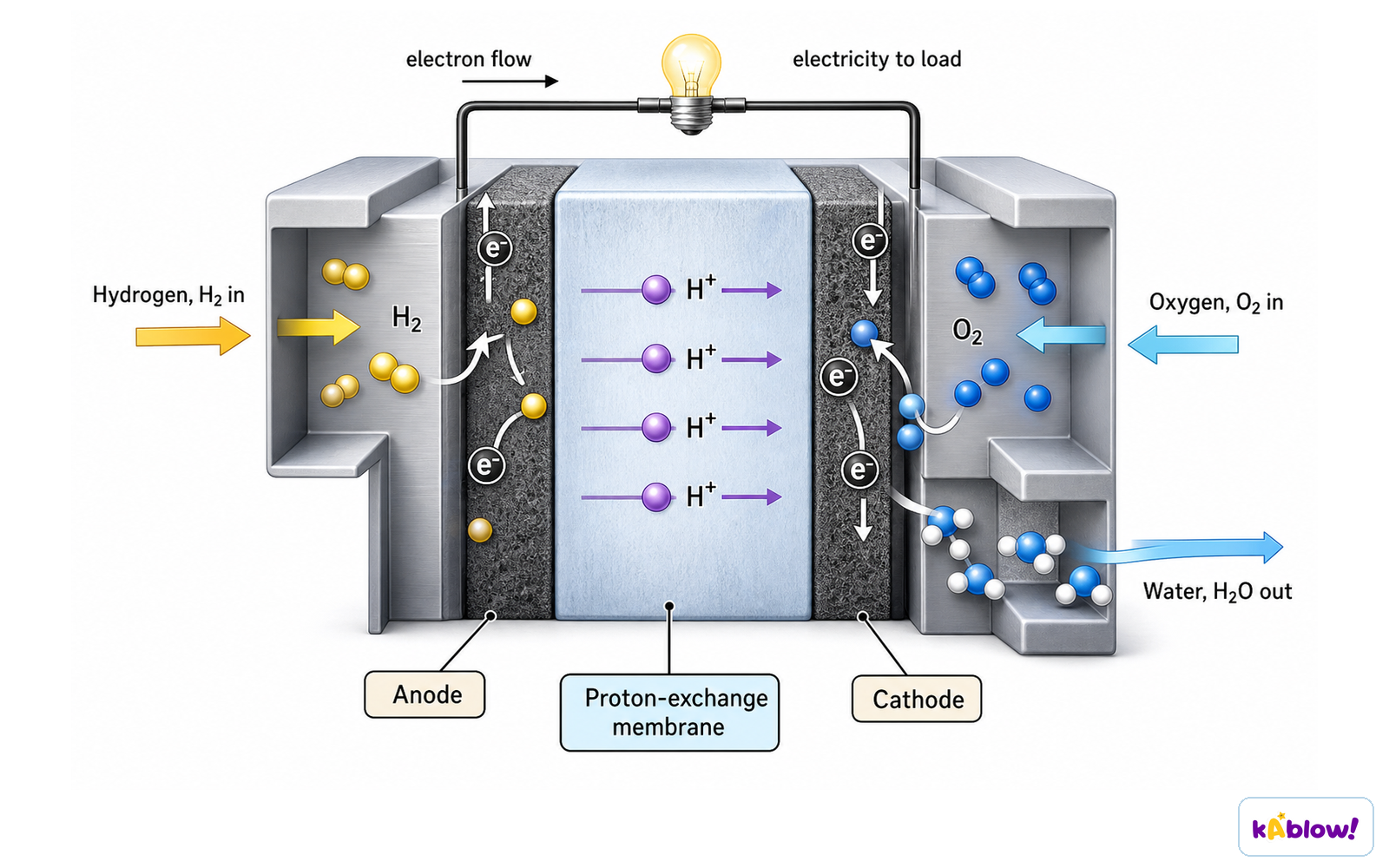
- A fuel cell is an electrochemical cell where a fuel donates electrons at one electrode and oxygen gains electrons at the other, generating a voltage.
- In a hydrogen-oxygen fuel cell, the electrolyte is aqueous sodium hydroxide; half-equations: 2H₂(g) + 4OH⁻(aq) → 4H₂O(l) + 4e⁻ and O₂(g) + 2H₂O + 4e⁻ → 4OH⁻(aq); overall: 2H₂(g) + O₂(g) → 2H₂O(l) Eθ = +1.23 V.
- The only product is water, so hydrogen fuel cells are environmentally friendly with no harmful emissions; they operate at room temperature and avoid combustion.
- Hydrogen fuel cells produce no nitrogen oxides (NOₓ) unlike high-temperature combustion; they have been used on spacecraft where product water can be drunk by astronauts.
- Disadvantages of hydrogen fuel cells: hydrogen is highly flammable, requires heavy storage tanks, and is mostly sourced from fossil fuels; low energy density by volume means larger containers.
- In a methanol fuel cell, methanol is the source of hydrogen ions; half-equations: CH₃OH(aq) + H₂O(l) → CO₂(g) + 6H⁺(aq) + 6e⁻ and O₂(g) + 4H⁺(aq) + 4e⁻ → 2H₂O(l); overall: CH₃OH(aq) + 1.5O₂(g) → CO₂(g) + 2H₂O(l).
- Advantages of methanol over hydrogen fuel cells: easier to store and transport, operates at low pressure and temperature, higher energy density, can be made from renewable resources.
- Disadvantages of methanol fuel cells: toxic and flammable, commonly made from fossil fuels, lower voltage and power output, low efficiency due to methanol crossover, requires expensive catalysts, and produces CO₂.
A hydrogen–oxygen fuel cell
スライド
練習問題
無料プレビュー — 62問中8問。すべて見るには登録を。
1.Which of the following is NOT required for combustion to occur?
Easy- AA fuel
- BOxygen
- CAn ignition source
- DA catalyst
2.What are the products of the complete combustion of a hydrocarbon?
Easy- ACarbon monoxide and water
- BCarbon dioxide and water
- CCarbon and water
- DCarbon dioxide and hydrogen
3.Which flame colour indicates complete combustion in a Bunsen burner?
Easy- AYellow, luminous
- BBlue, non-luminous
- COrange, sooty
- DGreen, non-luminous
4.Which of the following are greenhouse gases? (select all that apply)
Medium- ACarbon dioxide (CO2)
- BMethane (CH4)
- CNitrogen (N2)
- DWater vapour (H2O)
- ENitrous oxides (NOx)
5.The incomplete combustion of organic compounds can produce hydrogen gas.
EasyTrue or false?
6.Which of the following is the main product of the incomplete combustion of a hydrocarbon when oxygen is very limited?
Medium- ACarbon dioxide
- BCarbon monoxide
- CCarbon (soot)
- DHydrogen
7.Why is carbon monoxide dangerous to inhale?
Medium- AIt is a greenhouse gas
- BIt binds irreversibly to haemoglobin, preventing oxygen transport
- CIt is highly flammable
- DIt reacts with water to form an acid
8.Which of the following is a biofuel?
Easy- APetrol
- BDiesel
- CBioethanol
- DNatural gas
過去問
このトピックの過去問練習は近日公開。
近日公開