From Models To Materials
遊んで学ぼう
問題に答えてエネルギーを集めたら、釣りや探検を楽しもう。アカウント不要。
レッスンノート
Bonding Models
- Bonding models simplify complex systems and allow prediction of substance properties.
- Chemical bonding broadly falls into three types: ionic, covalent, and metallic.
- Real bonding situations are more complex than these three ideal types suggest.
- Example: Aluminium chloride (AlCl₃) contains a metal and non-metal, so it would be expected to be ionic with a high melting point, but it melts at 192 °C due to covalent character; its bonding is polar covalent, not purely ionic.
Bonding as a Continuum
- Bonding is better visualised using a bonding triangle, which places compounds on a spectrum.
- The triangle uses electronegativity difference (Δχ) on the y-axis and average electronegativity (χ̄) on the x-axis.
- Δχ = χA − χB; χ̄ = (χA + χB) / 2.
- Elements have zero Δχ and appear along the x-axis depending on their electronegativity.
- Metals have zero Δχ and appear along the x-axis near the metallic corner (bottom left).
- Ionic compounds have large Δχ and are placed near the apex of the triangle.
- Covalent compounds with low Δχ are near the bottom right; polar covalent compounds lie in between ionic and covalent.
- Bonding character is based on electronegativity trends, not just position in the Periodic Table.
Using the Triangular Bonding Diagram
- The triangular bonding diagram is in Section 17 of the IB Chemistry Data Booklet; electronegativity values are in Section 9.
- The diagram classifies bonds as a continuum between ionic (top), covalent (bottom right), and metallic (bottom left).
- Each compound is plotted using (x, y) = (average electronegativity, electronegativity difference).
- Example: Sodium (Na) has electronegativity 0.9 and Δχ = 0, placing it at the bottom left (100% metallic).
- Example: Chlorine (Cl₂) has electronegativity 3.2 and Δχ = 0, placing it at the bottom right (100% covalent).
- Example: Sodium chloride (NaCl) has χ̄ = (3.2 + 0.9)/2 = 2.05 and Δχ = 3.2 − 0.9 = 2.3, placing it near the apex with around 75% ionic character; this explains its high melting point and ability to conduct electricity when molten.
Percentage of Bonding Type
- The triangular bonding diagram can estimate the percentage of ionic or covalent character in a compound.
- Example: Aluminium chloride (AlCl₃) has χ̄ = (1.6 + 3.2)/2 = 2.4 and Δχ = 3.2 − 1.6 = 1.6, placing it at (2.4, 1.6) with 50% ionic character.
- Example: Aluminium oxide (Al₂O₃) has χ̄ = (1.6 + 3.4)/2 = 2.5 and Δχ = 3.4 − 1.6 = 1.8, placing it at (2.5, 1.8) with 60% ionic character.
- Both AlCl₃ and Al₂O₃ fall near the polar covalent region, indicating significant ionic character and covalent properties.
- Al₂O₃ has a much higher melting point (2072 °C) due to stronger ionic bonding; AlCl₃ melts at just 192 °C due to weaker covalent interactions.
- The diagram allows accurate assessment of real bonding behaviour and prediction of properties like melting point, solubility, and electrical conductivity.
Properties of Alloys
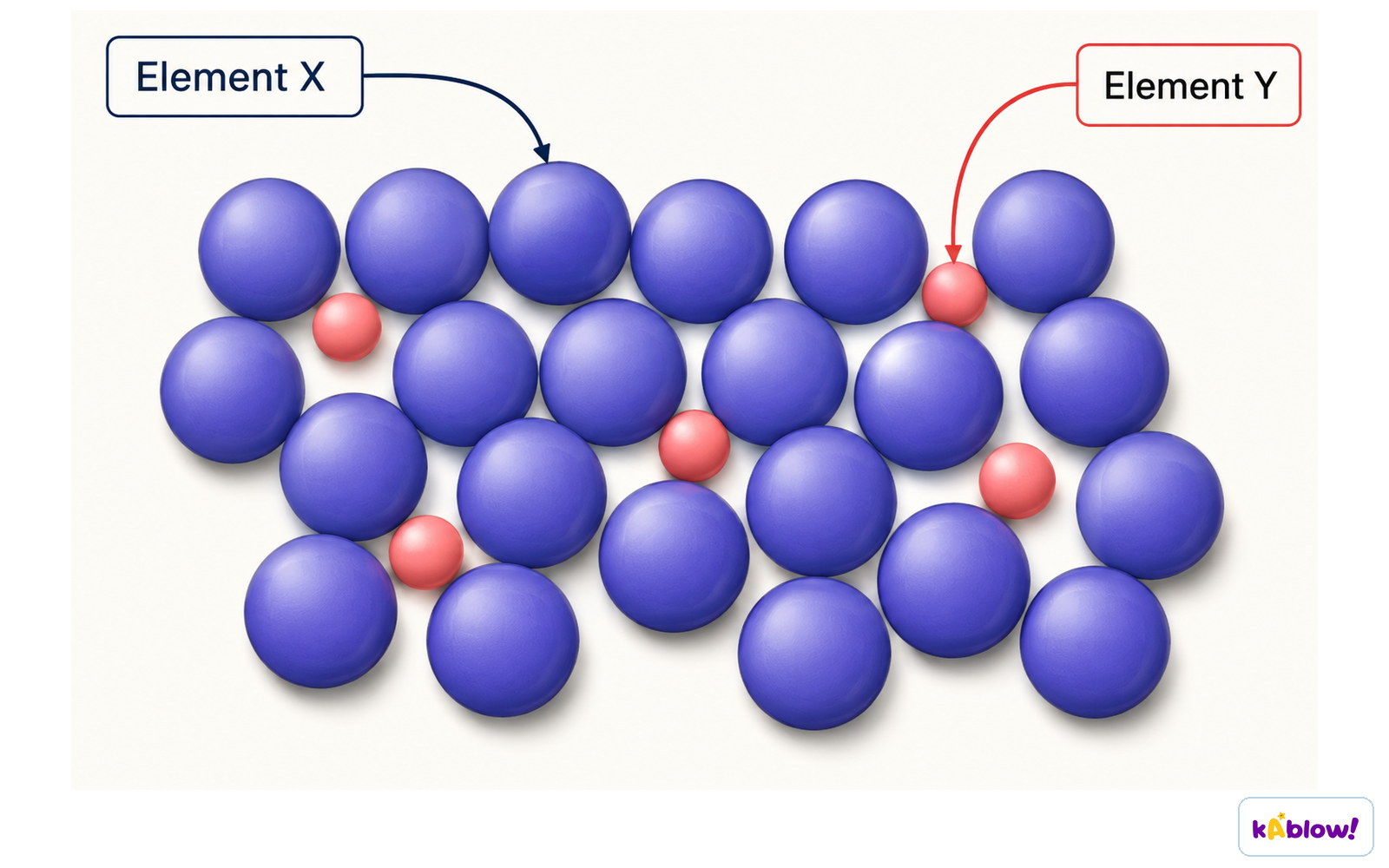
- An alloy is a mixture of metals, or a metal mixed with a non-metal such as carbon; the elements are physically combined but not chemically bonded.
- Atoms of different elements are spread throughout the metallic lattice and are held together by delocalized electrons, as in pure metals.
- Metallic bonds are non-directional, allowing atoms of different sizes to occupy the lattice.
- In a pure metal, cations are arranged in regular layers that slide past one another easily, making the metal malleable.
- In alloys, atoms of different sizes disrupt the regular pattern, making it harder for layers to slide, so alloys are harder and stronger than pure metals.
- Alloys may also be more corrosion resistant or resistant to extreme temperatures.
- Examples: Brass (copper and zinc) is strong and corrosion resistant; Steel (iron with carbon, often chromium, vanadium, molybdenum) is very strong; Stainless steel (iron, chromium, nickel, carbon) is corrosion resistant; Solder (lead and tin) has a low melting point; Bronze (copper and tin) is hard and corrosion resistant.
Structure of an alloy
Polymers
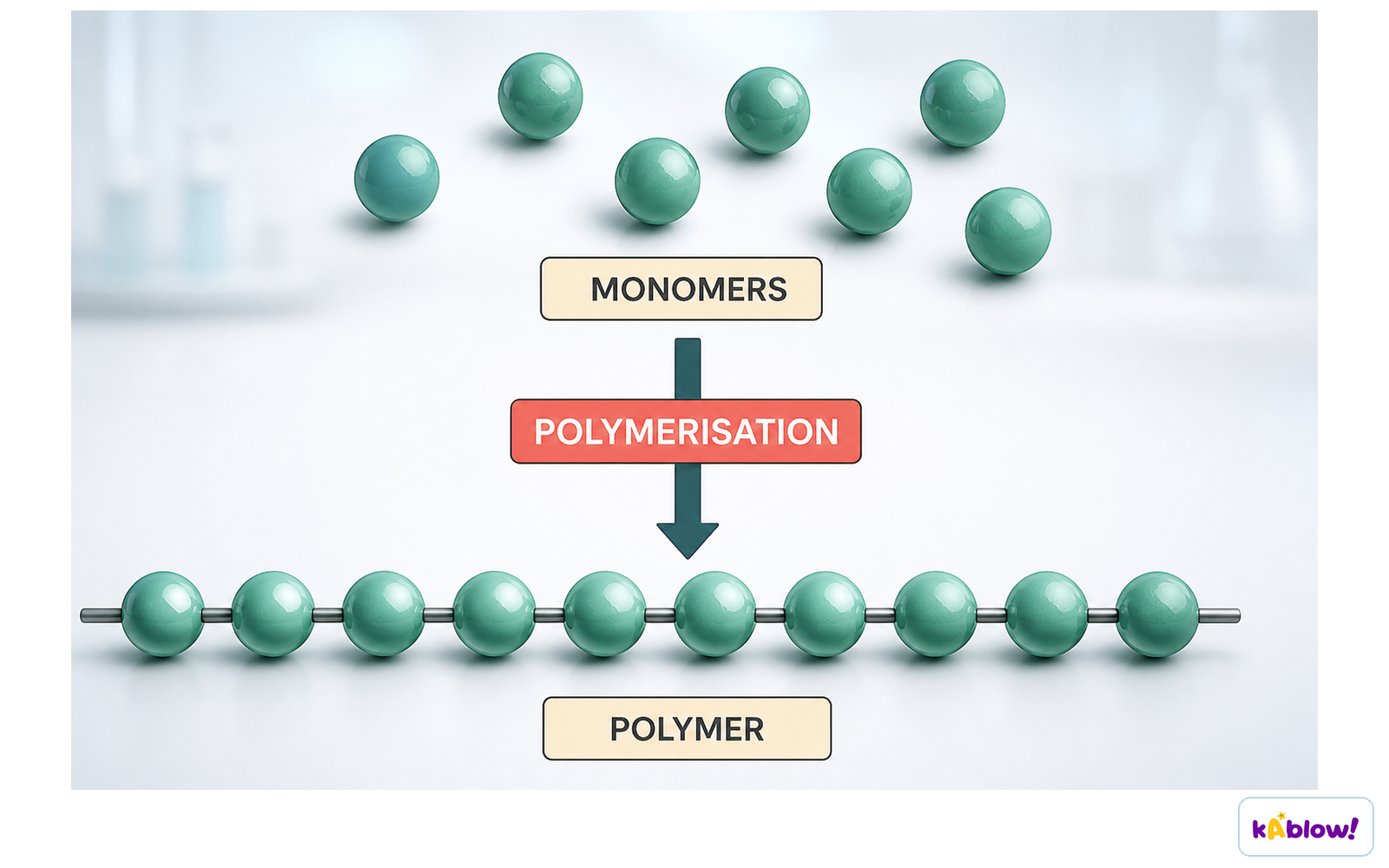
- Polymers are large molecules made by chemically linking many small molecules called monomers.
- A polymer must contain at least 50 repeating units, each joined to the next by strong covalent bonds.
- Polymers are also known as macromolecules due to their large size compared with simple molecules.
- Some polymers contain just one type of monomer unit, e.g. poly(ethene) and poly(chloroethene) (PVC).
- Others contain two or more different types of monomer units and are called copolymers, e.g. nylon and biological proteins.
- Natural polymers include proteins, starch, and DNA; DNA forms a double helix with millions of linked nucleotides.
- Synthetic polymers include plastics like poly(ethene) and nylon; they are man-made and widely used due to durability, low reactivity, and water resistance.
- Synthetic polymers are generally non-biodegradable because of their chemical stability, leading to long-lasting pollution.
Monomers joining to form a polymer
Addition Polymerisation
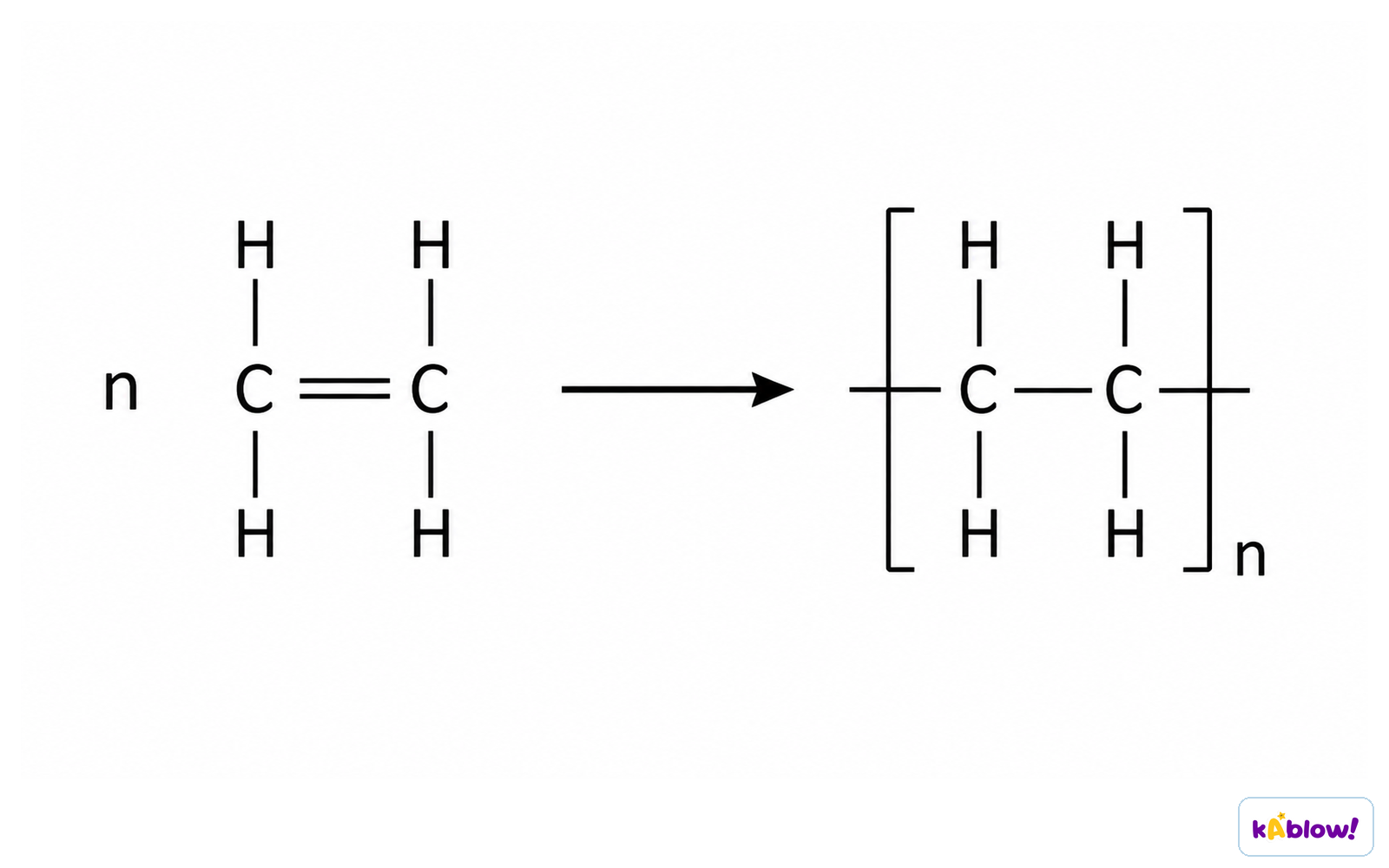
- Addition polymerisation involves monomers containing at least one C=C double bond joining together to form a long-chain polymer.
- The only product is the polymer; no by-products are formed.
- The π-bond in each C=C bond breaks, allowing monomers to link by forming new C–C single bonds.
- Examples: Poly(ethene) from ethene monomers; Poly(chloroethene) (PVC) from chloroethene monomers.
- A repeat unit is the smallest group of atoms that repeats to form the polymer chain; it is shown inside square brackets with an n outside.
- In poly(alkenes), the repeat unit is the same as the monomer except the C=C becomes a C–C bond.
- To deduce the monomer from a polymer, identify the repeat unit (2 carbons in the main chain) and replace the C–C bond with a C=C bond.
Addition polymerisation
Properties of Polymers
- Low density – polymer chains are loosely packed, so plastics are lightweight compared to metals or ceramics.
- Unreactive – most plastics don’t react easily because the polymer chains are chemically stable.
- Water-resistant – plastics repel water and don’t absorb moisture, making them ideal for containers and packaging.
- Strong – polymers are held together by strong covalent bonds, making many plastics tough and durable.
- These properties make polymers useful in everyday materials such as packaging, clothing, construction products, and transportation components.
スライド
練習問題
無料プレビュー — 67問中8問。すべて見るには登録を。
1.Which of the following statements about alloys are correct? I. Alloys contain atoms of all the same sizes II. An alloy is a mixture of a metal with another element III. Alloys are harder than the pure metal they originate from
Easy- AI and II only
- BI and III only
- CII and III only
- DI, II and III
2.A molecule of a polymer contained the sequence shown. Which monomer could produce this polymer by addition polymerisation?
Medium- ACHCl=CHCl
- BCH2=CHCl
- CCH3CCl=CHCl
- DCH3CCl=CH2
3.Which of the following chemicals is not correctly placed within this triangular bonding diagram?
Easy- ALi
- BO2
- CCH4
- DCBr4
4.Which type of bonding can be described as 'the electrostatic attraction between positive nuclei and electrons and occurs by the sharing of electrons'?
Medium- AHydrogen bonding
- BIonic bonding
- CMetallic bonding
- DCovalent bonding
5.A binary compound is plotted on a triangular bonding diagram. The electronegativity values for each element are 1.6 and 3.4. Which estimate for the percentage ionic and percentage covalent character in the compound is correct?
Medium- A10% covalent, 90% ionic
- B40% covalent, 60% ionic
- C55% covalent, 45% ionic
- D100% covalent, 0% ionic
6.The properties of alloys can be explained in terms of metals having I. Non-directional bonding II. Delocalised electrons III. Ions of different size
Medium- AI and II only
- BI and III only
- CII and III only
- DI, II and III
7.Using Sections 9 and 17 of the Data Booklet, which of the following predictions about gallium tribromide are incorrect? I. It is a poor insulator. II. It has a high melting and boiling point. III. It is hard and brittle.
Medium- AI and II only
- BI and III only
- CII and III only
- DI, II and III
8.Match each region of the triangular bonding diagram with the type of bonding found there.
Easy- Apex (top) of the triangle
- Bottom right of the triangle
- Bottom left of the triangle
- Ionic bonding
- Covalent bonding
- Metallic bonding