Functional Groups: Classification Of Organic Compounds
遊んで学ぼう
問題に答えてエネルギーを集めたら、釣りや探検を楽しもう。アカウント不要。
レッスンノート
Representing Formulas of Organic Compounds
- Empirical formula shows the simplest whole-number ratio of atoms in a molecule.
- Molecular formula shows the actual number of atoms of each element in a molecule.
- Structural formula (also called displayed or graphical formula) shows the spatial arrangement of all atoms and bonds in a molecule.
- Condensed structural formula omits most covalent bonds but shows enough information to make the structure clear; double and triple bonds are always shown.
- Skeletal formula represents carbon–carbon bonds as straight lines; each end or junction is a carbon atom, and hydrogen atoms bonded to carbon are omitted unless part of a functional group.
- Methane (CH₄) does not have a skeletal formula because it contains only one carbon atom.
- Stereochemical formula shows the three-dimensional arrangement of atoms or groups around a chiral carbon using solid lines (in plane), solid wedges (out of plane), and dashed wedges (behind plane).
Functional Groups
- Functional groups are atoms or groups of atoms that give organic compounds their characteristic physical and chemical properties.
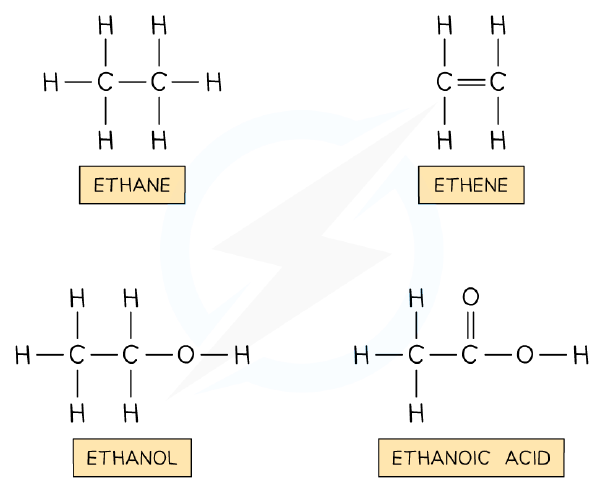
- Organic compounds with the same functional group belong to the same class (e.g., alkenes contain the C=C functional group, aldehydes contain the –CHO group).
- Compounds with only single bonds between carbon atoms are saturated; those with carbon–carbon double or triple bonds are unsaturated.
- Common functional groups and their IUPAC prefixes/suffixes include: alkane (–ane), alkene (–ene), alkyne (–yne), halogenoalkane (fluoro-, chloro-, bromo-, iodo-), alcohol (hydroxy-, –ol), aldehyde (–al), ketone (–one), carboxylic acid (–oic acid), ether (alkoxy-), amine (–amine), amide (–amide), ester (–oate), and aromatics (phenyl-).
Functional groups in organic compounds
Homologous Series
- A homologous series is a family of similar compounds with the same functional group and similar chemical properties, but differing by a –CH₂– group.
- Each member of a homologous series has the same general formula and similar chemical properties; physical properties change gradually as the number of carbon atoms increases.
- As the number of carbon atoms in a straight-chain homologous series increases, boiling and melting points increase due to stronger London dispersion forces.
- General formulae: alkanes CₙH₂ₙ₊₂, alkenes CₙH₂ₙ, alkynes CₙH₂ₙ₋₂, alcohols CₙH₂ₙ₊₁OH, aldehydes/ketones CₙH₂ₙO, carboxylic acids CₙH₂ₙ₊₁COOH.
- The smallest alkene is ethene (C₂H₄) because a minimum of two carbons is required for a C=C double bond.
IUPAC Nomenclature
- IUPAC nomenclature provides systematic names for organic compounds.
- For alkanes, the stem indicates the number of carbons in the longest chain (meth-, eth-, prop-, but-, pent-, hex-, etc.) and the suffix is -ane.
- When naming compounds with side chains or functional groups, number the longest chain from the end that gives the lowest possible numbers to substituents.
- Alkyl side chains are named by changing the -ane ending to -yl; if there are multiple identical groups, use di-, tri-, or tetra- prefixes.
- Alkenes and alkynes are named with -ene and -yne suffixes; the position of the double or triple bond is indicated by the lowest-numbered carbon involved.
- Halogenoalkanes use prefixes chloro-, bromo-, iodo- with the position number of the halogen.
- Alcohols use the suffix -ol; aldehydes use -al; ketones use -one; carboxylic acids use -oic acid.
- Arenes: benzene as main structure uses alkyl group + benzene (e.g., methylbenzene); when benzene is a substituent it is called a phenyl group.
Structural Isomers
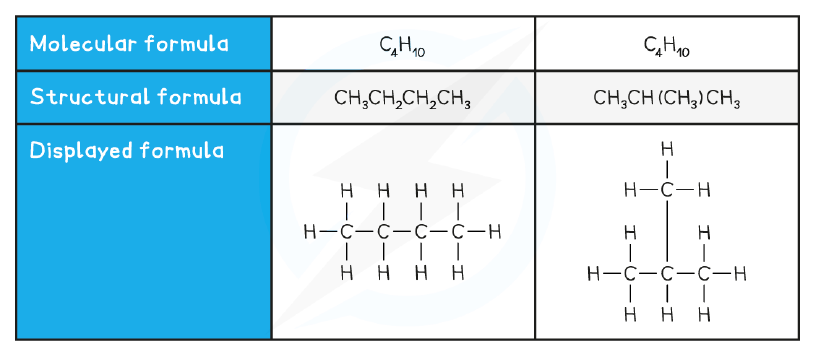
- Structural isomers are compounds with the same molecular formula but different structural formulae.
- Three types of structural isomerism: functional group isomerism, positional isomerism, and branched chain isomerism.
- Functional group isomers have different functional groups (e.g., propanal and propanone are functional group isomers of C₃H₆O).
- Positional isomers have the same functional group attached to different carbon atoms in the chain (e.g., butan-1-ol and butan-2-ol).
- Branched chain isomers have the same molecular formula but different longest carbon chains (e.g., pentane and 2,2-dimethylpropane).
- Alcohols, halogenoalkanes, and amines can be classified as primary, secondary, or tertiary based on the number of carbon atoms attached to the functional group carbon (or nitrogen for amines).
- To deduce all possible isomers, consider functional group, positional, and branched chain possibilities systematically.
Structural isomers
スライド
練習問題
無料プレビュー — 62問中8問。すべて見るには登録を。
1.Which of the following statements best defines a functional group?
Easy- AA specific atom or group of atoms that gives an organic compound its characteristic physical and chemical properties
- BThe longest continuous chain of carbon atoms in an organic molecule
- CAny group of atoms that contains only carbon and hydrogen
- DA group of compounds with the same general formula but different numbers of carbon atoms
2.Which of the following compounds are hydrocarbons?
Easy- AButane (C4H10) only
- BButane (C4H10) and butan-1-ol (C4H9OH)
- CButane (C4H10) and chlorobutane (C4H9Cl)
- DAll three compounds
3.Which of the following pairs of homologous series do NOT have the same C:H ratio in their general formulae?
Easy- AAldehydes and ketones
- BAlkanes and alkenes
- CCarboxylic acids and esters
- DAlkenes and aldehydes
4.Which of the following are features of members of the same homologous series? (select all that apply)
Medium- AThey have the same functional group.
- BThey have the same general formula.
- CThey have identical physical properties.
- DEach member differs from the next by a –CH2– group.
- EThey have the same molecular formula.
5.A homologous series is a family of compounds with the same functional group and similar chemical properties, in which each member differs from the next by a –CH2– group.
EasyTrue or false?
6.The molecular formula of a compound shows the simplest whole-number ratio of the atoms in the molecule.
EasyTrue or false?
7.Which of the following correctly gives the general formula of an alkane and an example?
Medium- ACnH2n+2, propane (C3H8)
- BCnH2n, propane (C3H8)
- CCnH2n+2, propene (C3H6)
- DCnH2n–2, propyne (C3H4)
8.Which of the following shows the correct order of boiling points for pentane, butane and propane (lowest to highest)?
Medium- Apropane < butane < pentane
- Bpentane < butane < propane
- Cbutane < propane < pentane
- Dpropane < pentane < butane