Fission
遊んで学ぼう
問題に答えてエネルギーを集めたら、釣りや探検を楽しもう。アカウント不要。
教育者の方へ: Fission(Physics、HL)向けのすぐ使えるレッスンスライド, 復習ノート — レッスンで使うか、学習者がライブゲームとして遊ぶインタラクティブなクラス活動としてトピックを実施できます。
レッスンノート
Spontaneous & Induced Fission
- Nuclear fission is the splitting of a large, unstable nucleus into two smaller nuclei.
- Isotopes of uranium and plutonium undergo fission and are used as fuels in nuclear power stations to convert nuclear energy into electrical energy.
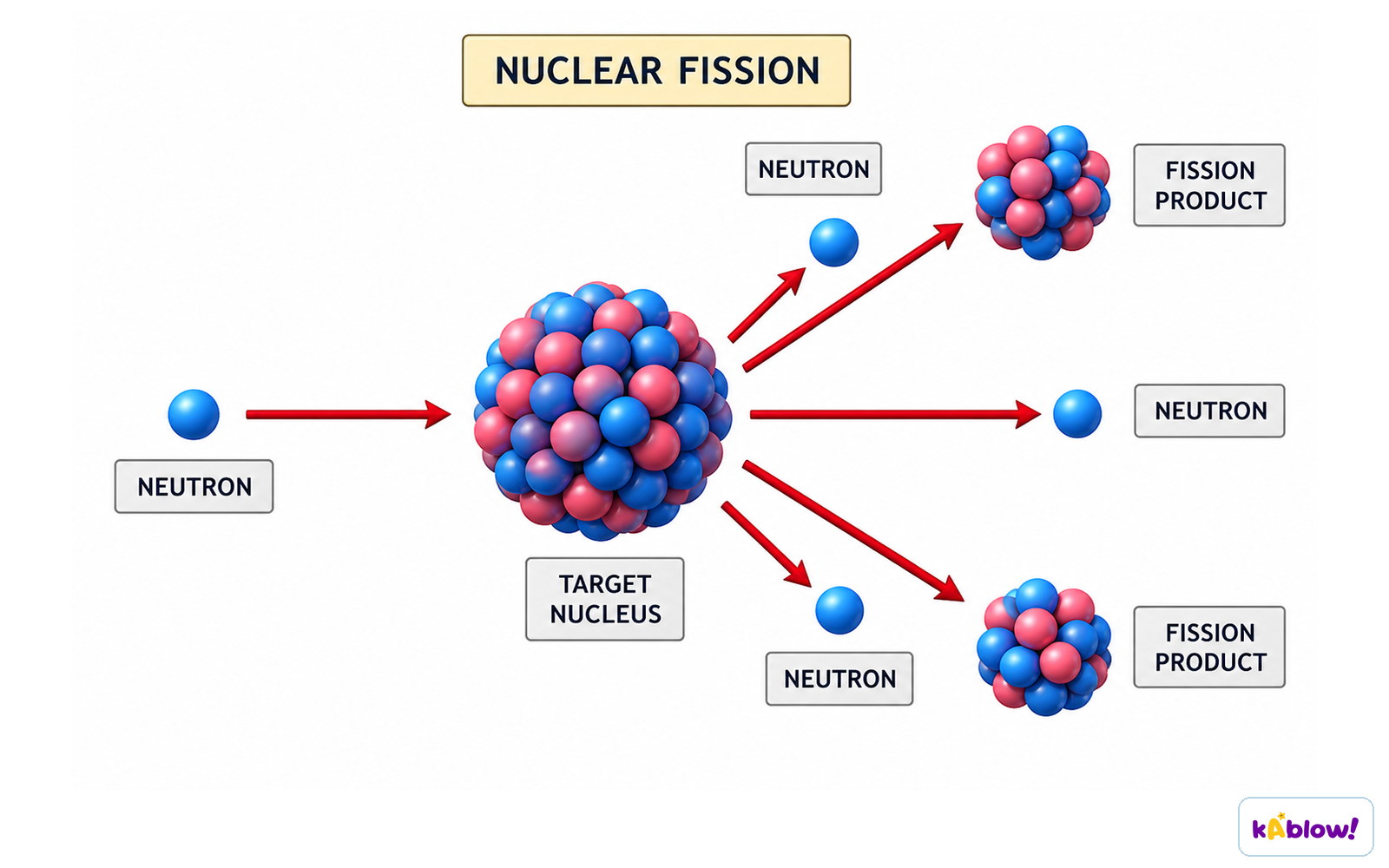
- During fission, a neutron collides with an unstable nucleus, which splits into two smaller daughter nuclei plus two or three neutrons; gamma rays are also emitted.
- Energy is transferred from the nuclear potential energy store of the nucleus to the kinetic energy store of the fission fragments, which move away very quickly and carry energy away as heat.
- Spontaneous fission is rare: it occurs without additional energy being put into the nucleus.
- Induced fission usually requires the unstable nucleus to first absorb a slow-moving (thermal) neutron.
- For example, uranium-235 has a very long half-life of 700 million years, so it has low activity and releases energy only if additional neutrons are added.
- In induced fission, a neutron is absorbed by uranium-235 to make uranium-236, which is very unstable and splits almost immediately.
Nuclear fission
Energy Released in Fission Reactions
- Daughter nuclei produced in fission have a higher binding energy per nucleon than the parent nucleus.
- Energy is released due to the mass defect between the parent nucleus and the daughter nuclei.
- Nuclear fission has the highest energy density of any fuel currently available (until fusion becomes feasible).
- Calculations often use: density = energy density / specific energy, and number of nuclei = (mass × Avogadro's number) / molar mass.
- The energy released per fission can be found from: energy released = (total binding energy of products) − (total binding energy of reactants).
- For uranium-235 fission into technetium-112 and indium-122, the energy released is about 191 MeV per fission.
- A 500 MW power plant at 35% efficiency requires about 1.58 kg of uranium-235 per day.
- Over 2 million times more coal than uranium-235 is required to achieve the same power output.
Chain Reactions from Fission
- Thermal neutrons have low energy and speed, allowing them to induce fission; neutrons with too much energy rebound away and fission does not take place.
- Only one extra neutron is required to induce a uranium-235 nucleus to split by fission.
- Each fission produces two or three neutrons which move away at high speed and can start further fission reactions.
- A chain reaction occurs when each fission goes on to cause at least one more fission.
- In a controlled chain reaction, only one thermal neutron from each fission is used to create another fission reaction.
- The critical mass is the minimum mass of fuel required to maintain a steady chain reaction.
- Using subcritical mass (less than critical) causes the reaction to eventually stop.
- Using supercritical mass (more than critical) leads to a runaway reaction and eventually an explosion.
Operation of a Nuclear Reactor
- In a nuclear reactor, a chain reaction is required to keep the reactor running; two factors must be controlled: the number of free neutrons and the energy of the free neutrons.
- The main components of a nuclear reactor are: control rods, moderators, heat exchangers, and shielding.
- The overall purpose of a nuclear reactor is to collect the heat energy produced from nuclear reactions.
- Control rods absorb neutrons; they are made of a material that absorbs neutrons without becoming dangerously unstable.
- The number of neutrons absorbed is controlled by varying the depth of the control rods in the fuel rods: lowering them decreases the rate of fission, raising them increases it.
- Moderators slow down neutrons; they surround the fuel and control rods and are made from materials that are poor absorbers of neutrons, such as water.
- Fast-moving neutrons slow down by colliding with moderator molecules, losing momentum until they are in thermal equilibrium with the moderator (thermal neutrons).
- Heat exchangers transfer thermal energy efficiently between the water systems of a nuclear power plant, producing steam to drive electricity-generating turbines.
- Shielding houses the reactor and absorbs hazardous radiation; it is made of steel and concrete nearly 2 metres thick.
Radioactive Waste Management
- There are three main types of nuclear waste: low-level, intermediate-level, and high-level waste.
- Low-level waste includes lightly contaminated clothing, gloves and tools; it is radioactive for a few years and is encased in concrete and stored a few metres underground.
- Intermediate-level waste includes waste from decommissioned nuclear power stations; it has a longer half-life and is encased in cement in steel drums and stored securely underground.
- High-level waste refers to unusable fission products from uranium-235 or from spent fuel rods; it is the most dangerous and remains radioactive for thousands of years.
- Spent fuel rods are extremely hot and highly radioactive, so they must be handled and stored much more carefully than other types of waste.
- Uranium-238 in fuel rods quickly decays into plutonium-239, which is high-level waste with a very long half-life of 24 000 years, presenting a long-term risk of contamination.
- Treatment of high-level waste: placed in cooling ponds for years, plutonium and uranium are harvested for reuse, waste is mixed with molten glass (vitrification), encased in steel, lead or concrete, and stored very deep underground.
- Isotopes with long half-lives must not enter water and food supplies; burial locations must be geologically stable, secure from attack, and designed for safety, but space for such locations is limited.
Advantages & Disadvantages of Nuclear Power
- Advantages: nuclear power stations produce no greenhouse gases during operation (climate change friendly).
- Advantages: uranium provides far more energy per kg compared to coal and other fossil fuels (high energy density).
- Advantages: reserves of fissionable materials are much higher compared to fossil fuel reserves (availability of fuel).
- Advantages: nuclear power is now regarded as one of the safest and most reliable processes for electricity production.
- Disadvantages: production of radioactive waste is very dangerous and expensive to deal with, and stays hazardous for thousands of years.
- Disadvantages: potential for catastrophic accidents, such as a nuclear meltdown (e.g. Chernobyl), with severe environmental and human consequences.
- Disadvantages: potential for misuse of nuclear material and infrastructure in nuclear weapons and terrorist attacks.
- Disadvantages: dangers associated with mining uranium, from handling to environmental effects.
Safety Measures and Society
- Several measures reduce workers' exposure to radiation: fuel rods are handled remotely by machines.
- The nuclear reactor is surrounded by very thick lead or concrete shielding to limit radiation exposure.
- In an emergency, control rods are fully lowered into the reactor core to stop fission reactions by absorbing all free neutrons; this is an emergency shutdown.
- Nuclear power can scare people if they do not understand it; it is dangerous if not handled properly and is invisible, which can be difficult for some people to comprehend.
- With increased education on nuclear energy, society can use this knowledge to inform their own decisions and opinions.
スライド
練習問題
無料プレビュー — 62問中8問。すべて見るには登録を。
1.Which of the following correctly describes the neutrons that are used to induce fission in uranium-235?
Easy- ASlow-moving thermal neutrons
- BFast-moving high-energy neutrons
- CProtons emitted by the moderator
- DGamma ray photons
2.A moderator slows down neutrons so that they become thermal neutrons.
EasyTrue or false?
3.In a nuclear reactor, what is the purpose of the control rods?
Medium- ATo absorb neutrons and control the rate of fission
- BTo slow down neutrons so they can induce fission
- CTo transfer heat to the coolant
- DTo shield workers from gamma radiation
4.Which of the following are products of the fission of a uranium-235 nucleus? (select all that apply)
Medium- ATwo smaller daughter nuclei
- BTwo or three neutrons
- CGamma rays
- DA single heavy nucleus
- EProtons
5.Match each nuclear reactor component with its purpose.
Medium- Control rods
- Moderator
- Heat exchanger
- Shielding
- Absorb neutrons
- Slow down neutrons
- Transfer thermal energy between water systems
- Absorb hazardous radiation
6.Place the stages of high-level radioactive waste treatment in the correct order, from first to last.
Medium- Place waste in cooling ponds
- Harvest plutonium and uranium isotopes
- Mix waste with molten glass (vitrification)
- Encapsulate in steel, lead or concrete containers
- Store deep underground
7.In a controlled chain reaction, what is meant by the critical mass of nuclear fuel?
Medium- AThe minimum mass required to maintain a steady chain reaction
- BThe maximum mass that can be safely stored
- CThe mass of fuel that produces a runaway explosion
- DThe mass of moderator needed to slow all neutrons
8.High-level nuclear waste remains radioactive for thousands of years.
EasyTrue or false?
過去問
このトピックの過去問練習は近日公開。
近日公開