Radioactive Decay
遊んで学ぼう
問題に答えてエネルギーを集めたら、釣りや探検を楽しもう。アカウント不要。
教育者の方へ: Radioactive Decay(Physics、HL)向けのすぐ使えるレッスンスライド, 復習ノート — レッスンで使うか、学習者がライブゲームとして遊ぶインタラクティブなクラス活動としてトピックを実施できます。
レッスンノート
Isotopes & Radioactive Decay
- Isotopes are nuclei with the same number of protons but different numbers of neutrons.
- An isotope of an element has a fixed proton number Z but a different nucleon number A.
- Some isotopes have an imbalance of neutrons and protons, making them unstable so they decay and emit radiation to become more stable.
- Isotopic data is the relative amounts of different isotopes of an element present within a substance.
- The relative atomic mass of an element can be calculated using the relative abundance values of its isotopes.
- Radioactive decay is the spontaneous disintegration of a nucleus to form a more stable nucleus, emitting an α, β or gamma particle.
- Radioactive decay is spontaneous (cannot be influenced by environmental factors such as temperature, pressure or chemical conditions) and random (the exact time of decay of a nucleus cannot be predicted).
- Fluctuations in the count rate of a Geiger-Müller tube provide evidence for the randomness of radioactive decay.
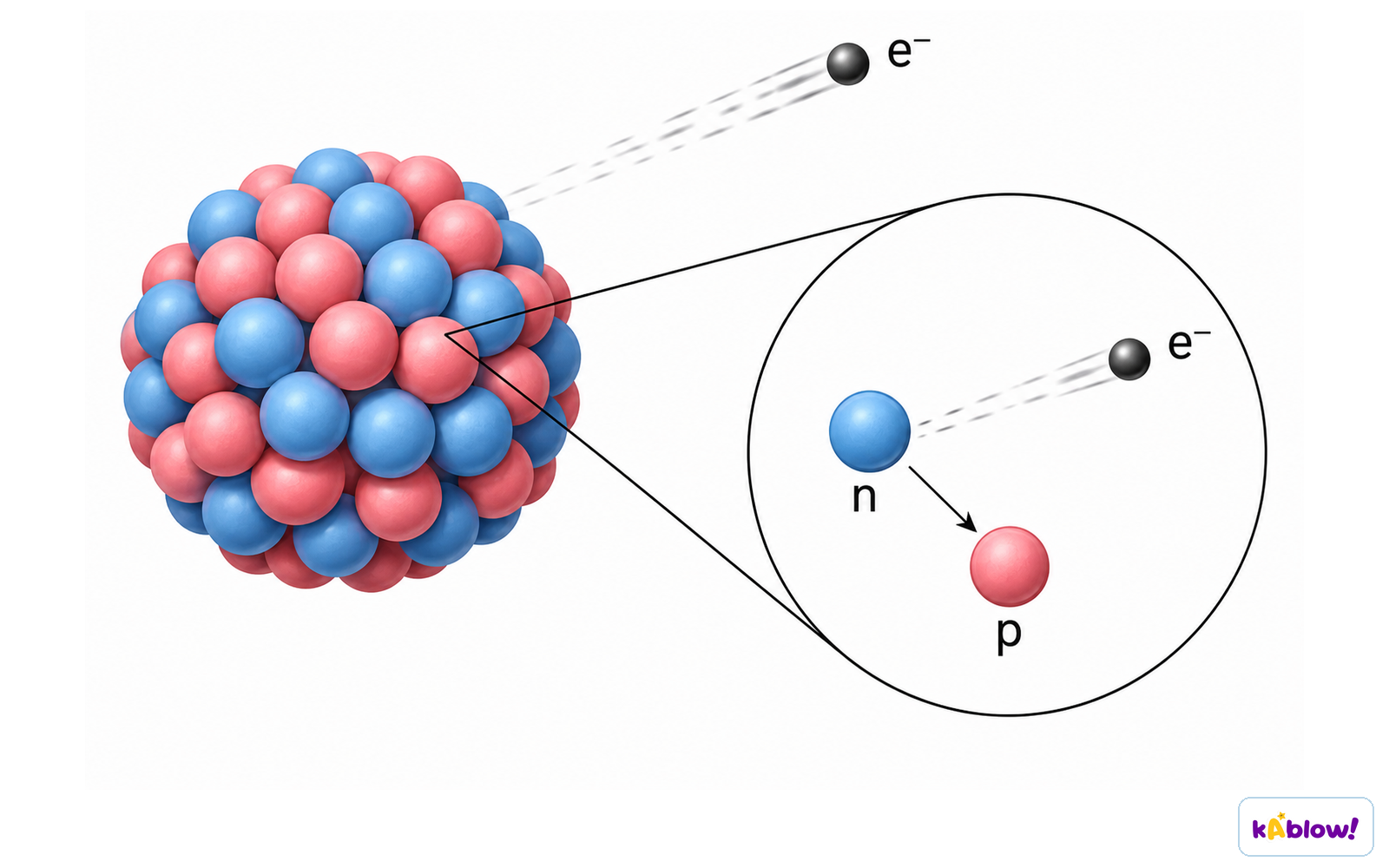
Beta decay
Background Radiation
- Background radiation is the ionising radiation present in the environment.
- Natural sources include radon gas from rocks and buildings, cosmic rays from space, carbon-14 in biological material, and radioactive material in food and drink.
- In the UK, radon gas is by far the largest proportion of background radiation, whereas radiation due to nuclear waste and fallout accounts for less than 1%.
- Artificial sources include nuclear medicine, nuclear waste, nuclear fallout from nuclear weapons, and nuclear accidents.
- Background radiation must be accounted for by taking readings with no source present and subtracting these from readings with the source present — this is the corrected count rate.
- Accuracy of count-rate results can be improved by repeating readings and taking averages and by taking readings over a long period of time.
Alpha, Beta & Gamma Particles
- An α (α) particle is a high-energy helium nucleus containing 2 protons and 2 neutrons; it has a mass of 4u and a charge of +2e.
- A β-minus (β⁻) particle is a high-energy electron with a mass of 0.0005u and a charge of −1e.
- A β-plus (β⁺) particle is a high-energy positron (the antimatter particle of the electron) with a mass of 0.0005u and a charge of +1e.
- Gamma (γ) rays are high-energy electromagnetic radiation emitted by nuclei that need to lose energy; they are photons with proton number 0.
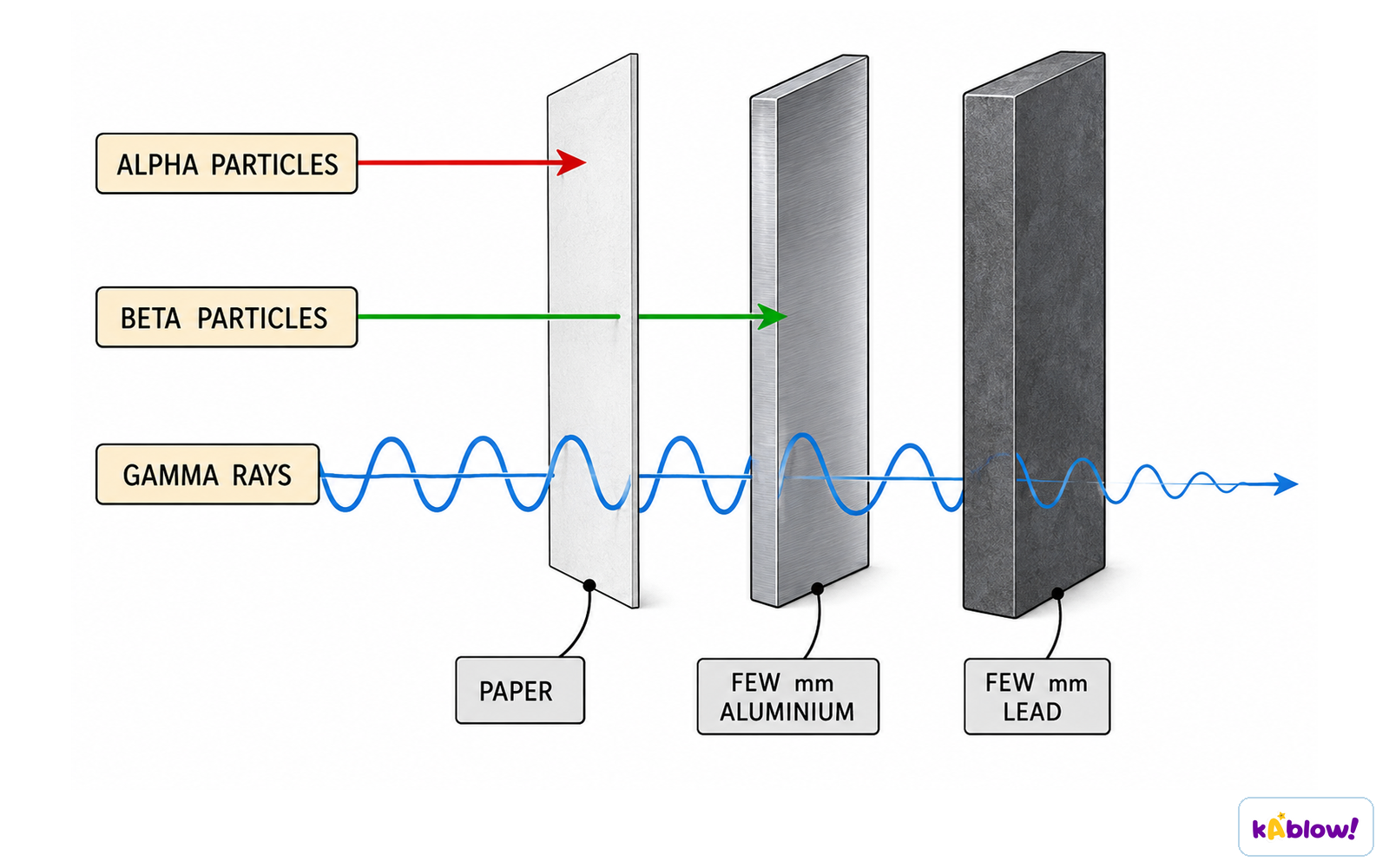
- Ionising ability is a measure of the ionisation caused when nuclear radiation passes through a material; penetrating power is a measure of the distance radiation travels before losing all its energy.
- The greater the ionising ability of radiation, the lower its penetrating power, and vice versa.
- α particles can be stopped by a single sheet of paper, β particles by a few millimetres of aluminium foil, and gamma intensity reduced by several centimetres of lead.
- α particles are deflected towards the negative plate in an electric field, β particles towards the positive plate, and gamma radiation is not deflected.
Penetrating power of alpha, beta and gamma radiation
Radioactive Decay Equations
- Too many neutrons → β-minus emission; too many protons → β-plus emission or electron capture; too many nucleons → α emission; too much energy → gamma emission.
- For β-minus (β⁻) emission: nucleon number is constant, neutron number decreases by 1, proton number increases by 1.
- For β-plus (β⁺) emission: nucleon number is constant, neutron number increases by 1, proton number decreases by 1.
- For α (α) emission: nucleon number decreases by 4, proton number decreases by 2, neutron number decreases by 2.
- For gamma (γ) emission: proton number and nucleon number remain the same; it usually occurs after another type of decay when the nucleus is excited.
- An electron neutrino is emitted during β⁺ decay and an electron antineutrino during β⁻ decay; both have no charge and negligible mass.
- In electron capture, an orbiting electron is taken in by the nucleus and combined with a proton to form a neutron and a neutrino.
Activity & Half-Life
- The activity of a radioactive sample is the number of nuclei which decay in a given time, measured in becquerels (Bq); 1 Bq is one decay per second.
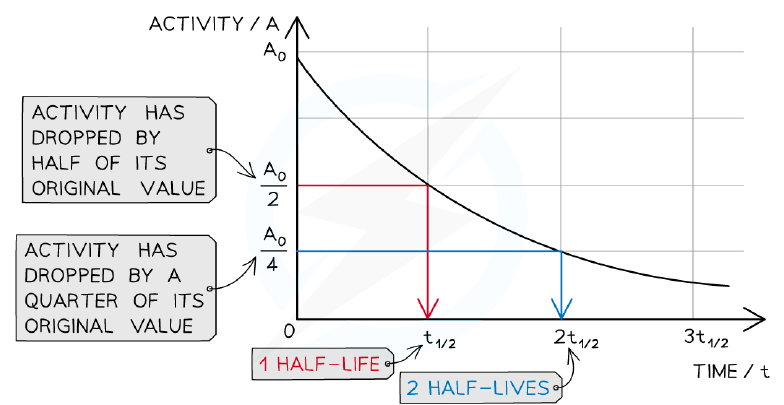
- Half-life is the time taken for half the undecayed nuclei to decay, or for the activity of a source to decay by half.
- Different isotopes have different half-lives, varying from a fraction of a second to billions of years.
- The proportion of an isotope remaining after n half-lives is (1/2)ⁿ.
- To find half-life from a decay curve, determine the time taken for the activity to decrease to half its original value.
- Carbon-14 has a half-life of 5700 years; after two half-lives (11 400 years) only 25% of the carbon-14 remains.
A half-life graph showing activity falling from A0 to A0/2 to A0/4
Decay Constant & The Law of Radioactive Decay
- The decay constant λ is the probability that an individual nucleus will decay per unit of time.
- Activity is calculated using A = ΔN/Δt = −λN, where N is the number of nuclei remaining; the minus sign indicates that the number of nuclei decreases with time.
- The greater the decay constant, the greater the activity of the sample.
- The exponential decay equation is N = N₀e^(−λt), where N₀ is the initial number of undecayed nuclei.
- Half-life and decay constant are linked by t½ = ln2/λ, so half-life and decay constant are inversely proportional.
- The shorter the half-life, the larger the decay constant and the faster the decay.
- Taking natural logs of the exponential equation gives ln N = −λt + ln N₀, which is a straight line with gradient −λ and y-intercept ln N₀.
Mass Defect & Nuclear Binding Energy
- Binding energy is the energy required to separate a nucleus into its individual protons and neutrons.
- Mass defect is the difference between the total mass of the separate nucleons and the mass of the nucleus.
- Mass defect is calculated using Δm = Zmₚ + Nmₙ − mtotal, where Z is the proton number, N the number of neutrons, and mtotal the nuclear rest mass.
- The mass defect can be used to calculate the total binding energy of a nucleus in joules.
- Binding energy per nucleon is found by dividing the total binding energy by the number of nucleons.
Binding Energy per Nucleon Curve & Nuclear Stability
- The binding energy per nucleon curve plots binding energy per nucleon in MeV against nucleon number A.
- Fusion of light nuclides releases energy, while fission of heavy nuclides releases energy.
- Iron-56 is located at the peak of the binding energy per nucleon curve, making it the most stable nucleus.
- Fusion occurs for nuclides with low nucleon numbers because the strong nuclear force pulls nucleons together, releasing energy as they combine.
- Fission occurs for nuclides with high nucleon numbers because the electrostatic repulsion between protons overcomes the strong nuclear force at large distances.
- In a fusion reaction, the mass of the products is less than the mass of the reactants; the difference (mass defect) is converted into energy.
Nuclear Energy Levels & Evidence for the Neutrino
- Nuclear energy levels are discrete, meaning nuclei can only exist at specific energy values.
- α particles are emitted with discrete energies, and gamma rays are emitted with discrete energies, providing evidence for discrete nuclear energy levels.
- The energies of emitted α particles and gamma photons are determined by the difference between nuclear energy levels.
- A nuclear energy level diagram can show α decay followed by gamma emission, with the gamma photon energy equal to the difference between levels.
- The neutrino was proposed to explain the continuous spectrum of β decay energies, as energy and momentum must be conserved.
- An electron neutrino is emitted during β⁺ decay and an electron antineutrino during β⁻ decay.
スライド
練習問題
無料プレビュー — 66問中8問。すべて見るには登録を。
1.Which statement best describes isotopes?
Easy- ANuclei with the same number of protons but different numbers of neutrons
- BNuclei with the same number of neutrons but different numbers of protons
- CNuclei with the same nucleon number but different proton numbers
- DNuclei with the same number of protons and the same number of neutrons
2.Radioactive decay is affected by changes in temperature and pressure.
EasyTrue or false?
3.What is meant by the decay constant λ?
Easy- AThe probability that an individual nucleus will decay per unit time
- BThe time taken for half the nuclei in a sample to decay
- CThe number of decays per second in a sample
- DThe total number of undecayed nuclei in a sample
4.Which of the following are natural sources of background radiation? (Select all that apply)
Medium- ARadon gas from rocks and buildings
- BCosmic rays from space
- CNuclear medicine procedures
- DCarbon-14 in biological material
- ENuclear fallout from weapons testing
5.Match each type of radiation with its correct property.
Medium- α particle
- β-minus particle
- Gamma radiation
- High-energy electron
- High-energy electromagnetic radiation
- Helium nucleus (2 protons, 2 neutrons)
6.Which of the following correctly describes what happens to a nucleus when it emits an α particle?
Medium- AProton number decreases by 2, nucleon number decreases by 4
- BProton number decreases by 4, nucleon number decreases by 2
- CProton number increases by 2, nucleon number decreases by 4
- DProton number decreases by 2, nucleon number remains the same
7.Order the following types of radiation from most ionising to least ionising.
Medium- α
- β
- Gamma
8.A radioactive nucleus undergoes β-minus decay. Which statement correctly describes the change in the nucleus?
Medium- AA neutron turns into a proton, and an electron and antineutrino are emitted
- BA proton turns into a neutron, and a positron and neutrino are emitted
- CA neutron turns into a proton, and a positron and neutrino are emitted
- DA proton turns into a neutron, and an electron and antineutrino are emitted
過去問
このトピックの過去問練習は近日公開。
近日公開